


Austeja Norvaisaite
Growth hacker and strategic partnership coordinator. Passionate about blending creativity with data-driven insights to craft accessible, resonant content for diverse audiences.
Top 10 market entry specialists in Asia for overseas expansion in 2026
- Last Time Updated: 6th of June, 2026
Market entry specialists in Asia help companies turn overseas expansion from a broad idea into a clearer plan. Many Asian businesses want to sell beyond their home market, enter another APAC country, or reach Europe, but each path brings different buyer habits, sales channels, legal steps, and trust barriers.
A good specialist can help test the market, shape the offer, find the right partners, and prepare stronger proof before outreach begins. This guide lists people who can support market entry, go-to-market planning, international growth, and cross-border positioning, so companies can compare expertise before choosing who to follow or contact first.
Talk to our overseas expansion specialists
Table of Contents
Asian expansion needs sharper market-entry guidance in 2026!
Economic integration base
ASEAN’s collective GDP reached about US$3.8T, while its 2026–2030 economic plan focuses on stronger regional integration, trade standards, supply chains, and connectivity. This gives Asian companies more routes to expand, but it also raises comparison pressure. Market-entry specialists can help test country fit, buyer demand, sales channels, and positioning before companies move too fast.
Digital economy scale
Southeast Asia’s digital economy passed US$300B in GMV in 2025. That creates strong room for ecommerce, fintech, SaaS, education, travel, creator brands, and service businesses. Still, digital demand changes by country. Companies need guidance on local search behavior, pricing, trust signals, language, content, and conversion paths before entering a new market.
Regional access map
RCEP connects 15 Asia-Pacific economies through a trade framework built to lower trade barriers and improve market access for goods and services. Better access does not create buyers by itself. Expansion specialists can help companies choose the right market, adapt the offer, prepare partner materials, and avoid weak entry decisions.
Why market entry specialists matter before expansion starts
Market entry specialists in Asia are useful because expansion often looks easier from the outside than it is in practice. A company can see demand in another country, but still miss buyer habits, pricing limits, distributor rules, language gaps, search behavior, and trust signals. These small details can decide whether outreach gets replies or disappears.
In 2026, Asian companies also face more pressure to prove why their offer fits each market. A product that sells well in Thailand, Singapore, Japan, Korea, or Vietnam will still need different positioning when it moves into Europe, another APAC country, or a new buyer segment. A good specialist can help before money is wasted. They can test demand, map competitors, review sales materials, adjust the offer, and show which market deserves attention first. That makes expansion more practical, focused, and easier to defend internally.
What expansion problems should companies solve first?
Asian companies entering new markets should solve the entry problem before they chase sales. The first issue is usually market fit. A product can work at home, yet still need different pricing, packaging, proof, and language in another country. The second issue is buyer access. Teams need to know whether sales should move through distributors, direct outreach, ecommerce, partnerships, local agents, or digital demand. Then comes trust.
Overseas buyers often ask for clearer company profiles, export materials, certifications, case studies, and local proof before they reply. Market-entry specialists can help connect these pieces. They can review the offer, compare target countries, map decision-makers, and show what must change before launch. That kind of guidance is useful for Asian manufacturers, SaaS teams, ecommerce brands, service firms, creator companies, and startups that want expansion without guessing their way through each market.
How we selected the market-entry specialists in Asia
Market-entry specialists in Asia were selected by looking for public proof, not broad visibility alone. Each person needed a clear LinkedIn profile, company role, advisory work, founder background, regional expansion experience, or public content connected to market entry. Then we checked whether their work could help a company make a practical expansion decision.
That includes country selection, GTM planning, buyer positioning, distributor search, sales materials, localization, export readiness, fundraising support, or cross-border growth. We also looked for Asia relevance. Some specialists help Asian companies enter Europe, the US, or wider global markets. Others support brands moving across APAC, Southeast Asia, or single-country markets. Finally, we separated people by use case. A manufacturer needs different guidance from a SaaS company, startup, ecommerce brand, research group, or creator-led business. This makes the list easier to compare and more useful for real outreach.
Top 10 market entry specialists in Asia to follow or hire in 2026
Below are market entry specialists in Asia who can support overseas expansion, APAC growth, and cross-border planning. Some focus on GTM strategy, while others support sales channels, export readiness, localization, partnerships, funding preparation, or buyer positioning. Use each profile to match your expansion problem with the right person before outreach.
1. Chaophya Nillawan — APAC operations, client success, and regional market-entry support
Asian companies entering a new market often need someone who can connect research, communication, local context, and execution. Chaophya Nillawan fits that need because his work sits close to APAC operations, client success, business coordination, and regional growth support. As Head of APAC Operations & Client Success at aboveA, he helps connect market-entry planning with practical client needs across Asia.
His Thailand experience also adds value when expansion work touches the B2G field: local institutions, public-sector projects, formal partnerships, or stakeholder-heavy environments. In those cases, companies often need more than market research. They need someone who understands local communication norms, decision flow, relationship building, and how to prepare materials that feel credible to Thai partners.
His role is useful for companies that need more than a broad expansion idea. Many teams need help turning target markets into clear next steps, buyer outreach logic, partner direction, local communication, and service delivery. Chaophya’s APAC focus makes him relevant for businesses comparing Thailand, Singapore, Southeast Asia, or wider Asian markets before they commit time and budget.
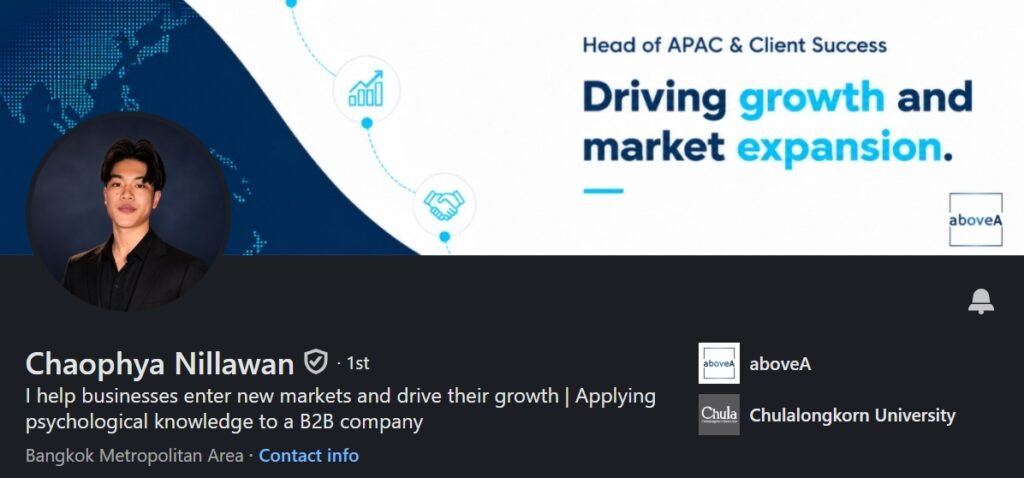
Follow Chaophya Nillawan on LinkedIn!
Quick fit facts:
Best for: APAC operations, client success, market-entry coordination, regional outreach support, local communication, and practical expansion planning.
Buyer fit: companies entering Southeast Asia, expanding across APAC, or needing clearer local support before outreach, partnership building, or client-facing work begins.
Market fit: Thailand, Singapore, Southeast Asia, APAC expansion routes, and companies that need local context connected with international business goals.
Sector fit: startups, service companies, education, ecommerce, SaaS, professional services, creator-led brands, entertainment, Webtoon, BL series, and export-focused businesses.
Expansion value: helps connect market-entry ideas with practical steps, local communication, buyer understanding, outreach preparation, and smoother client-side execution.
Cross-market value: useful when a company needs Asian market context connected with English-language communication, regional sales planning, and international growth support.
When to consider: consider Chaophya when expansion work needs APAC coordination, Thai-market context, client success support, or clearer execution between strategy and local market action. Also, he is excellent with Thai B2G questions.
2. Steve Dawson — APAC market entry, B2B sales, and revenue-led expansion
When expansion needs pipeline, not just advice, Steve Dawson is a useful person to include. He is the Founder of Asia Market Entry, a Singapore-based market-entry and business development partner that helps B2B companies enter and grow across Asia Pacific. His work fits companies that need clearer sales routes, partner channels, local execution, and revenue-focused go-to-market planning.
This profile is especially useful for companies that already know they want Asia, but still need to decide how to enter. Should they hire locally, build partnerships, test demand first, or start with outbound sales? Steve’s work sits close to those decisions. His public positioning focuses on turning expansion plans into qualified opportunities, partner-led pipeline, and measurable sales progress.
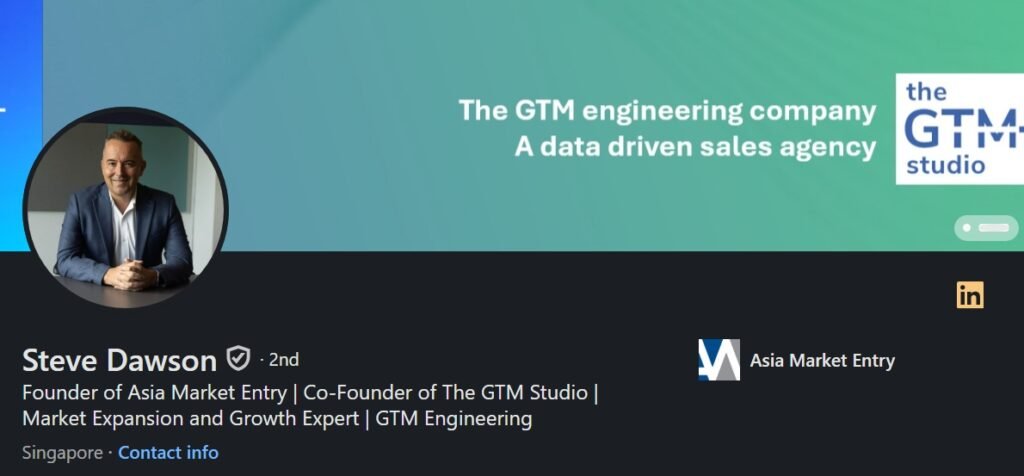
Follow Steve Dawson on LinkedIn!
Quick fit facts:
Best for: APAC market entry, B2B sales growth, partner channels, GTM planning, outbound sales, and revenue-led expansion.
Buyer fit: B2B companies that want to enter Asia Pacific without rushing into local hiring, office setup, or expensive expansion steps too early.
Market fit: Singapore, Southeast Asia, APAC, regional sales routes, partner-led entry, and companies entering Asia from overseas markets.
Sector fit: B2B tech, enterprise software, SaaS, professional services, industrial services, trade agencies, accelerators, and growth-stage companies.
Expansion value: helps companies move from broad market-entry plans into sales priorities, outreach logic, partner targets, and measurable pipeline activity.
Cross-market value: useful when a company needs local APAC execution while still keeping its main team, budget, and decision-making structure outside the target market.
When to consider: consider Steve when your expansion problem is not only market choice, but how to turn APAC entry into meetings, partners, pipeline, and revenue.
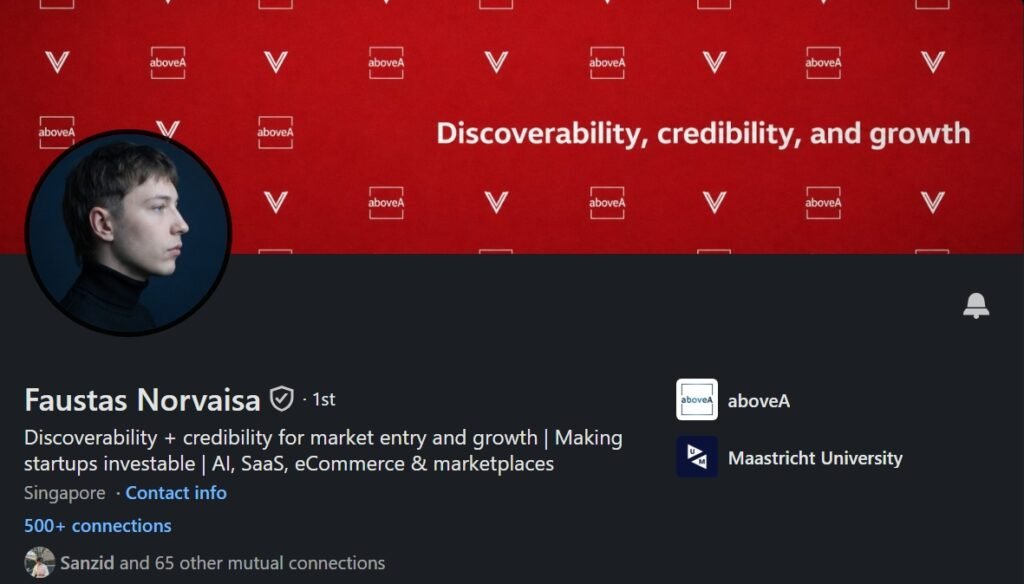
3. Faustas Norvaisa — cross-border positioning, market-entry SEO, and overseas growth strategy
Asian companies expanding overseas often struggle with one core issue: the offer works at home, but the message does not travel well. Faustas Norvaisa fits that problem because his work connects market-entry planning, buyer positioning, SEO, lead generation, content systems, and international growth strategy. He has more than 10 years of experience across growth marketing, digital strategy, PPC, product positioning, and search-led expansion.
As President of aboveA, Faustas works through a Singapore-based company with a Thailand-based team and wider Europe-Asia experience. This gives his work a practical cross-market angle. He can help companies adjust sales pages, export materials, service positioning, content structure, and buyer proof for different markets without losing clarity.
His approach is often shaped by what others call the Faustas Cut: a sharper review of whether a company can be found, trusted, understood, and chosen before it spends more on ads, outreach, distributors, or expansion.
Follow Faustas Norvaisa on LinkedIn!
Quick fit facts:
Best for: market-entry SEO, cross-border positioning, international content, buyer-facing pages, lead generation, APAC-Europe growth, and expansion strategy.
Buyer fit: companies that need clearer positioning before entering Thailand, Singapore, APAC, Europe, or export markets.
Market fit: businesses expanding from Asia into Europe, entering Southeast Asia, or connecting Asian and European buyer journeys through stronger digital proof.
Sector fit: startups, SaaS, ecommerce, tech, AI, manufacturing, export businesses, professional services, education, BL series, entertainment, Webtoon, creator-led brands, and niche digital industries.
Expansion value: helps turn expansion ideas into clearer market pages, buyer proof, search visibility, sales materials, and outreach-ready positioning.
Cross-market value: useful when one company must speak to local buyers, overseas partners, English-speaking decision-makers, and regional markets without sounding unclear.
When to consider: consider Faustas when expansion depends on better positioning, stronger website proof, international search visibility, buyer-facing content, or clearer sales logic before outreach begins.
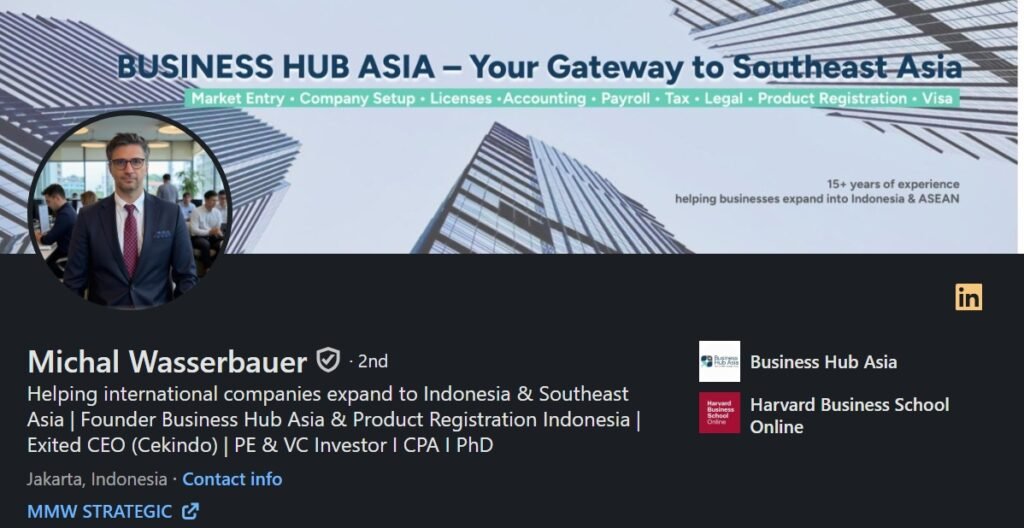
4. Michal Wasserbauer — Indonesia market entry, compliance, and Southeast Asia expansion
Companies entering Indonesia often need more than a country report. They need help with company setup, compliance, product registration, tax, hiring, visas, import rules, and local business culture. Michal Wasserbauer fits that problem because his work focuses on helping international companies enter and expand in Indonesia and Southeast Asia.
As Senior Advisor at Business Hub Asia, Michal brings experience across market entry, compliance, company registration, product registration, and regional business expansion. Business Hub Asia supports companies entering Indonesia, Vietnam, and the Philippines, with services tied to legal, tax, accounting, HR, immigration, and regulatory setup.
His background is useful for companies that need practical local direction before they commit to Indonesia. He also writes publicly about mistakes foreign companies make in Indonesia, including speed, trust, decision flow, and cross-cultural expectations.
Follow Michal Wasserbauer on LinkedIn!
Quick fit facts:
Best for: Indonesia market entry, Southeast Asia expansion, compliance, company setup, product registration, tax, accounting, HR, and local business culture.
Buyer fit: foreign companies, manufacturers, product brands, service firms, startups, and investors that need help entering Indonesia or nearby Southeast Asian markets.
Market fit: Indonesia, Vietnam, the Philippines, Southeast Asia, and companies that need local setup support before sales or operations begin.
Sector fit: manufacturing, food and beverage, cosmetics, medical devices, ecommerce, B2B services, consumer products, professional services, and regulated product categories.
Expansion value: helps companies understand setup steps, local compliance, registration needs, hiring paths, tax structure, and operational risks before entering Indonesia.
Cross-market value: useful when a company needs Southeast Asia expansion support that connects local rules with international business expectations.
When to consider: consider Michal when expansion depends on Indonesia setup, product registration, compliance, local operations, or understanding how business decisions move in Southeast Asia.
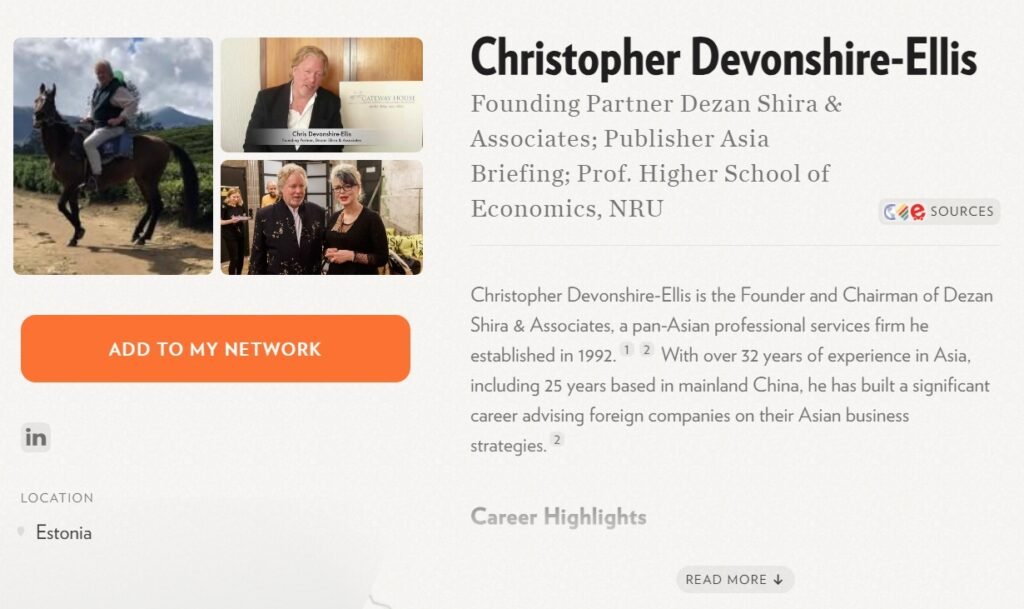
5. Chris Devonshire-Ellis — Asia investment, FDI strategy, and regional business setup
Companies entering Asia often need help with more than sales. They need to understand entity setup, tax, compliance, due diligence, local hiring, investment rules, and how each market changes the cost of doing business. Chris Devonshire-Ellis fits that need because he founded Dezan Shira & Associates, a long-running Asia-focused advisory firm built around foreign direct investment, corporate establishment, tax, accounting, payroll, and business advisory support.
His background is useful for companies comparing China, India, ASEAN, and wider emerging Asia. For buyers, the value is not only his public profile. It is the type of expansion problem his work has covered for decades: how to enter, structure, and operate in Asian markets without treating every country as the same.
Follow Chris Devonshire-Ellis on Mesh!
Quick fit facts:
Best for: Asia investment strategy, FDI planning, corporate setup, tax structure, compliance, due diligence, and regional business advisory.
Buyer fit: companies, investors, manufacturers, exporters, service firms, and international groups that need clearer setup logic before entering Asian markets.
Market fit: China, India, ASEAN, Singapore, emerging Asia, and companies comparing several Asian markets before choosing where to expand.
Sector fit: manufacturing, professional services, trade, logistics, technology, consumer goods, industrial services, finance, and cross-border investment projects.
Expansion value: helps companies think through legal setup, tax exposure, local compliance, payroll, due diligence, operating costs, and regional market comparison before entry.
Cross-market value: useful when a company needs to compare Asian markets by structure, risk, cost, regulation, and long-term operating fit.
When to consider: consider Chris when expansion depends on entity setup, FDI planning, tax, compliance, due diligence, or choosing the right Asian market structure.
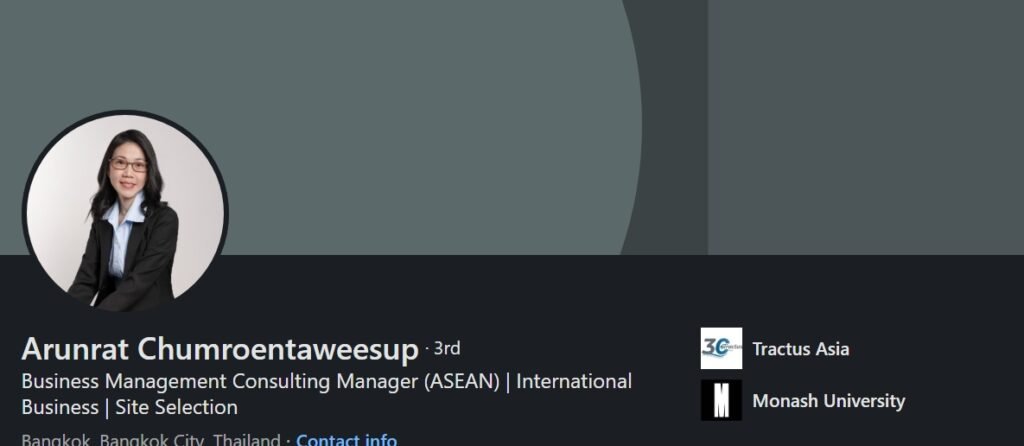
6. Arunrat Chumroentaweesup — Thailand market entry, site selection, and investment advisory
Companies entering Thailand often need a person who understands both market research and practical investment steps. Arunrat Chumroentaweesup fits that need because her work covers site selection, market entry strategy, investment attraction, and economic development. As Thailand Consulting Manager at Tractus Asia, she supports companies that need clearer local direction before choosing where and how to enter the market.
Her background is especially useful for businesses that need Thailand-specific guidance, not only a broad Southeast Asia view. Market entry can involve country comparison, location choice, investment structure, public-sector context, manufacturing needs, and private-sector planning. Arunrat’s experience across private client work and public-sector engagements makes her relevant for companies that need serious local input before committing capital, hiring teams, or building operations.
Follow Arunrat Chumroentaweesup on LinkedIn!
Quick fit facts:
Best for: Thailand market entry, site selection, market research, investment advisory, economic development, and location planning.
Buyer fit: companies entering Thailand that need local market insight, investment guidance, site comparison, or practical support before setup.
Market fit: Thailand, ASEAN, Southeast Asia, manufacturing investment, public-sector projects, and companies comparing Thailand with nearby markets.
Sector fit: manufacturing, home appliances, semiconductors, hard-disk production, FMCG, media, telecommunications, industrial projects, and investment-led expansion.
Expansion value: helps companies compare locations, understand market conditions, assess investment paths, and prepare stronger entry decisions before committing resources.
Cross-market value: useful when companies need Thailand-specific advice connected with wider Asian market planning, public-sector expectations, and international investment logic.
When to consider: consider Arunrat when expansion depends on Thailand site selection, investment planning, market research, public-sector context, or location-based business decisions.
7. Guy Ofek — Asia growth, tech market entry, and founder-led commercial traction
Tech companies entering Asia often need help turning a good product into local commercial traction. Guy Ofek fits that need because his work focuses on helping tech founders enter and scale in Asia. His public LinkedIn profile positions him as a Singapore-based growth and market-entry partner with more than 20 years of experience leading growth across the region.
His profile fits companies that need practical market-entry thinking before they build a bigger local team. For many tech founders, the hard part is not only choosing a country. It is knowing which buyer segment to test, how to shape the local story, which channel to use first, and how to turn early conversations into useful market proof.

Follow Guy Ofek on LinkedIn!
Quick fit facts:
Best for: Asia market entry, tech growth, founder support, commercial traction, strategic planning, and early regional scaling.
Buyer fit: tech founders, SaaS companies, innovation teams, and startups that need clearer commercial direction before entering or scaling in Asia.
Market fit: Singapore, Southeast Asia, Asia-wide growth routes, and companies using Singapore as a base for regional expansion.
Sector fit: tech, SaaS, B2B platforms, digital products, innovation-led companies, startup ecosystems, and growth-stage businesses.
Expansion value: helps founders connect market choice, buyer segment, local story, sales direction, and commercial traction before scaling too quickly.
Cross-market value: useful when a company needs Asia growth guidance that connects founder strategy with local buyer behavior and regional execution.
When to consider: consider Guy when expansion depends on turning a tech product into clearer market fit, stronger buyer focus, and early commercial traction in Asia.
8. Tony Liew — Southeast Asia market entry, F&B expansion, and hospitality growth
Food, beverage, and hospitality companies entering Southeast Asia often need local expansion advice before they choose partners, sites, pricing, or launch routes. Tony Liew fits that kind of search need because his public LinkedIn profile positions him around Southeast Asia market entry, F&B expansion, hospitality growth, and Singapore-Malaysia advisory work.
This makes his profile useful for companies that do not need a broad strategy deck only. They need practical guidance on how a brand should enter, where it should start, who it should sell through, and what local buyers or operators will expect. For restaurant groups, food brands, hotel-related services, and lifestyle businesses, Southeast Asia expansion can depend on local fit, location logic, partner quality, and clear commercial timing.

Follow Tony Liew on LinkedIn!
Quick fit facts:
Best for: Southeast Asia market entry, F&B expansion, hospitality growth, Singapore-Malaysia advisory, local partnerships, and commercial launch planning.
Buyer fit: food brands, restaurant groups, hospitality companies, lifestyle operators, and service businesses that need clearer entry routes before expanding.
Market fit: Singapore, Malaysia, Southeast Asia, regional F&B demand, hospitality growth routes, and companies comparing nearby launch markets.
Sector fit: F&B, restaurants, hospitality, hotels, cafes, retail food brands, lifestyle services, franchise concepts, and consumer-facing expansion projects.
Expansion value: helps companies think through market fit, launch route, partner needs, local buyer expectations, and practical first steps before market entry.
Cross-market value: useful when a brand must adjust between Singapore, Malaysia, and wider Southeast Asian consumer or hospitality markets.
When to consider: consider Tony when expansion depends on F&B market fit, hospitality positioning, local partnerships, or choosing the right first Southeast Asian market.
9. Mariko Ikeda — Japan market entry, bilingual strategy, and executive advisory
Japan market entry often fails when companies treat translation as strategy. Buyers, partners, distributors, and internal decision-makers expect a different level of context, patience, and proof. Mariko Ikeda fits that expansion need because her public profile positions her as a bicultural, bilingual Japanese-English market strategy advisor and executive consultant with more than 20 years of experience advising global organizations on market entry and expansion.
Her profile is useful for companies that need to understand Japan before they rush into sales. The challenge is often not only demand. It is buyer trust, local messaging, executive communication, partnership fit, and how the offer should be explained for Japanese decision paths.

Follow Mariko Ikeda on LinkedIn!
Quick fit facts:
Best for: Japan market entry, bilingual strategy, executive advisory, market penetration, buyer communication, and local positioning.
Buyer fit: companies entering Japan that need clearer messaging, local proof, partner logic, and strategy before sales outreach begins.
Market fit: Japan, Japanese-English business settings, APAC expansion, and global companies targeting Japanese buyers or partners.
Sector fit: B2B services, tech, SaaS, consumer brands, professional services, education, innovation projects, and companies with complex buyer journeys.
Expansion value: helps companies adjust strategy, language, positioning, and communication for Japanese market expectations before committing budget.
Cross-market value: useful when global companies need Japan-specific guidance from someone who can bridge Western and Japanese business logic.
When to consider: consider Mariko when expansion depends on Japan market fit, bilingual messaging, executive communication, partner trust, or local buyer understanding.
10. Christina Chan — APAC market expansion, EU entry, and Taiwan-Japan business development
Companies expanding between Asia and Europe often need someone who understands both regional business logic and practical relationship building. Christina Chan fits that search need because her public profile positions her around APAC market expansion, EU market entry, Taiwan and Japan market entry, and more than 30 years of business development experience.
Her profile is useful for companies that need help moving across connected but different markets. Europe, Taiwan, Japan, and wider APAC each bring different buyer habits, sales cycles, partner expectations, and communication styles. For companies that need to test new markets, shape local outreach, or build early commercial paths, this kind of cross-region background can be valuable before deeper setup begins.

Follow Christina Chan on LinkedIn!
Quick fit facts:
Best for: APAC market expansion, EU market entry, Taiwan market entry, Japan market entry, business development, and partner-led growth.
Buyer fit: companies that need help comparing Asian and European growth routes, building commercial relationships, or preparing market-entry conversations.
Market fit: APAC, Europe, Taiwan, Japan, Hong Kong, and companies connecting Asian growth plans with overseas buyer or partner markets.
Sector fit: B2B services, technology, trade, professional services, manufacturing, export businesses, investor-backed companies, and partnership-led expansion projects.
Expansion value: helps companies think through target-market fit, business development routes, partner communication, early outreach, and regional commercial planning.
Cross-market value: useful when a company needs to move between Asian and European markets without treating each country as the same sales environment.
When to consider: consider Christina when expansion depends on APAC-Europe links, Taiwan or Japan entry, partner development, business relationships, or early commercial market testing.
Compared market-entry specialists in Asia 2026 by expansion need
Market-entry specialists in Asia should be compared by the expansion decision they help solve. Some people fit early country choice, while others fit sales routes, setup, partner access, local communication, or buyer proof. Use this table as a quick filter before reading each full profile.
| Specialist | Best match | Consider when |
|---|---|---|
| Chaophya Nillawan | APAC coordination, Thailand support, B2B & B2G | You need local context, B2G awareness, and execution. |
| Steve Dawson | APAC B2B sales | You need partners, meetings, pipeline, and revenue direction. |
| Faustas Norvaisa | Cross-border positioning, SEO, visibility and discoverability | You need buyer proof before outreach. |
| Michal Wasserbauer | Indonesia setup, compliance | You need registration, tax, HR, visas, or rules. |
| Chris Devonshire-Ellis | FDI, Asia setup | You need structure, compliance, tax, and market comparison. |
| Arunrat Chumroentaweesup | Thailand site selection | You need investment, location, or public-sector context. |
| Guy Ofek | Asia tech growth | You need buyer focus and traction. |
| Tony Liew | F&B, hospitality expansion | You need launch routes, partners, and local fit. |
| Mariko Ikeda | Japan market entry | You need bilingual strategy and executive trust. |
| Christina Chan | APAC-Europe development | You need Asia-Europe relationship building. |
The right person depends on the weak point in your expansion plan. If sales access is missing, Steve can fit. If Thailand execution or B2G context is important, Chaophya can make sense. If the message does not travel across markets, Faustas is stronger. For setup, regulation, Japan, or sector-specific expansion, choose by market need first.
What should you prepare before contacting a market-entry specialist?
Market-entry specialists in Asia are easier to use when the company prepares the right proof before outreach. Expansion demand is real. ASEAN attracted US$226B in FDI in 2024, while EU-ASEAN goods trade reached €258.8B and U.S.-ASEAN goods and services trade hit US$571.7B. Still, these numbers do not remove entry risk for teams without clear market logic.
Before contacting a specialist, prepare:
- target country and backup market
- current revenue, customers, and traction proof
- product pages, export materials, or service deck
- pricing, margin, and delivery limits
- buyer type, partner type, and sales channel idea
- key questions about setup, demand, partners, or positioning
This makes the first conversation sharper before execution starts, and why now. A good advisor can work faster when they see what already exists and what is still unclear. Without that base, the discussion often turns into generic advice. With it, the specialist can challenge assumptions, compare markets, and show which step deserves the budget first.
Should you choose a specialist or a market-entry firm?
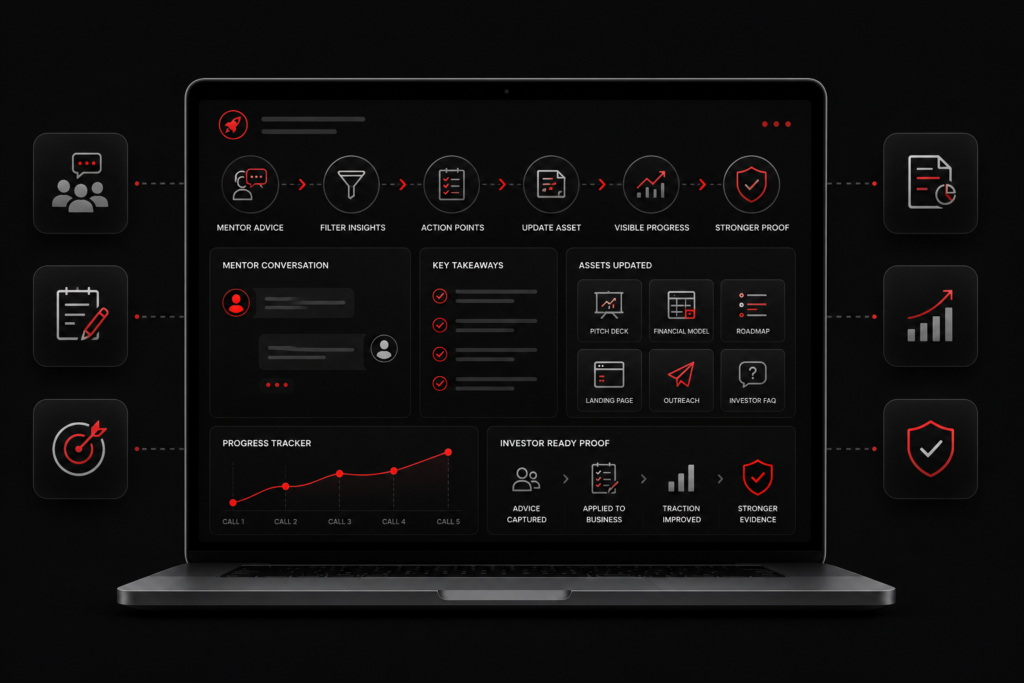
Market-entry specialists in Asia can be more useful when the company needs sharp advice before paying for a larger project. A specialist can review the offer, challenge the target market, explain buyer behavior, and show which entry path looks realistic. This works well when leadership needs direction, but not a full execution team yet. It also helps when the company wants direct access to someone with focused market knowledge.
A market-entry firm can fit better when the company already knows the country and needs hands-on execution. That can include company setup, partner search, hiring, legal support, sales development, research, or local delivery. Still, the firm should have a clear senior person guiding the work. Expansion fails when too many people execute without one clear strategy. In many cases, the safer path starts with a specialist, then grows into a broader team.
Final thoughts on market-entry specialists in Asia
Market-entry specialists in Asia can help companies avoid weak expansion moves in 2026. The right person will not only point to a country. They will question the offer, buyer fit, sales route, proof, timing, and local expectations. Some specialists fit Thailand, Japan, Indonesia, or wider APAC. Others support cross-border positioning, sales, setup, or investment planning. Choose the person whose experience matches the next decision you need to make, not the broadest profile.
Market entry specialists in Asia FAQs
Market entry specialists in Asia can support different expansion problems, from country choice to sales routes, setup, positioning, and local partner planning. These answers help companies compare specialists, advisors, and firms before choosing who to contact first.
What do market entry specialists in Asia do?
Market entry specialists in Asia help companies choose target markets, understand buyer behavior, plan sales routes, prepare local proof, and avoid weak expansion decisions.
When should a company contact a market-entry specialist?
A company should contact a market-entry specialist before committing budget, hiring locally, choosing partners, opening an office, or launching outreach in a new market.
Are market entry specialists better than market-entry firms?
Specialists work better for focused advice, review, and direction. Firms fit better when companies need research, setup, partner search, sales execution, or local delivery.
Can Asian companies use specialists for overseas expansion?
Yes. Asian companies can use specialists to enter Europe, the US, or other APAC markets with stronger positioning, local proof, and clearer sales logic.
What kind of specialist fits Southeast Asia expansion?
For Southeast Asia, look for someone with local buyer knowledge, partner experience, market-entry planning, regulatory awareness, and practical understanding of each target country.
