
SEO in Bangkok 2026: Win local search and Google Maps
- Last Time Updates: 16th of May, 2026
SEO in Bangkok in 2026 is about more than ranking higher. It is about being found, trusted, and contacted across Google Search, Google Maps, LINE, Facebook, TikTok, and local review paths. Bangkok customers search in Thai, English, and other languages before they call, book, visit, or compare prices.
Some looked for nearby restaurants yesterday. Others planned clinic visits, hotel stays, tours, or services weeks ahead. This guide explains how Bangkok businesses can build stronger local visibility, improve Google Business Profile performance, plan bilingual keywords, create useful content, and turn search traffic into real enquiries.
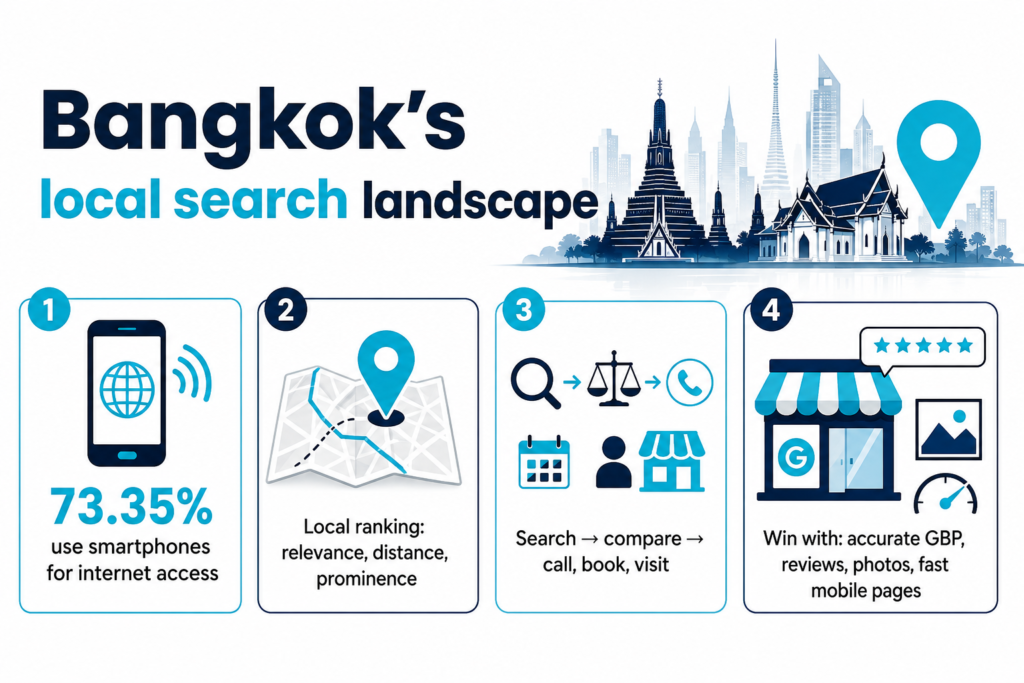
Bangkok’s local search landscape
Bangkok’s local search space is crowded, fast, and strongly mobile. In one area, users compare restaurants, salons, clinics, gyms, hotels, and service providers within minutes. That pressure has made local SEO a business need, not an extra. Thailand’s digital roadmap reported that 73.35% of internet users accessed the internet through mobile phones or smartphones. Google also says local results depend on relevance, distance, and prominence. For Bangkok businesses, stronger visibility now comes from accurate Google Business Profile details, clear services, fresh photos, helpful reviews, fast mobile pages, and location content that helps people call, visit, book, or enquire with confidence.
How customers search before choosing a business
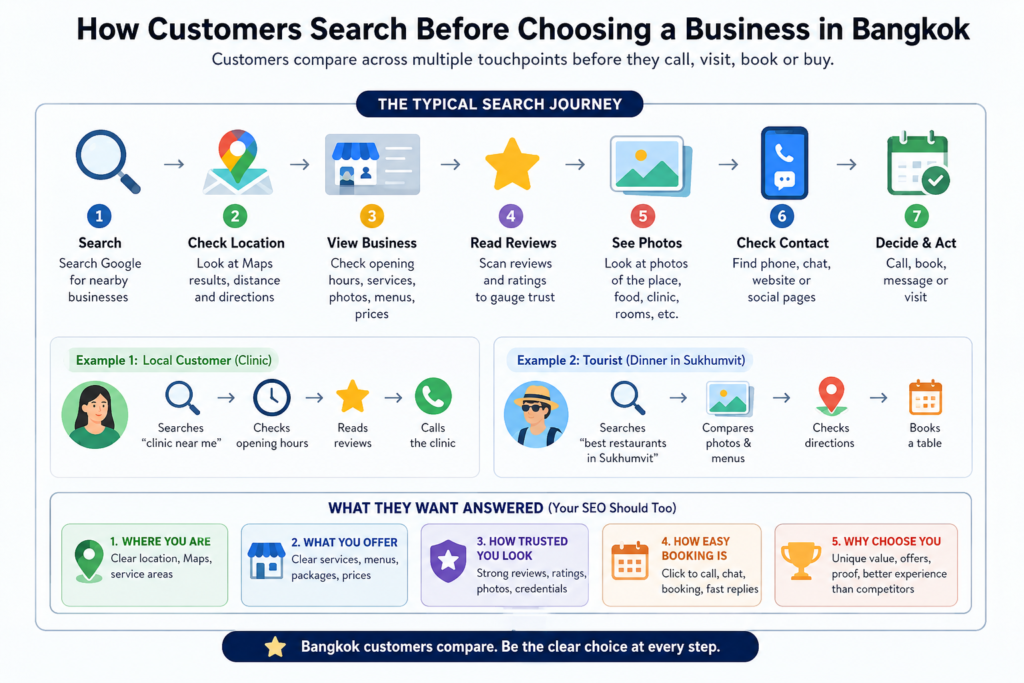
Bangkok customers rarely choose from one search result. They compare options across Google Search, Google Maps, reviews, photos, menus, prices, social pages, and contact links. A local customer searched for a nearby clinic, checked opening hours, then looked at reviews before calling. A tourist planned dinner in Sukhumvit, compared photos, and checked directions before booking. This is why Bangkok SEO needs more than keywords. Each search result should answer fast questions: where you are, what you offer, how trusted you look, how easy booking is, and why someone should choose you over another nearby business.
Thai and English search intent in Bangkok
Bangkok SEO works better when keyword planning reflects real search behavior rather than a direct translation. Thai customers often search with short, location-led phrases when they need a nearby service. Tourists and expats use broader comparison terms because they want proof before booking. Business buyers search with service, city, and trust signals because they compare providers before sending an enquiry.
| User group | Search behavior | Example search phrase | What the page should include |
|---|---|---|---|
| Thai local customers | Search fast on mobile for nearby options | ร้านอาหารใกล้ฉัน | Hours, map pin, menu, reviews, parking |
| Tourists | Compare before visiting or booking | best Thai massage Bangkok | Photos, prices, location, booking button |
| Expats | Look for trusted English-friendly services | English speaking dentist Bangkok | Staff language, service details, insurance notes |
| Area-based users | Search by district, BTS, or MRT | cafe near Asok BTS | Directions, nearby landmarks, opening hours |
| B2B buyers | Compare providers before enquiry | SEO agency Bangkok | Case studies, services, process, contact form |
This matters because one Bangkok business can serve several audiences at once. A strong page structure should connect language, location, service need, and proof so that users can decide faster.
Why Google Business Profile matters in Bangkok
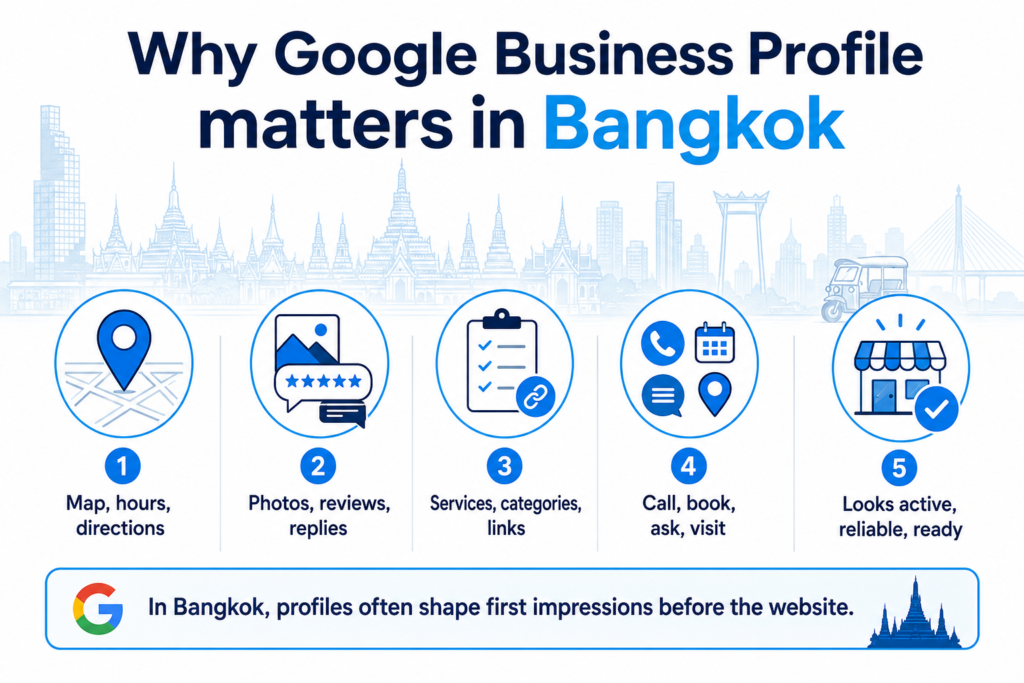
Google Business Profile is often the first place Bangkok customers judge a business. They see your map pin, hours, photos, reviews, service list, directions, and contact options before reaching your website. This profile should match your website, social pages, and real store details. Wrong hours, missing categories, old photos, or weak replies can reduce trust fast. Strong profiles add clear services, fresh images, local keywords, booking links, products, and helpful review responses.
For restaurants, spas, clinics, hotels, and shops, this turns search into action. People can call, book, ask questions, or get directions without extra steps. In Bangkok’s dense market, a complete profile helps your business look active, reliable, and ready to serve today.
How to compete in Google Maps results in 2026
Google Maps competition in Bangkok during 2026 is won through accuracy, activity, and proof. A business should first check that its name, address, phone number, hours, category, website, and service areas match everywhere online.
After that, it should improve the details that customers notice fastest. Photos should show the real place, staff, products, rooms, food, parking, entrances, or service results. Reviews should receive helpful replies, not copied answers. Services should be listed clearly, so Google and customers understand what the business offers. Local content also supports Maps visibility. A clinic in Sukhumvit, a café near Asok, or a spa in Silom should mention the area naturally on its website. Google Maps users already search with intent. They wanted directions, a call, a booking, or a quick comparison. Strong map visibility helps the business meet that demand before a competitor wins the visit.
Why bilingual content matters for Bangkok SEO in 2026
In 2026. Bangkok search is multilingual because the city serves locals, expats, tourists, and international buyers. A direct translation will not cover that demand. Thai users often search with short, practical phrases, while English users compare service quality, prices, reviews, and booking options. A business that writes for both groups can appear in more searches and answer stronger questions before users leave the page.
Strong bilingual SEO should include:
- Thai service pages for local daily searches and nearby intent.
- English pages for tourists, expats, investors, and B2B buyers.
- Area keywords such as Sukhumvit, Silom, Asok, Ari, Sathorn, and Bang Na.
- Clear contact paths, including phone, LINE, booking forms, and maps.
- Local proof, such as reviews, photos, case studies, and service examples.
This does not mean copying the same page in another language. Each version should match how that audience thinks. A Thai page can focus on speed, location, price, and convenience. An English page can explain trust, process, safety, and booking details. Better language fit turns search visibility into real action.
How AI search changes SEO in Bangkok
SEO in Bangkok now has to work for both classic search results and AI-assisted answers. Google still reads pages, checks business information, and looks for useful content. At the same time, users now expect faster answers. They want to know which business fits their need, where it is located, what it offers, and whether it looks safe to contact.
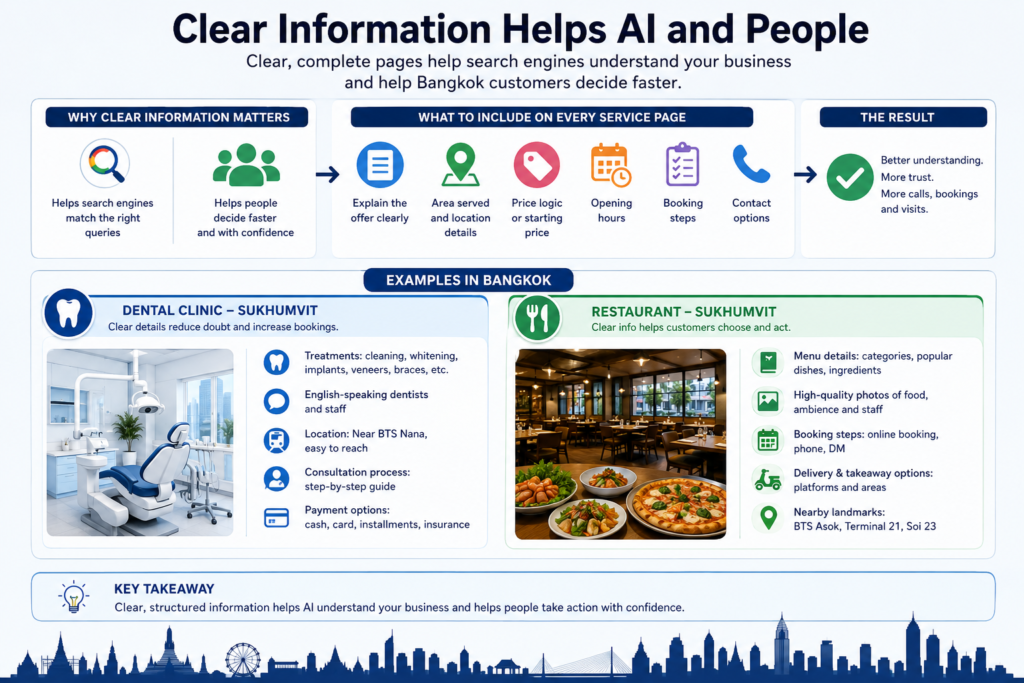
Clear information helps AI and people
Bangkok businesses should make their pages easy to understand. A service page should explain the offer, area served, price logic, booking steps, opening hours, and contact options. This helps search engines connect the business with the right query. It also helps users decide faster.
For example, a dental clinic in Sukhumvit should explain its treatments, English-speaking support, location near BTS, consultation process, and payment options. A restaurant should show menu details, photos, booking steps, delivery choices, and nearby landmarks. Clear details reduce doubt before a user calls or visits.
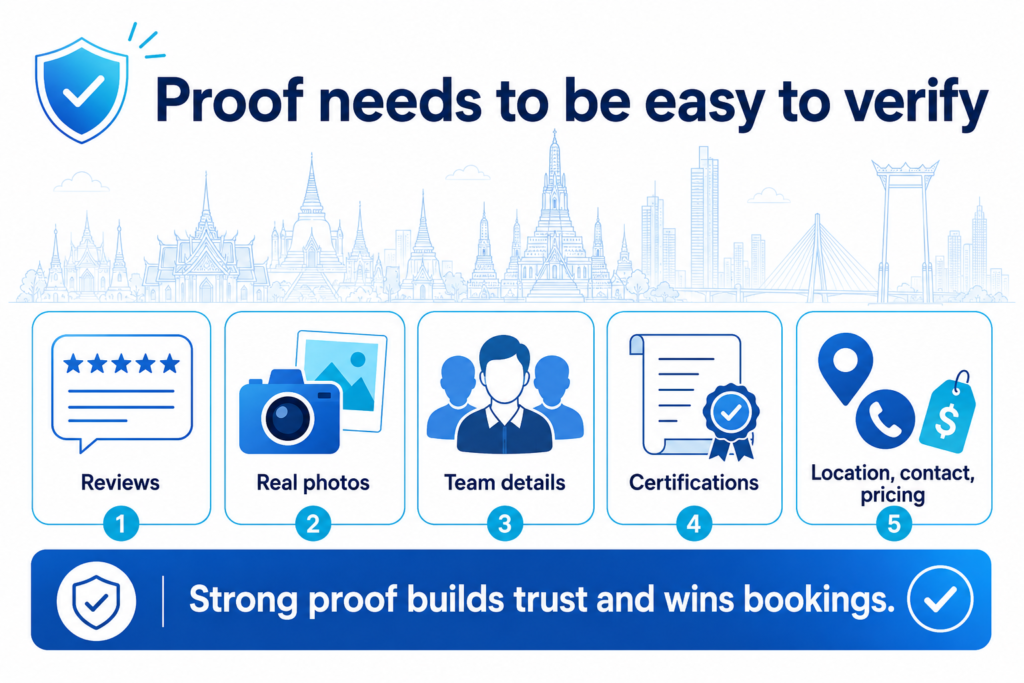
Proof needs to be easy to verify
AI search also rewards clarity around trust. A business should show reviews, real photos, team details, certifications, location proof, customer examples, and updated contact details. These signals help users understand whether the company is active and reliable.
Bangkok is full of similar businesses. Many offer the same services, use similar claims, and compete in the same areas. Proof gives users a reason to choose one option over another. A spa with fresh photos, clear pricing, strong reviews, and easy booking looks more ready than a competitor with thin information.
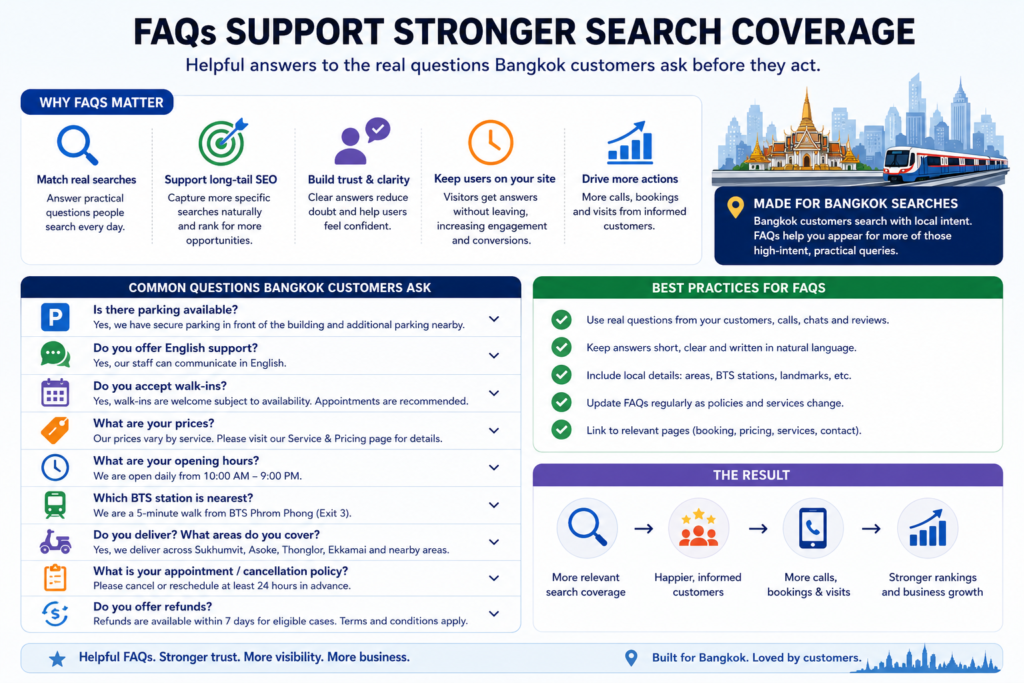
FAQs support stronger search coverage
FAQs are useful because Bangkok customers ask practical questions before taking action. They search for parking, language support, walk-in availability, prices, opening hours, nearby BTS stations, delivery zones, appointment rules, and refund terms.
Each answer should be short, helpful, and written in natural language. A good FAQ section can support long-tail search phrases without forcing keywords into the page. It also helps users get answers without leaving the site.
Local detail keeps content useful
AI search should not push businesses toward generic content. Bangkok pages work better when they include real local context. Mention service areas, nearby transport points, district differences, customer types, and common decision factors. Strong local detail shows that the business understands the city, not only the keyword.
How Bangkok businesses can prepare for AI search
AI search should be treated as an extension of Bangkok SEO, not a shortcut around it. Google says its generative search features, including AI Overviews and AI Mode, still rely on core Search ranking and quality systems, so useful pages, crawlable content, and clear business details still matter. For local companies, this means service pages should explain what the business offers, where it operates, how customers can book, which languages are supported, and what proof supports trust. A clinic, spa, hotel, restaurant, or SEO agency should also keep photos, reviews, FAQs, prices, directions, and Google Business Profile details accurate.
This helps people and search systems understand the business faster. Bangkok teams should avoid fake mentions, copied AI content, or pages made only to chase AI answers. Google’s spam policies now include attempts to manipulate generative AI responses, so the safer strategy is strong local content, real proof, and clean technical SEO. It keeps the article relevant without promising ranking gains from AI visibility alone in 2026.
Social proof and reviews in Bangkok local SEO
Bangkok buyers rarely trust one search result without checking proof. They compare ratings, photos, comments, Facebook pages, LINE response speed, TikTok videos, menus, prices, and recent activity. A business can rank well and still lose the customer when its public proof looks weak. That is why reviews and social signals should sit inside the SEO strategy, not outside it.
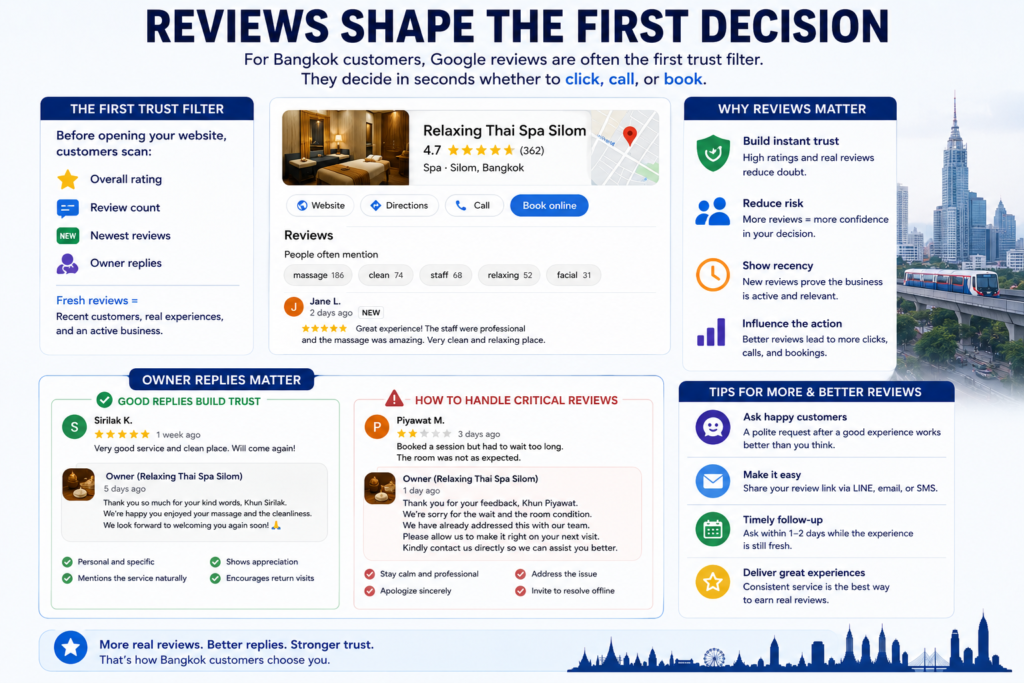
Reviews shape the first decision
Google reviews often become the first trust filter. A user searching for a spa in Silom, a clinic near Asok, or a café in Ari will scan the rating, review count, newest comments, and owner replies before opening the website. Old reviews still help, yet fresh reviews show that people visited recently and had a real experience.
Replies matter too. A short, copied reply can look careless. A useful answer shows that the business listens, solves issues, and respects customers. Positive replies can mention the service naturally. Critical replies should stay calm, specific, and helpful. This protects trust and gives future customers more confidence.
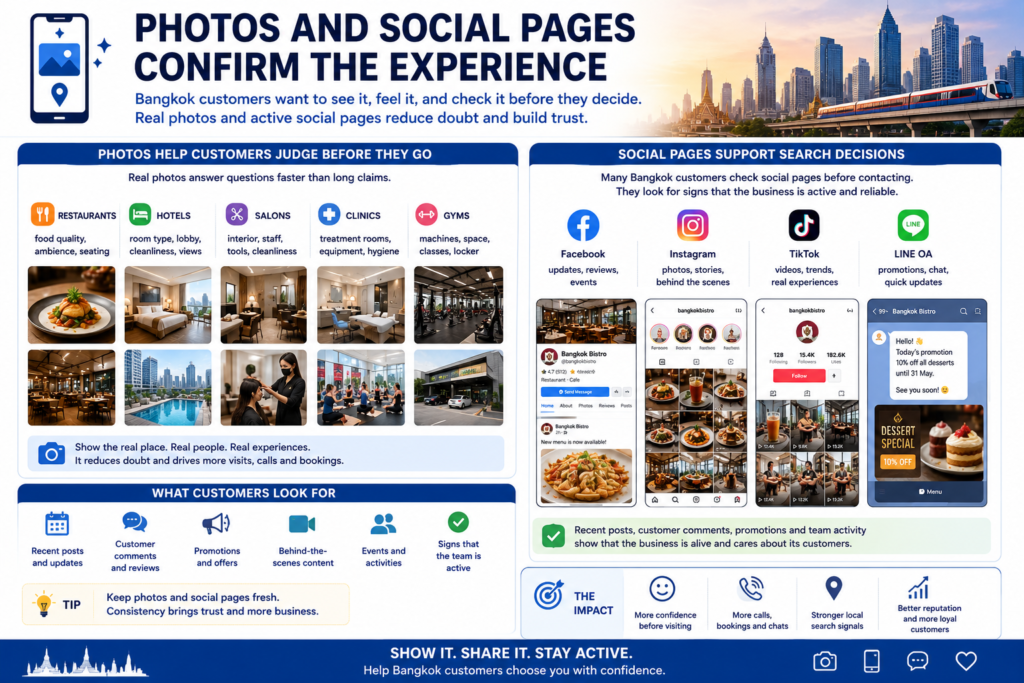
Photos and social pages confirm the experience
Bangkok customers often want to see the place before they go. Photos help them judge cleanliness, space, style, food quality, staff, parking, entrance, room type, or treatment setup. For restaurants, hotels, salons, clinics, gyms, and retail shops, real images reduce doubt faster than long claims.
Social pages also support search decisions. Many users check Facebook, Instagram, TikTok, or LINE before contacting a business. They look for recent posts, customer comments, event updates, promotions, behind-the-scenes content, and signs that the team is active. A strong social presence can make the business look alive, even when the website is simple.
Trust signals should connect across channels
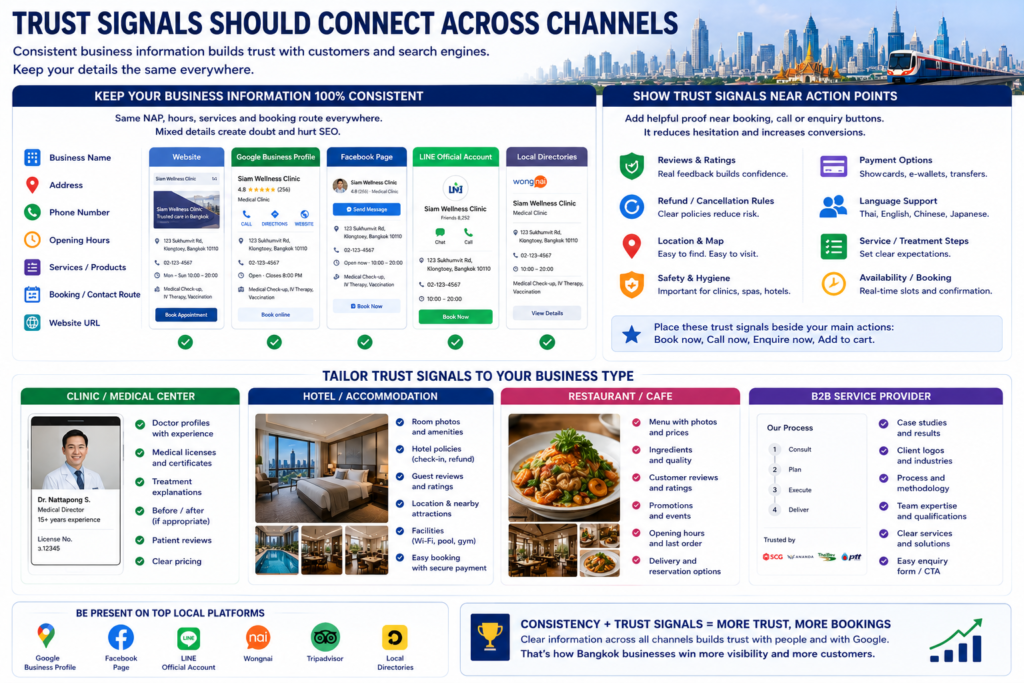
SEO works better when business information stays consistent. The same name, address, phone number, hours, service list, and booking route should appear on the website, Google Business Profile, Facebook page, LINE account, and local directories. Mixed details create doubt. They can also confuse search engines.
Bangkok businesses should also add trust signals near action points. A booking page can show reviews, refund rules, service steps, location details, safety notes, payment options, or language support. A clinic can show doctor profiles and licenses. A hotel can show policies and room photos. A B2B service provider can showcase case studies, client types, process steps, and clear enquiry forms.
Social proof turns visibility into enquiries
Search visibility brings attention. Social proof helps turn that attention into action. Someone who finds two similar businesses will often choose the one with clearer reviews, better photos, faster replies, and stronger public details.
That is where Bangkok SEO becomes practical. A business should not treat reviews, photos, social media, and website content as separate work. They all support the same decision. The customer wants to know whether the business is real, active, nearby, trusted, and easy to contact. Strong proof answers those questions before a competitor does. This work also helps with longer buying journeys. A tourist planning a trip will check options days before arrival. A local customer will save a place, ask a friend, then return later. An expat will compare language support and reviews before booking. Strong proof keeps the business in the shortlist after the first search, which matters in a city with so many similar choices across every busy district nearby.
Local content that brings better enquiries
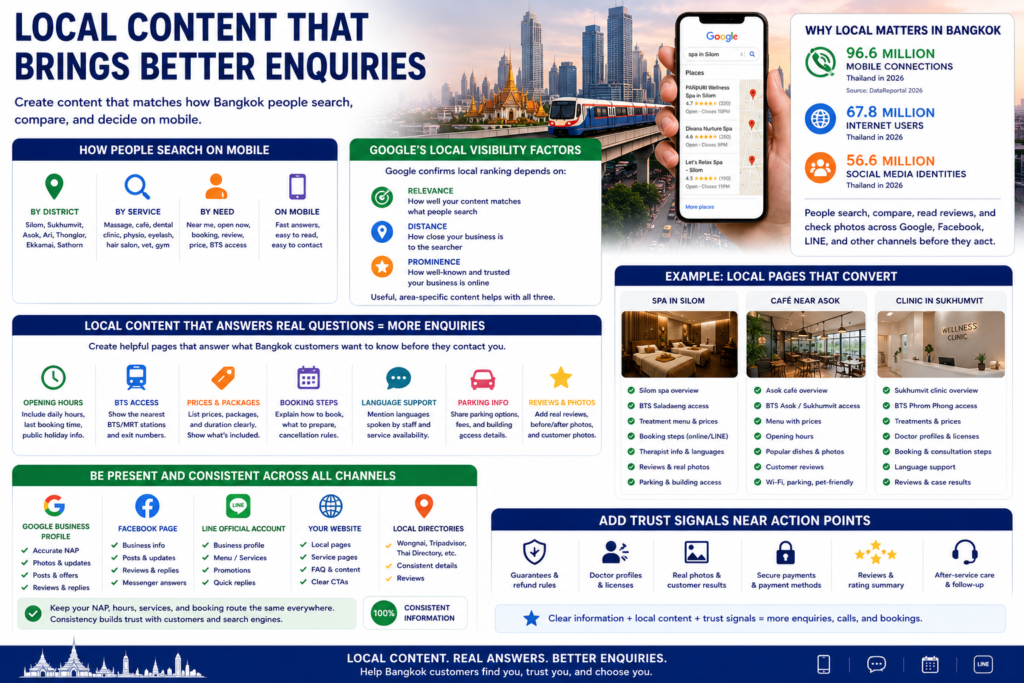
Local content in Bangkok should reflect how people search on mobile, by district, service, and need. DataReportal’s 2026 Thailand report recorded 96.6 million mobile connections, showing why nearby searches matter so much in daily decisions. Thailand also had 67.8 million internet users and 56.6 million social media identities in 2026, so users often compare Google results with Facebook, LINE, reviews, and photos before contacting a business.
A spa in Silom, café near Asok, or clinic in Sukhumvit needs content that answers local questions: opening hours, BTS access, prices, booking steps, language support, parking, and reviews. Google says local visibility depends on relevance, distance, and prominence, so useful area-specific pages help search engines and customers understand where the business fits.
Technical SEO for Bangkok websites
Technical SEO for Bangkok websites should focus on speed, stability, and smooth mobile actions. Google’s Core Web Vitals guidance says a strong page should load its largest visible content within 2.5 seconds, respond to user interaction in under 200 milliseconds, and keep layout shift below 0.1. These benchmarks are listed in Google’s own Core Web Vitals documentation:
For local businesses in Bangkok, those numbers matter because users often compare several restaurants, clinics, spas, hotels, or shops before calling or booking. A slow menu, shifting booking button, broken map link, or delayed LINE button can turn ready demand into a lost enquiry. Google Search Console also reports URL performance as Poor, Need improvement, or Good, based on LCP, INP, and CLS data. Bangkok websites should keep service pages crawlable, fast, structured, and easy to contact from mobile search.
How to measure Bangkok SEO performance
Bangkok SEO should be measured by real customer actions, not only ranking positions. A page can rank well and still fail if users do not call, book, ask for directions, or send an enquiry. Tracking should connect Google Search, Google Maps, website behavior, LINE clicks, phone taps, and booking forms.
| Metric | What it shows | Why it matters |
|---|---|---|
| Map direction requests | People plan to visit | Strong local intent |
| Phone clicks | Users want fast contact | Useful for clinics, spas, shops |
| LINE clicks | Users prefer chat | Common in Thailand |
| Booking form starts | Users consider buying | Shows service interest |
| Area keyword rankings | Visibility by district | Helps compare Sukhumvit, Silom, Ari |
| Review growth | Trust is improving | Supports local conversion |
Good reporting should separate traffic from demand. A Bangkok business needs to know which districts, services, languages, and pages bring serious enquiries. That makes SEO easier to improve month by month.
Common local SEO mistakes Bangkok businesses should fix
Bangkok SEO often fails because businesses treat search as a one-time setup. They add a few keywords, publish basic pages, and wait for results. In a dense city, that approach falls behind quickly. Competitors keep updating photos, reviews, service pages, prices, and map details. Customers also compare more than one business before they decide.
Weak Google Business Profile details
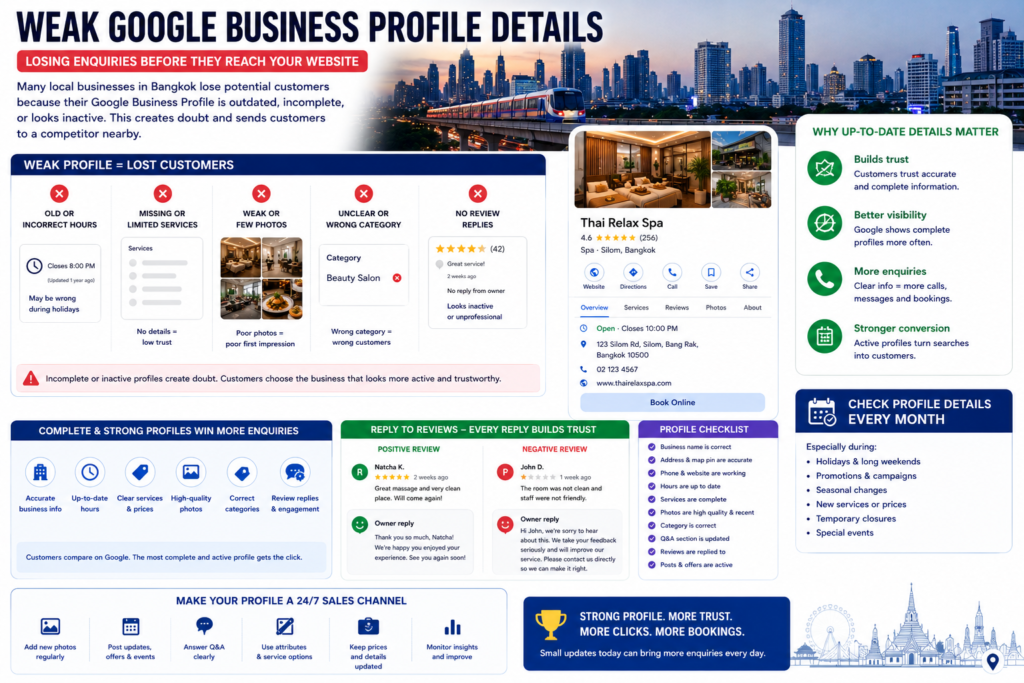
Many local businesses lose enquiries before users reach the website. Their Google Business Profile has old hours, missing services, weak photos, unclear categories, or no review replies. This creates doubt. A customer who sees incomplete details will choose another nearby option that looks more active. Bangkok businesses should check profile details every month, especially during holidays, promotions, seasonal changes, and service updates.
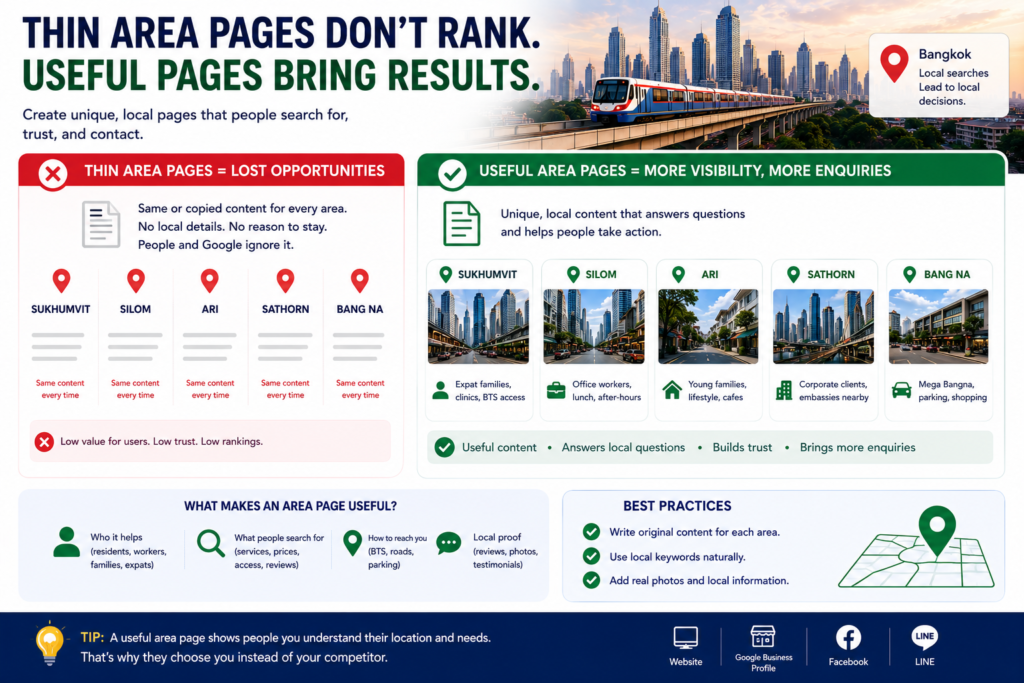
Thin area pages
Some companies create location pages for Sukhumvit, Silom, Ari, Sathorn, and Bang Na with almost the same text. That hurts quality. Each area page should explain who the service helps, what people search for there, how users can reach the business, and which local details matter. A useful page gives people a reason to stay. A copied page only fills space.
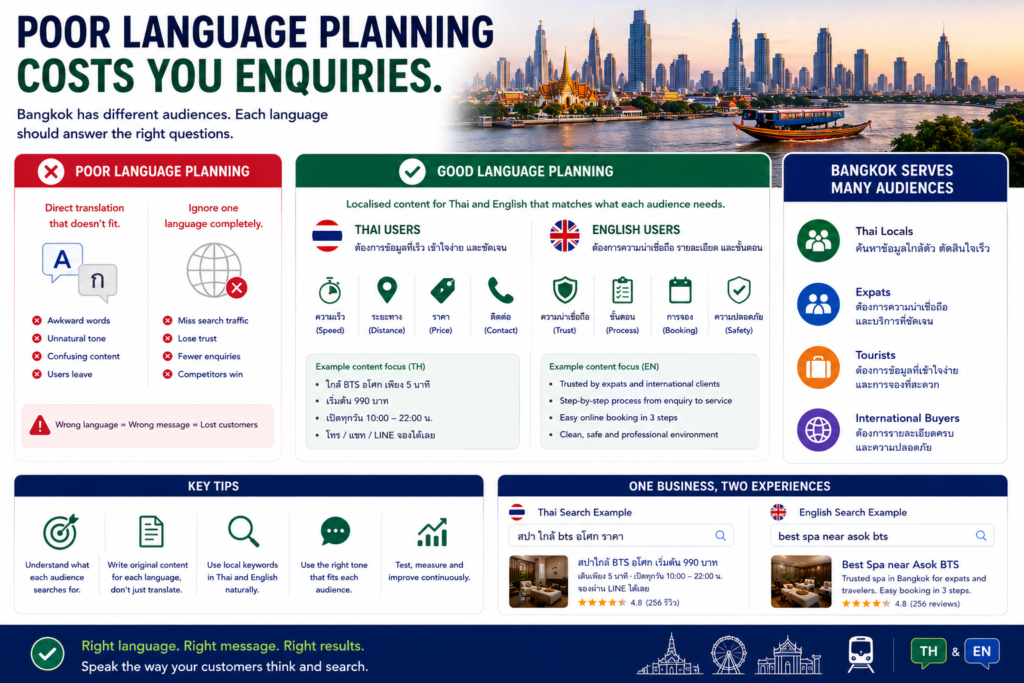
Poor language planning
Bangkok serves Thai locals, expats, tourists, and international buyers. Many websites still translate English pages directly into Thai, or they ignore English search demand entirely. This creates gaps. Thai users often want speed, distance, price, and contact details. English users often need trust, process, booking steps, and safety information. Each language version should answer the right questions.
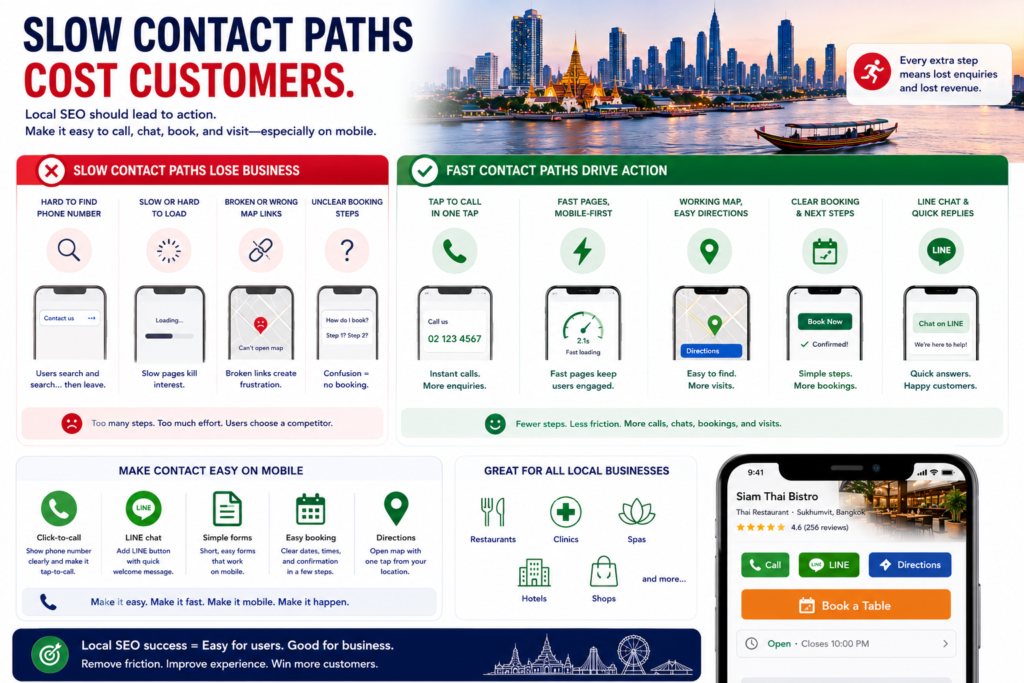
Slow contact paths
Local SEO should lead to action. If users need to search for a phone number, wait for a slow page, open a broken map link, or guess how to book, the website loses value. Restaurants, clinics, spas, hotels, and shops should make calls, LINE chats, forms, bookings, and directions easy to use on mobile.
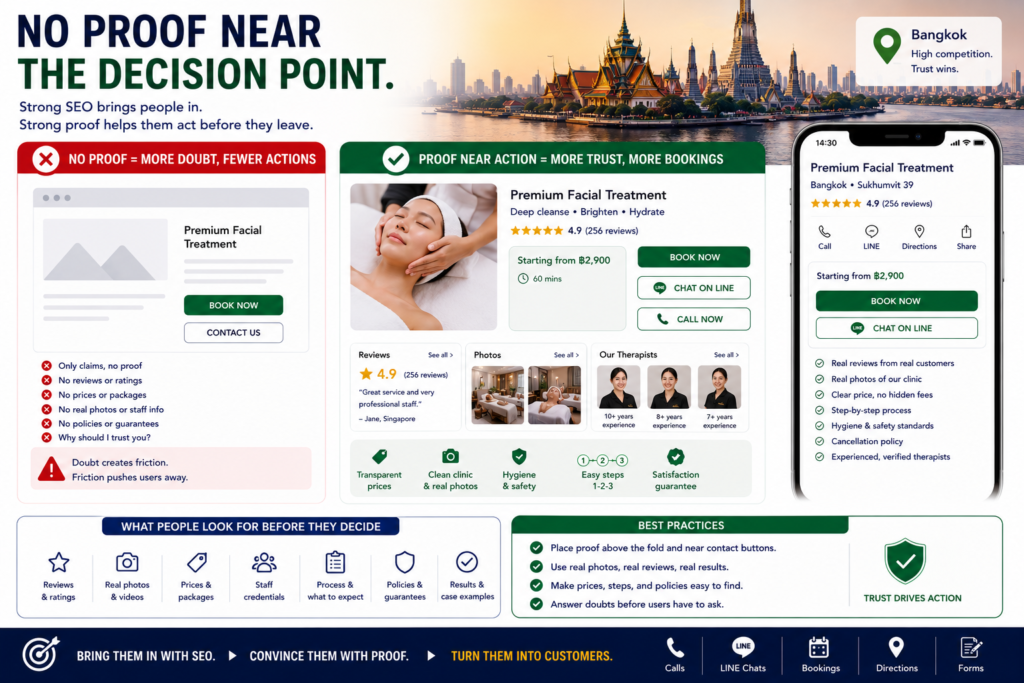
No proof near the decision point
Bangkok competition is full of similar claims. A business needs proof near contact buttons, service pages, and booking sections. Reviews, photos, prices, staff details, case examples, policies, and clear service steps help reduce doubt. Strong SEO brings people in. Strong proof helps them act before they leave.
Building a stronger Bangkok SEO strategy
Bangkok SEO works best when every search touchpoint supports the same decision. A customer should find the business, understand the offer, trust the proof, and contact the team without confusion. That means the website, Google Business Profile, reviews, photos, social pages, LINE account, and booking paths should stay aligned. Strong local SEO also keeps improving. Search terms changed, competitors updated profiles, and customers expected faster answers. For Bangkok businesses, winning local search in 2026 means building clear visibility, useful content, local proof, and simple conversion paths that turn attention into enquiries and visits from nearby buyers across busy districts today.
Keeping Bangkok SEO active
Bangkok SEO needs steady work because the market keeps moving. A business can improve rankings one month, then lose attention when competitors add better photos, stronger reviews, faster pages, or clearer service content. That is why audits should not stop at keywords. Teams should review Google Business Profile data, Search Console queries, map actions, booking paths, language pages, and competitor changes. Each update should remove friction for users. Better headings, clearer prices, fresh proof, faster contact buttons, and stronger area content all help. Over time, this creates search visibility that brings calls, visits, bookings, and enquiries.
Why LINE clicks matter in Bangkok SEO
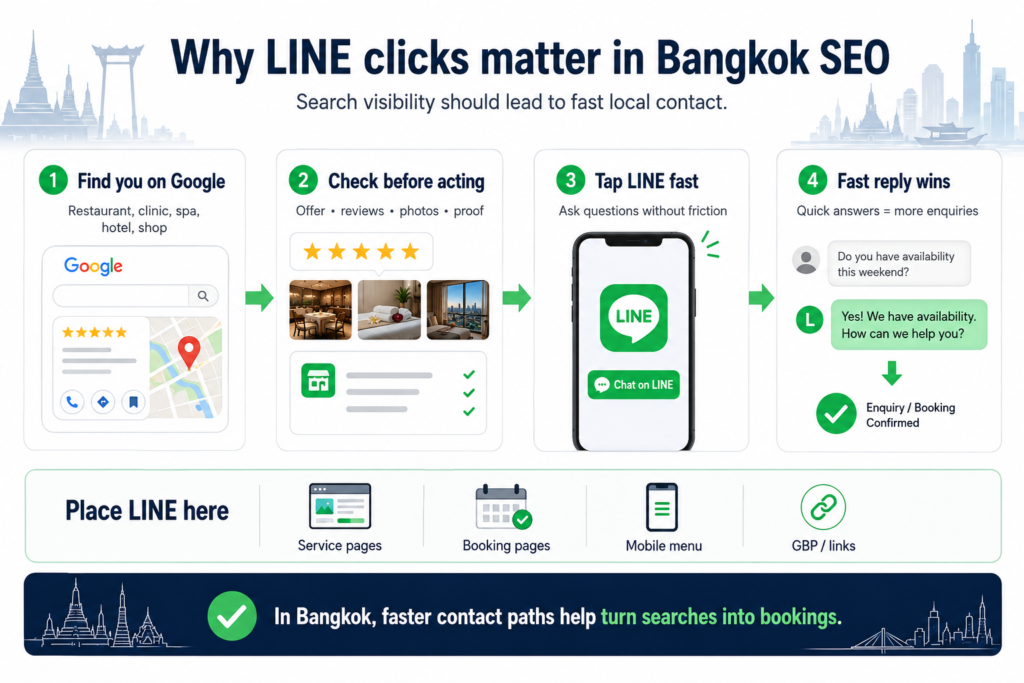
Bangkok SEO should connect search visibility with the way customers actually contact businesses. Many users find a restaurant, clinic, spa, hotel, or shop through Google, then ask questions through LINE before booking or visiting. That makes LINE clicks a useful conversion signal, not just a contact option. A strong local setup should place LINE buttons on service pages, Google Business Profile links where possible, booking pages, and mobile menus. Users should see the offer, check proof, compare photos, then contact the team without friction. In Bangkok, the business that answers faster often wins the enquiry.
Conclusion
SEO in Bangkok in 2026 rewards businesses that are easy to find, trust, and contact. Customers compare maps, reviews, photos, prices, social pages, and LINE before they decide. That means stronger results come from accurate Google Business Profile details, useful Thai and English content, fast mobile pages, local proof, and clear booking paths. The goal is not traffic alone. It is turning nearby searches into calls, visits, enquiries, and bookings. In a dense city, the clearest business often wins before the customer keeps scrolling or opens another nearby result.
Meet the Author

Faustas Norvaisa
A Growth & Product Expert with 9 years of experience in revenue diversification, international expansion, SEO, and digital marketing. Passionate about scaling businesses and building global brands, he empowers companies to thrive with his motto, "sharing is caring.
