Founder-Led Sales: How to Leverage Your Story to Close Deals in 2026?
- Last Time Updated: 20th of May, 2026
Founder-led sales helps early startup teams turn the founder’s story into trust, clearer conversations, and stronger sales opportunities. In 2026, buyers do not reply only because a product sounds useful. They check who built it, what problem the founder understands, and whether the company shows real proof.
That is why this article explains how to use your story without sounding vague, forced, or too personal. You will learn how founder-led selling works, why story-based trust matters, how LinkedIn and search support outreach, and how simple sales habits can help founders close better deals with less online friction during early growth.
What is founder-led sales in 2026?
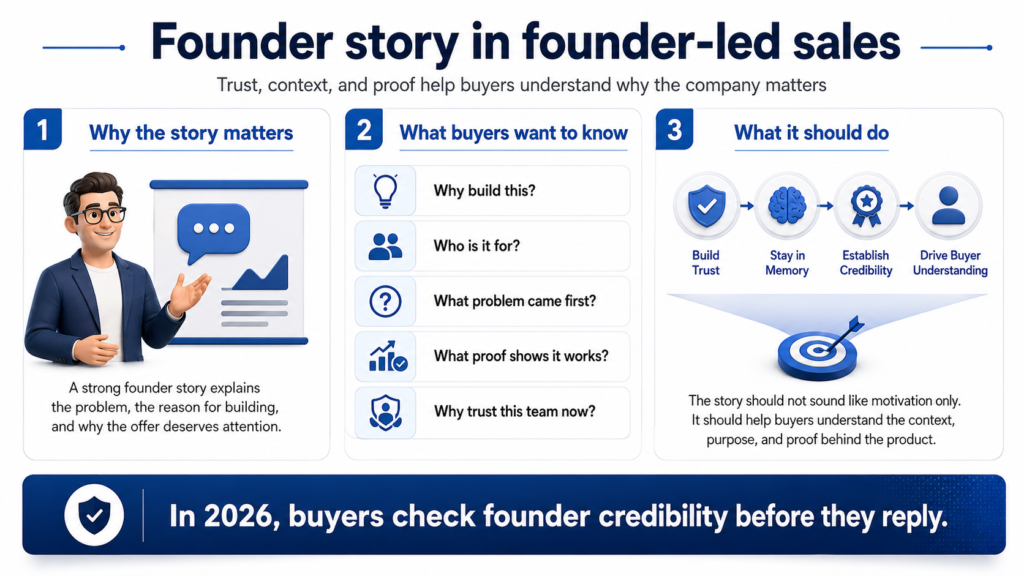
Founder-led sales in 2026 means the founder plays a direct role in building trust, starting conversations, and helping buyers understand the company. It is not only about sending LinkedIn messages or joining early sales calls. It is about using the founder’s insight to show why the product exists, who it helps, and what problem it solves.
This matters because early startups often lack strong brand awareness. Buyers want to know who stands behind the offer before they reply, book a demo, or share the idea with their team. A clear founder voice can make the company easier to understand and easier to trust.
When done well, founder-led sales connects your story, outreach, content, website, and sales calls into one clear growth path.
Why your story converts better when it proves something
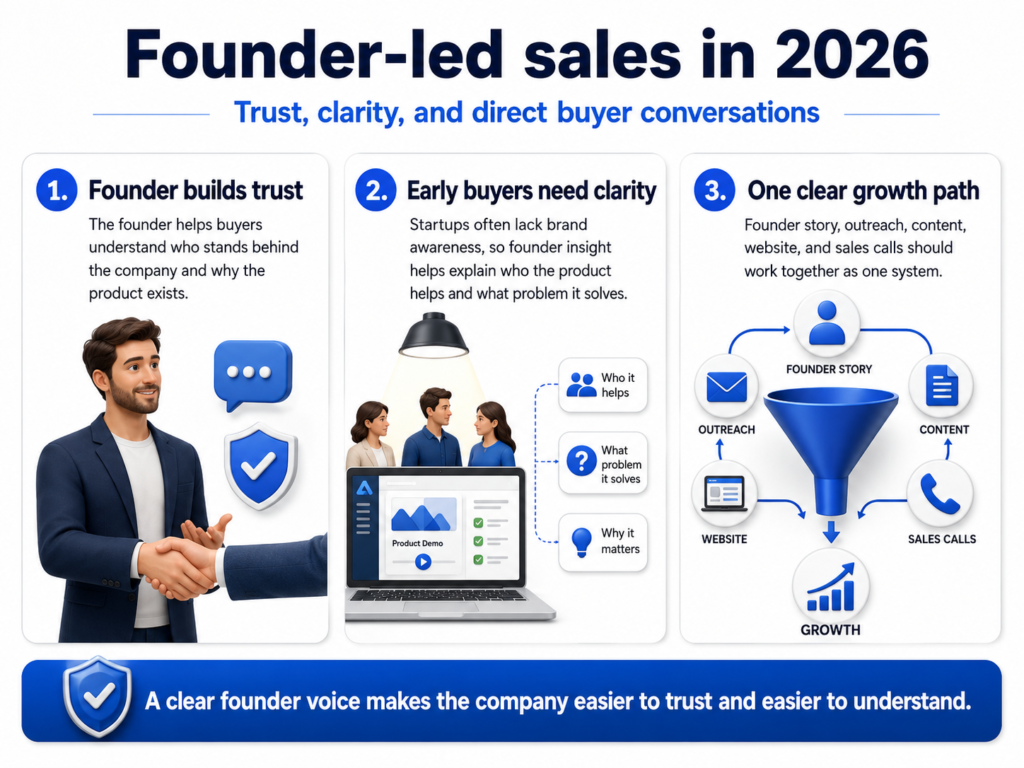
Founder-led sales works best when your story gives buyers a reason to trust you. A simple personal story is not enough. Buyers need to understand what problem you saw, why you cared, what you built, and why your solution deserves attention.
That is where your founder story becomes useful in sales. It shows the thinking behind the product. It also makes your company easier to remember. A scripted pitch can explain features, but a strong founder story explains purpose, context, and proof.
Your story should answer simple buyer questions:
- Why did you build this?
- Who is it really for?
- What problem did you notice first?
- What proof shows the product can work?
- Why should buyers trust your team now?
In 2026, buyers are more careful. They compare options, check founder profiles, read public content, and look for signs of credibility before they reply. So your story should not sound like motivation. It should help buyers feel that your company understands their problem and has a real reason to exist.
Founder-led sales in action: LinkedIn, search, and buyer intent
Founder-led sales become stronger when your content answers what buyers already want to know. In 2026, people will not only search for products. They search for founders, opinions, proof, use cases, and signs that a company understands their problem.
That is why your LinkedIn posts, website content, and outreach messages should not work separately. They should support the same story. If a buyer sees your post, checks your profile, visits your website, and then reads your message, each step should make it easier for the buyer to trust.
| Search intent / keyword | What buyers want to know | How your founder content helps |
|---|---|---|
| founder-led growth strategies | How founders create early traction | Share lessons from customer calls, launches, and sales tests |
| how to sell as a founder | How to start sales without a big team | Show outreach examples, call notes, and simple sales habits |
| personal brand selling | How trust turns into sales interest | Explain your point of view, customer problem, and proof |
| startup founder story | Why the company exists | Share the problem, insight, and mission behind the product |
When your content matches buyer intent, it does not feel like empty self-promotion. It feels useful. That is the difference. Your story gives people a reason to care, while your proof gives them a reason to reply. From there, your sales process becomes easier to structure.
Step-by-step: how to sell with your story in 2026
Founder-led sales become easier when your story is turned into simple sales actions. The goal is not to talk about yourself all the time. The goal is to help buyers understand why your company exists, what problem you solve, and why your team can be trusted.
In 2026, this matters because buyers often check your profile, posts, website, and proof before they answer. So your story should support each part of the sales path, from the first post to the first call.
1. Write a short origin story
Your origin story should explain the problem that pushed you to build the company. Keep it short. Buyers do not need your full life story. They need the reason behind the product.
A good structure is simple:
Problem → insight → solution → mission
For example:
“We built [product] after seeing how hard it was for [audience] to solve [specific problem]. Existing options were too slow, expensive, or unclear. So we created a simpler way to help [audience] get [result].”
Use this story in your LinkedIn bio, About page, outreach messages, pitch deck, and demo opening.
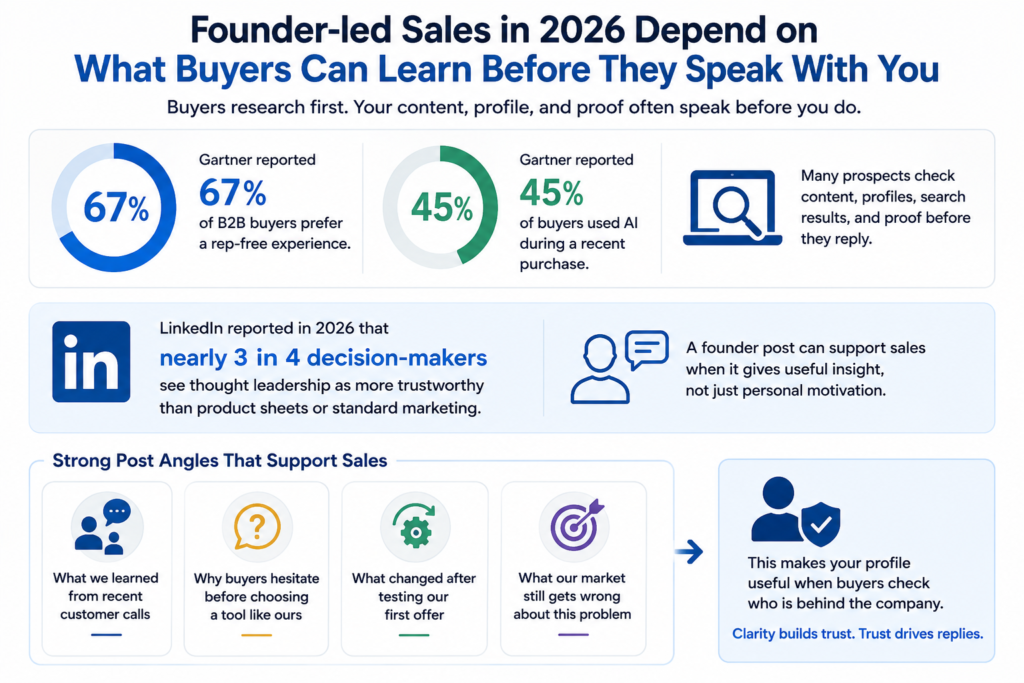
2. Turn customer insight into LinkedIn posts
This is why founder content should not only announce updates. It should show what the founder understands from real customer conversations. Share what buyers keep asking, what objections appear in calls, what product changes came from feedback, and what your market keeps misunderstanding.
LinkedIn also reported in 2026 that nearly three in four decision-makers see thought leadership as more trustworthy than product sheets or standard marketing materials. So a founder post can support sales when it gives useful insight, not just personal motivation.
Strong post angles include:
- What we learned from recent customer calls
- Why buyers hesitate before choosing a tool like ours
- What changed after testing our first offer
- What our market still gets wrong about this problem
This makes your profile useful when buyers check who is behind the company.
3. Start conversations with context
Cold outreach needs more proof in 2026 because inboxes are crowded, and buyers ignore weak templates. Instantly’s 2026 cold email benchmark found an average reply rate of 3.43%, while top-performing senders passed 10%. The gap shows that outreach still works, but only when the message feels relevant.
So do not open with a general pitch. Open with a reason that connects to the buyer’s role, company, market, or recent activity.
For example:
“Hi [Name], I noticed your team is working on [specific area]. We help companies dealing with [related problem], and I thought the connection was relevant. Open to a short conversation next week?”
This message works better than a copied pitch because it gives the person context. It shows that the founder did basic research and understands why the conversation could matter.
4. Use calls to prove you understand the problem
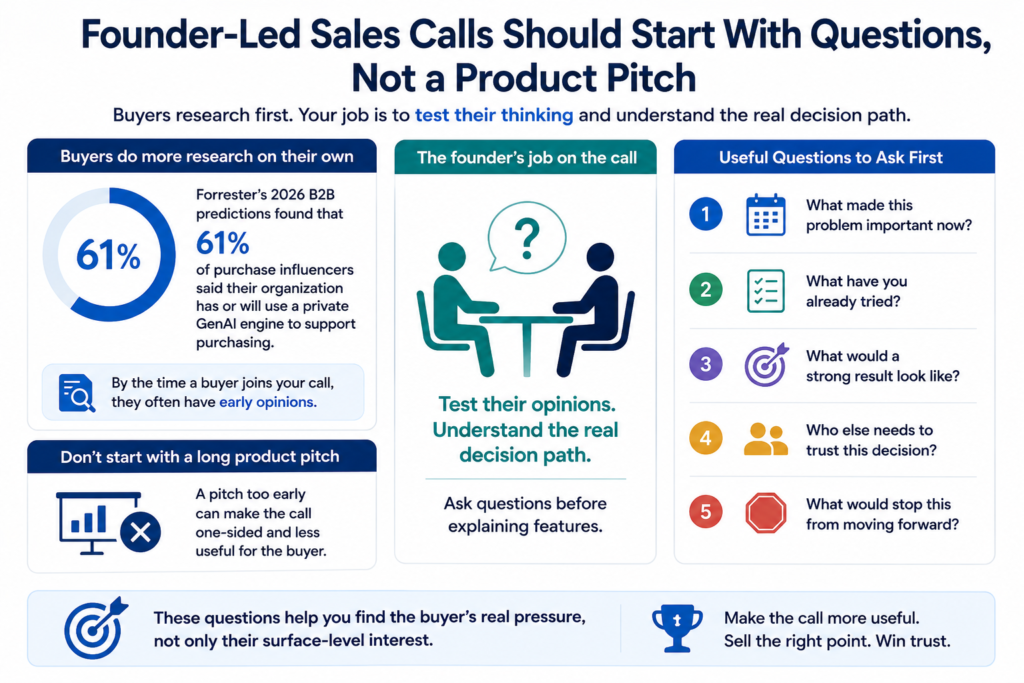
Founder-led sales calls should not start with a long product pitch. Buyers already do more research alone. Forrester’s 2026 B2B predictions also noted that 61% of purchase influencers said their organization has or will use a private GenAI engine to support purchasing. So by the time a buyer joins a call, they often have early opinions already.
The founder’s job is to test those opinions and understand the real decision path. Ask questions before explaining features.
Useful questions include:
- What made this problem important now?
- What have you already tried?
- What would a strong result look like?
- Who else needs to trust this decision?
- What would stop this from moving forward?
These questions help you find the buyer’s real pressure, not only their surface-level interest. That makes the call more useful and helps you avoid selling the wrong point.
5. Turn early proof into trust assets
Founder-led sales become stronger when every useful result becomes proof. This matters more in 2026 because AI tools now shape vendor research. G2 reported that 69% of B2B software buyers chose a different vendor than they first planned after AI chatbot guidance, and one-third bought from a vendor they had not heard of before.
That means your proof should be easy to find and easy to understand. A good testimonial, case study, LinkedIn post, or sales follow-up should show what changed, not only that someone liked working with you.
Use this simple proof structure:
- What problem existed
- What action was taken
- What changed after the work
- Why the result mattered
Early proof does not need to be huge. It needs to be specific. If a buyer or AI tool can clearly understand your result, your story becomes more credible before the next conversation starts.
Founder-led sales vs traditional sales teams in 2026
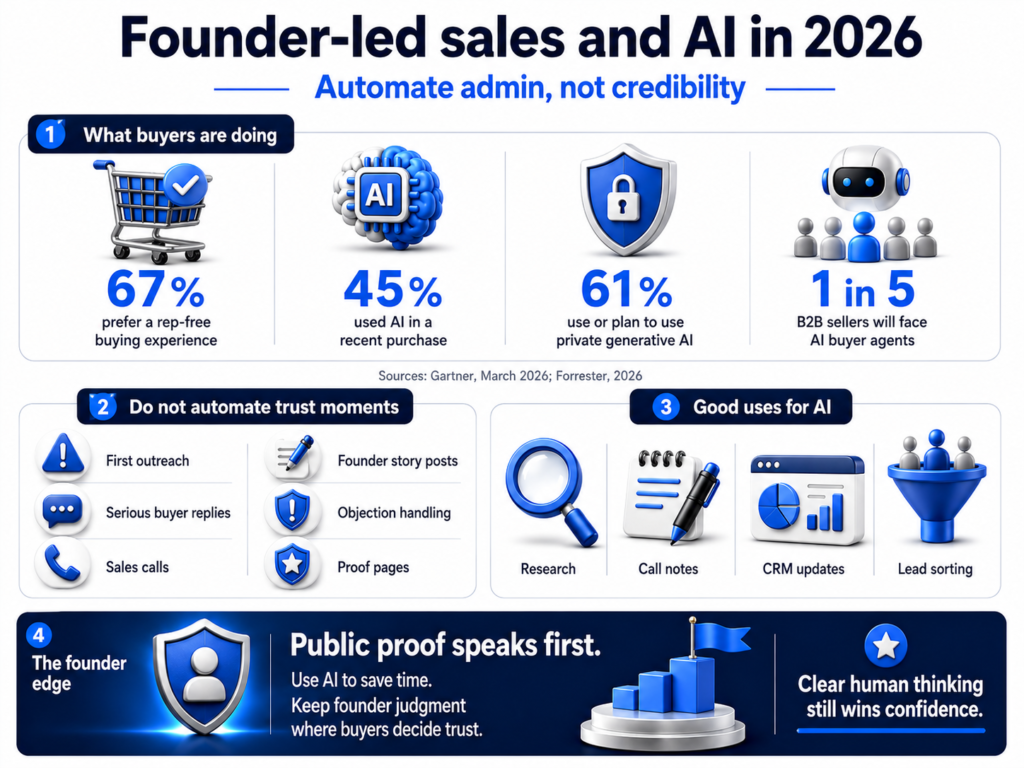
Founder-led sales and traditional sales teams both matter, but they work best at different stages. In early startup growth, the founder often has an advantage because buyers want direct answers, clear thinking, and proof that the company understands the problem. Gartner reported in 2026 that 67% of B2B buyers prefer a rep-free buying experience, while 45% used AI during a recent purchase. That means many buyers already research the company before they speak with anyone.
This does not mean sales teams are less useful. It means early-stage companies need founder visibility before they scale sales. A sales rep can follow a process. A founder can explain why the company exists, what the market taught them, and why the product deserves trust.
| Area | Founder-led sales | Traditional sales team |
|---|---|---|
| Best stage | Early startup, first customers, founder-market fit | Later growth, repeatable pipeline, bigger volume |
| Buyer trust | Strong when the founder shows real insight and proof | Builds through process, follow-ups, and brand assets |
| Content value | Founder posts can support search, LinkedIn, and AI discovery | Sales content often stays inside emails and calls |
| Speed of learning | Fast because the founder hears objections directly | Slower if feedback stays inside CRM notes |
| Weakness | Hard to scale if the founder handles every deal | Can sound generic if the team lacks a strong story |
| Best use | Complex early sales, high-trust offers, new categories | Clear offers, mature funnels, repeatable buyer paths |
LinkedIn’s 2026 B2B insights also support this shift. Its research with Edelman found that nearly three in four decision-makers see thought leadership as more trustworthy than product sheets or standard marketing materials. For a founder, this means useful public thinking can support sales before outreach starts.
AI-assisted buying makes this even more important. G2 reported in April 2026 that 69% of B2B software buyers chose a different vendor than first planned after AI chatbot guidance, and 33% bought from a vendor they had not heard of before.
So the real question is not whether founder-led sales is better than a sales team. The better question is timing. Founders should lead sales until the company understands the buyer, the objections, the proof needed, and the message that closes deals. After that, a sales team can scale what the founder has already proved.
What founders should not automate in 2026
Founder-led sales in 2026 should use automation for speed, not for judgment. AI can help founders research accounts, summarize calls, update CRM fields, and draft follow-ups. Salesforce reported that UK sellers expect AI agents to cut prospect research time by 38% and email drafting time by 38%, which supports automation for routine sales work. Still, trust-heavy moments need human control. Sinch’s 2026 research found that 74% of enterprises had rolled back or shut down a live AI customer communications agent after governance failures.
That shows the risk of letting automation speak for the company without enough review. Founders should keep control over high-value first messages, serious objections, discovery calls, testimonials, and case studies. Automate support work, not credibility, when stakes are high and trust matters.
How founder-led sales supports startup fundability in 2026
Founder-led sales also supports startup fundability because investors want proof that demand is real. A good story can open the door, but traction keeps the conversation alive. In Q1 2026, Carta reported that around 3,000 U.S.-based startups raised pre-seed funding, with more than $2.3 billion already recorded and the total expected to reach about $2.9 billion after more data is added. That shows capital still exists, but founders need clearer evidence to compete for it.
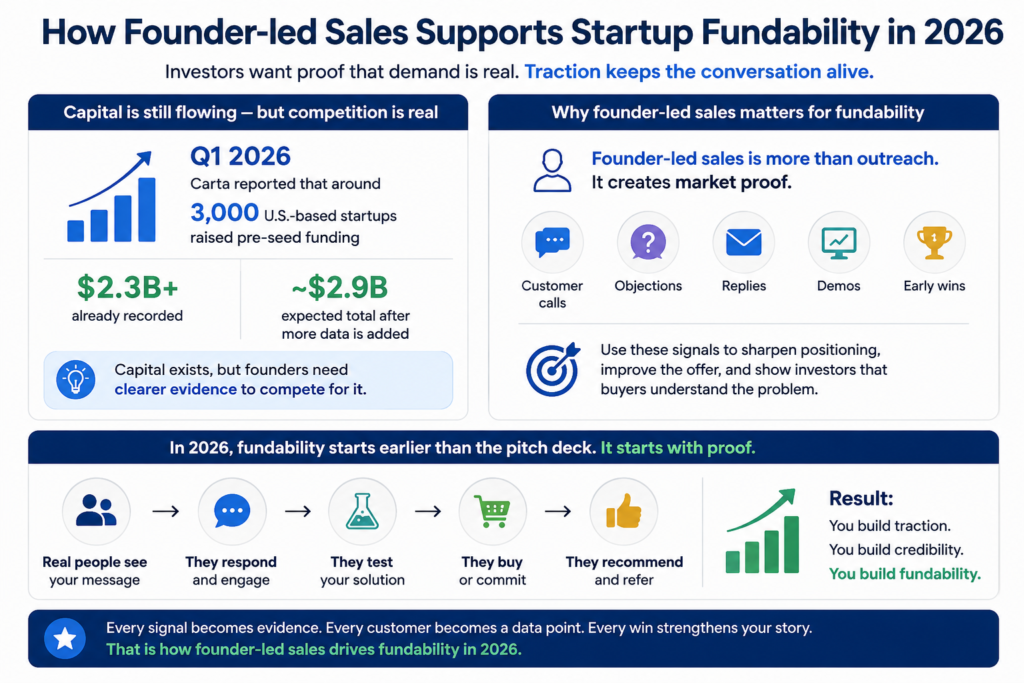
This is where founder-led sales becomes more than outreach. Every customer call, objection, reply, demo, and early win can become market proof. Founders can use these signals to sharpen positioning, improve the offer, and show investors that buyers understand the problem. In 2026, fundability starts earlier than the pitch deck. It starts when the founder can prove that real people care enough to respond, test, buy, or recommend.
How aboveA helps founders turn visibility into fundability
Founder-led sales can create attention, but attention alone does not make a startup easier to fund. Investors still need proof that the founder understands the market, speaks to real buyers, and can turn early interest into a repeatable growth path. SeedBlink’s 2026 investor outlook says founders are expected to show execution speed, resource discipline, clear market thinking, and a realistic path toward a durable business.
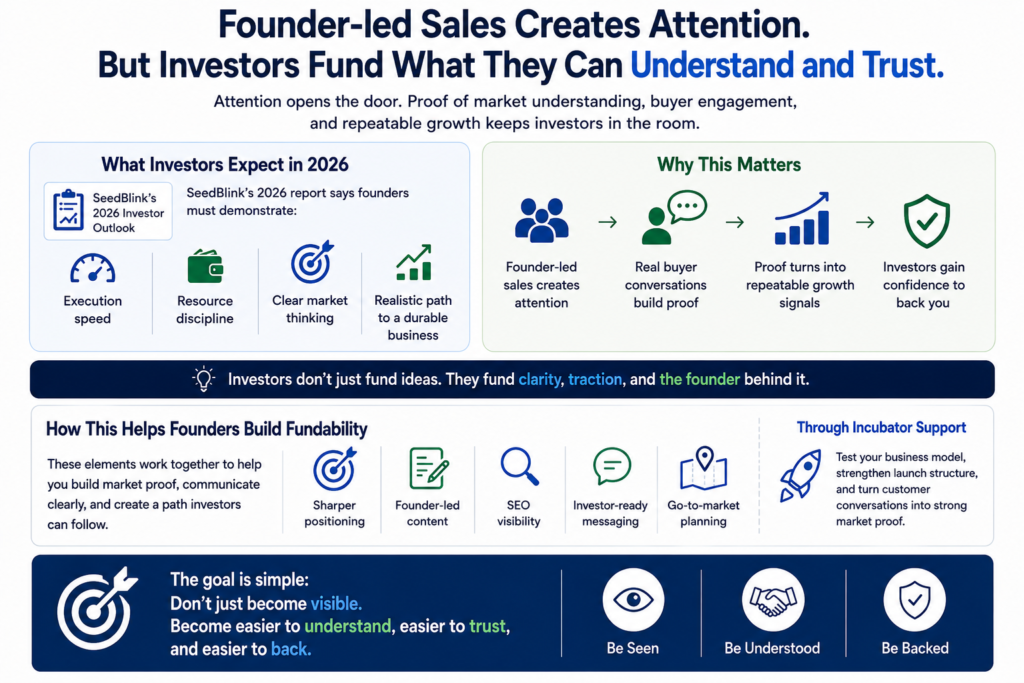
aboveA helps founders connect those pieces before they scale too fast. This includes sharper positioning, founder-led content, sales story development, SEO visibility, investor-ready messaging, and go-to-market planning. Through aboveA’s incubator work, early-stage founders can also test their business model, improve launch structure, and turn customer conversations into stronger market proof.
For founders, the goal is simple. Do not only become visible. Become easier to understand, easier to trust, and easier to back.
Wrapping Up
Founder-led sales in 2026 is not only about telling a personal story. It is about turning founder insight into trust, proof, and better sales conversations. Buyers want to understand who built the company, why the problem matters, and what evidence supports the offer.
When your content, outreach, calls, and proof all align, your story becomes a sales asset. For early-stage founders, that clarity can support stronger traction, better investor conversations, and a more fundable startup during uncertain markets and growth.
Meet the Author

Faustas Norvaisa
A Growth & Product Expert with 10 years of experience in revenue diversification, international expansion, SEO, and digital marketing. Passionate about scaling businesses and building global brands, he empowers companies to thrive with his motto, "sharing is caring.
