Chaophya Nillawan
A content writer at aboveA focused on go-to-market strategy, international expansion, and startup growth across Europe and Southeast Asia. With a psychology background, he helps businesses build trust, enter new markets, and become more fundable.
10 best startup mentors in DACH 2026
- Last Time Updated: 26th of May, 2026
Startup mentors in DACH 2026 can help founders survive a market where good technology still fails when the proof is weak. In Germany, deep tech and B2B buyers often expect technical depth, clear pilots, and enterprise trust. In Austria, access can depend on angel networks, accelerators, and visible founder credibility. In Switzerland, science-backed startups face sharper questions around regulation, funding fit, and global scale. So this guide is not a name list. It helps founders match mentors to the decision blocking growth: funding, SaaS sales, fintech trust, deep tech validation, corporate partnerships, or market entry.
Make your startup relevant, profitable, and competitive in 2026!
Table of Contents
DACH founders face a higher bar in 2026!
European hub rank
Munich’s UnternehmerTUM ranked No. 1 in the Financial Times and Statista 2026 startup hub ranking, with Germany also taking the top three positions through UnternehmerTUM, Start2 Group, and BayStartUP. DACH founders now compete in a region where mentorship, funding access, corporate links, and technical depth are easier to compare. A weak deck, soft traction story, or vague market-entry plan will lose attention faster. Strong mentors can help founders sharpen proof before serious outreach begins.
Swiss VC rebound
Swiss startups raised CHF 2.95B in 2025, up nearly 24% from 2024, while Series A funding reached a record CHF 1.116B. That creates opportunity, but not easy access. Capital is moving toward stronger companies with clearer evidence, stronger teams, and sharper sector logic. Founders in healthtech, AI, fintech, SaaS, and deep tech need mentors who can challenge regulation, funding fit, global scale, and investor proof before the pitch reaches the room.
Accelerator route
In Austria, 53% of young companies have already joined an incubator or accelerator, and accelerators are linked to 22% of funding raised. Mentorship is not just soft advice in this market. It can shape access, confidence, investor readiness, and founder visibility. For DACH founders, the right mentor can clarify which route fits best: angel funding, venture capital, corporate pilots, university-linked support, or cross-border expansion into Germany, Austria, Switzerland, and wider Europe.
Why startup mentors in DACH are useful in 2026
Startup mentors in DACH 2026 are useful when founders face a market that rewards preparation, not noise. Munich’s UnternehmerTUM ranked first in Europe’s 2026 startup hub ranking, while Start2 Group and BayStartUP also placed in the top three. So, founders in Germany, Austria, and Switzerland are not building in a weak ecosystem. They are building inside a region where support quality, investor access, technical depth, and mentor networks are already highly visible. A vague deck, soft traction story, or unclear GTM plan will be compared fast. Good mentors can challenge the business before investors, accelerators, or corporate buyers do.
At the same time, European VC has become more selective. KPMG reported that Europe raised $25.7B across 1,939 VC deals in Q1 2026, with capital concentrated in large, late-stage rounds and a strong focus on AI and defence tech. Switzerland also rebounded, with startups raising CHF 2.95B in 2025. For founders, the message is clear: access exists, but weak proof wastes it. The right DACH mentor should test funding logic, technical defensibility, enterprise trust, regulatory risk, and cross-border scale before outreach starts.
How we selected 2026 startup mentors in DACH
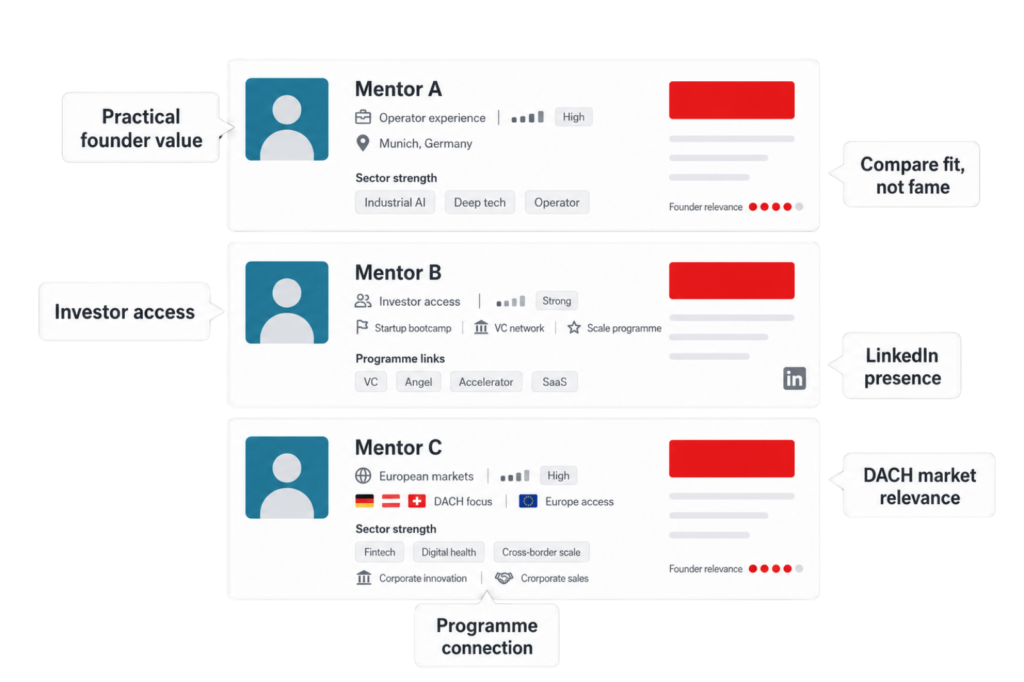
Startup mentors in DACH were selected for practical founder value, not name recognition alone. The list focuses on people connected to startup building, venture capital, accelerators, angel investing, deep tech, SaaS, fintech, digital health, corporate innovation, ecosystem access, or cross-border scale. We also looked at visible public work, LinkedIn presence, programme connection, founder relevance, and whether each person can help founders make sharper decisions in Germany, Austria, Switzerland, or wider European markets.
The goal is not to rank mentors as “best” in a fixed order. A founder building industrial AI in Munich needs different support from a Swiss healthtech founder, an Austrian pre-seed team, or a SaaS company preparing corporate sales. Instead, this list helps founders compare mentor fit by sector strength, investor access, operator experience, programme links, and the decision to block growth now. Use it as a shortlist, then check each person’s current role, availability, and relevance before reaching out.
Startup mentors in DACH to know in 2026
Startup mentors in DACH can help founders prepare for funding, pitch reviews, technical proof, corporate sales, and cross-border growth. This list compares mentor fit across Germany, Austria, and Switzerland by sector strength, ecosystem work, investor access, and practical founder value before outreach begins in 2026.
1. Helmut Schönenberger — deep tech, startup hubs, and industrial venture building
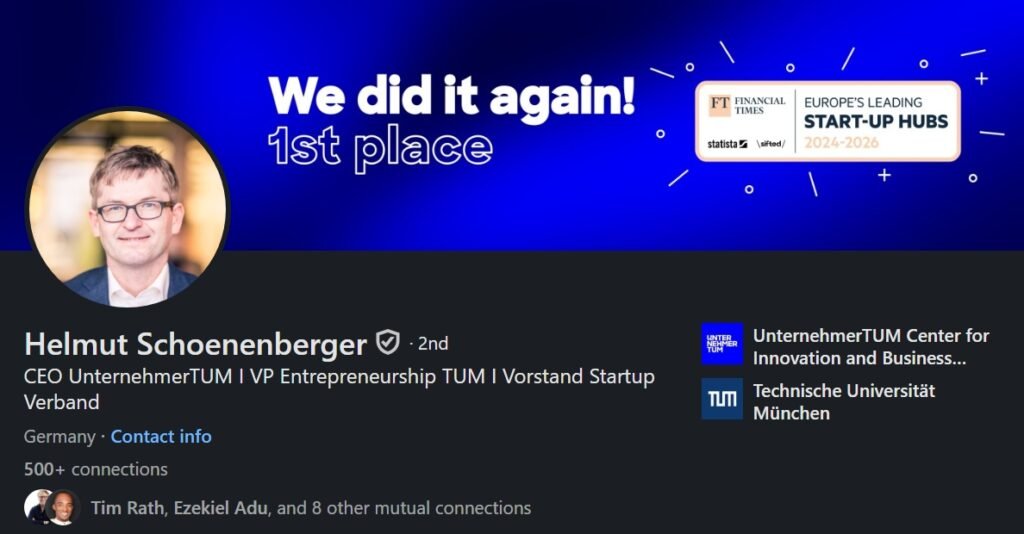
Helmut Schönenberger is a strong first mentor to include because his work connects deep tech, university entrepreneurship, industrial innovation, venture building, and one of Europe’s most influential startup hubs. He is Co-Founder and CEO of UnternehmerTUM, the startup and innovation center linked to the Technical University of Munich, while TUM also lists him as an Honorary Professor in Entrepreneurship Practice. His profile is especially useful for founders building science-backed products, B2B technology, AI, robotics, mobility, smart enterprise tools, or industrial ventures that need more than a pitch deck.
UnternehmerTUM has supported over 1,000 startups and topped the Financial Times startup hub ranking for three consecutive years, which makes his ecosystem value highly relevant for DACH founders preparing serious investor, corporate, or market conversations.
Follow Helmut Schönenberger on LinkedIn!
Quick fit facts:
Best for: deep tech, university startups, industrial innovation, venture building, corporate partnerships, Munich ecosystem access.
Founder fit: early-stage and growth-stage founders building technical products, research-backed ventures, B2B tools, or corporate-facing startups.
Sector fit: AI, robotics, mobility, smart enterprise, additive manufacturing, deep tech, industrial SaaS, and science-based startups.
Mentor value: helps founders understand technical proof, corporate fit, venture building, funding readiness, product validation, and industrial scale logic
Programme or ecosystem: UnternehmerTUM, Technical University of Munich, TUM Venture Labs, Munich startup ecosystem, German deep tech ecosystem.
Best way to approach: share your technology area, current proof, target customer, corporate or investor goal, and the specific scale challenge you need help with.
2. Verena Pausder — startup policy, founder visibility, and German ecosystem leadership
Verena Pausder is a strong second mentor to include because her work connects entrepreneurship, startup policy, digital education, founder visibility, and Germany’s wider innovation agenda. She is Chairwoman of the German Startup Association, and her own profile describes her as an entrepreneur, investor, and one of the best-known voices in the German startup scene. Her profile fits founders who need to understand how Germany thinks about startup conditions, late-stage capital, talent, deep tech, research transfer, diversity, and public ecosystem credibility. She is especially useful for founders preparing policy-facing growth, ecosystem partnerships, public visibility, or investor conversations where the company story needs stronger national, market, and founder relevance.
Follow Verena Pausder on LinkedIn!
Quick fit facts:
Best for: startup policy, founder visibility, German ecosystem access, digital education, investor readiness, public positioning.
Founder fit: early-stage and growth-stage founders preparing ecosystem partnerships, public visibility, investor conversations, or Germany-focused growth.
Sector fit: edtech, digital products, SaaS, deep tech, AI, consumer platforms, and mission-led startups.
Mentor value: helps founders understand ecosystem credibility, policy context, founder positioning, investor narrative, public trust, and Germany’s startup agenda.
Programme or ecosystem: German Startup Association, FC Viktoria Berlin, FAST & CURIOUS, digital education initiatives, German startup ecosystem.
Best way to approach: share your startup stage, Germany link, visibility challenge, ecosystem goal, and the specific investor, policy, or market decision you need help with.
3. Faustas Norvaiša — investor proof, DACH market logic, and Europe–Asia growth
Faustas Norvaiša is a strong third mentor to include because his work connects investor proof, market-entry strategy, SEO visibility, credibility systems, and cross-border growth between Europe and Asia. He is the CEO and Co-Founder of aboveA, where his work focuses on international expansion, SEO strategy, go-to-market thinking, and helping companies become easier to find, understand, and trust in new markets. His DACH relevance comes from experience with European market-entry logic, German business contexts, and growth work tied to international positioning, including projects connected to Germany and wider European expansion.
Founders who work closely with him often describe his process as “the Faustas cut”: the point where weak claims, decorative strategy, unclear traction, and inflated market stories are stripped away before investors, partners, customers, or new markets judge them. This makes him useful for founders who need sharper pitch logic, stronger proof, clearer GTM routes, better search visibility, and a business story that can travel between DACH, Southeast Asia, and other cross-border markets.
Follow Faustas Norvaisa on LinkedIn!
Quick fit facts:
Best for: investor proof, fundability, SEO visibility, market entry, GTM strategy, Europe–Asia expansion, AI governance.
Founder fit: early-stage and growth-stage founders preparing for funding, DACH entry, Asian expansion, credibility work, or investor-facing proof.
Sector fit: SaaS, ecommerce, marketplaces, AI companies, service businesses, education, B2B platforms, and cross-border startups.
Mentor value: helps founders connect proof, positioning, visibility, investor logic, trust systems, and practical market-entry decisions.
Programme or ecosystem: aboveA, aboveA Academy, VAVILA Group, VAVILA One, REDH, market-entry advisory, startup incubator-style programmes.
Best way to approach: share your target market, traction proof, deck issue, DACH or Asia expansion goal, and the specific decision you need challenged.
4. Christian Miele — venture capital, AI, and European scale strategy
Christian Miele is a strong fourth mentor to include because his work connects venture capital, AI, robotics, energy, European scale, and startup policy. He is a General Partner at Headline, where his portfolio links to companies such as Mistral AI, NUMA, Trawa, and Sparetech, and he has been active in the startup ecosystem since 2010 as an entrepreneur, angel investor, and venture capitalist.
His profile is especially useful for founders who need sharper investor logic, stronger technical positioning, clearer scale potential, and a better understanding of how European VCs judge ambition, defensibility, and timing. He also chaired the German Startup Association from 2019 to 2023, which adds ecosystem and policy relevance for DACH founders preparing serious funding conversations.
Follow Christian Miele on LinkedIn!
Quick fit facts:
Best for: venture capital, AI, robotics, energy, European scale, investor readiness, startup policy.
Founder fit: early-stage and growth-stage founders preparing for VC funding, AI scale, deep tech validation, or European investor conversations.
Sector fit: AI, robotics, energy, SaaS, Industry 4.0, healthcare, hospitality tech, and venture-backed software companies.
Mentor value: helps founders understand VC expectations, defensibility, timing, funding logic, technical positioning, and European scale strategy.
Programme or ecosystem: Headline, German Startup Association, European VC ecosystem, German startup policy network.
Best way to approach: share your funding stage, technical edge, traction proof, target market, and the specific investor-readiness question you need challenged.
5. Lea-Sophie Cramer — operator experience, brand building, and consumer growth
Lea-Sophie Cramer is a strong fifth mentor to include because her work connects startup building, consumer brand growth, ecommerce, investing, leadership visibility, and founder storytelling in Germany. She co-founded AMORELIE in 2013 and later sold the company to ProSiebenSat.1, while OMR describes her in 2026 as an entrepreneur, podcaster, and investor connected to EPIX Sports, an operational holding company focused on expanding and professionalising sports operators. Her profile is especially useful for founders who need to understand how a category can be repositioned, how a consumer brand earns attention, and how founder visibility can support trust without becoming empty personal branding.
Follow Lea-Sophie Cramer on LinkedIn!
Quick fit facts:
Best for: consumer brands, ecommerce, founder visibility, category positioning, brand trust, operator-led growth.
Founder fit: early-stage and growth-stage founders building consumer products, digital brands, communities, or visibility-led companies.
Sector fit: ecommerce, consumer platforms, sports tech, lifestyle brands, marketplaces, digital products, and founder-led brands.
Mentor value: helps founders understand brand positioning, category trust, customer demand, founder storytelling, investor confidence, and practical growth.
Programme or ecosystem: AMORELIE, EPIX Sports, FAST & CURIOUS podcast, German consumer startup ecosystem.
Best way to approach: share your brand category, customer segment, traction proof, positioning issue, and the specific growth or visibility decision you need help with.
6. Johann “Hansi” Hansmann — angel investing, early-stage capital, and Austrian startup judgment
Startup mentors in DACH list couldn’t be possible be complete without Johann “Hansi” Hansmann because his work connects angel investing, founder judgment, early-stage capital, and Austria’s startup ecosystem. He is linked to Hans(wo)men Group and is described as one of Austria’s most renowned business angels, with public materials noting more than 100 startup investments and exits such as Runtastic, Shpock, MySugr, Durchblicker, and Busuu. That makes his profile useful for founders who need honest feedback before pre-seed, seed, or angel investor conversations. His value is not only capital access. It is the ability to challenge founder quality, scale potential, defensible technology, timing, and whether the startup looks serious enough for early investor risk.
Follow Johann “Hansi” Hansmann on LinkedIn!
Quick fit facts:
Best for: angel investing, early-stage funding, founder feedback, Austrian ecosystem access, pre-seed readiness, startup scaling.
Founder fit: early-stage founders preparing for angel funding, first investor conversations, pre-seed rounds, or stronger business model review.
Sector fit: B2B tech, B2C platforms, SaaS, marketplaces, digital products, defensible technology, and scalable startup models.
Mentor value: helps founders understand investor risk, founder quality, early traction, scale potential, defensibility, and realistic funding readiness.
Programme or ecosystem: Hans(wo)men Group, Austrian Angel Investors Association, Calm/Storm Ventures, Austrian startup and angel investor ecosystem.
Best way to approach: share your startup stage, traction proof, funding goal, defensible edge, and the specific angel-investor question you need challenged.
7. Selma Prodanovic — angel investing, founder confidence, and European ecosystem building
Selma Prodanovic is a strong seventh mentor to include because her work connects angel investing, ecosystem building, founder confidence, gender-balanced capital, and European startup visibility. She is widely described as the “Startup-Grande-Dame” and has shaped Austria’s startup and angel investing scene for more than 20 years. Through Brainswork, 1MillionStartups, the Austrian Angel Investors Association, EBAN, and Rising Tide Europe, her work fits founders who need more than technical advice.
She is especially useful for teams preparing early investor conversations, impact-led growth, stronger founder presence, and ecosystem access across Austria and wider Europe. Her mentor value comes from helping founders build boldness, network quality, investor confidence, and clearer positioning before they ask serious people for support.
Follow Selma Prodanovic on LinkedIn!
Quick fit facts:
Best for: angel investing, founder confidence, ecosystem access, impact startups, gender-balanced capital, European visibility.
Founder fit: early-stage and growth-stage founders preparing investor conversations, ecosystem positioning, public visibility, or confidence-led leadership work.
Sector fit: impact startups, founder-led ventures, SaaS, marketplaces, education, community platforms, women-led startups, and purpose-driven companies.
Mentor value: helps founders understand investor confidence, network building, ecosystem trust, personal positioning, early-stage capital, and founder boldness.
Programme or ecosystem: Brainswork, 1MillionStartups, Austrian Angel Investors Association, EBAN, Rising Tide Europe, European angel investor ecosystem.
Best way to approach: share your startup stage, founder challenge, investor goal, ecosystem need, and the specific confidence, visibility, or funding question you need help with.
8. Lisa-Marie Fassl — pre-seed funding, female founders, and early-stage investor readiness
Lisa-Marie Fassl is a strong eighth mentor to include because her work connects pre-seed funding, female-founded startups, angel investing, ecosystem building, and early-stage investor readiness in Europe. She is Managing Partner at Fund F, a VC fund investing in European pre-seed and seed companies co-founded by women, and she previously served as CEO of the Austrian Angel Investors Association.
Her profile is especially useful for founders who need sharper funding logic, stronger investor preparation, better network access, and clearer early-stage positioning. With her background across Female Founders, Fund F, angel investor networks, startup policy, and university teaching, she brings a practical view of how young companies can turn ambition into a fundable case before entering serious investor conversations.
Follow Lisa-Marie Fassl on LinkedIn!
Quick fit facts:
Best for: pre-seed funding, female founders, angel networks, early-stage VC, investor readiness, European startup access.
Founder fit: early-stage founders preparing for pre-seed, seed funding, investor outreach, accelerator applications, or stronger founder positioning.
Sector fit: SaaS, climate tech, femtech, healthtech, fintech, HR tech, digital products, and scalable European startups.
Mentor value: helps founders understand funding fit, investor expectations, early-stage proof, gender-diverse capital access, network quality, and startup positioning.
Programme or ecosystem: Fund F, Female Founders, Austrian Angel Investors Association, Vienna startup ecosystem, European early-stage VC ecosystem.
Best way to approach: share your startup stage, founder team, traction proof, funding goal, target investors, and the specific investor-readiness issue you need help with.
9. Jordi Montserrat — Swiss startup programmes, fundraising, and science-backed scale
Jordi Montserrat is a strong ninth mentor to include because his work connects Swiss startup programmes, fundraising, investor access, science-backed ventures, and global expansion. He is Co-Founder and Managing Partner of Venturelab, a Swiss startup support organisation with a 20-year track record and work with over 90% of Swiss-based startups.
Venture Kick also lists him as Co-Founder and Managing Partner, while the programme says it has supported 1,234+ Swiss startup projects, helped create 980+ incorporated startups, and backed 16,100+ jobs since 2007. His profile is especially useful for founders building research-backed, deep tech, healthtech, fintech, SaaS, or university-linked ventures that need stronger business training, investor preparation, and international growth routes.
Follow Jordi Montserrat on LinkedIn!
Quick fit facts:
Best for: Swiss startup programmes, fundraising, Venture Kick, science-backed startups, investor access, global expansion.
Founder fit: early-stage and growth-stage founders preparing for funding, Venture Kick, investor roadshows, international scale, or Swiss ecosystem access.
Sector fit: deep tech, healthtech, fintech, SaaS, AI, medtech, university spin-offs, and science-based ventures.
Mentor value: helps founders understand fundraising, business training, investor networks, Swiss programme fit, internationalisation, and startup readiness.
Programme or ecosystem: Venturelab, Venture Kick, Venture Leaders, TOP 100 Swiss Startup Award, Innosuisse Startup Trainings, Swiss startup ecosystem.
Best way to approach: share your startup stage, scientific or technical proof, funding goal, Swiss programme interest, target market, and the specific investor or scale decision you need help with.
10. Thomas Dübendorfer — Swiss angel investing, ICT startups, and early-stage investor access
Thomas Dübendorfer is a strong tenth mentor to include because his work connects Swiss angel investing, ICT startups, cybersecurity, early-stage funding, and founder-to-investor access. He is President and Co-Founder of SICTIC, described by SICTIC and the University of Zurich as Switzerland’s leading angel investor club, and he was named SECA Business Angel of the Year 2024.
His background also includes computer science at ETH Zurich, security and privacy work at Google Zürich, Silicon Valley experience, and board roles across Swiss technology startups. His profile is especially useful for founders building B2B tech, AI, cybersecurity, software, or Swiss-based ventures that need clearer investor fit, stronger early proof, and sharper funding readiness before angel conversations.
Follow Thomas Dübendorfer on LinkedIn!
Quick fit facts:
Best for: Swiss angel investing, ICT startups, cybersecurity, B2B tech, early-stage funding, investor access.
Founder fit: early-stage founders preparing for angel investment, Swiss investor meetings, first funding rounds, or sharper technical proof.
Sector fit: B2B software, cybersecurity, ICT, AI, SaaS, enterprise technology, data tools, and Swiss technology startups.
Mentor value: helps founders understand angel investor logic, early-stage proof, technical credibility, Swiss funding routes, investor fit, and startup-to-exit thinking.
Programme or ecosystem: SICTIC, Swiss ICT Investor Club, Datartis Ventures, Swiss Angel Investor Handbook, Swiss startup and angel investor ecosystem.
Best way to approach: share your Swiss link, technical product, current proof, funding round, investor target, and the specific angel-readiness issue you need help with.
Which DACH startup mentor fits your founder problem?
DACH startup mentors should be matched to the decision blocking growth, not the most familiar name. A deep tech founder in Munich needs different guidance from a Swiss ICT startup, an Austrian pre-seed team, or a founder trying to connect Europe with Asia. Use this table to compare mentor fit before outreach.
| Founder problem | Strong mentor fit | Why this match works |
|---|---|---|
| Deep tech and industrial venture building | Helmut Schönenberger | Strong fit for technical proof, university spin-offs, and corporate innovation |
| German ecosystem visibility and policy context | Verena Pausder | Useful for founder positioning, public trust, and ecosystem-level credibility |
| Investor proof and Europe–Asia growth | Faustas Norvaiša | Connects proof, visibility, GTM, market entry, and cross-border fundability |
| VC funding, AI, and European scale | Christian Miele | Strong for investor logic, defensibility, and venture-backed growth |
| Consumer brand and founder visibility | Lea-Sophie Cramer | Useful for category positioning, trust, and brand-led growth |
| Angel funding and early-stage judgment | Johann “Hansi” Hansmann | Strong for pre-seed feedback, scale potential, and investor readiness |
| Ecosystem access and founder confidence | Selma Prodanovic | Helps with networks, visibility, and early investor trust |
| Female-founded pre-seed startups | Lisa-Marie Fassl | Useful for early-stage funding, Fund F fit, and investor preparation |
| Swiss startup programmes and fundraising | Jordi Montserrat | Strong for Venturelab, Venture Kick, and science-backed scale |
| Swiss angel investment and ICT startups | Thomas Dübendorfer | Fits technical startups preparing for angel funding and investor access |
A useful shortlist should include two or three mentors whose experience matches the founder’s next serious decision.
What should founders prepare before contacting startup mentors?
Startup mentors in DACH can give stronger advice when founders bring proof, context, and one clear decision. Before contacting anyone, prepare a simple mentor brief:
- Startup stage, sector, product, and target market
- Main problem: funding, GTM, partnerships, hiring, product, or expansion
- Current proof: users, revenue, pilots, waitlist, LOIs, case studies, or pipeline
- Specific ask: deck review, intro, strategy challenge, accelerator fit, or market-entry feedback
- Reason this mentor fits the problem
This prevents vague outreach and turns mentorship into a practical review, not a general chat. It also helps founders compare advice across investors, operators, ecosystem builders, and corporate innovation leaders. Better preparation usually leads to sharper feedback, stronger follow-up, and clearer next steps after the first conversation ends with confidence.
How mentor advice becomes startup proof
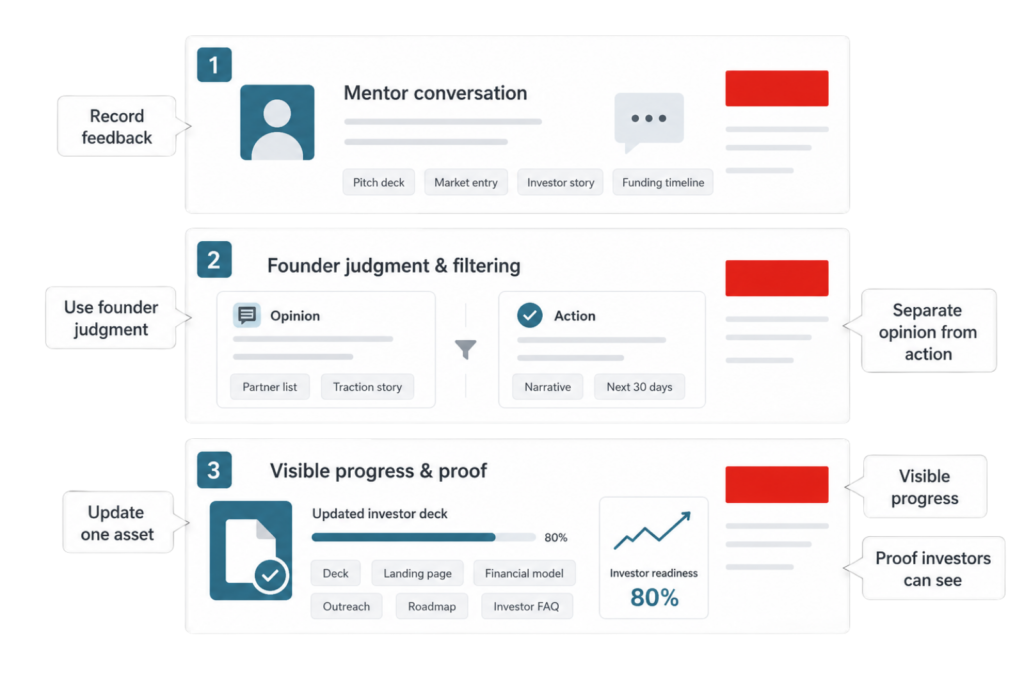
Startup mentors in DACH should not replace founder judgment. Their advice becomes useful when it turns into proof a founder can show after the call. In Germany, that proof could be stronger technical validation, enterprise buyer logic, or a cleaner deep tech narrative. In Austria, it could mean sharper pre-seed positioning, clearer angel investor fit, or better accelerator readiness. In Switzerland, it could become a stronger funding route, regulatory answer, science-backed traction story, or international scale plan. After each mentor conversation, founders should update one visible asset: deck, data room, landing page, financial model, product roadmap, investor FAQ, or partner outreach note. Then feedback becomes measurable. It also shows future investors that advice was tested, applied, and turned into stronger business evidence.
Conclusion: choosing startup mentors in DACH
Startup mentors in DACH should help founders prepare for stricter investor, corporate, technical, and cross-border review. Germany, Austria, and Switzerland offer strong ecosystems, but strong ecosystems also expose weak proof faster. Use this guide to shortlist mentors by sector, stage, and decision need. Then approach with evidence, context, and one clear ask so every conversation improves readiness, trust, and startup progress in 2026.
Startup mentors in DACH 2026 FAQs
Startup mentors in DACH 2026 FAQs answer practical founder questions about funding, mentor fit, outreach, proof, and cross-border growth decisions.
Who are the best startup mentors in DACH in 2026?
The best mentor depends on your founder problem. Deep tech, SaaS, fintech, angel funding, corporate sales, and Swiss programmes each need different experience before outreach.
How should founders choose startup mentors in DACH?
Founders should compare mentors by sector fit, stage, investor access, operator background, and the decision blocking growth now, not public reputation alone.
Can foreign founders contact startup mentors in DACH?
Yes. Foreign founders can contact DACH mentors when they show market relevance, clear proof, serious intent, and one focused question tied to Germany, Austria, or Switzerland.
What should founders prepare before contacting a DACH startup mentor?
Founders should prepare their stage, traction, target market, funding goal, technical proof, deck issue, and the exact decision they want the mentor to challenge.
Do startup mentors in DACH help with funding?
Startup mentors can improve funding readiness, but they do not replace traction. Their value comes from sharpening proof, investor logic, introductions, and timing.
