

Faustas Norvaisa
A Growth & Product Expert with 9 years of experience in revenue diversification, international expansion, SEO, and digital marketing. Passionate about scaling businesses and building global brands, he empowers companies to thrive with his motto, "sharing is caring.
SEO for Research Websites: Build a Content Hub That Works
- Last time updated: 2nd of June, 2026
SEO for research websites is not only about ranking project pages. It is about making funded work easier to find, understand, trust, and use. Research teams often publish reports, outputs, partner updates, and findings, yet hide the real value inside PDFs, thin news posts, or unclear pages.
That weakens dissemination, stakeholder reach, public trust, and future collaboration. This expert guide explains how to build a research content hub with clear structure, plain-language pages, search intent, internal links, AI-ready answers, and impact-focused content. You will learn what to include, how to organize it, and how to make research visibility useful.
Turn research outputs into usable content
Table of Contents
SEO for research websites: updated for 2026
Research funding scale
The Horizon Europe 2026–2027 work programme allocates €14 billion for research and innovation. That scale creates more pressure for funded projects to show public value, not only academic progress. Research websites now need clearer project pages, output sections, report hubs, partner explanations, and impact content so funders, collaborators, policymakers, and communities can understand what the work produces.
AI search visibility
A 2026 study of 11,500 real-user queries found Google AI Overviews appeared for 51.5% of representative queries. Research teams now compete inside AI-shaped search results, not only classic rankings. SEO for research websites should improve entity clarity, source-backed pages, researcher bios, report landing pages, FAQs, citations, and structured explanations that AI tools can read and summarize.
Question-query pressure
Another 2026 AI Overview study found activation reached 64.7% for question-form queries, while nearly 30% of cited domains did not appear in normal first-page results. This matters because funders, journalists, students, partners, and policymakers often search with direct questions. Research content hubs should answer those questions with plain-language summaries, evidence pages, stakeholder sections, and clear internal links.
Why do research websites need SEO and content hubs?
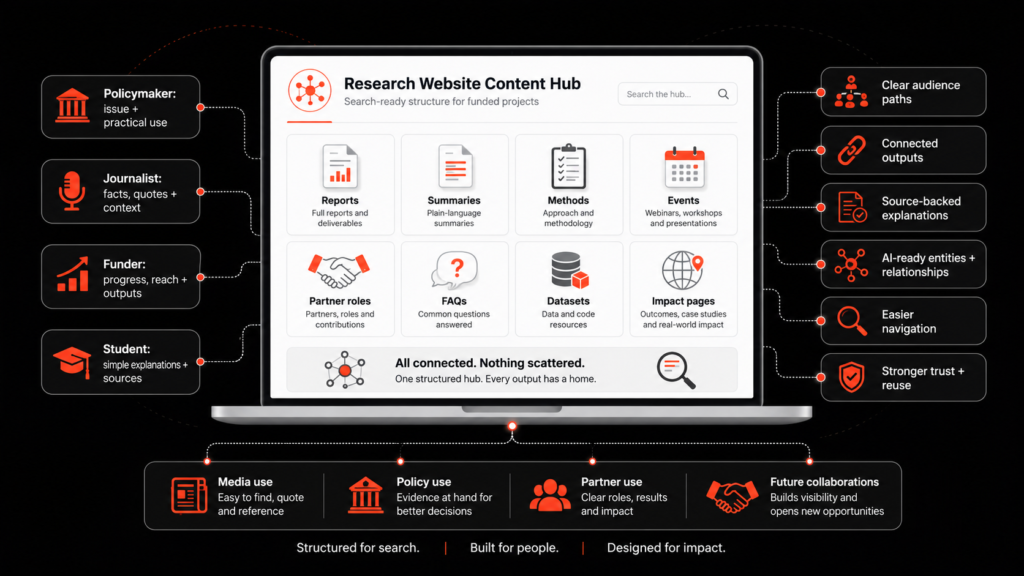
SEO for research websites works best when every important output has a clear place. A funded project should not hide findings inside one PDF, one news post, or one partner update. People arrive with different needs. A policymaker wants the issue and practical use. A journalist wants facts, quotes, and context. A funder wants progress, reach, and visible outputs. A student wants simple explanations and source links. A content hub gives each audience a path without breaking the project into scattered fragments. It can connect reports, summaries, methods, events, partner roles, FAQs, datasets, and impact pages. Strong structure also supports AI search because tools need clear entities, relationships, and source-backed explanations. When the website becomes easier to navigate, the research becomes easier to trust and reuse across media, policy, partners, and future collaborations.
How should research teams structure pages for search?
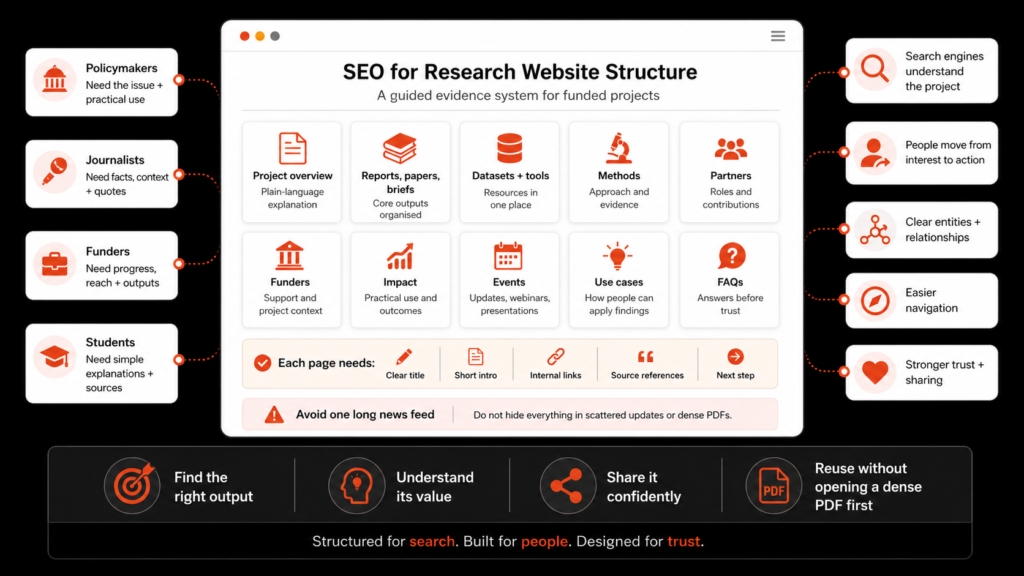
Research website structure should begin with the questions different audiences ask before they trust the work. One page should explain the project in plain language. Another should organize reports, papers, briefs, datasets, and tools. Separate pages can cover methods, partners, funders, impact, events, and practical use cases. This structure helps search engines understand the project, but it also helps people move faster from interest to action. Each page needs a clear title, short intro, internal links, source references, and a next step. Research teams should avoid placing every update inside one long news feed. A strong structure turns the website into a guided evidence system where readers can find the right output, understand its value, and share it confidently without opening a dense PDF first.
What content should a research hub include?
A research content hub should organize project value around what real readers need to understand before they trust the work. UNESCO’s 2026 R&D data release says global R&D spending reached 1.92% of GDP in 2023, while Pew reported that 77% of U.S. adults had at least fair confidence in scientists in 2026. Those numbers show both scale and trust pressure: research is growing, but credibility still needs clear public access.
Useful hub pages can include:
- Plain-language project overview
- Report and output landing pages
- Findings, methods, and evidence pages
- Partner, funder, and team profiles
- FAQs for stakeholder questions
- Impact and use-case pages
Each page should answer one audience need, link to proof, and guide the next action. A strong hub helps readers, search engines, and AI tools understand context, credibility, outputs, and practical use faster without forcing readers through dense technical files.
How can SEO support research dissemination?
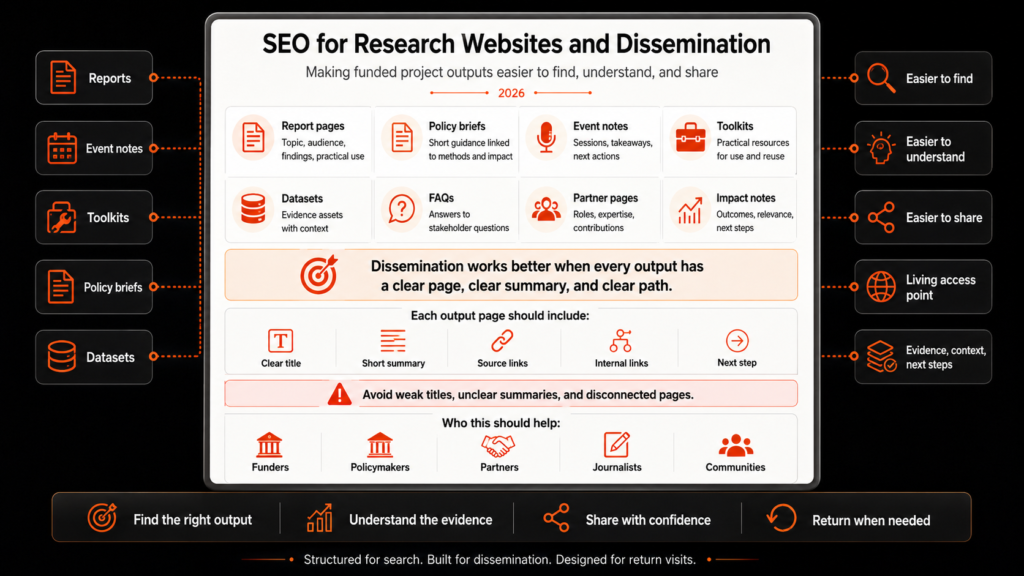
SEO for research websites should support dissemination by making important outputs easier to find, understand, and share. A funded project might publish reports, event notes, toolkits, policy briefs, or datasets, but those outputs lose value when they sit behind weak titles, unclear summaries, or disconnected pages. Search structure gives each output a clearer role.
A report page can explain the topic, audience, key findings, and practical use before linking to the full file. A brief can connect to related methods, partner pages, and impact notes. FAQs can answer questions that stakeholders already ask. This helps dissemination move beyond one announcement. The website becomes a living access point where funders, policymakers, partners, journalists, and communities can return when they need evidence, context, or next steps.
How can semantic SEO and programmatic pages support research hubs?
Semantic SEO for research websites should map the project as a connected knowledge system, not a set of isolated pages. Researchers, funders, institutions, reports, datasets, methods, events, and findings should be named consistently, linked internally, and marked with clear metadata. This matters because Crossref’s 2026 stats show 183,690,160 records in its database, while Crossref also reported over 2 billion citation links connecting research outputs. A programmatic approach can turn repeated research assets into structured page templates, such as report pages, researcher profiles, dataset pages, policy-brief pages, and event pages.
Use templates for:
- project entities
- outputs and reports
- researchers and partners
- datasets and methods
- stakeholder FAQs
Google says structured data helps Search understand page content and gather information about people, books, companies, and other entities. Research hubs should use that logic to make evidence easier to crawl, connect, summarize, and reuse. This keeps growth scalable when projects add new partners, outputs, updates, and findings.
How should research websites prepare for AI search?
Research websites should prepare for AI search by making each important idea clear, named, linked, and backed by evidence. AI tools do not only scan for keywords. They try to understand people, institutions, funders, topics, findings, methods, outputs, and relationships between pages. A project site with thin summaries and scattered PDFs gives weak signals. A stronger site gives direct answers, plain-language context, source links, researcher details, partner roles, and related pages that help AI systems connect the research to the right topic.
1. Make entities clear
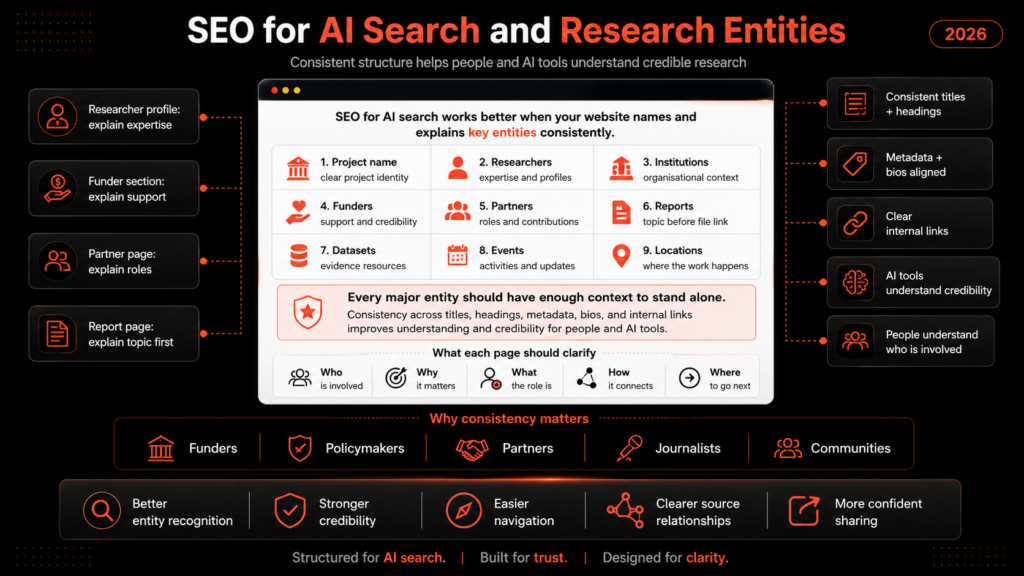
AI search works better when the website names the project, researchers, institutions, funders, partners, reports, datasets, events, and locations consistently. Each major entity should have enough context to stand alone. A researcher profile should explain expertise. A funder section should explain support. A partner page should explain roles. A report page should explain the topic before linking to the file. Consistency across titles, headings, metadata, bios, and internal links helps people and AI tools understand who is involved and why the work is credible.
2. Answer real research questions
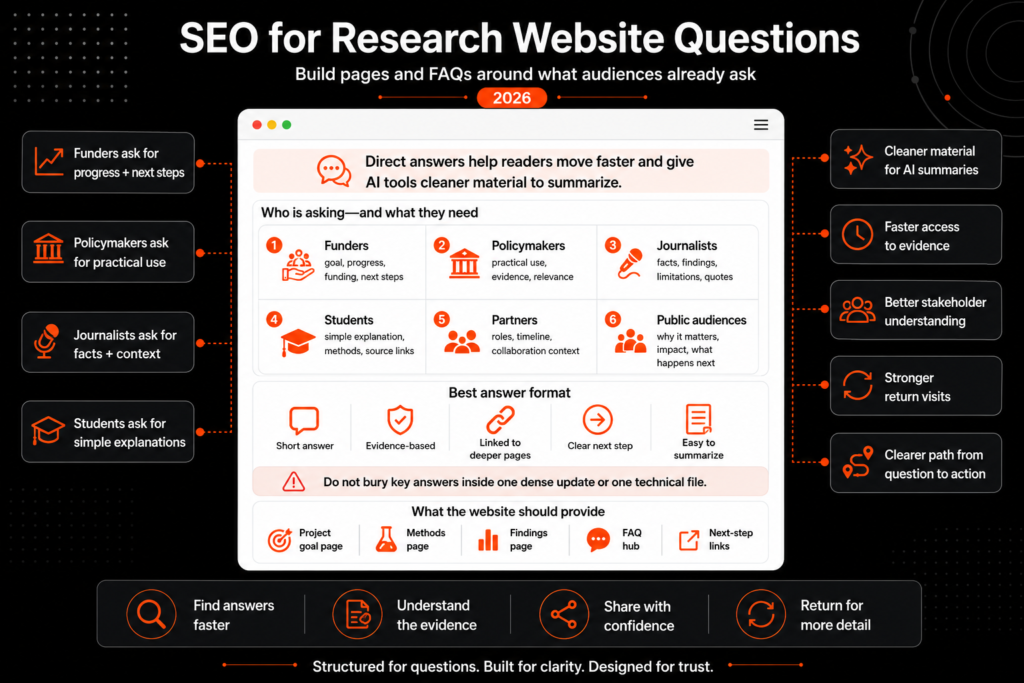
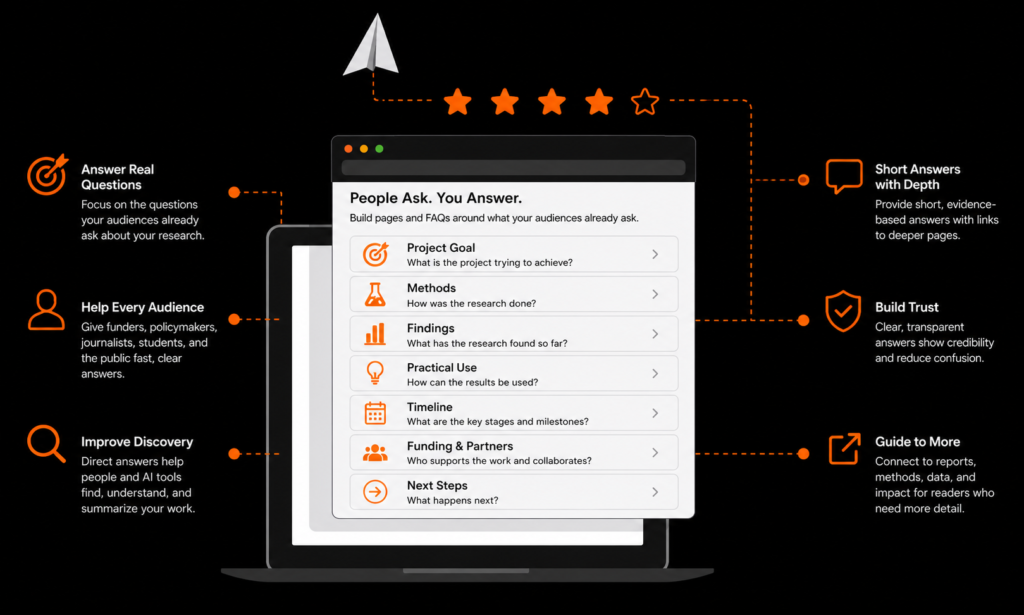
Research teams should build pages and FAQs around questions that funders, policymakers, journalists, students, partners, and public audiences already ask. These questions might cover the project goal, methods, early findings, practical use, limitations, timeline, funding, or next steps. Direct answers help readers move faster, but they also give AI tools cleaner material to summarize. The best answers are short, evidence-based, and connected to deeper pages for readers who need more detail.
3. Connect pages into one evidence system
A research website should not leave important outputs isolated. Project summaries should link to findings, methods, reports, partner pages, events, and impact content. Report pages should link back to the main project explanation and forward to use cases or stakeholder summaries. Internal links help readers follow the logic of the work. They also help AI systems understand relationships between evidence, people, outputs, and decisions.
AI search readiness is not about writing robotic content. It is about making funded research easier to interpret, cite, summarize, and reuse. When the site has clear structure, proof, and audience-ready answers, the research becomes more visible across search, AI tools, media work, policy review, partner discovery, and future collaboration too.
When should research teams update the content hub?
Research teams should update the content hub whenever the project produces new evidence, reaches a milestone, changes its audience value, or needs to correct public understanding. A content hub is not a static archive. It is the public layer of the research project, so it should move with the work. Google says site owners can request re-indexing after they have recently added or made changes to a page, but crawling can still take a few days to a few weeks. That is why updates should happen early, not after dissemination pressure appears.
1. Update after every meaningful project output
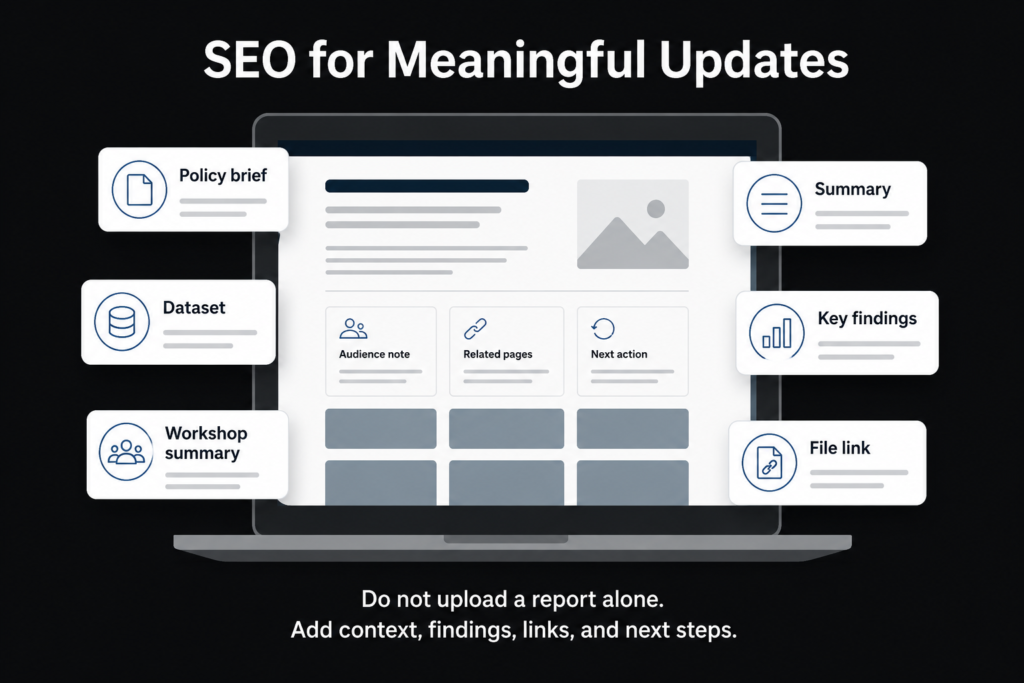
A meaningful update is not only a final report. It can be a policy brief, dataset, workshop summary, new publication, event recording, partner result, methodology note, funding milestone, media mention, or public-facing finding. Each update should improve an existing page or create a new landing page when the output deserves its own search path. A report should not be uploaded alone. It needs a summary, audience note, key findings, file link, related pages, and next action. This helps readers understand the value before downloading technical material.
2. Treat updates as communication evidence
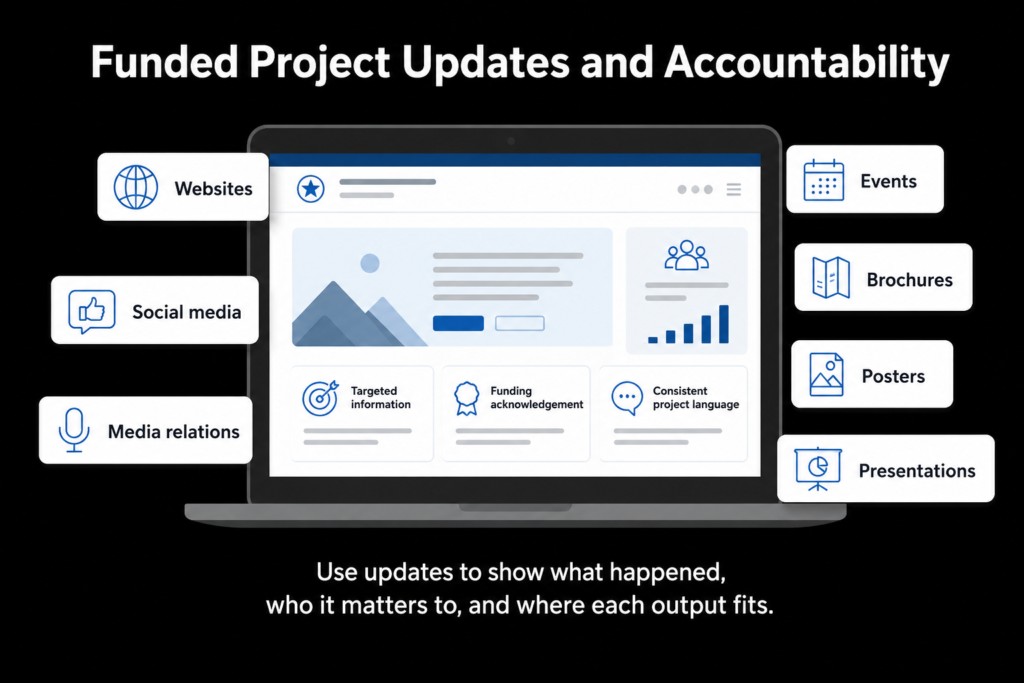
For funded projects, updates also support accountability. CINEA says beneficiaries should engage in specific communication activities and provide targeted information to different audiences. It also lists websites, social media, media relations, events, brochures, posters, and presentations as communication activities. That makes the content hub a practical place to show what has happened, who it matters to, and where each output sits in the wider project story. Updates should also use accurate information, clear funding acknowledgement, and consistent project language.
3. Use technical signals correctly
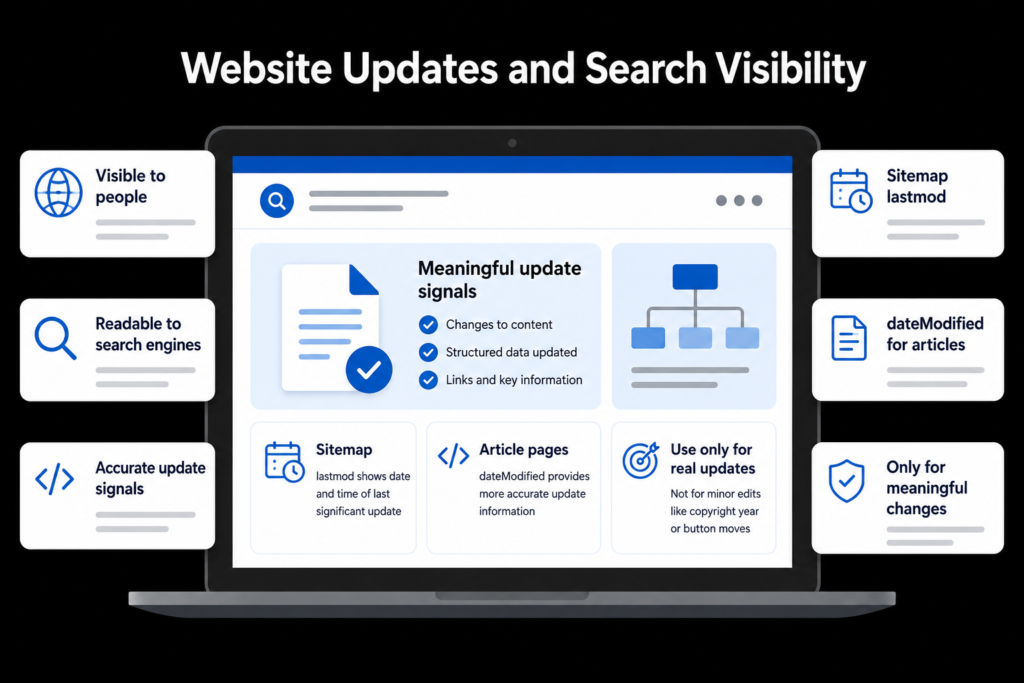
Website updates should be visible to people and readable to search engines. Google’s sitemap documentation says the lastmod value should show the date and time of the last significant update, such as changes to main content, structured data, or links. For article-style pages, Google recommends the dateModified property when the site wants to provide more accurate update information. Research teams should use those signals only when the page has changed meaningfully. Changing a copyright year or moving a button is not enough. If a method, finding, partner role, dataset, limitation, or report link changes, the page deserves a real update.
4. Review the hub before major project moments
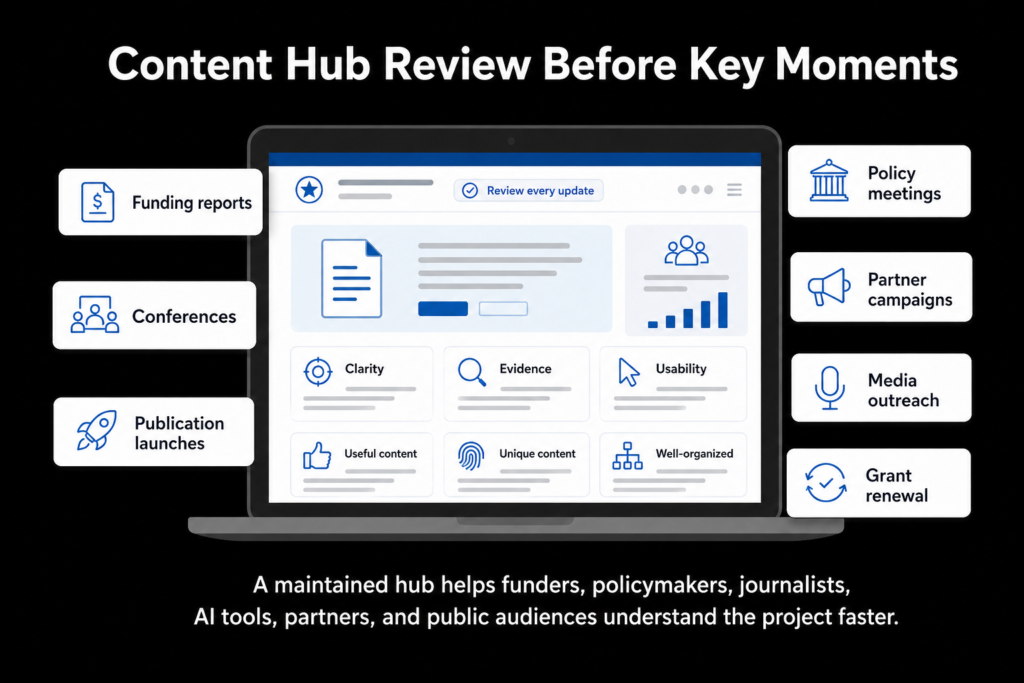
A content hub should be reviewed before funding reports, conferences, publication launches, policy meetings, partner campaigns, media outreach, and grant renewal conversations. Google also published official guidance for generative AI search on May 15, 2026, stressing that SEO best practices remain relevant and that useful, unique, well-organized content matters. For research teams, that means every update should strengthen clarity, evidence, and usability. The better the hub is maintained, the easier it becomes for funders, policymakers, journalists, AI tools, partners, and public audiences to understand the project without digging through disconnected files.
How can research teams measure website performance?
SEO for research websites should be measured by visibility, use, and stakeholder action, not only traffic. A funded project can attract visitors, yet still fail if people do not reach reports, understand findings, contact the team, or share outputs with the right audience.
Research teams should track how people move through the content hub. Useful signals include visits to report pages, clicks on PDF downloads, time spent on findings pages, internal link use, search queries, FAQ performance, media referrals, partner traffic, and contact form submissions. These numbers help the team see which audiences are finding the project and which outputs need clearer explanations.
Performance review should also include content quality. If key reports receive weak engagement, the problem might be the title, summary, page structure, or audience path. A strong research website keeps improving after launch, so each update makes the project easier to find, understand, and use.
What mistakes weaken SEO for research websites?
SEO for research websites often fails when teams treat the site as a file archive instead of a communication system. A project can have strong findings, respected partners, and useful outputs, yet still lose visibility when readers face unclear pages, dense PDFs, weak titles, and disconnected updates.
| Mistake | Why it weakens visibility | Better approach |
|---|---|---|
| Only uploading PDFs | Searchers cannot quickly see value, findings, or audience use | Create report landing pages with summaries and links |
| Writing in grant language | Public readers, journalists, and policymakers lose context fast | Use plain-language project and findings pages |
| Hiding partner roles | Credibility becomes harder to understand | Add partner, funder, and researcher profile sections |
| Posting isolated updates | News items do not build a clear content path | Link updates to reports, methods, impact, and FAQs |
| Ignoring audience questions | The site misses real search intent | Build FAQs around funder, policy, media, and public needs |
The strongest research websites explain the project before asking people to download more. Each page should give context, show proof, link to evidence, and guide the next step. That makes the research easier to discover, understand, quote, and use.
How Can aboveA Help With SEO For Research Websites?
aboveA helps research teams turn complex project material into a clearer content system that people, search engines, and AI tools can understand. The work starts by reviewing the project’s goals, audiences, existing outputs, website structure, and communication gaps. Then we map what each audience needs to find, understand, and trust.
That can include project pages, report landing pages, plain-language summaries, stakeholder FAQs, researcher profiles, partner sections, impact pages, content hub planning, internal linking, metadata, and SEO-ready page briefs.
The goal is not to make research sound less serious. The goal is to make strong work easier to access, explain, quote, and use. Funders need visible progress. Policymakers need practical context. Journalists need clear facts. Partners need credibility signals. Public audiences need simple entry points.
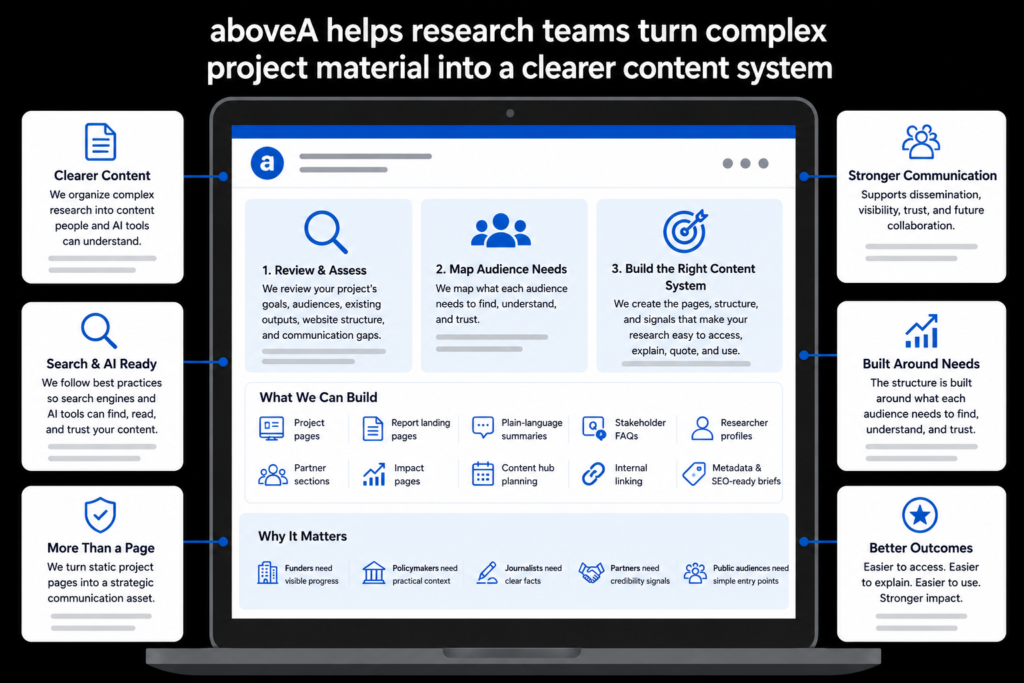
aboveA builds the structure around those needs, so the research website becomes more than a static project page. It becomes a useful communication asset that supports dissemination, visibility, trust, and future collaboration.
Final thoughts on SEO for research websites
SEO for research websites should make funded work easier to find, understand, and use. A strong content hub organizes reports, findings, partners, methods, impact notes, and public summaries into clear paths for each audience. Research teams should not wait until the project ends to structure this content. When pages explain value, link to evidence, and support real questions, the website becomes a stronger tool for dissemination, trust, collaboration, and long-term public impact.
SEO for research websites FAQs
SEO for research websites helps funded teams organize project pages, reports, findings, and stakeholder content into clearer paths. These answers explain how research hubs support visibility, dissemination, trust, AI search, and public access.
What is SEO for research websites?
SEO for research websites helps funded projects make reports, findings, teams, partners, methods, and impact content easier to find, understand, trust, and use.
Why do research projects need content hubs?
Research projects need content hubs because reports, updates, datasets, and findings often become scattered. A hub gives each audience a clearer path to useful information.
How is research website SEO different from normal SEO?
Research website SEO focuses on evidence, credibility, public clarity, dissemination, stakeholder questions, institutional context, outputs, citations, and impact, not only traffic or keywords.
What pages should a research website include?
A research website should include project overview, findings, reports, methods, partners, funders, researcher profiles, FAQs, resources, impact content, and contact pages.
Can SEO support research dissemination?
Yes. SEO supports dissemination by making outputs easier to locate, summarize, link, share, cite, and reuse by funders, policymakers, journalists, partners, and communities.
How does semantic SEO help research websites?
Semantic SEO connects researchers, institutions, funders, reports, datasets, methods, and findings into one clear system that search engines and AI tools can better understand.
Should research teams use programmatic pages?
Yes, when projects have repeated assets like reports, datasets, events, partners, briefs, or researcher profiles. Templates keep pages consistent, scalable, and easier to manage.
How often should research teams update their website?
Research teams should update the website after meaningful outputs, events, findings, reports, partner changes, funding milestones, media mentions, or new stakeholder questions appear.
Can aboveA help with SEO for research websites?
Yes. aboveA helps funded teams structure research websites, content hubs, report pages, stakeholder FAQs, semantic SEO, and AI-ready content so complex work becomes easier to find, understand, and use.
