


Chaophya Nillawan
A content writer at aboveA focused on go-to-market strategy, international expansion, and startup growth across Europe and Southeast Asia. With a psychology background, he helps businesses build trust, enter new markets, and become more fundable.
10 Best APAC Market Entry Agencies for Startups 2026
- Last Time Updated: 28th of May, 2026
APAC market entry agencies for startups can turn regional expansion from a risky guess into a clearer decision. In 2026, founders are not only asking where to launch. They need to know which market fits their product, what proof buyers expect, which partners can open doors, and what setup risks could slow growth. Singapore, Japan, Thailand, Indonesia, Hong Kong, South Korea, and Australia each demand different sales logic, trust signals, pricing, compliance, and localization.
This guide compares agencies that help startups choose the right first market, build local credibility, and enter APAC with stronger evidence before spending heavily on scale.
Kickstart your market entry in APAC!
Table of Contents
APAC entry needs sharper choices in 2026!
Ecommerce market weight
Asia-Pacific will remain the world’s largest retail ecommerce region in 2026, holding more than 60% of the global total. Yet growth is uneven, ranging from 21.5% in the Philippines to 4.7% in Japan. Startups need market-entry agencies that can compare demand, maturity, pricing, competition, and buyer behavior before founders choose where to spend.
Southeast Asia digital scale
Southeast Asia’s digital economy is expected to pass US$300B in GMV, with revenue reaching US$135B. The opportunity is real, but the region is no longer only about fast user growth. Founders now need sharper positioning, local proof, payment logic, channel choices, and monetization plans before entering crowded digital markets.
Funding concentration
Singapore captured 91.5% of Southeast Asia’s startup funding value in Q1 2026, while the region recorded only 98 equity deals, the lowest quarterly deal count in at least eight years. Capital is still available, but it is selective. Startups need agencies that can strengthen traction, governance, partner logic, and market proof before regional expansion.
Why APAC market entry is harder in 2026
APAC market entry now punishes shallow planning because founders face selective capital, fragmented digital habits, and costly localization gaps at the same time. Bain’s 2026 Asia-Pacific Private Equity Report says regional fund-raising fell 37% to $58 billion in 2025, a 12-year low, while 62% of GPs named a strong track record as the top fund-raising challenge.
That pressure reaches startups too: weak proof, vague traction, and unclear local fit get filtered faster. Localization adds another barrier. A 2026 Lokalise report found 36% of companies had delayed or pulled back from market entry due to localization problems, and poor localization costs 20% of potential revenue each year.
Digital access is also uneven. Opensignal reported that 15% of smartphone users in emerging APAC markets go online only through mobile, rising to 30% in India. Agencies must help founders test demand, trust, and channels before launch, not after budgets are already committed and wasted.
How we picked and evaluated APAC market entry agencies
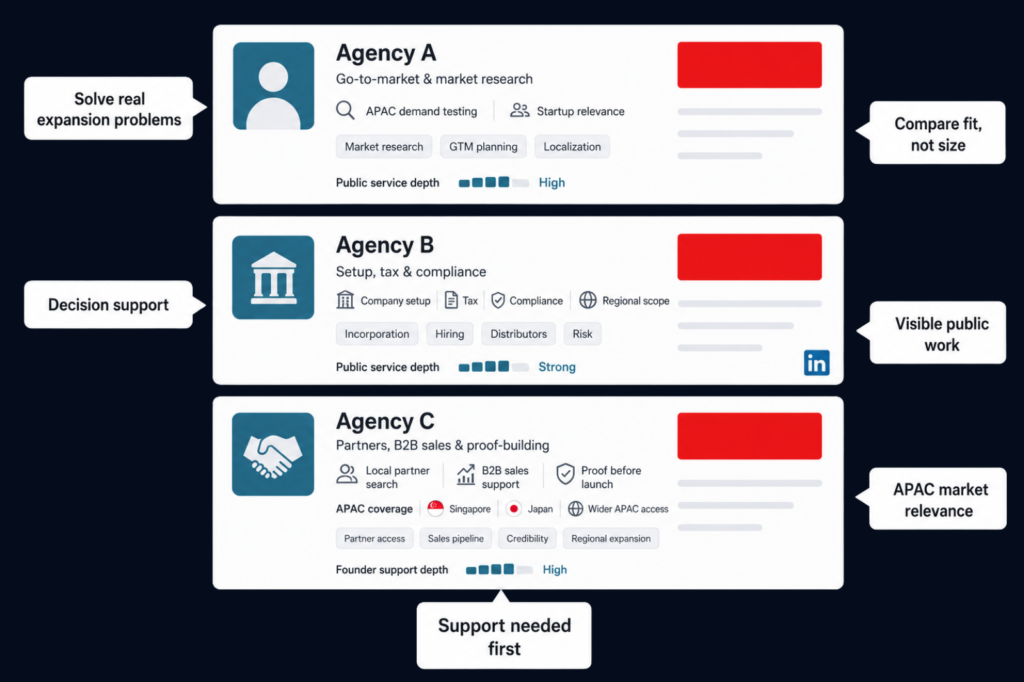
APAC market entry agencies were evaluated by how well they solve real startup expansion problems, not by brand size alone. We looked for firms that support one or more key needs: market research, go-to-market planning, local partner search, B2B sales support, company setup, tax, compliance, localization, regional expansion, or proof-building before launch.
Each agency was reviewed through public service pages, regional focus, visible market-entry experience, startup relevance, sector fit, and practical support depth. We also considered whether the agency helps founders make clearer decisions before spending on incorporation, hiring, paid campaigns, distributors, events, or local sales teams.
The list includes different types of providers because startups do not enter APAC with the same problem. Some need a legal setup. Others need customer research, local demand tests, credibility assets, sales pipeline, or partner access. Payment did not decide placement. The goal is to help founders compare agency fit by expansion risk, market stage, and the kind of support they need first.
1. aboveA – International growth and market expansion expert
aboveA is a growth and market-entry partner for startups that need stronger proof before entering APAC markets. The company works across international SEO, AI search visibility, startup advisory, content strategy, lead generation, credibility-building, and go-to-market planning. This makes aboveA a strong fit for founders who need more than basic company setup. It supports the harder part of expansion: helping a new market understand, trust, and take the startup seriously.
aboveA is especially useful for startups entering Singapore, Thailand, Hong Kong, Japan, South Korea, Australia, or wider Southeast Asia without strong local recognition. Many founders try to expand with one landing page, broad paid ads, and a general pitch. That often creates traffic without trust. aboveA helps sharpen market-entry messaging, buyer proof, founder positioning, search visibility, partner-facing materials, and investor-facing narratives before serious regional spending begins.
The company’s strength is its proof-first expansion logic. Instead of treating APAC market entry as a launch campaign, aboveA focuses on the signals buyers, partners, investors, and local stakeholders need before they engage. Its wider ecosystem, including aboveA Academy, incubator-style support, and growth advisory work, also makes it relevant for early-stage and scaling startups that need clearer direction before choosing markets, agencies, partners, or sales routes.
aboveA Facts:
Founded: 2022
Best for: Startups entering APAC that need market-entry proof, visibility, and GTM clarity
Core Strengths: International growth strategy, startup positioning, SEO, AI search visibility, credibility-building
Client Reviews: ★ 5.0/5 on Google and Clutch from verified reviews, praised for value, GTM, strategic approach, responsiveness, SEO, and practical project support
Core Specialties: International SEO, content strategy, lead generation, founder positioning, startup advisory, AI visibility
Advantages: Strong startup focus, proof-led expansion logic, APAC relevance, lean growth approach, credibility-first positioning
Disadvantages: Not a legal setup, payroll, tax, or compliance provider

Visit aboveA
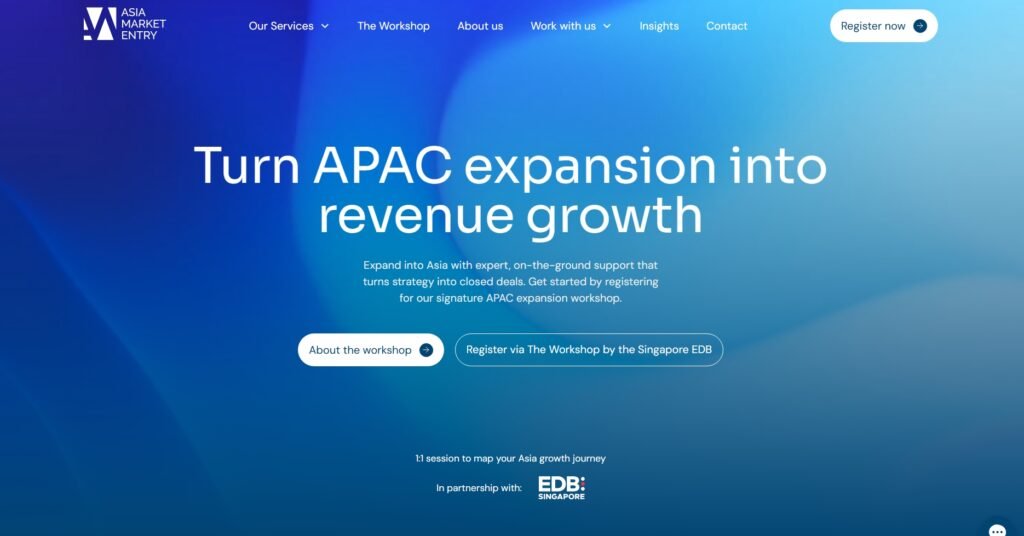
2. Asia Market Entry – B2B sales and partner growth specialist
Asia Market Entry is a Singapore-based market entry and business development partner for international B2B companies expanding into the Asia-Pacific. The firm is not positioned as a broad advisory provider. Its focus is more commercial: helping companies build a pipeline, activate partners, support regional sales, and turn APAC expansion plans into qualified opportunities.
Asia Market Entry is especially relevant for startups and scaleups that already know their offer but need help selling it in a new region. Its services include APAC expansion support, fractional sales, partner programmes, lead follow-up, channel activation, workshops, and go-to-market execution. This makes it a strong fit for B2B SaaS, enterprise software, industrial technology, and specialist service companies that need local sales movement before hiring a full regional team.
The strongest value is practical market access. Many startups enter APAC with research but no real conversations, partners, or local follow-through. Asia Market Entry helps reduce that gap by supporting sales activity and partner development on the ground. It is best suited for founders who need commercial traction, not only market intelligence or company formation.
Asia Market Entry facts:
Founded: Not clearly stated in public sources; the company states it has 10+ years supporting B2B expansion into Asia
Best for: B2B startups and scaleups needing APAC sales pipeline, partner access, and local commercial support
Core Strengths: APAC sales growth, partner development, fractional sales, pipeline creation, B2B market entry
Client Reviews: ★ 5.0/5 on Google, out of 4 public reviews available
Core Specialties: APAC expansion, go-to-market support, partner programmes, fractional sales, lead follow-up, regional workshops
Advantages: Strong B2B focus, Singapore base, sales-led approach, partner activation, regional APAC experience
Disadvantages: Less suited for consumer brands, legal setup, tax compliance, or broad branding projects
Visit Asia Market Entry
3. YCP Solidiance – Asia market research and GTM strategy advisor
YCP Solidiance is an Asia-focused management consulting firm that helps companies understand, enter, and grow across complex regional markets. The firm is best suited for startups and scaleups that need serious market research before choosing their first APAC country, customer segment, pricing route, or go-to-market model.
YCP Solidiance is especially useful when founders need answers before execution. A startup might know that APAC looks attractive, but still lack clarity on local competition, buyer behavior, distribution options, category maturity, regulation, pricing pressure, or channel fit. The firm’s work across market research, growth strategy, go-to-market planning, operations, investment support, and digital transformation makes it relevant for teams that need data-backed direction before launching.
Its strongest value is structured regional insight. Some startups do not fail because the product is weak. They fail because they enter the wrong market first, pick the wrong channel, or assume Asia works like one connected buyer group. YCP Solidiance is a strong fit for founders who need market selection, strategic validation, and local research before spending on hiring, setup, sales, or paid growth.
YCP Solidiance facts:
Founded: YCP Group was founded in 2011; Solidiance merged with YCP Group in 2018
Best for: Startups and scaleups needing APAC market research, entry strategy, and GTM planning
Core Strengths: Market research, Asia growth strategy, GTM planning, operations, investment support
Client Reviews: No verified public Google, Clutch, G2, Trustpilot, or similar client review score found during research. Although we found ★ 3.4/5 stars across major employer review platforms like Glassdoor.
Core Specialties: Asia market research, market entry strategy, go-to-market strategy, digital transformation, business growth consulting
Advantages: Strong Asia focus, broad regional office network, research-led strategy, cross-industry consulting depth
Disadvantages: Likely better suited for funded startups, scaleups, and larger firms than very early-stage teams with small budgets

Visit YCP Solidiance
4. Tractus Asia – Low-risk Asia market testing partner
Tractus Asia is a strategy and operations consulting firm that helps companies decide where to enter, how to structure market entry, and how to turn expansion plans into operational reality. The firm is especially useful for startups and scaleups that need a lower-risk way to test Asian markets before committing to full local hiring, incorporation, or large sales infrastructure.
Tractus Asia is relevant for founders entering complex B2B, industrial, manufacturing, technology, trade, or service markets where local partners, distributors, site decisions, regulations, and operational setup can strongly affect success. Its market-entry support includes research, feasibility analysis, distributor and partner search, site location advisory, regulatory review, negotiations, project management, and implementation support.
The strongest value is practical risk reduction. Some startups have early international interest, but they do not yet know which market, partner route, distributor model, or operating structure can work. Tractus Asia helps founders and executives test opportunity with local expertise before expansion becomes too expensive to reverse. It is better suited for startups with serious regional plans than companies looking only for digital campaigns or brand awareness.
Tractus Asia facts:
Founded: 1995
Best for: Startups and scaleups testing Asian market entry before full local commitment
Core Strengths: Market research, feasibility analysis, partner search, distributor support, site location advisory
Core Specialties: Asia market research, market entry strategy, go-to-market strategy, digital transformation, business growth consulting
Advantages: Long Asia track record, strong regional footprint, practical execution support, useful for B2B and industrial expansion
Disadvantages: Less suited for startups needing SEO, paid media, brand campaigns, or lightweight digital growth support

Visit Tractus Asia
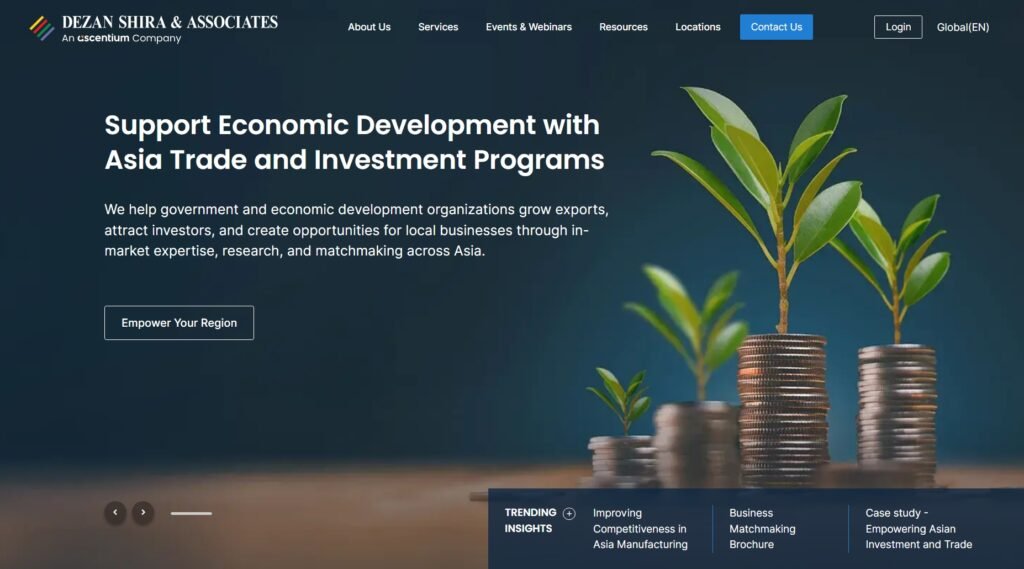
5. Dezan Shira & Associates – Legal, tax, and operational setup advisor
Dezan Shira & Associates is a pan-Asia professional services firm that helps international companies enter, operate, and grow across Asian markets. It is best suited for startups and scaleups that already see APAC as a serious expansion route and need support with legal setup, tax planning, accounting, HR, payroll, compliance, business intelligence, and operating structure.
Dezan Shira & Associates is especially useful when market entry moves from research into execution. A startup might need to compare Singapore, Vietnam, India, China, Indonesia, or another Asian market, but the real challenge often starts after the first decision. Entity type, tax exposure, hiring rules, payroll, reporting, licensing, and local regulatory duties can all affect launch speed and long-term risk.
Its greatest value lies in regulatory and operational depth. Startups that treat APAC entry as only a sales or marketing problem can face delays once compliance, hiring, and tax issues appear. Dezan Shira & Associates helps founders and executives build a more stable foundation before local operations become harder to manage.
Dezan Shira & Associates facts:
Founded: 1992
Best for: Startups, scaleups, and international businesses needing Asia legal, tax, HR, payroll, and operational setup support
Core Strengths: Market entry, corporate setup, legal advisory, tax planning, accounting, HR, payroll, business intelligence
Client Reviews: Unfortunately, there were no verified public Google, Clutch, G2, Trustpilot, or similar client review scores found during research. But we found ★ 3,7/5 stars across major employer review platforms like Glassdoor. Employees and clients generally emphasize the firm for its multicultural environment, excellent learning opportunities, and deep expertise in Asian market entry.
Core Specialties: Asia market entry, business registration, tax, accounting, payroll, HR, legal advisory, technology and operational support
Advantages: Long Asia track record, pan-Asia footprint, strong regulatory knowledge, useful for serious operational expansion
Disadvantages: Less suited for startups needing brand positioning, SEO, paid campaigns, or lightweight GTM experiments
Visit Dezan Shira & Associates
6. Acclime – Company formation and compliance support firm
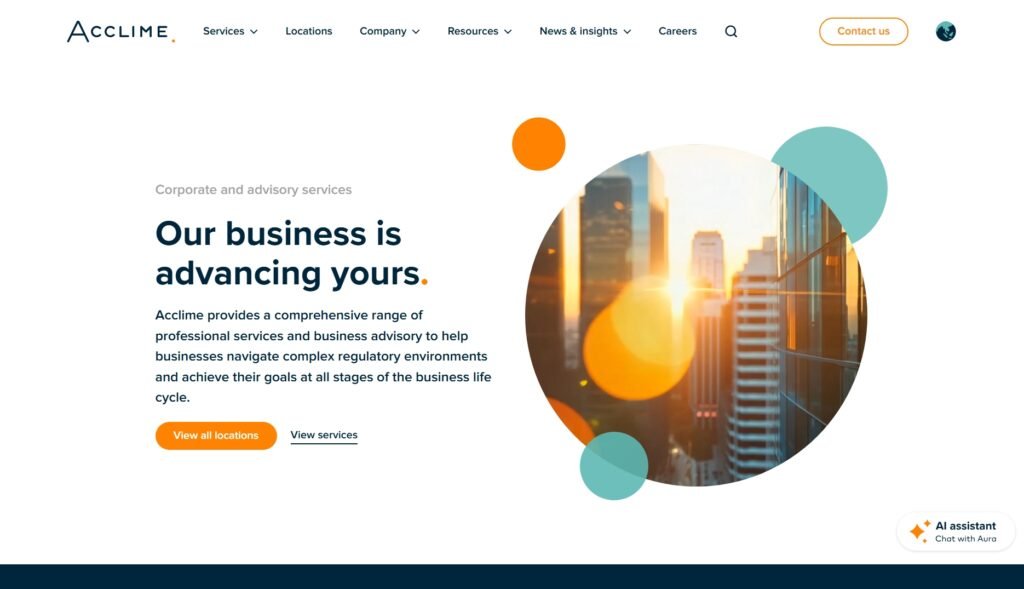
Acclime is an Asia-Pacific corporate and advisory services firm that helps companies enter, establish, and operate across complex regional markets. It is best suited for startups and scaleups that already know APAC expansion is a serious move and need support with company formation, local administration, accounting, tax, payroll, HR, compliance, and establishment planning.
Acclime is especially useful when founders want to compare regional setup options before choosing where to build a formal presence. Singapore, Hong Kong, Vietnam, Thailand, Indonesia, Cambodia, and other APAC markets have different rules, costs, hiring requirements, reporting duties, and tax structures. For startups, those details can affect runway, hiring speed, investor confidence, and operating risk.
Its greatest value lies in helping companies move from interest to proper structure. Acclime will not replace a GTM or marketing agency, but it can help founders avoid weak operational decisions when entering Asia-Pacific. It fits startups that need to become legally and financially ready before regional sales, hiring, or fundraising activity grows.
Acclime facts:
Founded: 2019
Best for: Startups and scaleups needing APAC company formation, compliance, payroll, HR, and establishment support
Core Strengths: Corporate services, market entry advisory, incorporation, accounting, tax, payroll, HR, compliance
Client Reviews: No verified public Google, Clutch, G2, Trustpilot, or similar client review score found during research. Glassdoor shows a ★ 2.7/5 employee rating from 34 reviews, which reflects employee sentiment, not client satisfaction
Core Specialties: Company formation, corporate administration, tax, accounting, payroll, HR, compliance, market entry advisory
Advantages: Strong APAC footprint, local experts in key markets, integrated corporate services, useful for formal regional setup
Disadvantages: Less suited for startups needing SEO, brand positioning, lead generation, partner outreach, or demand testing
Visit Acclime
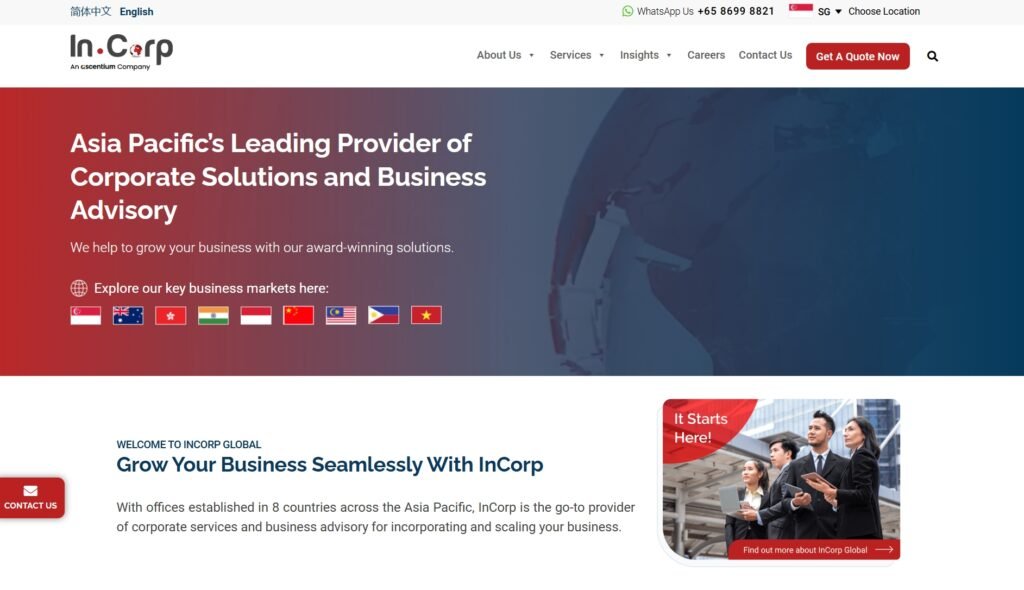
7. InCorp Global – Singapore setup and regional expansion partner
InCorp Global is a corporate services and business advisory provider for companies entering and scaling across the Asia-Pacific. It is best suited for startups and growth companies that want to use Singapore as a regional base, then expand into nearby APAC markets with stronger corporate, accounting, tax, payroll, and compliance support.
InCorp Global is especially useful when founders need the operational side of market entry handled properly. A startup might already have demand signals, investor interest, or expansion plans, but still need help with incorporation, corporate secretarial duties, accounting, finance outsourcing, HR, payroll, immigration, tax, business advisory, and governance. These details can affect investor confidence, hiring readiness, and regional operating risk.
Its greatest value lies in helping startups move from informal expansion plans to a cleaner business structure. InCorp Global is not mainly a GTM, SEO, or sales agency. Its role is stronger when a startup needs a proper Singapore or APAC operating base before scaling partnerships, hiring, fundraising, or regional delivery.
InCorp Global facts:
Founded: 2015; the group also states 40+ years of track record across its wider network
Best for: Startups using Singapore as a base for APAC setup, compliance, and regional expansion
Core Strengths: Incorporation, corporate secretarial services, accounting, tax, payroll, HR, compliance, business advisory
Client Reviews: ★4,3/5 on Google. More review scores were not found on Clutch, G2, Trustpilot, or similar platforms during research. Glassdoor lists a ★2.5/5 employee rating from 119 reviews, but this should not be taken as client feedback.
Core Specialties: Company incorporation, corporate governance, accounting, finance outsourcing, payroll, tax, immigration, business advisory
Advantages: Strong Singapore and APAC footprint, broad corporate services, startup support through ACE partnership, useful for formal market setup
Disadvantages: Less suited for startups needing SEO, brand positioning, demand generation, local sales outreach, or market-entry proof-building
Visit InCorp Global
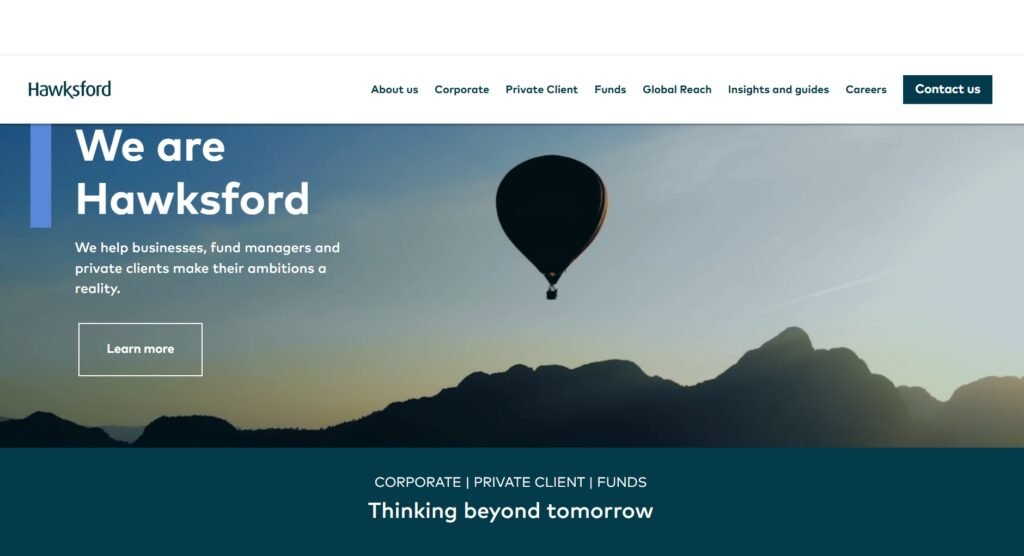
8. Hawksford – Hong Kong, Singapore, and China entry specialist
Hawksford is an international corporate services provider that supports companies with entity formation, administration, accounting, tax, HR, payroll, compliance, and corporate governance. It is best suited for startups and growth companies that need a stable operating structure before entering Hong Kong, Singapore, China, or wider regional markets.
Hawksford is especially useful when APAC market entry depends on choosing the right legal base and staying compliant after launch. A startup might want to use Hong Kong as a gateway to mainland China, Singapore as a regional headquarters, or both as part of a broader Asia-Pacific structure. In those cases, company setup, tax planning, payroll, reporting, and governance become more than admin tasks. They shape investor confidence and reduce operational risk.
Its strongest value is structured corporate support. Hawksford will not replace a GTM, SEO, or sales agency, but it can help founders avoid messy setup decisions when expansion becomes serious. It fits startups that need proper legal and administrative foundations before hiring, fundraising, opening accounts, or building regional partnerships.
Hawksford facts:
Founded: 1963
Best for: Startups and growth companies entering Hong Kong, Singapore, China, or wider APAC with setup and compliance needs
Core Strengths: Entity formation, corporate administration, company secretarial work, accounting, tax, HR, payroll, compliance
Client Reviews: Public client-rating data is limited. No clear Google, Clutch, G2, Trustpilot, DesignRush, or GoodFirms score was found. Glassdoor lists Hawksford at ★3.3/5 from 99 employee reviews, which is useful workplace context but not a client satisfaction rating
Core Specialties: Company formation, corporate services, tax, accounting, governance, payroll, HR, China and Hong Kong business support
Advantages: Long company history, strong corporate services focus, relevant for Hong Kong/Singapore/China structures, useful for regulated setup decisions
Disadvantages: Less suited for startups needing market proof, SEO, paid growth, partner outreach, or local demand testing
Visit Hawksford
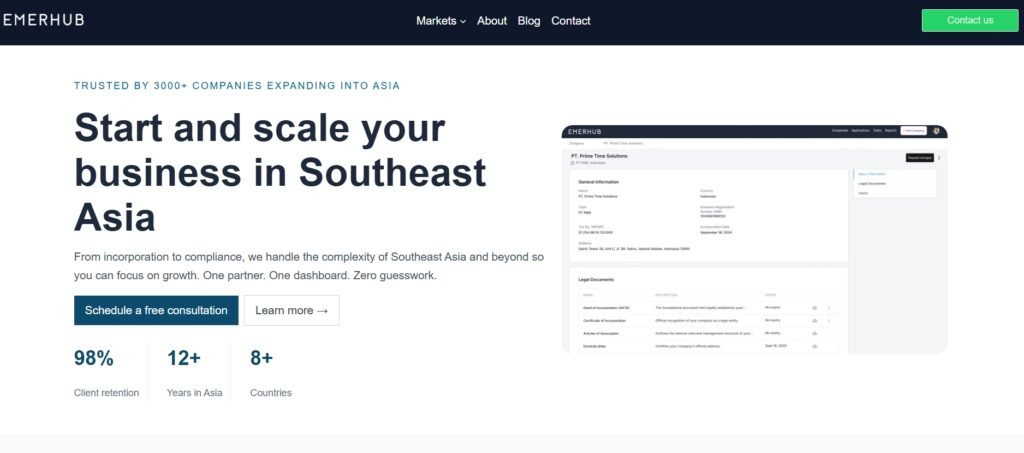
9. Emerhub – Southeast Asia licensing and setup provider
Emerhub is a Southeast Asia market-entry and corporate services provider that helps foreign companies register, license, and operate in emerging markets. It is best suited for startups and growth companies entering Indonesia, Vietnam, the Philippines, Thailand, Malaysia, Singapore, Cambodia, Bali, Hong Kong, or the UAE with setup, licensing, tax, accounting, HR, and compliance needs.
Emerhub is especially useful when founders need to understand local rules before opening a company, hiring staff, importing goods, or applying for sector-specific licenses. Southeast Asia can look attractive from the outside, but market entry often becomes slow when ownership rules, permits, reporting duties, tax obligations, or visa requirements are misunderstood. For startups, these issues can delay launch and drain focus.
Its strongest value is practical setup support across several emerging markets. Emerhub will not replace a growth, SEO, or sales agency, but it can help founders become operational in the right structure. It fits startups that already know where they want to enter and need local administration handled before deeper market growth begins.
Emerhub facts:
Founded: 2011
Best for: Startups and foreign companies needing Southeast Asia company setup, licensing, tax, and compliance support
Core Strengths: Company registration, licensing, corporate secretarial work, accounting, tax reporting, HR, importing support
Client Reviews: ★4,3/5 on Google based on 1 review, Trustpilot ★3,8/5 based on several. Meanwhile, Glassdoor shows a ★3.3/5 employee rating from 26 reviews, so it can add workplace context, but should not be treated as client-review proof
Core Specialties: Southeast Asia market entry, business registration, licensing, tax, accounting, payroll, HR, importer of record support
Advantages: Strong Southeast Asia focus, practical setup support, coverage across several emerging markets, useful for regulated entry steps
Disadvantages: Less suited for startups needing brand strategy, SEO, investor proof, local sales pipeline, or partner-facing growth materials
Visit Emerhub
10. Reachlane – Thailand and Southeast Asia B2B GTM agency
Reachlane is a Bangkok-based B2B marketing and business development agency that supports companies expanding across Thailand, Southeast Asia, and wider APAC markets. It is best suited for startups and scaleups selling technical, industrial, manufacturing, engineering, or specialist B2B products that need localized go-to-market execution instead of broad brand awareness.
Reachlane is especially useful when APAC expansion depends on reaching the right buyers, distributors, or decision-makers. Its services cover market intelligence, strategy, account-based advertising, prospect list building, lead generation, telemarketing, webinars, seminars, exhibitions, SEO, AEO, social media management, B2B video, and channel marketing. This makes it relevant for companies that need practical demand creation and sales support without building a full in-house regional team.
Its greatest value lies in local execution for complex B2B markets. Many startups entering Southeast Asia struggle because technical offers need translation into local sales logic, trust signals, events, content, and follow-up. Reachlane helps close that gap by acting like an external marketing and business development team for APAC growth.
Emerhub facts:
Founded: Not clearly stated in public sources
Best for: B2B startups and scaleups entering Thailand, Southeast Asia, or APAC with technical or industrial products
Core Strengths: B2B lead generation, APAC GTM execution, channel marketing, prospect list building, telemarketing, content, events
Client Reviews: Public client-review visibility is thin. No clear Google, Clutch, G2, Trustpilot, DesignRush, or GoodFirms score was found, so buyers should ask Reachlane for client references, case examples, or campaign results before engagement
Core Specialties: B2B marketing, APAC expansion, industrial lead generation, channel partner marketing, SEO, AEO, webinars, exhibitions, B2B video
Advantages: Strong B2B and industrial focus, Thailand base, Southeast Asia relevance, practical sales-support services, useful for distributor-led markets
Disadvantages: Less suited for startups needing legal setup, tax compliance, corporate structuring, or broad consumer branding

Visit Reachlane
APAC market entry agency comparison
APAC market entry agencies should not be compared as if they solve the same problem. Some help startups build trust and demand, while others focus on setup, compliance, research, sales, or partner access. This table helps founders compare each provider by practical expansion need.
| Provider | Best fit | Main support | Main limit |
|---|---|---|---|
| aboveA | Startups needing proof and visibility | GTM clarity, SEO, AI visibility, credibility | Not legal or tax setup |
| Asia Market Entry | B2B startups needing pipeline | Sales, partners, fractional sales | Less useful for consumer brands |
| YCP Solidiance | Scaleups needing research | Market research, GTM strategy | Higher fit for funded teams |
| Tractus Asia | B2B firms testing Asia | Feasibility, distributors, implementation | Not a digital growth agency |
| Dezan Shira | Firms entering formal operations | Legal, tax, HR, payroll | Not built for demand generation |
| Acclime | Companies needing structure | Formation, compliance, accounting | Limited marketing support |
| InCorp Global | Singapore-led APAC setup | Incorporation, governance, payroll | Not focused on traction |
| Hawksford | HK, SG, China setup | Entity formation, tax, admin | Less useful for demand testing |
| Emerhub | Southeast Asia setup needs | Licensing, tax, compliance, HR | Not a GTM growth partner |
| Reachlane | Technical B2B expansion | Lead gen, channel marketing, events | Not a corporate setup firm |
The right choice depends on the startup’s first risk. If buyers do not trust the company yet, choose proof and GTM support. If the barrier is legal setup, choose a corporate services firm.
How should startups shortlist APAC market entry agencies?
Shortlisting APAC market entry agencies should start with the risk blocking expansion. If buyers do not trust the offer yet, prioritize proof, positioning, visibility, and GTM support. If the barrier is incorporation, tax, payroll, licensing, or reporting, choose a corporate services firm. If market choice is still unclear, start with research and local validation.
Ask each provider for APAC case examples, sector fit, review sources, first deliverables, timeline, pricing model, and support owner. A useful shortlist should compare two or three agency types, then judge which partner reduces the most expensive uncertainty first, before budget moves into launch activity locally.
What questions should startups ask before contacting APAC market entry agencies?
Startups should ask clear questions before contacting APAC market entry agencies because the first call can reveal whether the provider understands real expansion risk. A strong agency should explain how it will reduce uncertainty, not only list services. Founders should use outreach to test the provider’s market knowledge, sector fit, process, and proof quality.
- Which APAC markets do you know best for our sector?
- Have you helped startups at our stage before?
- What would you test before recommending a launch market?
- Do you support research, GTM execution, setup, or all three?
- What proof do you need from us before starting?
- Can you share relevant case examples or references?
- What would the first 60–90 days include?
- How do you measure early market-entry progress?
- Who will lead our account day to day?
- What risks would you check before we spend on launch?
The best answers should be specific, not generic. If an agency cannot explain market choice, buyer behavior, timelines, local trust, partner access, or first deliverables, the fit is weak. A good APAC market entry partner should help founders make better decisions before expansion budget moves into setup, hiring, events, ads, or local sales activity.
What should startups avoid in 2026?
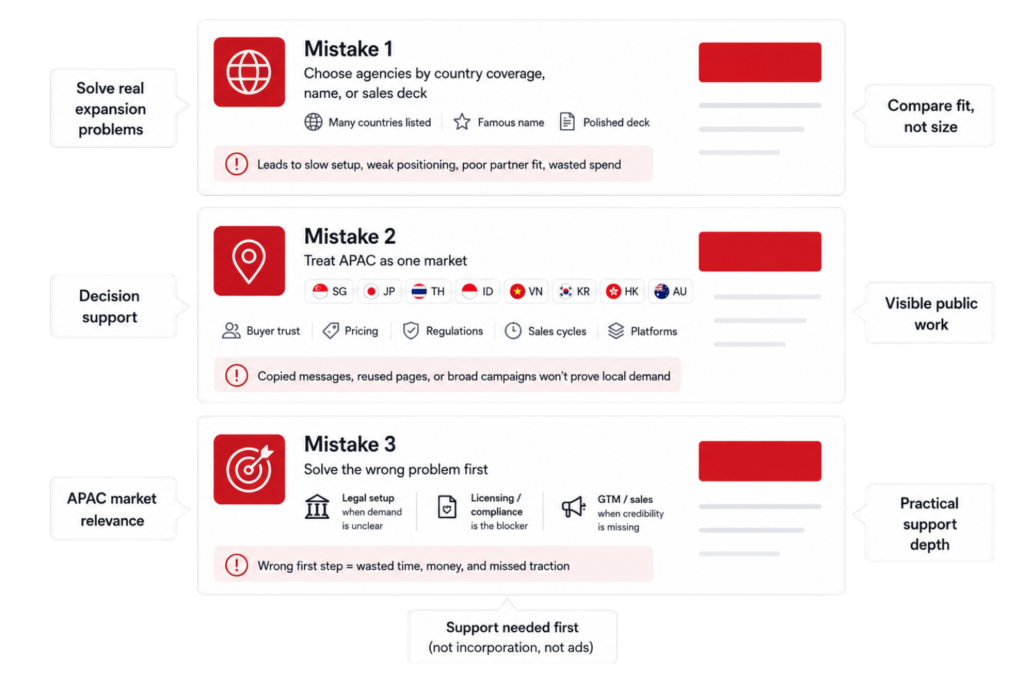
Startups entering APAC in 2026 should avoid choosing market entry agencies based only on country coverage, famous names, or polished sales decks. A provider can list many markets and still lack the right sector knowledge, buyer access, or execution depth for your startup. That mistake can lead to slow setup, weak positioning, poor partner fit, and wasted launch spend.
Founders should also avoid treating APAC as one market. Singapore, Japan, Thailand, Indonesia, Vietnam, South Korea, Hong Kong, and Australia all work differently. Buyer trust, pricing, regulations, sales cycles, platforms, and partner expectations can shift fast between countries. A copied message, reused landing page, or broad paid campaign will not prove local demand.
The biggest mistake is solving the wrong problem first. If demand is unclear, legal setup alone will not create traction. If licensing is the blocker, a GTM agency cannot replace proper compliance support. A good partner should identify the most expensive risk before the startup spends on launch activity.
Final thoughts on APAC market entry agencies
APAC market entry agencies should be chosen based on the risk they solve best. aboveA is a strong fit for startups needing proof, visibility, positioning, and GTM clarity before expansion. Asia Market Entry and Reachlane fit B2B teams that need sales movement, partners, or pipeline support. YCP Solidiance and Tractus Asia suit founders who need research and market validation. Dezan Shira, Acclime, InCorp, Hawksford, and Emerhub are better for setup, tax, licensing, compliance, and operating structure. The right partner is the one that solves the first serious blocker.
FAQs about APAC market entry agencies
APAC market entry agencies raise practical questions for startups comparing strategy, setup, GTM, compliance, partner access, and early proof needs.
What does an APAC market entry agency do?
An APAC market entry agency helps startups assess target countries, plan GTM routes, build local proof, find partners, manage setup, or reduce launch risk.
How do startups choose the right APAC market entry agency?
Startups should choose based on the first blocker. Some need demand proof, others need research, legal setup, partner access, localization, or sales execution.
Is Singapore the best base for APAC expansion?
Singapore can be a strong APAC base for startups needing regional credibility, investor access, English-language operations, fintech strength, and easier Southeast Asia coordination.
How can startups reduce APAC expansion risk?
Startups can reduce risk by testing demand first, adapting messaging, checking legal requirements, validating partners, building proof, and avoiding large spending before clear signals.
Are APAC market entry agencies worth it for early-stage startups?
They can be worth it when the agency solves a clear risk. Early-stage startups should avoid broad retainers and start with a scoped sprint.
