
Faustas Norvaisa
A Growth & Product Expert with 9 years of experience in revenue diversification, international expansion, SEO, and digital marketing. Passionate about scaling businesses and building global brands, he empowers companies to thrive with his motto, "sharing is caring.
How Korean startups can become fundable for global expansion in 2026
Korean startup global expansion can open stronger growth paths, but it also brings new pressure in 2026. A company may have traction in Korea, yet still need fresh proof before investors, partners, or customers abroad believe the story.
This guide aims to explain how Korean startups and growing companies can prepare for overseas market entry, especially when funding depends on local trust. You will learn what foreign investors check, why domestic success may not be enough, and how to build proof in a new country. We will also cover common mistakes, readiness signals, and practical steps before raising money or entering another market.
Expand and solidify your Korean business overseas with aboveA!
Table of Contents
Korean startup global expansion is becoming more structured
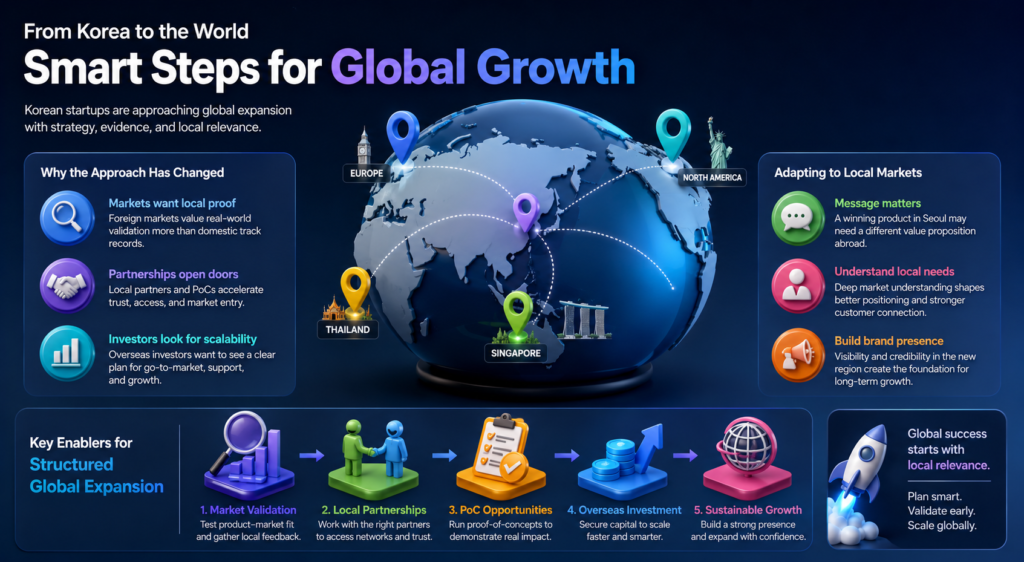
In 2026, Korean startup global expansion is no longer only about finding a distributor or opening a small office abroad. The market reality has changed a lot in the past few years. A lot of founders are now looking for market validation, local partners, PoC opportunities, and overseas investment before they commit fully.
This shift is crucial because foreign markets judge Korean companies through local evidence. A strong product in Seoul may still need a new sales message in Singapore, Thailand, the US, or Europe. Investors also want to see how the company will sell, support customers, and grow inside that country. Moreover, it will require you to show your deeper understanding of the target market. Also, your preparedness and brand’s exposure foundations in the new region. Next, let’s explore why Korean traction alone may not be enough overseas.
Why domestic traction in Korea is not enough abroad
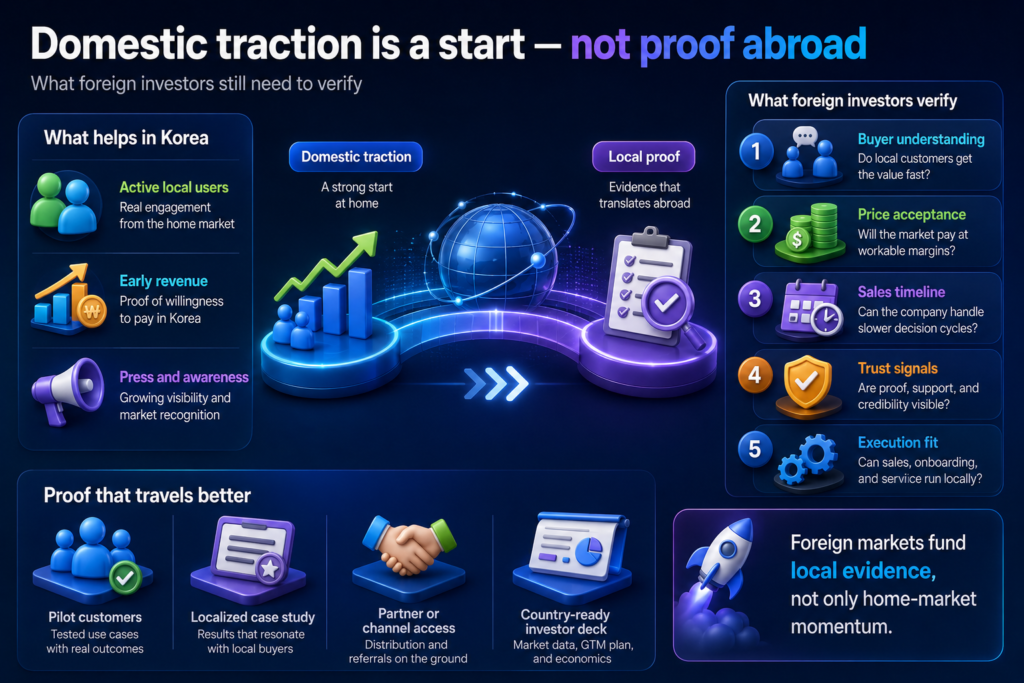
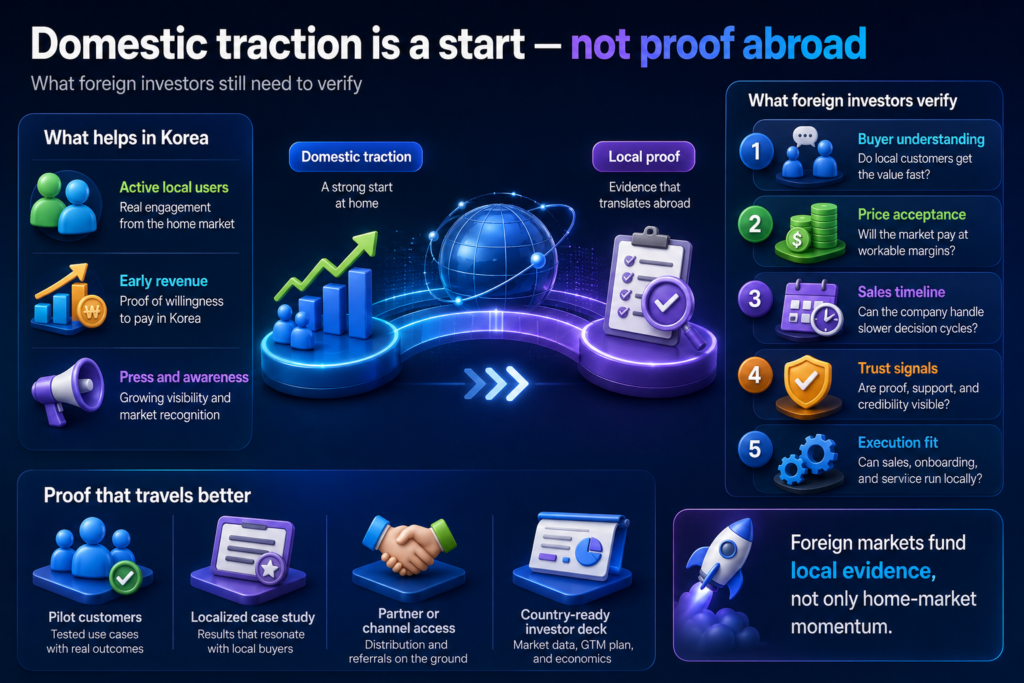
Domestic traction in Korea can help, but it does not prove that a company will work overseas. Investors in a new country look at the market in front of them. They often tend to ask whether local buyers will understand the product, trust the brand, and have the budget to use it.
This is where many Korean startups face a gap, if not a pivot. Strong Korean users, local press, or early revenue can support the story. Yet foreign investors still need country-specific proof. Pricing can change. Sales cycles can be longer. Customer habits could be different. The problem can look smaller, but urgent abroad – and for all variables, you need an answer, proof, credibility, and a verified performance track. Simply put, Korean companies need to translate traction into local evidence. In the following section, let’s take a look at what foreign investors usually check first.
What foreign investors check before funding Korean companies
As established at the beginning, foreign investors funding Korean companies usually check whether the business can survive outside Korea. They do not only ask if the product is good. They put a lot of emphasis on whether the company can sell, support, and grow in the new market. That’s your main goal: to support and verify before asking for funding. That said, we made a quick table to help you on this matter, which you may use to double-check if you have everything needed for starters:
| Investor check | What they want to confirm | Proof Korean founders can prepare |
|---|---|---|
| Local buyer demand | The problem exists in the target country | Buyer interviews, demo requests, paid tests, waitlists, pilot users |
| Market entry access | The team can reach customers without guessing | Local partners, reseller talks, industry contacts, event meetings |
| Sales fit | Korean traction can turn into foreign revenue | Pricing tests, sales pipeline, trial conversion, local objections |
| Trust and clarity | The company looks serious to foreign buyers | English deck, clear website, founder profiles, case studies |
| Funding use | The round will create measurable progress | 6–12 month plan, hiring needs, sales targets, market milestones |
These checks will help investors see where the risk sits. A Korean startup may have strong home-market proof, but foreign investors need local evidence. What you need to do is de-risking. Next, we will look at how Korean startups can build that market-entry proof before serious outreach begins.
How Korean startups can build market-entry proof before funding
Moreover, market-entry proof for Korean startups must be built before the funding story reaches foreign investors. A company can have a strong product, but the new market must have its own evidence. That proof can come from local buyer talks, partner meetings, pilot results, legal checks, and early demand signals. It must answer one clear question: why should this country believe the company now? When Korean founders prepare this early, the funding conversation becomes less abstract and more practical. However, from our experience at aboveA, many Korean businesses still fail at this stage. That is why this topic deserves a closer look. Let’s break down what really matters, so you can avoid the common mistakes and enter new markets with a clearer path forward.
1. Start with one target market, not five
First, Korean startups expanding overseas should avoid testing too many countries at once. A wide map can look ambitious – yes. But investors want sharp proof from one clear market first. Korea’s 2026 K-Startup Center intake is built around practical market entry, PoC access, investor links, and local advisory, which shows how structured overseas expansion has become. MSS also said 119 startups across five KSC locations attracted about US$240 million in overseas investment in the past year. That kind of support works best when a founder knows and can show which country, buyer group, and problem matter first. Thus, pick one market, then prove the first wedge before opening the next door.
2. Turn local conversations into proof
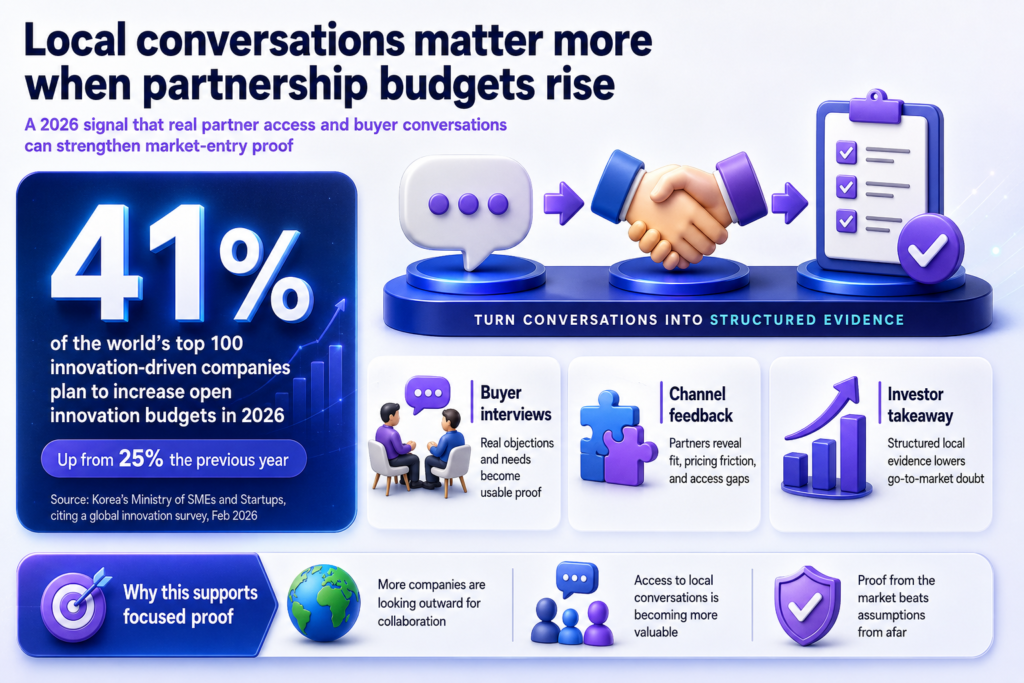
Second, market-entry proof should not be only about some research done with Google, but must incorporate real conversations. Founders can and must collect buyer interviews, demo notes, reseller feedback, pricing objections, and pilot interest – to verify your suitability, market understanding, and commercial potential. This is also why Korea’s 2026 Corporate Partnership for Overseas Expansion Program matters. MSS describes it as a way to connect smaller Korean firms with large corporations that already have global infrastructure and networks. Or maybe use incubators like aboveA instead, which helps with pre-investment and entry build-up. Nonetheless, the signal these cooperation do can be very useful for startups. It will show that you have access, no matter the business size. A small company can still build stronger proof when it connects with the right partners that already know the target country, channel, and buyer expectations. Those notes should then be structured and summarized for investors in plain language, with dates and next steps where possible.
3. Show that the company can sell abroad
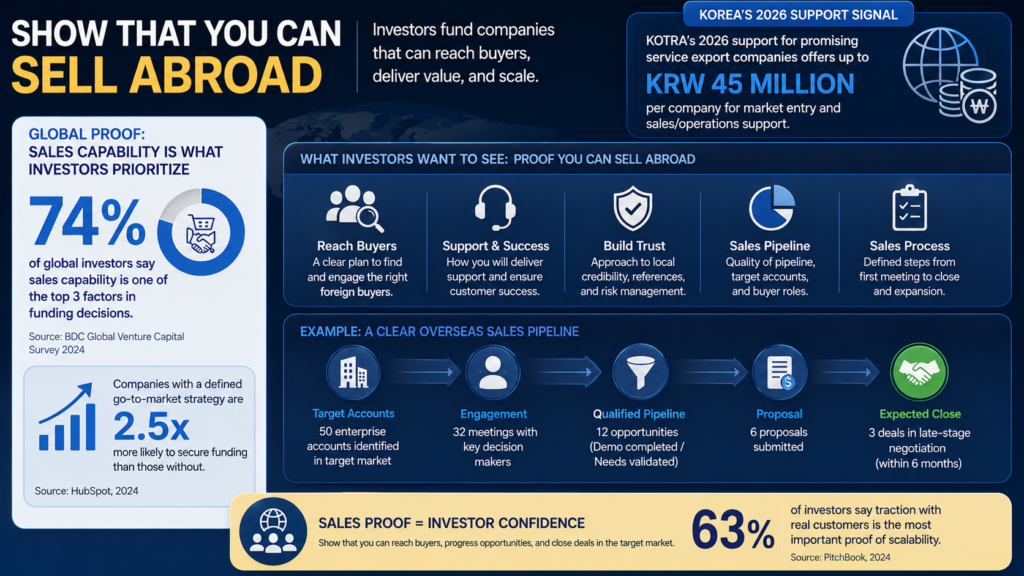
Third, in overseas expansion, Korean companies need sales proof, not only the product. A foreign investor will ask how the company will reach buyers, handle support, and manage trust after the first meeting. KOTRA’s 2026 support for promising service export companies includes overseas partner discovery, consulting, market research for permits and licenses, exhibitions, consultations, and business trip support, with up to KRW 45 million per company expected. That is a useful signal. It shows that market entry is treated as a sales and operations problem, not only a branding exercise. Founders should show pipeline quality, target accounts, buyer roles, and expected sales steps.
4. Prepare for legal, trade, and IP questions
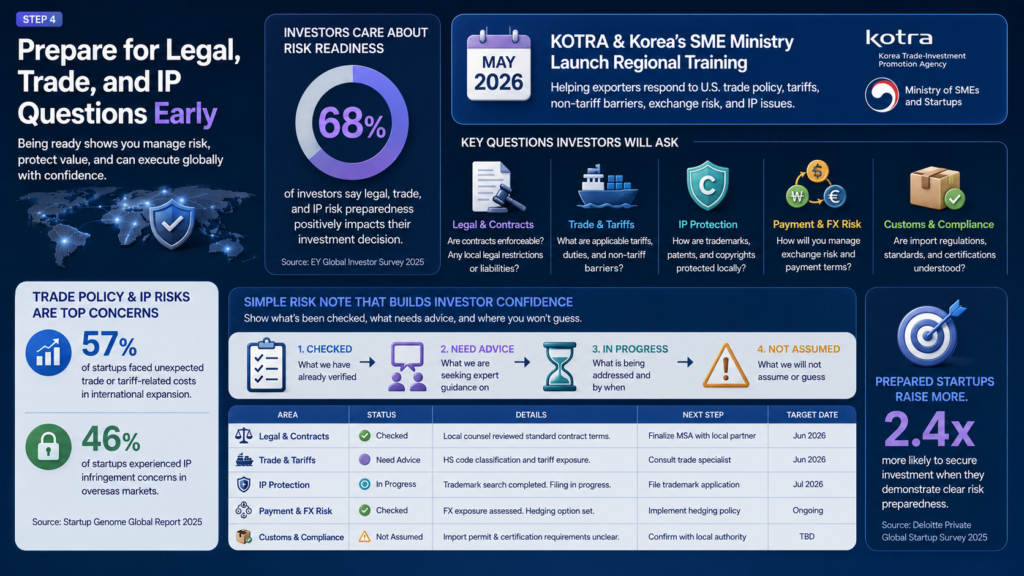
Finally, Korean companies entering foreign markets should prepare for legal, trade, and IP questions early. These questions can affect pricing, contracts, product launch, and investor confidence. In May 2026, KOTRA and Korea’s SME Ministry launched regional training to help exporters respond to U.S. trade policy, tariffs, non-tariff barriers, exchange risk, and IP issues. That matters for startups, too. Even a young company can face trademark copying, customs delays, contract risk, or unclear local rules. A simple risk note can make the investor conversation calmer. It can show what has already been checked, what still needs advice, and where the founder will not guess.
That being said, market-entry proof should make the next country easier to understand. Korean founders do not need perfect results before funding talks, but they do need organized evidence. A focused market, real buyer feedback, partner access, sales logic, and risk notes all help. Next, we will explain how funding pressure changes when overseas expansion becomes urgent, and capital timing becomes harder.
How funding pressure changes during overseas expansion
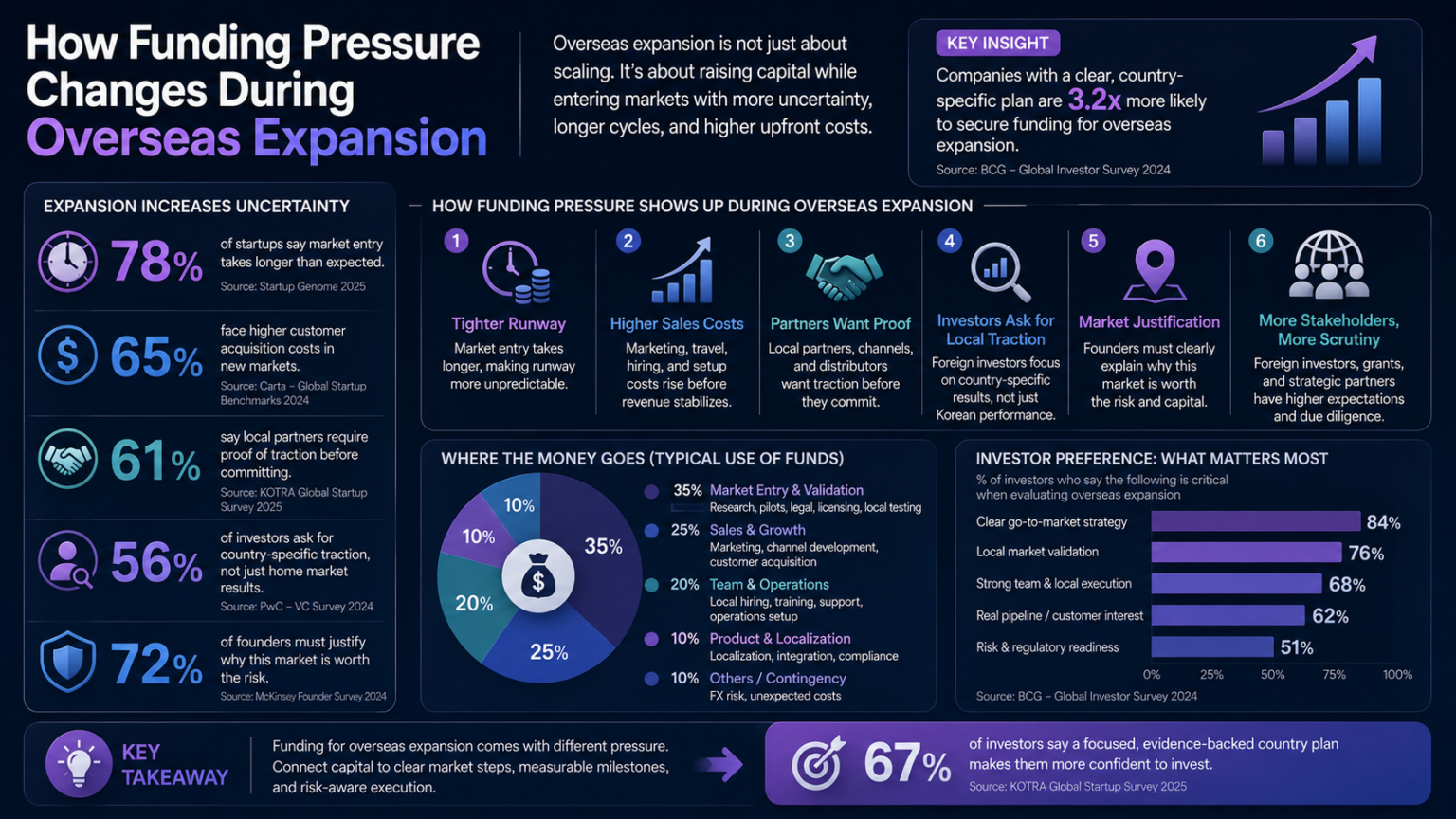
Of course, funding pressure during a Korean startup’s overseas expansion is different from normal growth funding. The company is not only asking for money to scale. It is asking for capital while entering a market where trust, sales cycles, hiring, and local rules may still be unclear.
This pressure can show up in several ways:
- the runway becomes tighter because market entry takes longer than expected
- sales costs rise before revenue becomes stable
- local partners may want proof before committing
- investors may ask for country-specific traction, not Korean results
- founders must explain why this market is worth the risk
This is especially true when expansion depends on foreign investors, grants, or strategic partners. That is why the funding story must connect capital to clear market steps. Investors should see what the money will test, build, or unlock. A vague global plan is weak. A focused country plan is stronger with evidence. Next, we will cover the common mistakes Korean companies make when entering foreign markets.
Common mistakes Korean companies make when entering foreign markets
Common mistakes in a Korean company’s overseas expansion often start with speed. Founders want to move quickly because the product works in Korea, but new markets do not copy Korean demand. Even with more support available, capital is still competitive. Korea’s Fund of Funds contribution is set to rise from KRW 500 billion in 2025 to KRW 820 billion in 2026, which shows stronger funding infrastructure, but not automatic investor trust.
| Mistake | Why it weakens expansion | Better approach |
|---|---|---|
| Entering too many countries | The team spreads budget and proof too thin | Choose one priority market first |
| Translating Korean materials only | The message may sound clear, but not locally relevant | Rewrite for local buyers and investors |
| Pitching before proof | Investors see ambition, not market evidence | Build pilots, buyer notes, and partner signals |
| Ignoring local sales habits | The sales cycle may be longer or less direct | Map decision-makers and buying steps early |
| Treating grants as strategy | Support helps, but cannot replace demand | Connect funding to clear market milestones |
Another issue is concentration. Korea ranks 20th globally for startup ecosystem competitiveness, but only three Korean cities are listed among the top 500 startup cities, according to the ministry’s cited StartupBlink data. This makes focused market selection even more important. Next, we will compare country-specific readiness.
Country-specific readiness for Korean companies expanding abroad
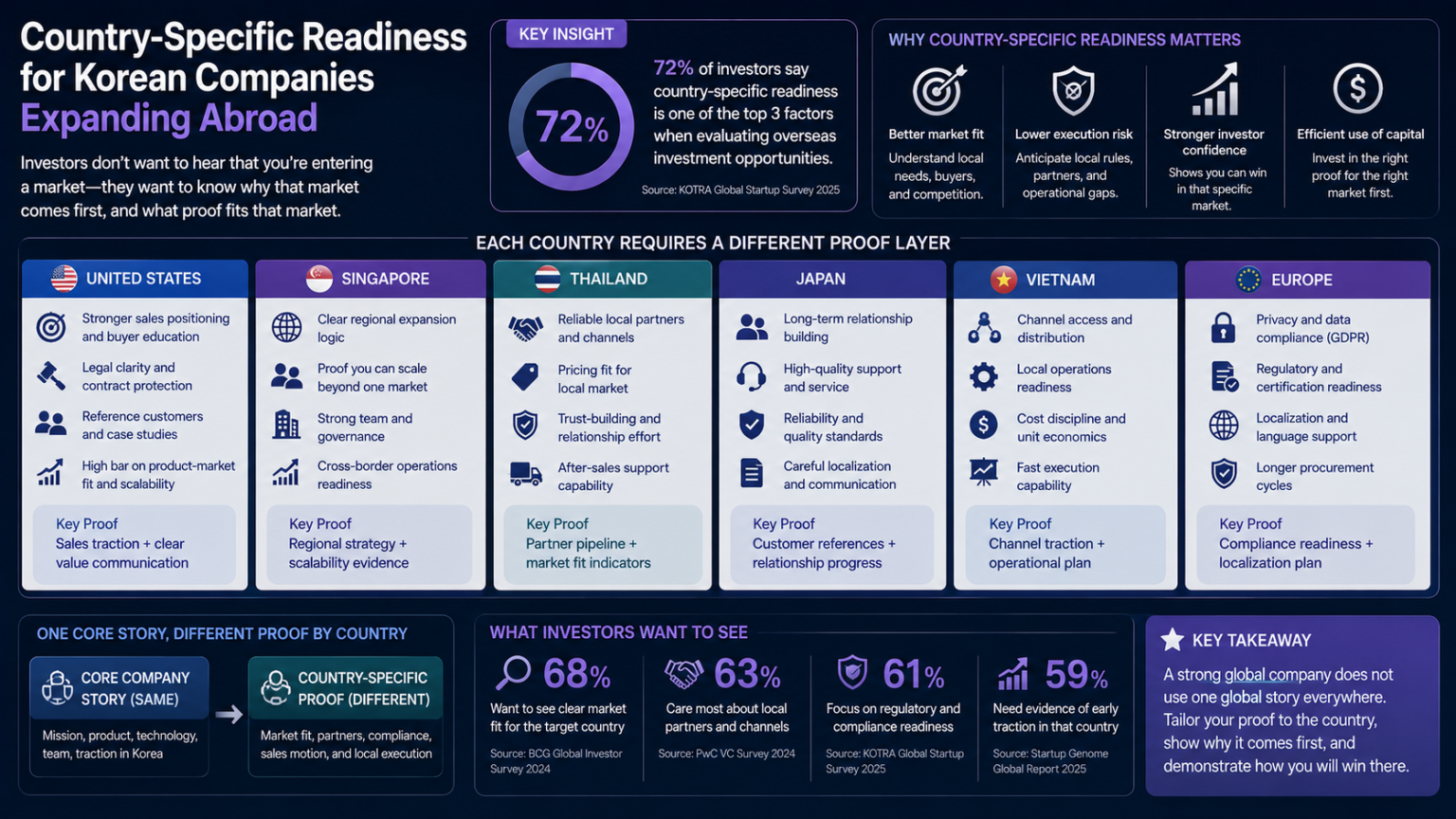
Country-specific readiness helps Korean companies avoid weak global expansion plans. Investors do not want to hear only that the company is entering the US, Singapore, Thailand, Japan, Vietnam, or Europe. They want to know why that market comes first.
Each country may require a different proof layer. The US may need stronger sales positioning, buyer education, and legal clarity. Singapore may require sharper regional logic and proof that the company can scale beyond one small market. Thailand may depend more on local partners, pricing fit, and trust-building. Japan may need slower relationship work and high-quality support. Vietnam may require channel access, local operations, and cost discipline. Europe may bring privacy, compliance, and localization questions earlier.
Because of this, Korean founders should not use one global story everywhere. The core company story can stay the same, but the proof must change by country.
Why credibility and discoverability matter before pre-seed funding
Credibility and discoverability issues matter early because pre-seed investors often have limited proof to review. A Korean startup can not have strong revenue yet, but it can still look prepared, active, and easier to trust. This is important for Korean startups expanding abroad, where investors may not know the founders, the Korean market, or the company’s past work.
Credibility shows that the company is serious. This can come from a clear website, founder profiles, pilot updates, customer notes, partner mentions, media coverage, accelerator activity, or useful content that explains the problem well. Discoverability helps investors and partners find those signals when they search online.
This is also why startups should build credibility before chasing traffic or investor attention. A company that gets found but fails the trust check will still lose buyers, partners, and funding interest. We explained this in more detail in our guide on why startups need credibility before traffic, where we break down how reviews, founder visibility, clear policies, proof assets, and trust signals affect conversion.
For pre-seed founders, this does not mean pretending to be bigger. It means making real proof visible. If a Korean startup wants funding in another country, the first search result, pitch deck, LinkedIn page, and product page should tell the same story. When these parts match, investors spend less time guessing and more time reviewing the opportunity. This also makes later outreach stronger, because the company already has trust signals before the first serious call.
Where Korean companies can look for overseas funding opportunities
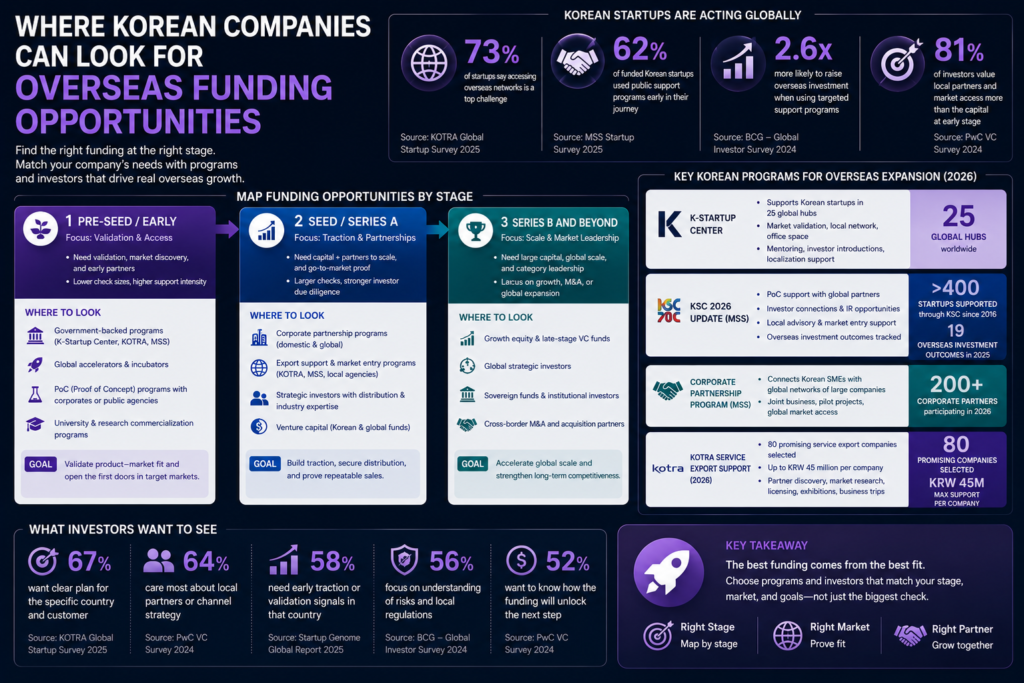
Funding opportunities for Korean companies going abroad should be mapped by stage, not searched randomly. Pre-seed founders can start with government-backed expansion programs, accelerators, and PoC routes because they often need validation before large checks. For example, the K-Startup Center supports Korean startups entering global hubs, while MSS’s 2026 KSC update highlights PoC, investor links, local advisory, and overseas investment outcomes.
Seed and Series A companies should also look at corporate partnerships, export support, and strategic investors. MSS opened the 2026 Corporate Partnership for Overseas Expansion Program to connect Korean SMEs with large companies that already have global networks. KOTRA also selected 80 promising service export companies in 2026, with support for overseas partner discovery, market research, licensing, exhibitions, and business trips.
The key is fit. A pre-seed startup should look for validation and access. A Series A company should look for capital, distribution, and market proof that can support faster expansion.
Where outside support can help Korean companies expand abroad
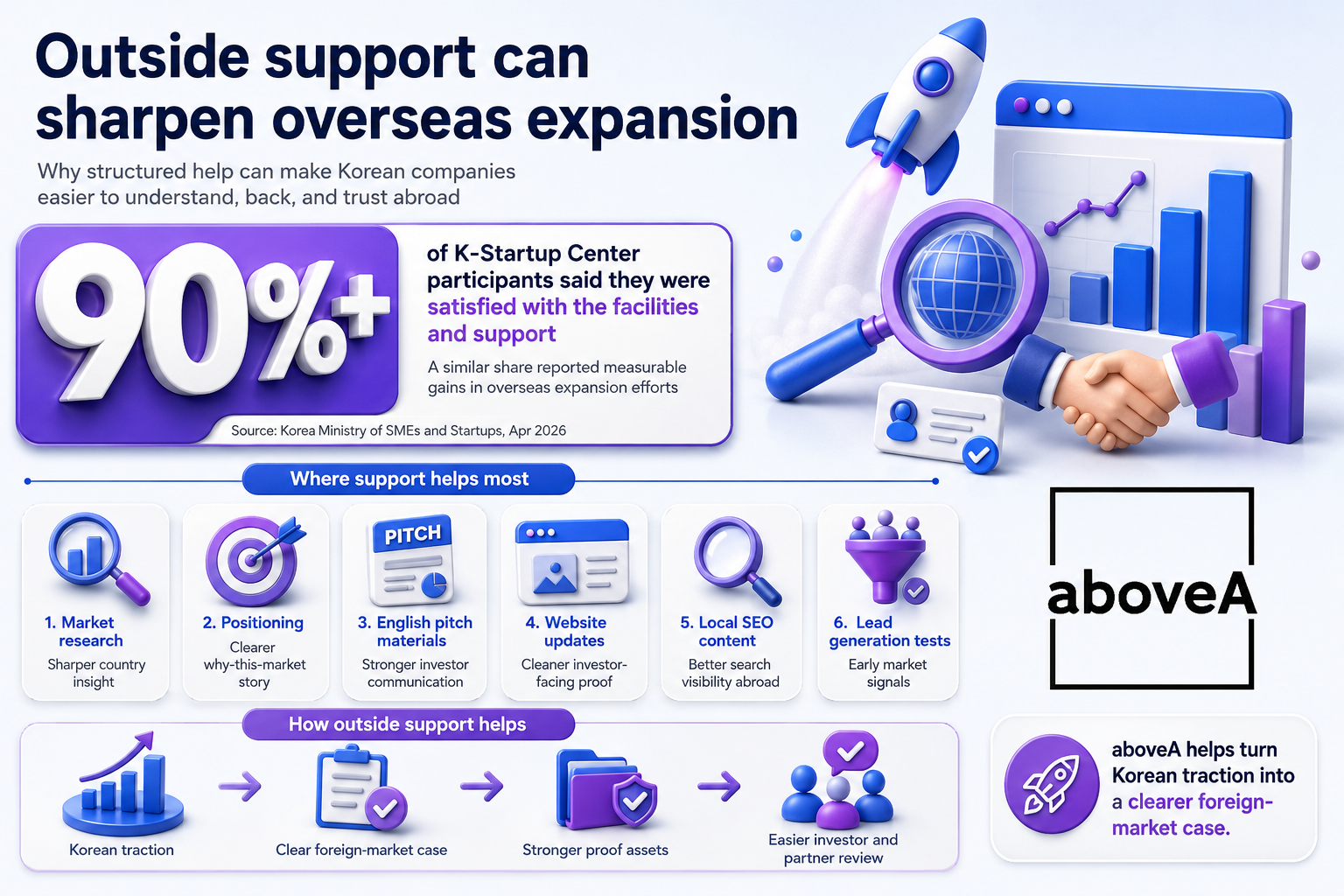
Outside support for Korean companies expanding abroad should not replace the founder’s own market judgment. The team still needs to understand the product, customer, and long-term plan better than anyone else. However, external help can make the expansion story clearer before investors, partners, or buyers review it.
This support can include market research, country-specific positioning, English pitch materials, investor-facing website updates, local SEO content, lead generation tests, and proof-building assets. It can also help Korean founders avoid generic global expansion language. Instead of saying the company is ready for the world, the story can explain why one target country matters now.
For aboveA, this work is practical. We help turn Korean traction into a clearer foreign-market case, so investors see the next step, not only the ambition. Next, we will close with the main lessons for Korean founders.
Final thoughts on Korean startup global expansion
Korean startups expanding abroad should treat funding as a trust test, not only a money request. Domestic traction can open the first door, but foreign markets need local proof, clearer positioning, and a plan that fits real buyers. Founders should choose one target market, test demand, organize investor materials, and explain how capital will reduce risk. That preparation makes outreach sharper and less random. When the company is easier to understand, investors can focus on the opportunity, not the confusion. Next, founders should turn these lessons into a simple checklist before outreach.
Frequently asked questions about overseas Korean startup funding in 2026
Korean startup global expansion raises practical questions about funding, local proof, investor trust, market choice, and overseas readiness.
Can Korean startups raise funding abroad?
Yes, Korean startups can raise funding abroad, but foreign investors usually expect local proof, clear market logic, English materials, and a focused country entry plan.
What should Korean startups prepare before overseas expansion?
Korean startups should prepare market research, buyer feedback, partner notes, legal checks, investor materials, local sales logic, and proof that demand exists abroad.
Is Korean traction enough for foreign investors?
Korean traction helps, but it is rarely enough alone. Foreign investors also want local buyer signals, pricing tests, market access, and country-specific growth plans.
Where can Korean companies find overseas funding opportunities?
Korean companies can explore the K-Startup Center, MSS programs, KOTRA support, accelerators, corporate partners, local investors, grants, and strategic funds in target markets.
What mistakes do Korean companies make when expanding abroad?
Common mistakes include entering too many markets, translating materials without local positioning, pitching too early, ignoring sales habits, and relying too much on grants.
Why does discoverability matter before pre-seed funding?
Discoverability helps investors find real signals before a call. A clear website, founder profile, content, and product page can make early proof easier to trust.
How can Korean startups become more fundable abroad?
Korean startups become more fundable abroad by choosing one market, testing demand, building local proof, cleaning investor materials, and linking funding to clear milestones.
