
Oscar Leung
Researcher at aboveA and fascinated by digital marketing, and the way businesses connect with their audiences, and build their brand awareness.
Digital Marketing Statistics for 2026: Fresh Data and Trends
- Last Time Updated: 12th of June, 2026
Digital marketing statistics in 2026 keep evolving. They have a serious role in shaping how brands and companies form their strategies and tactics. Search is shifting, social platforms are moving fast, paid ads are getting harder to manage, and AI is becoming part of daily marketing work. That is why fresh data matters.
Useful statistics can help marketers and decision-makers see where attention should go, what buyers respond to, and where teams must spend time and budget. In this report, we will look at digital marketing statistics and trends of 2026 across SEO, content, social media, email, paid ads, e-commerce, AI, and measurement. Made so you can make smarter decisions with more confidence – well-informed decisions this year.
Need help in digital marketing? We’ll support you.
Table of Contents
Global Digital Marketing Overview in 2026
Digital marketing in 2026 is moving in a more demanding direction. The ever-changing tech environment makes marketing’s ability to deliver results, pacing, and rules that govern it. Hence, making founders, marketers, and other responsible individuals keep up with this rapid speed.
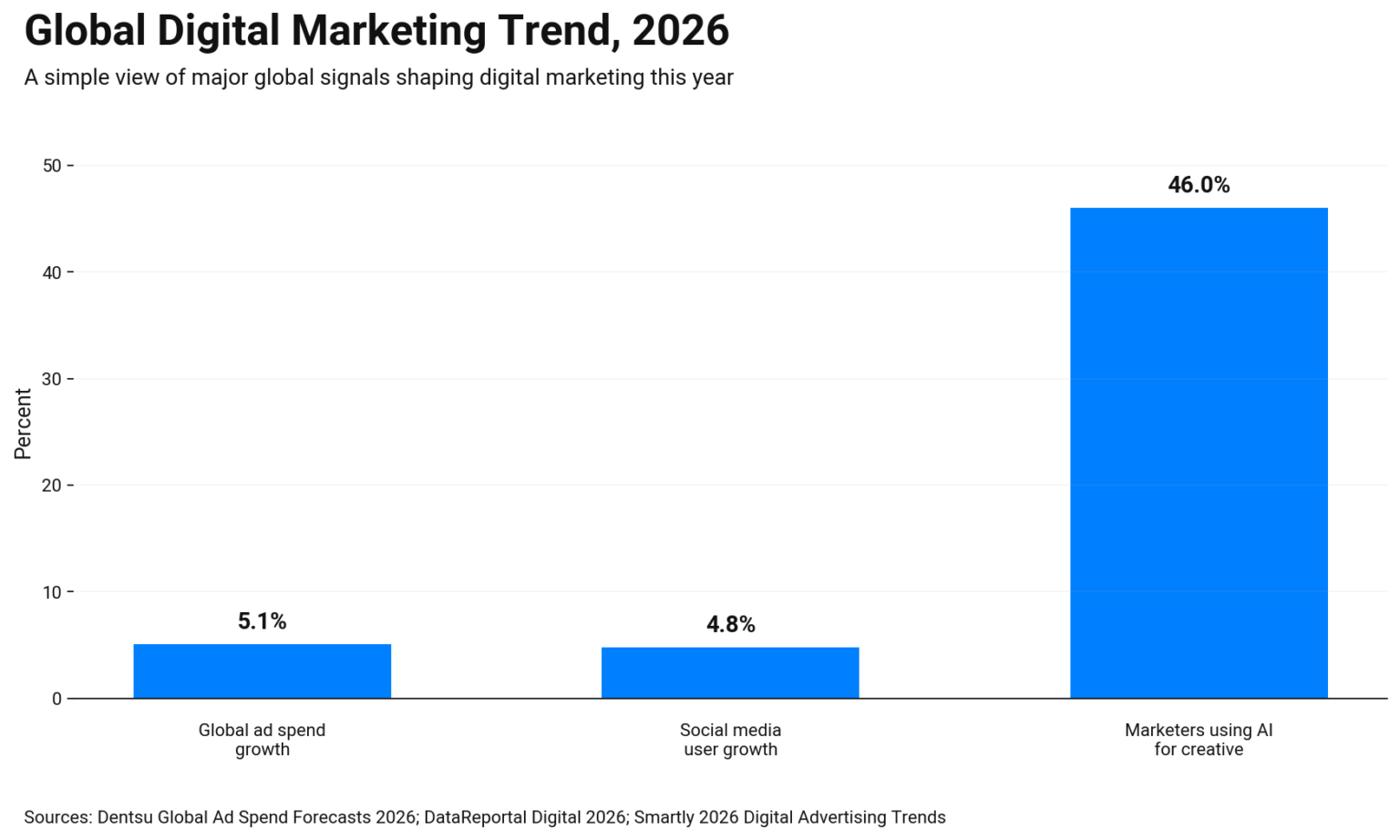
Consequently, this makes planning harder, but also stresses having stronger strategies and tactics. On top of that, user behavior is shifting as well. People compare more options, switch between platforms faster, and expect clearer value before they take action.
That said, businesses are under pressure to show stronger results from the money and time they spend on marketing. Because of that, it is no longer enough to bring in visits alone. Businesses need qualified traffic, stronger content, better targeting, cleaner data, and well-made ways to measure what works. This is a colossal enterprise, but with the right approach – manageable.
How We Collected Digital Marketing stats for 2026?
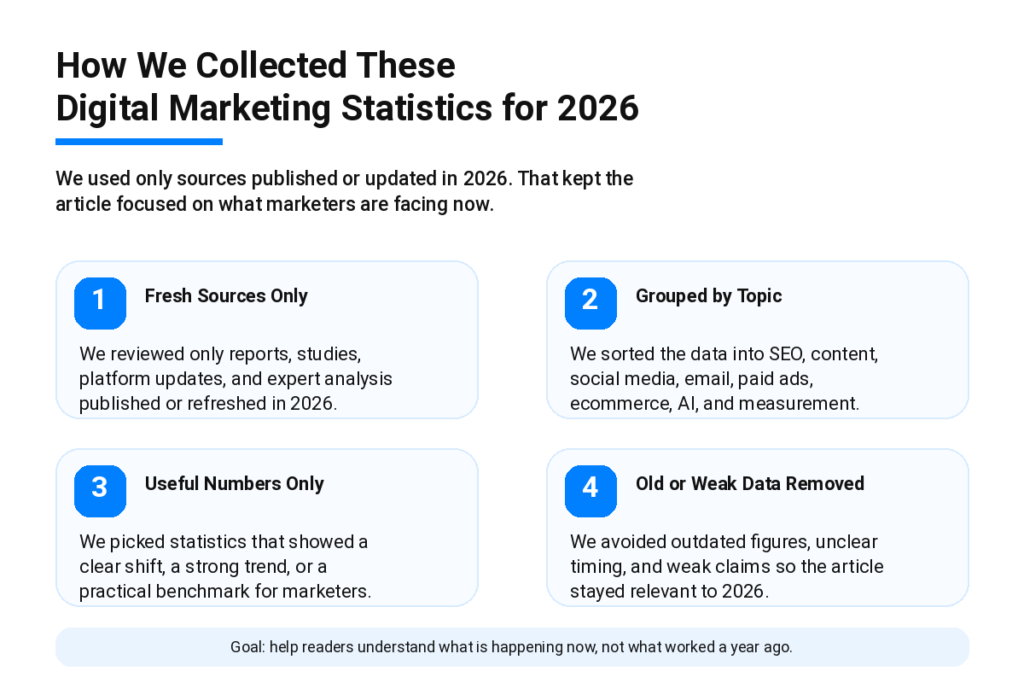
To build this article, we took some effort to review sources published or updated in 2026. This was important since older reports can still be useful for background, but they do not always reflect what marketers are facing now. So, instead of mixing years, we focused on fresh data, current benchmark reports, new platform studies, industry updates, and recent expert analysis.
We also grouped the statistics by topic to make the article easier to follow. As a result, you will see separate sections for SEO, content, social media, email, paid ads, ecommerce, AI, and measurement. In each case, we selected numbers that show a clear shift, a strong trend, or a useful benchmark.
At the same time, we avoided outdated figures, weak claims, and statistics with unclear timing. That way, the article stays relevant to 2026. More importantly, it helps readers understand what is happening now, not what worked a year ago.
SEO and Search Statistics in 2026
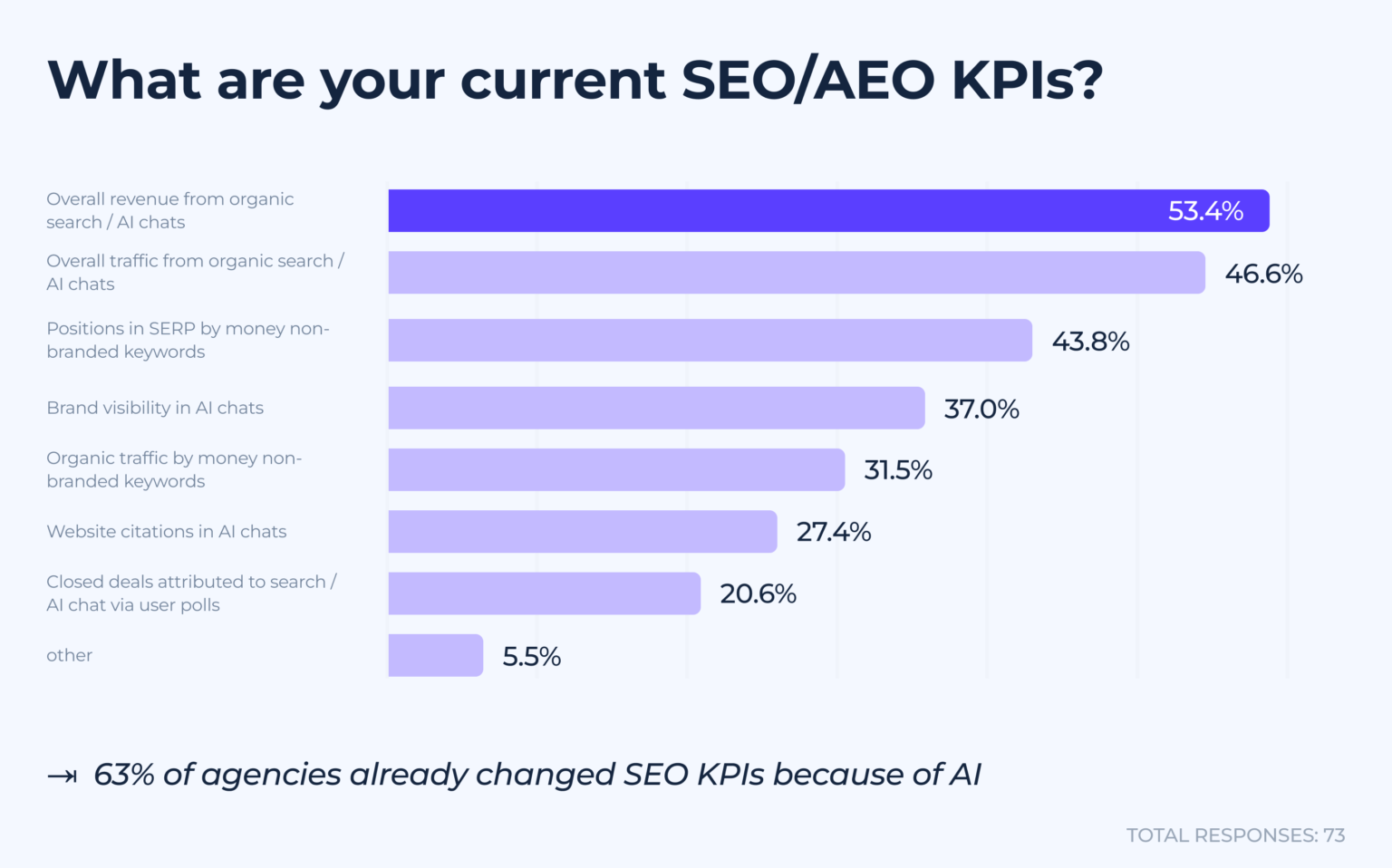
To begin with, organic search is still one of the most important digital channels in 2026, but the way people find information is changing. Google search results now include more AI-driven summaries, and that means brands cannot judge success by rankings alone. Because of this, marketers need to look more closely at visibility, clicks, and what kind of traffic actually turns into results.
Only 38% of pages cited in AI Overviews also rank in the top 10 results
Ai overviews are becoming increasingly important. Ahrefs published this update in March 2026 after analyzing 863,000 keyword SERPs and 4 million AI Overview URLs. This matters because strong rankings still help, but they no longer explain the full picture. A page can miss the top 10 and still appear in AI-generated search answers. So, SEO work now needs to think beyond classic blue-link rankings.
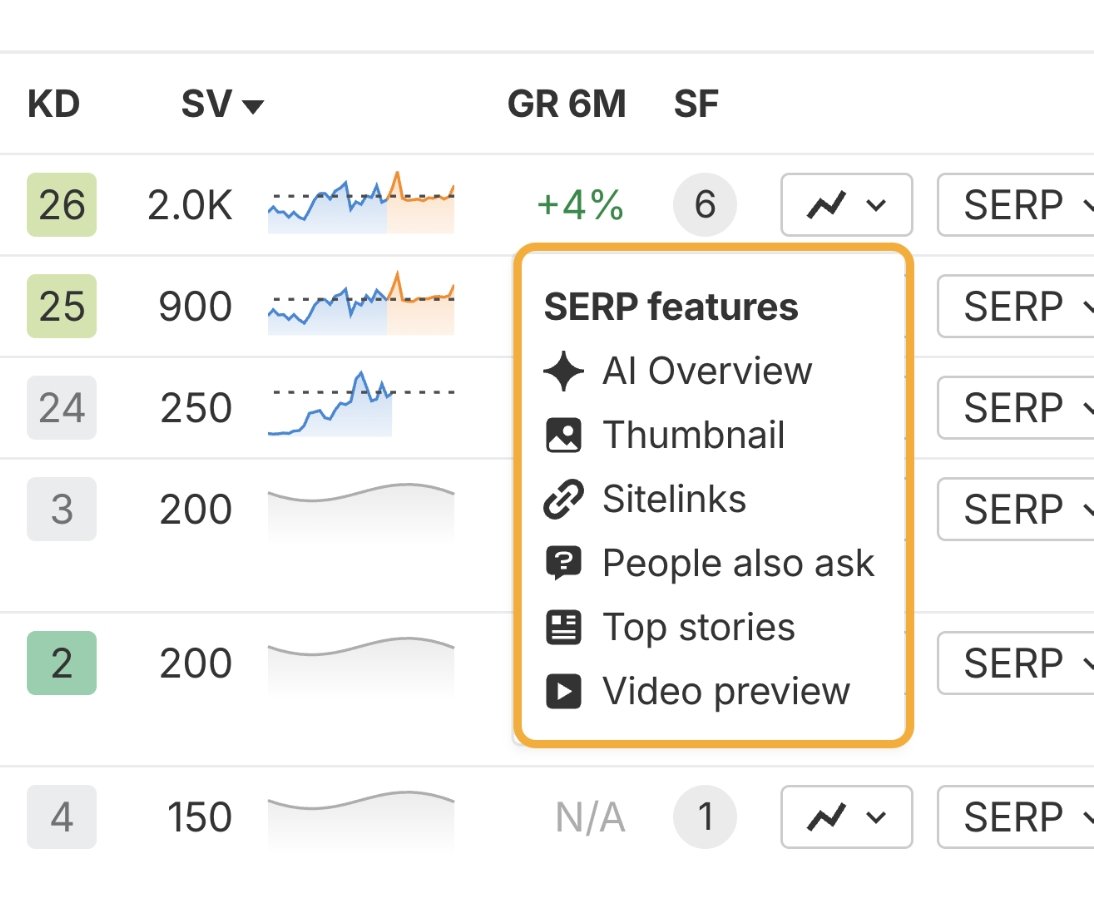
31.2% of AI Overview cited URLs came from positions 11–100, while 31.0% came from beyond the top 100 blocks
This is another sign that Google is pulling from a wider set of sources. Google itself says AI Overviews and AI Mode may use a “query fan-out” process that runs related searches across subtopics and data sources. As a result, pages can gain visibility through relevance and supporting context, not only through one exact ranking position.
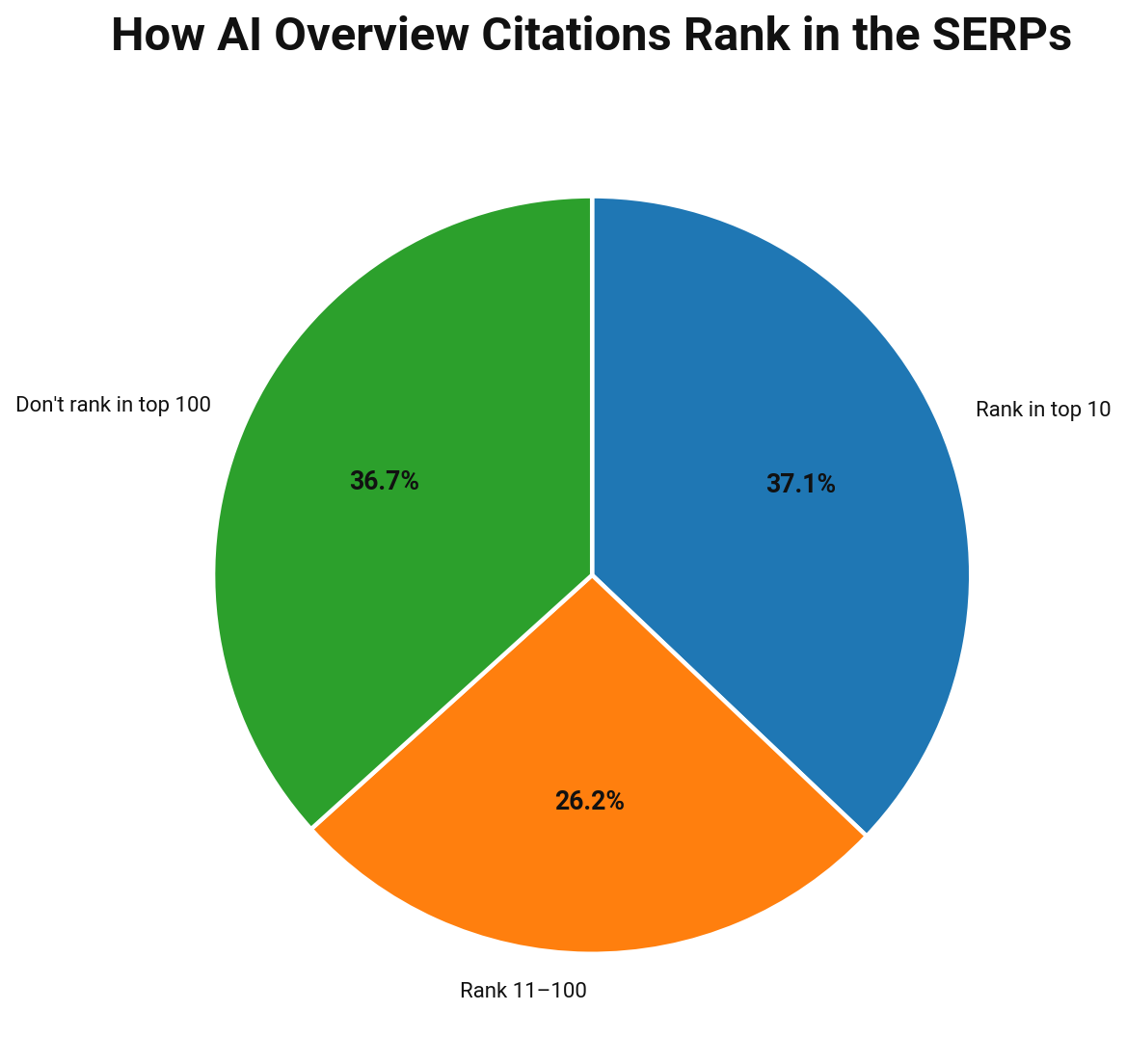
More than 1.5 billion users now use AI Overviews globally
Ai iverviews are no longer a side feature sitting on the edge of search. Google’s own materials show that AI Overviews are already part of mainstream search behavior, which means marketers need to think about how their content appears inside AI-assisted discovery, not only in standard blue-link results. The search page itself is becoming more active, more layered, and less dependent on a one-click path.
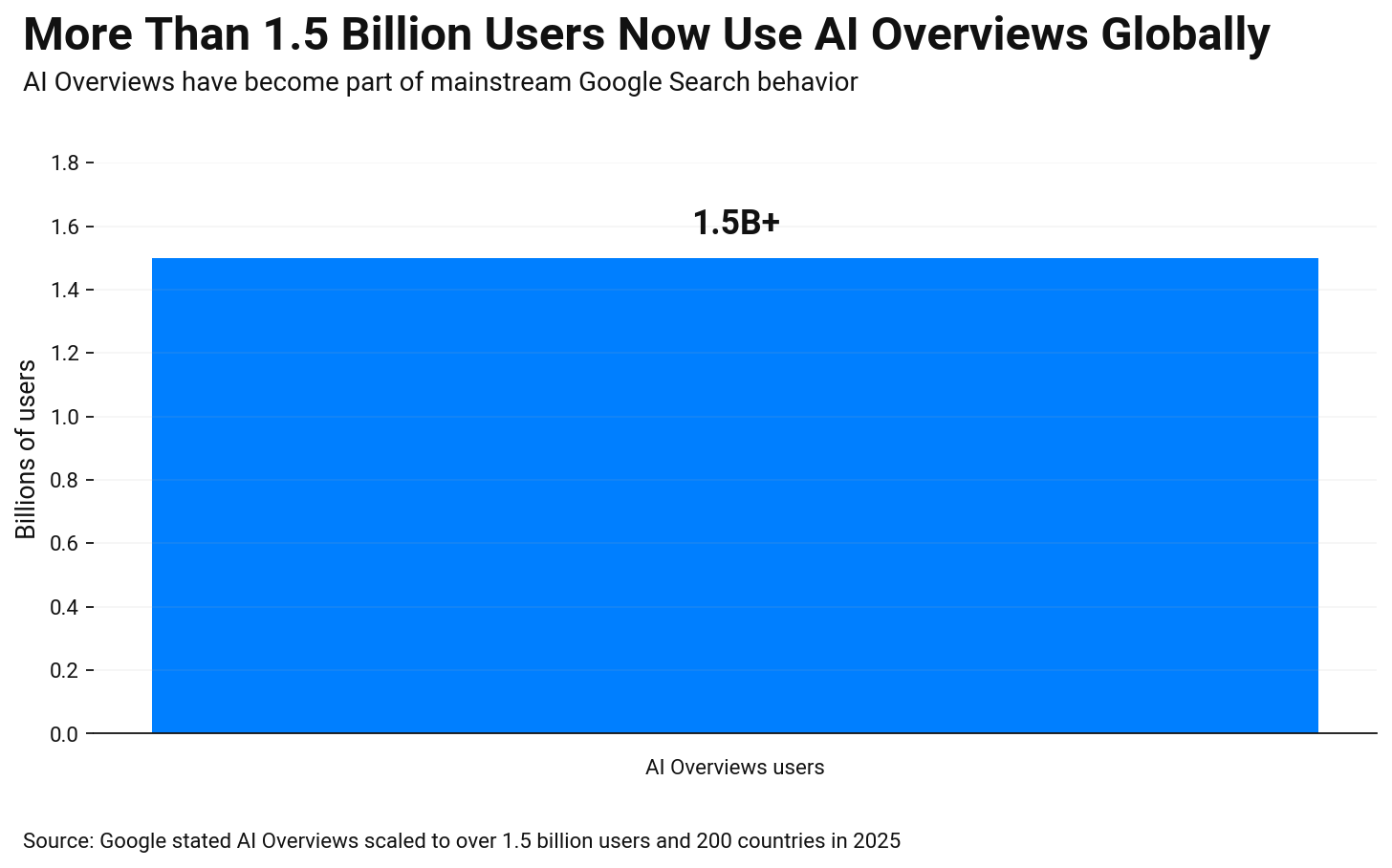
37% of SEO agencies now track brand visibility in AI chats as a KPI
Brand visibility is becoming a key necessity this year. A March 2026 industry study from Sitechecker found that agencies are no longer focusing solely on rankings. They are also watching whether brands appear inside AI-driven answers and conversations. That reflects a broader shift in SEO: visibility now spans search results, AI summaries, and answer-based discovery.
Together, these figures show that SEO in 2026 is broader than ranking for a keyword and waiting for clicks. Visibility now depends more on relevance, coverage, and how well a brand shows up across newer search formats. Pages still need to rank, of course, but they also need to support discovery in a search environment that is becoming more mixed and less linear.
Content Marketing Statistics in 2026
Content marketing in 2026 is under more pressure to prove quality, trust, and business value. Publishing more is not enough on its own. Teams now need stronger strategy, sharper distribution, and content that can support discovery, evaluation, and conversion across more than one channel.
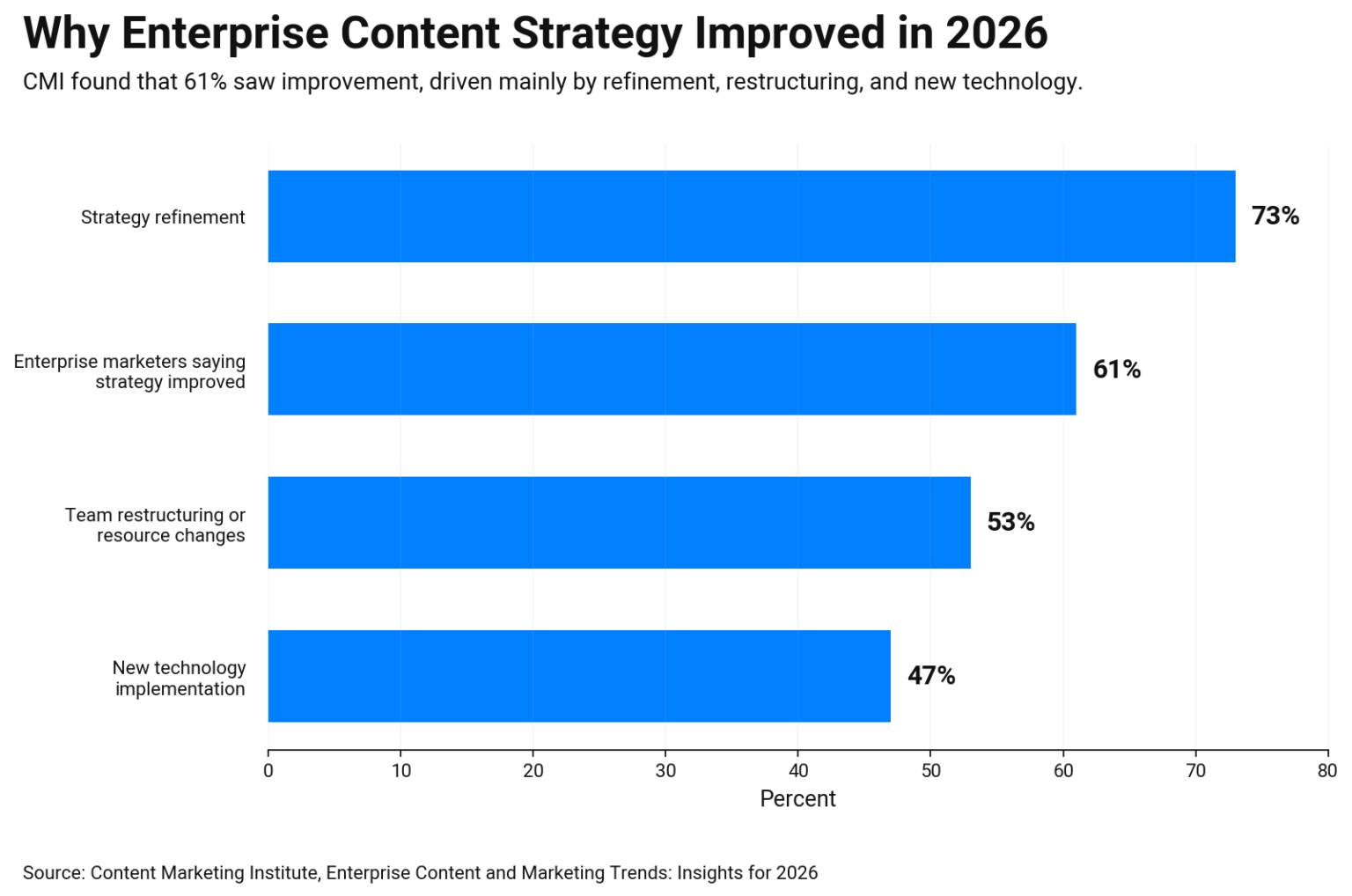
61% of enterprise marketers say their content strategy improved over the last 12 months
Enterprise content strategy is moving forward more through refinement than through volume. In Enterprise Content and Marketing Trends: Insights for 2026, Content Marketing Institute found that strategy refinement was the main reason behind those gains, followed by team restructuring and new technology implementation. That pattern suggests that better planning, clearer ownership, and stronger execution are shaping content results more than publishing speed alone.
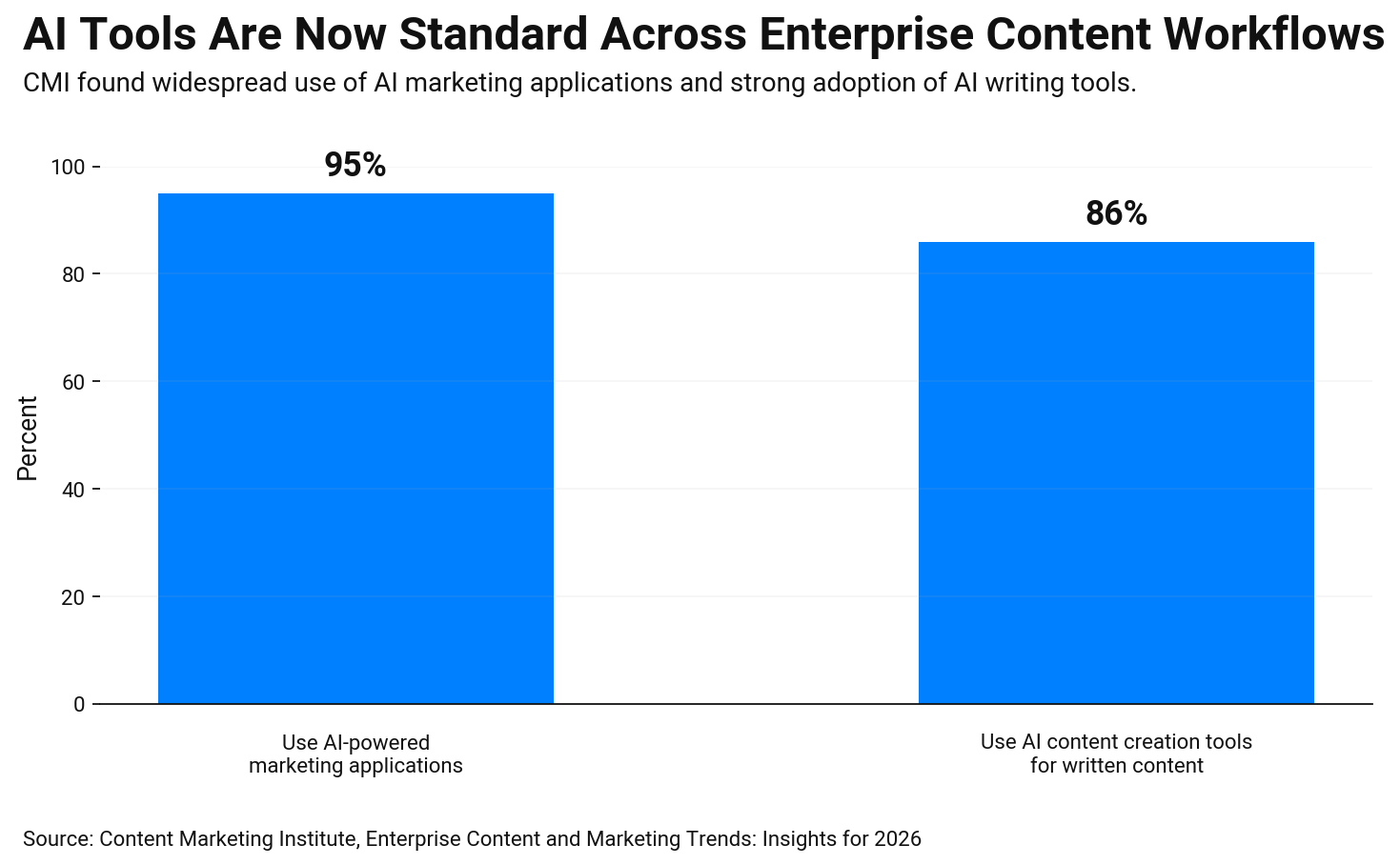
95% of enterprise marketers use AI-powered marketing applications, and 86% use AI content creation tools for written content
AI-powered content workflows are now part of normal operations for many teams, but adoption alone does not guarantee stronger output. In Enterprise Content and Marketing Trends: Insights for 2026, Content Marketing Institute also found that marketers are using AI heavily inside content processes, which shows how deeply these tools are now built into everyday work. Even so, the wider challenge is still quality control, relevance, and making sure content stays useful instead of generic.
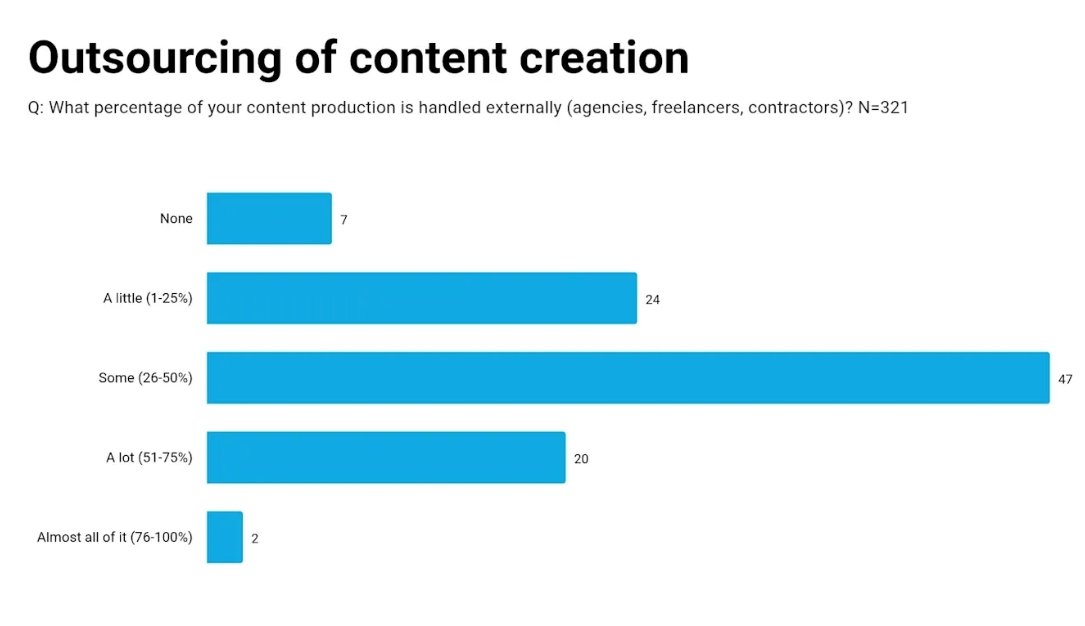
47% of teams outsource 26–50% of content production, even while 77% use AI writing tools
Content production still depends on human support more than many marketers expected. In 2026 B2B SaaS Content and Website Performance Benchmarks, Benchmarker and Contentful found that outside help remains common even with widespread AI use. That points to a practical reality: briefs, editing, distribution, content refreshes, and subject-matter depth still need hands-on work, especially when brands want content that performs beyond surface traffic.
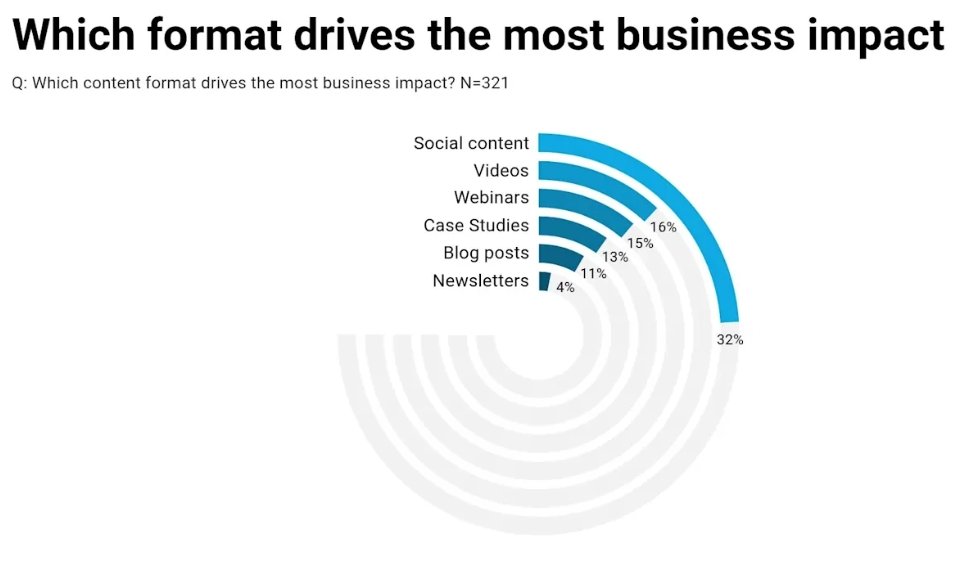
Only 11% of respondents say blog posts are their top business impact driver, while social content leads at 32%
Blog content still matters, but it is no longer the automatic star of the content mix. In 2026 B2B SaaS Content and Website Performance Benchmarks, blogs sat in the middle of the pack for business impact, behind social content, video, webinars, and case studies. That shift shows why stronger content programs now connect blog articles with distribution, supporting assets, and lower-funnel content instead of expecting one post to carry the full result.
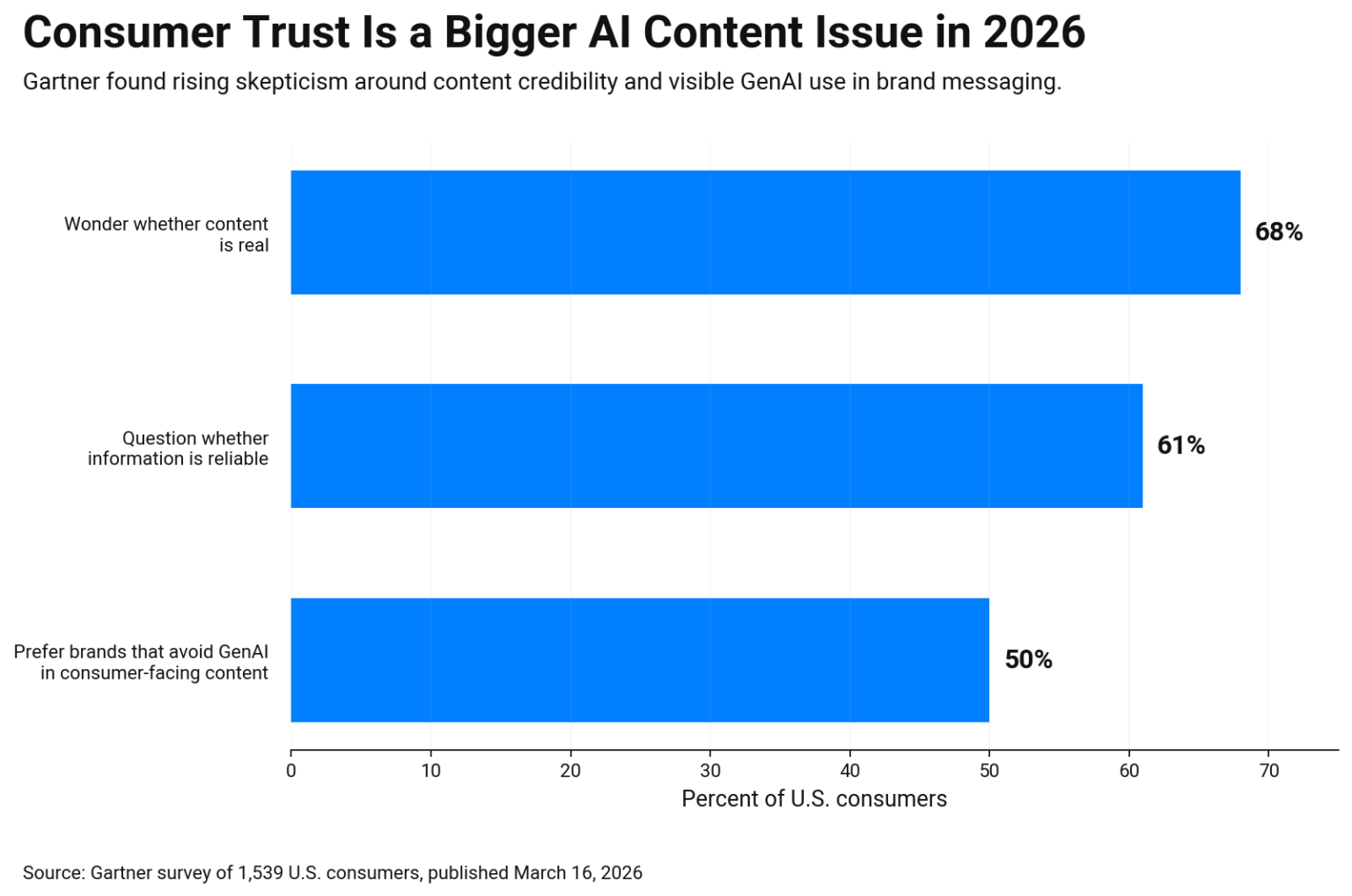
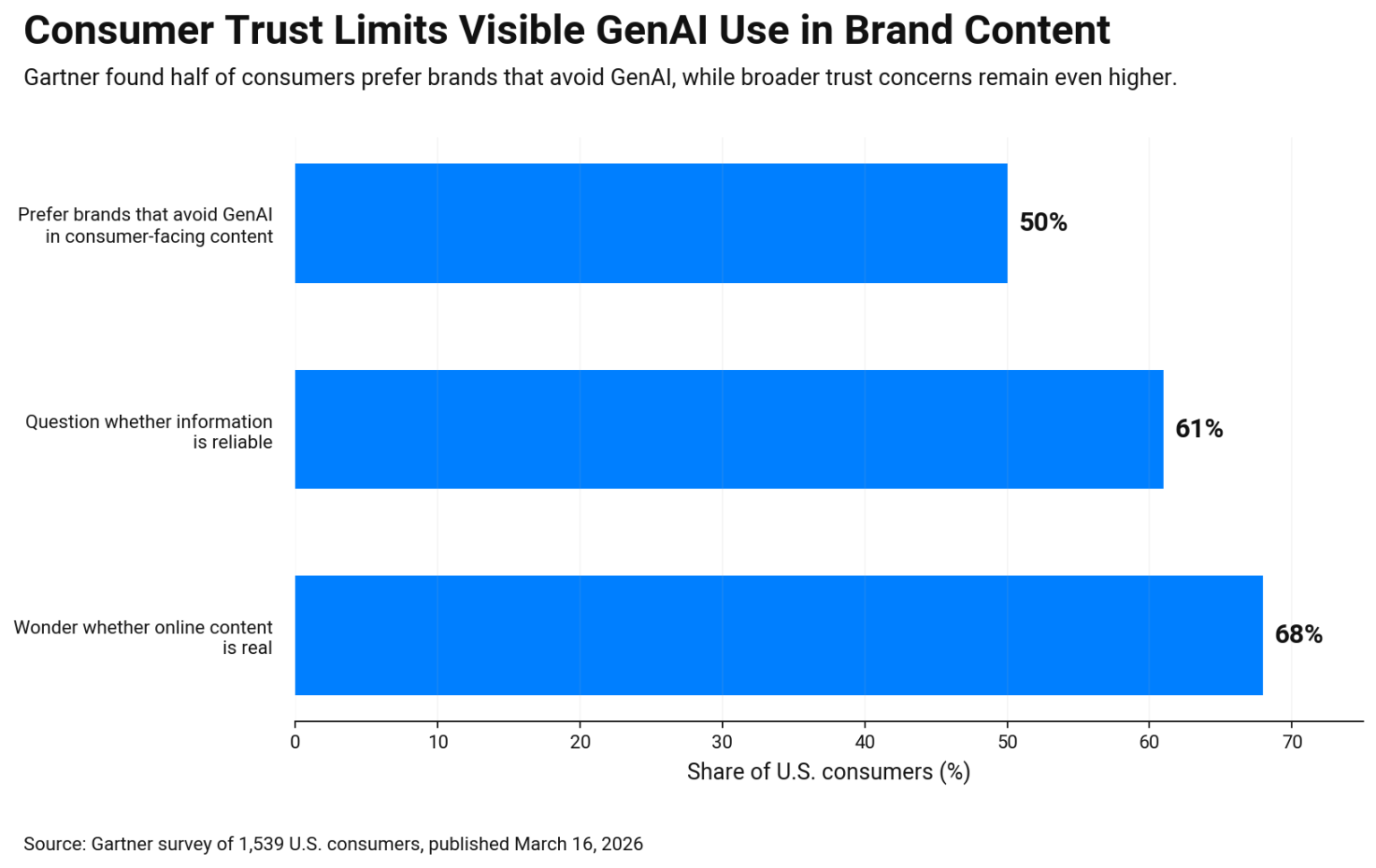
50% of consumers say they would rather buy from brands that avoid GenAI in consumer-facing content
Consumer trust is becoming a bigger content issue as AI use expands. In Gartner’s March 2026 survey, half of U.S. consumers said they preferred brands that do not use GenAI in customer-facing messages, while many also said they question whether online content is real or reliable. That makes trust, transparency, and content credibility much more important in 2026, especially for brands that use AI in visible ways.
Taken together, these numbers show that content marketing in 2026 is becoming more disciplined. Content strategy, content production, and consumer trust now carry more weight than simple publishing output. Teams that connect quality with distribution, measurement, and credibility are in a stronger position than those that only focus on speed.
Social Media Marketing Statistics in 2026
Social media marketing in 2026 is doing more than driving awareness. Platforms now shape discovery, trust, and buying decisions at the same time, which means brands need content that can earn attention and support action across more than one stage of the journey.
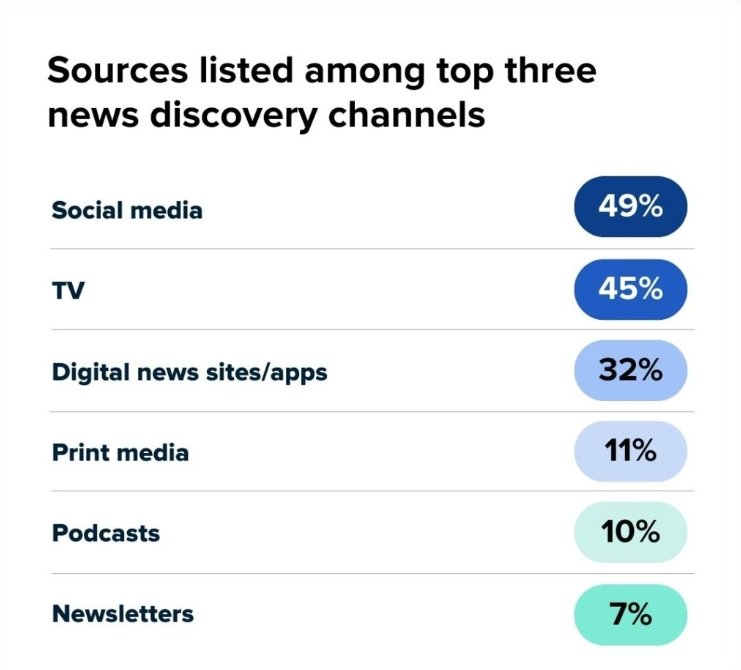
Social media is now the most common source of news for almost half the population
Social media discovery is becoming part of everyday decision-making, not only casual browsing. In The State of Social Media 2026, Sprout Social found that social platforms now sit just ahead of TV as a news source, with even stronger usage among Gen Z at 67% and millennials at 61%. That shift makes social content more important for visibility, brand recall, and early trust, especially when younger audiences are already using these platforms to understand what matters.
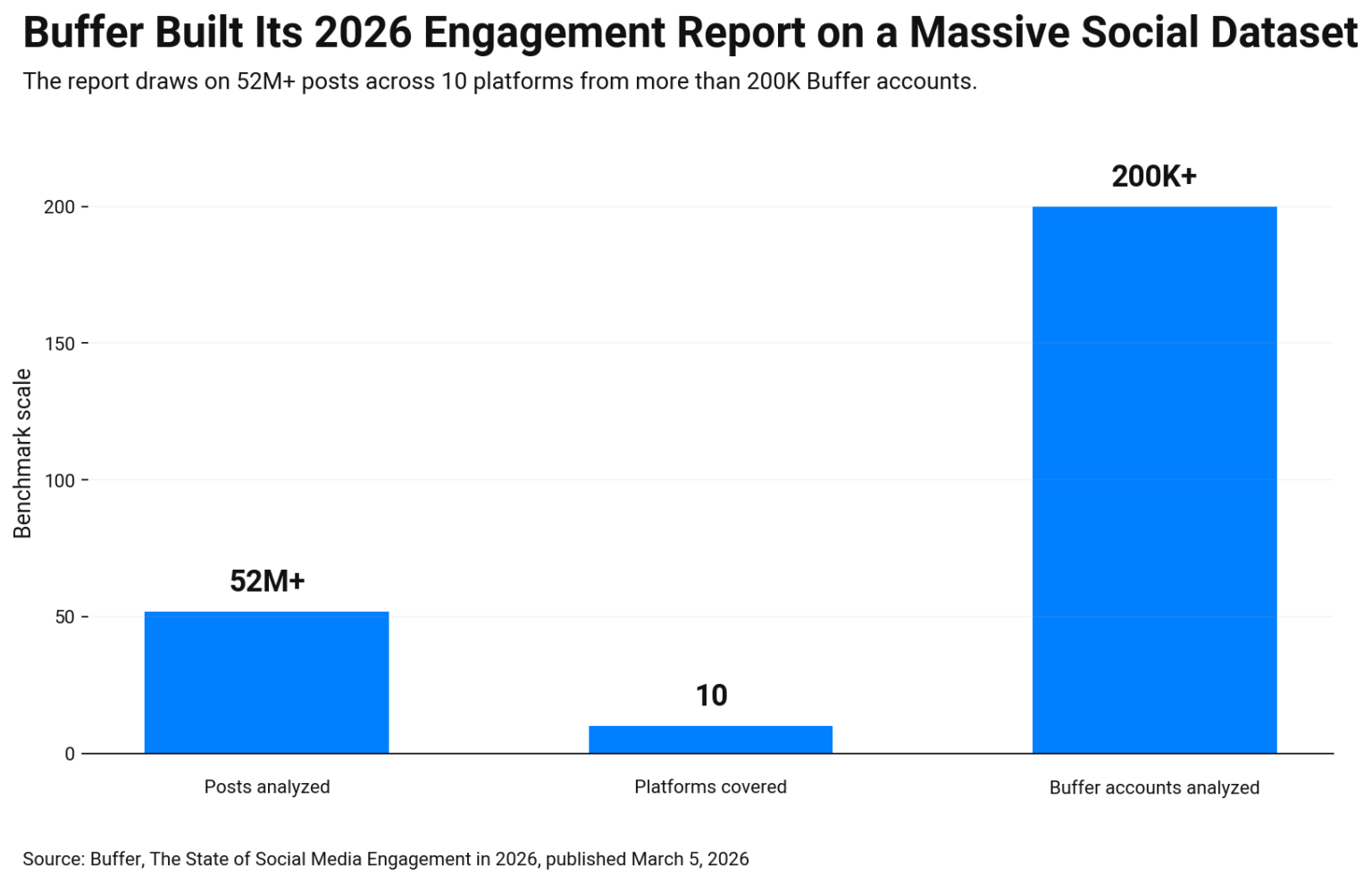
Buffer analyzed more than 52 million posts across 10 platforms for its 2026 engagement report
Social media engagement in 2026 needs to be judged against a much larger and more competitive content environment. In The State of Social Media Engagement in 2026, Buffer used a wide dataset across major networks, which gives marketers a clearer benchmark for how hard it has become to earn reactions, clicks, and meaningful interaction. Bigger content volume across platforms means brands need sharper format choices, stronger hooks, and more consistent publishing if they want social efforts to stand out.
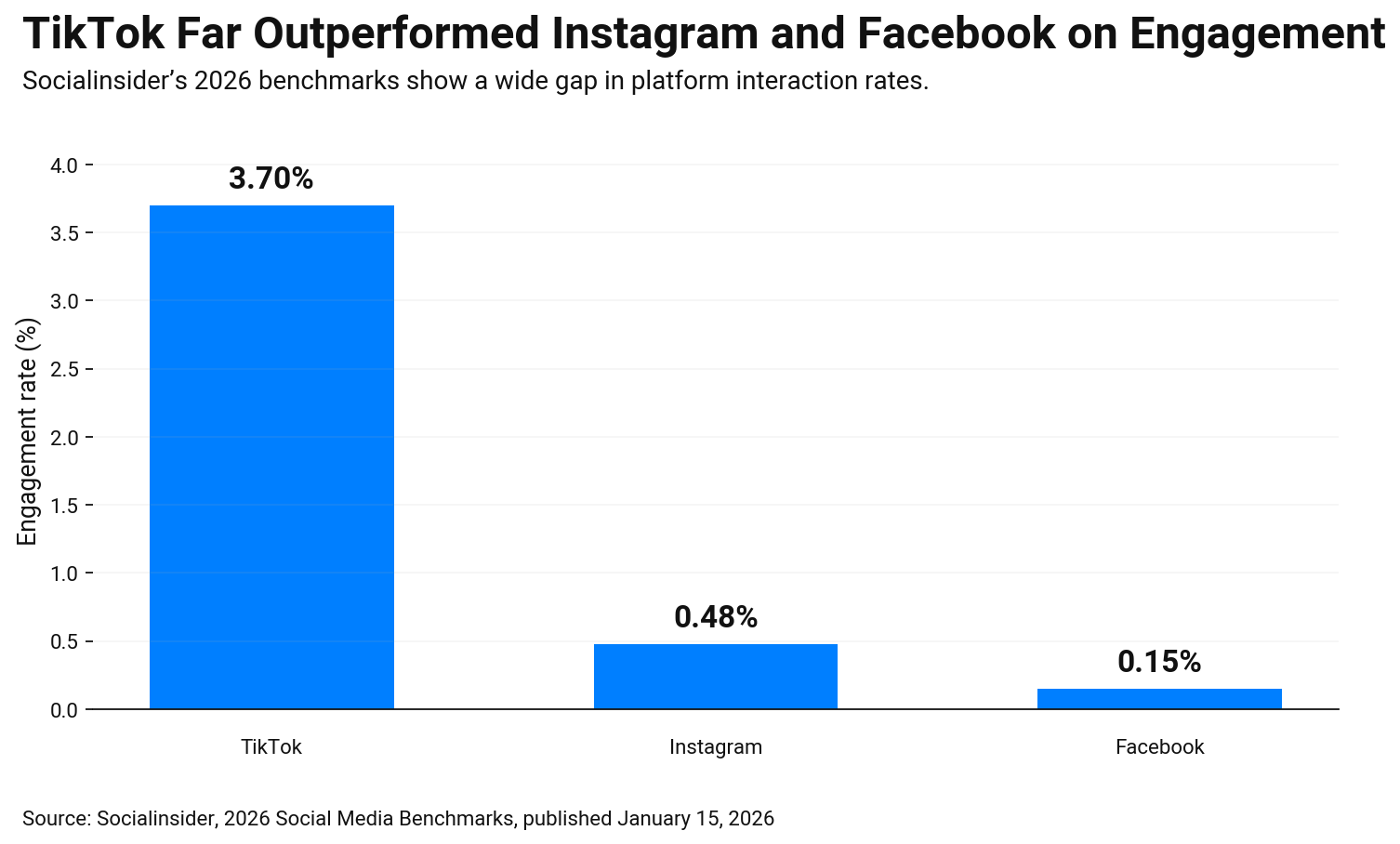
TikTok’s engagement rate reached 3.70%, while Instagram averaged 0.48% and Facebook averaged 0.15%
Platform engagement gaps are still wide, and that changes how brands should plan content by channel. In 2026 Social Media Benchmarks, Socialinsider found that TikTok stayed far ahead on engagement, while Instagram remained much lower and Facebook sat lower still. That does not mean every brand should chase one platform, but it does show that reach and interaction behave very differently across networks, so the same content logic will not work everywhere.
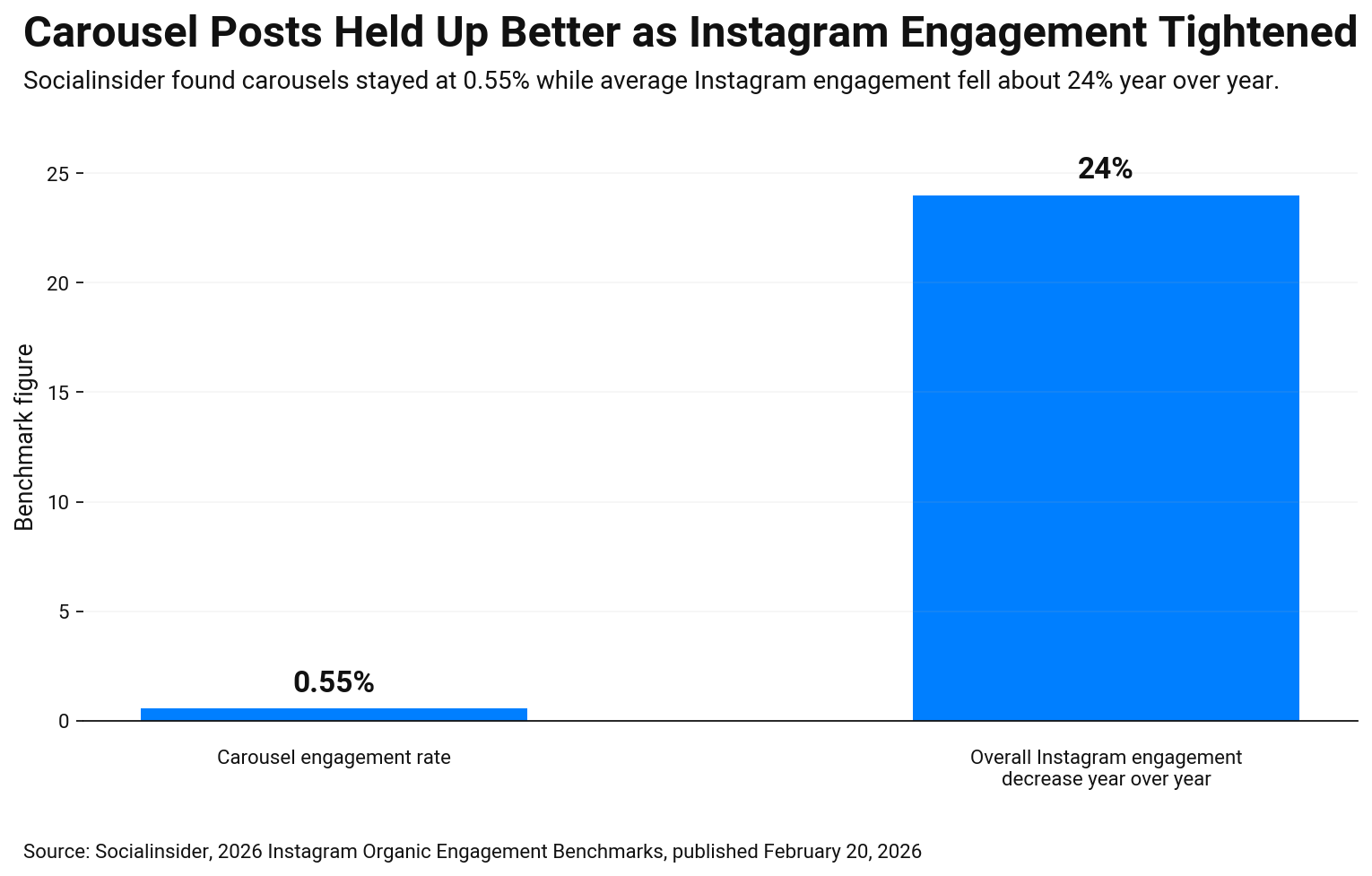
Instagram engagement on carousels held at 0.55%, while overall Instagram engagement dropped by about 24% year over year
Instagram content formats are separating more clearly in performance. In 2026 Instagram Organic Engagement Benchmarks, Socialinsider found that carousel posts stayed more resilient even as overall engagement tightened and follower growth slowed. That makes format choice more important than before. Brands that rely too heavily on one post type may miss stronger results that come from mixing formats based on how users actually respond now.
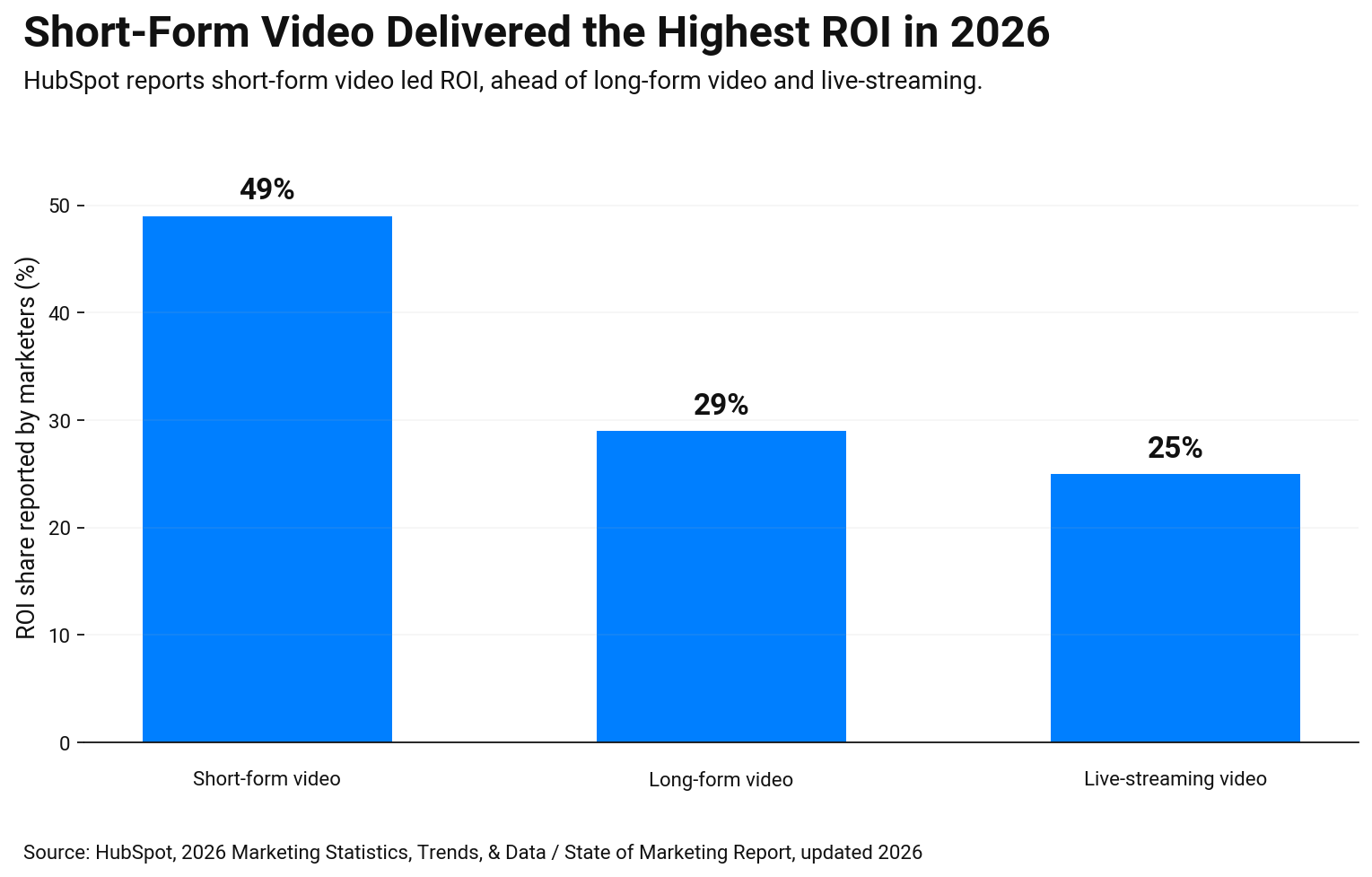
Short-form video delivers the highest ROI for social media marketers at 49%
Short-form video keeps leading because it fits how users consume content across major platforms. In 2026 Marketing Statistics, Trends, & Data, HubSpot reports that short-form video drives the highest ROI, ahead of long-form video and live-streaming. That helps explain why so many social strategies now lean on faster visual content. Brands are trying to match shorter attention patterns while still giving users enough value to remember the message and take the next step.
Taken together, these numbers show that social media in 2026 is not a side channel. Social media discovery, platform engagement gaps, and short-form video now shape how people find information, compare brands, and respond to content. Stronger social results depend less on posting for presence alone and more on matching the platform, the format, and the audience expectation behind each piece of content.
Email Marketing Statistics in 2026
Email marketing in 2026 is still one of the steadier digital channels, but steady does not mean simple. Open rates remain strong in many regions, yet clicks, revenue efficiency, and inbox placement now show a bigger gap between average programs and better-built ones. That makes email less about sending more and more about timing, relevance, and list quality.
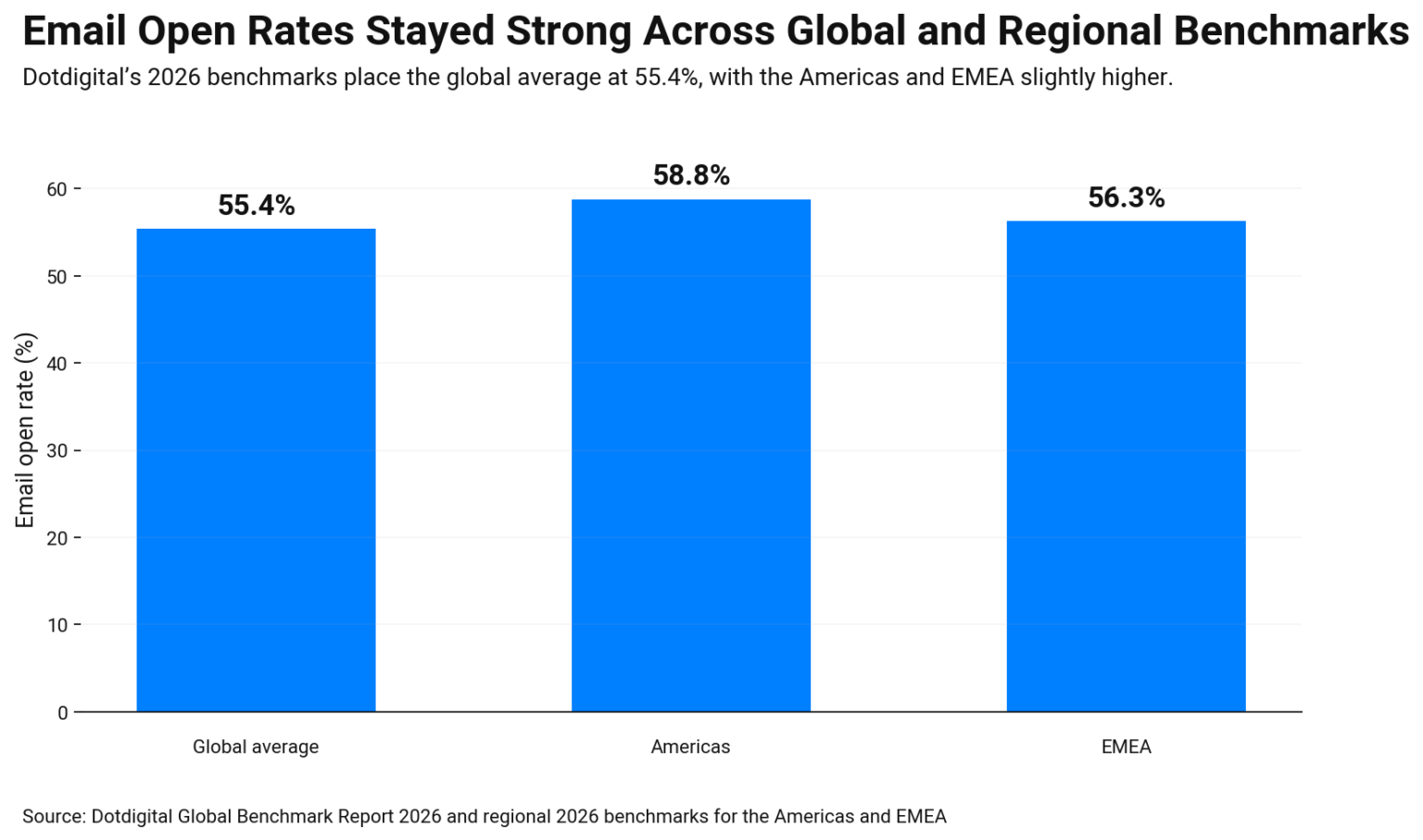
The global average email open rate in 2026 is 55.4%
Email open rates are still healthy on a broad level, which shows that the inbox remains a place where brands can reach people directly. In Global Benchmark Report 2026, Dotdigital reports a 55.4% global open rate, while its regional 2026 benchmarks place the Americas even higher at 58.8% and EMEA at 56.3%. Strong opens, however, do not tell the full story by themselves, because attention inside the inbox is only one part of performance.
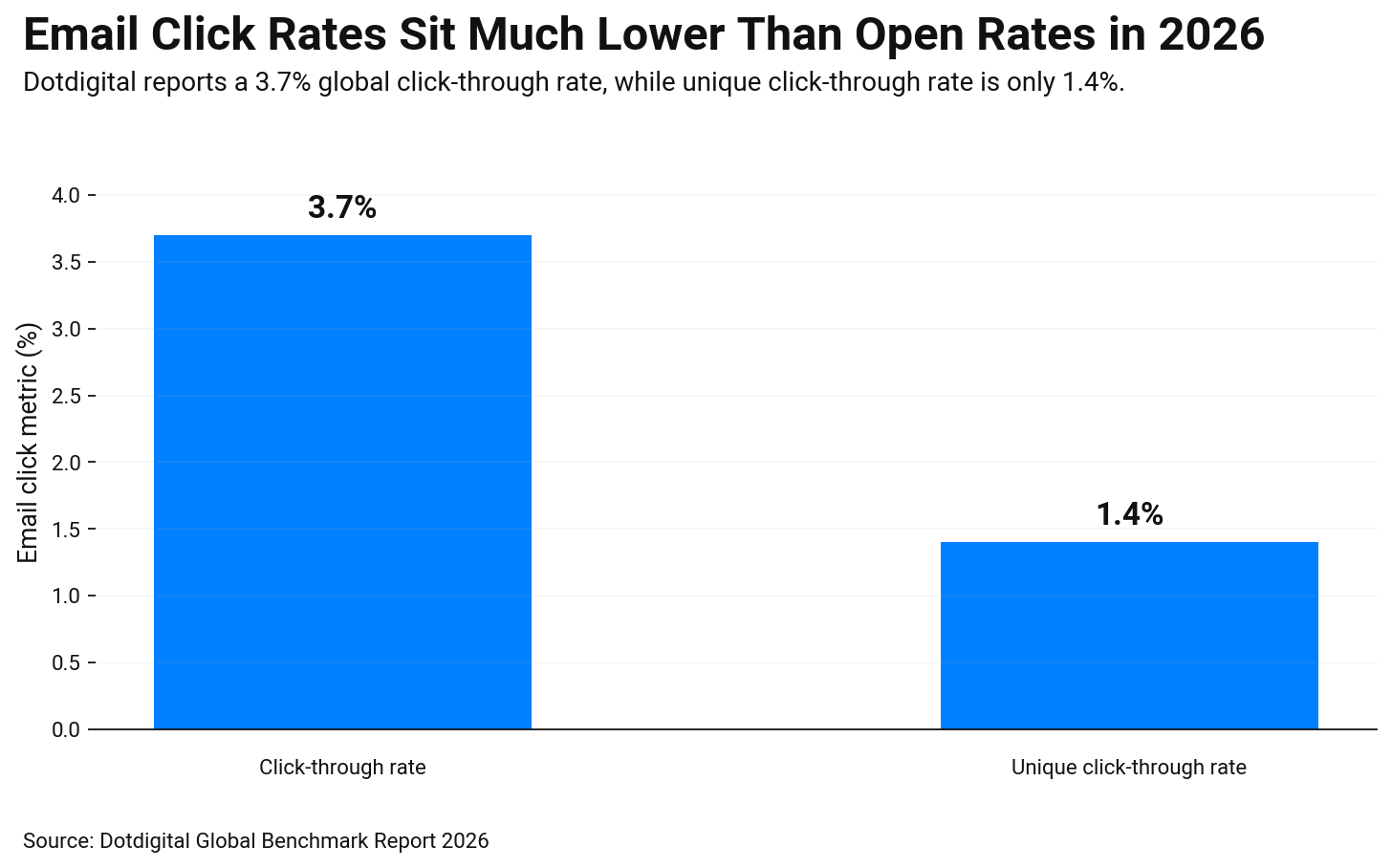
The global average email click-through rate is 3.7%, while unique click-through rate sits at 1.4%
Email click-through rates show a tighter reality than opens. In the Global Benchmark Report 2026, Dotdigital reports that global clicks sit far below open activity, and its 2026 regional benchmarks show the same pattern across markets. That gap points to a clear issue for marketers: getting the message opened is no longer enough, because the bigger challenge now is giving readers a reason to act once they are inside the email.
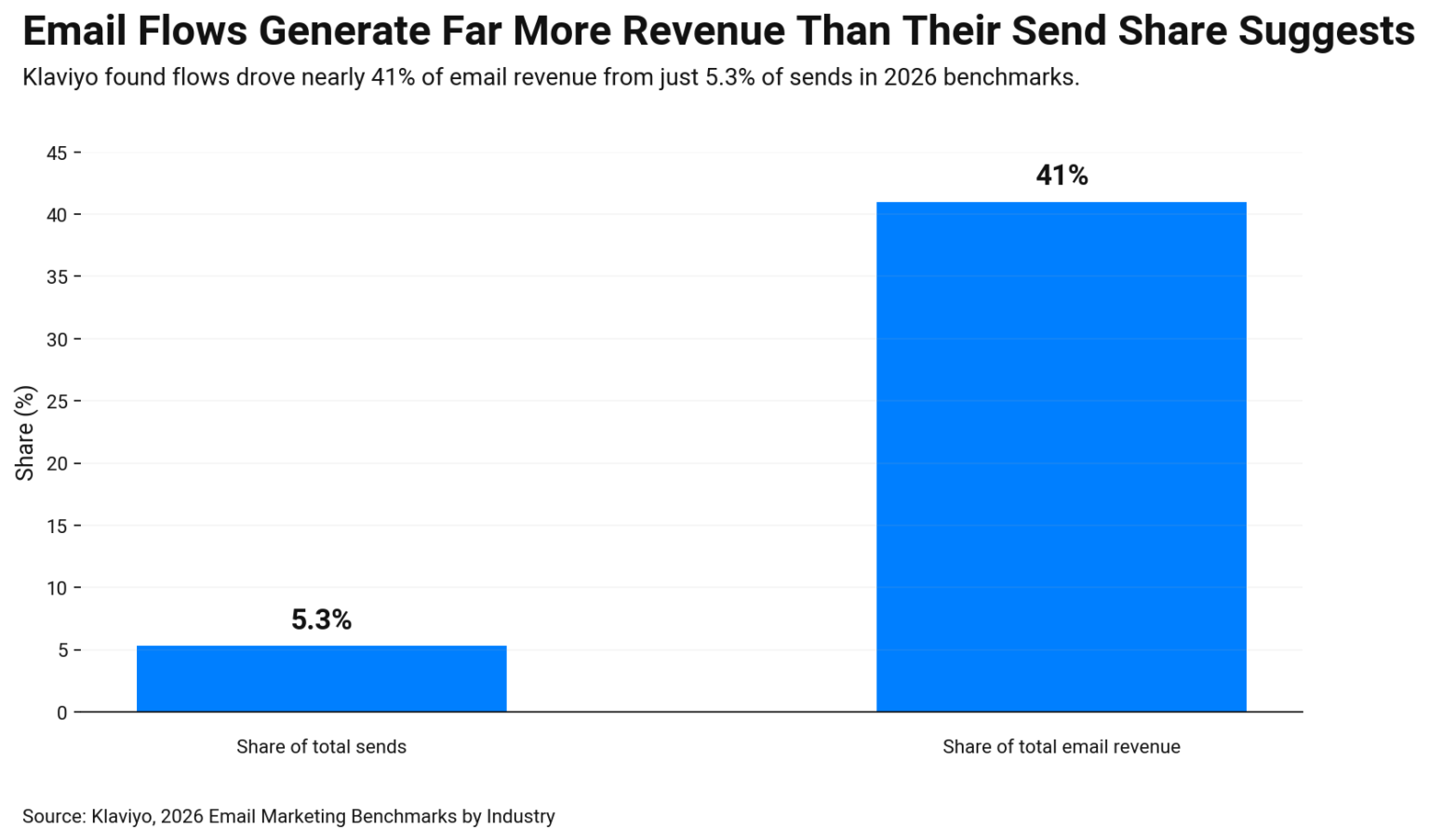
Email flows generate nearly 41% of total email revenue from just 5.3% of sends
Email flows are proving far more efficient than standard campaign blasts. In 2026 Email Marketing Benchmarks by Industry, Klaviyo reports that campaigns account for 94.7% of send volume, yet flows produce nearly 41% of revenue from only 5.3% of sends. That split gives a much stronger picture of what works in 2026: automated emails tied to behavior, timing, and intent are carrying more business value than bulk volume on its own.
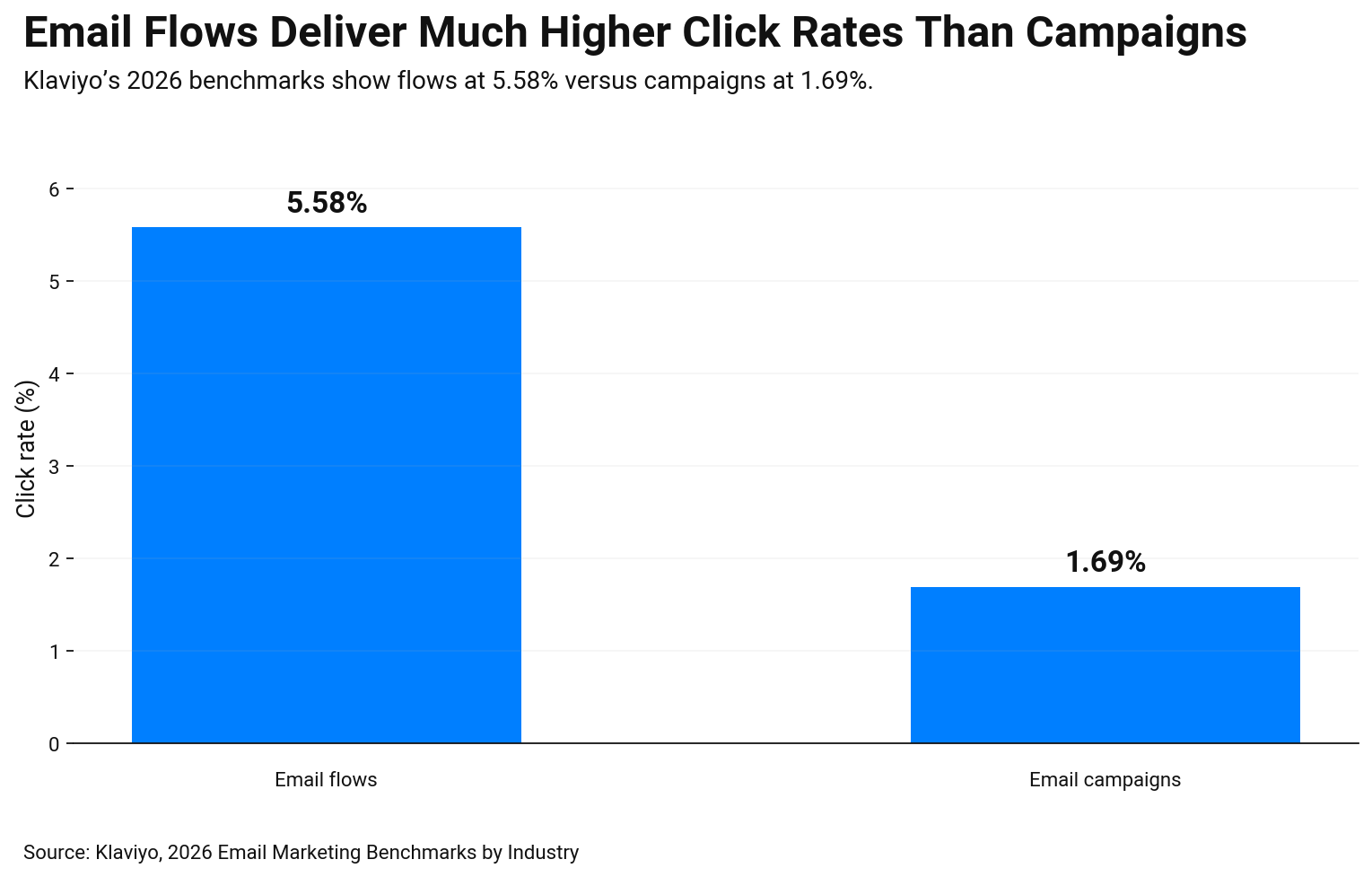
Email flows deliver more than 3 times higher click rates than campaigns, at 5.58% versus 1.69%
Email flow engagement is stronger because relevance tends to be stronger, too. In 2026 Email Marketing Benchmarks by Industry, Klaviyo found that flows outperform campaigns not only on clicks, but also on placed order rates and revenue per recipient. That suggests many brands are seeing better results when email responds to user behavior, such as welcome journeys, browse activity, or abandonment, instead of relying too heavily on one-size-fits-all sends.
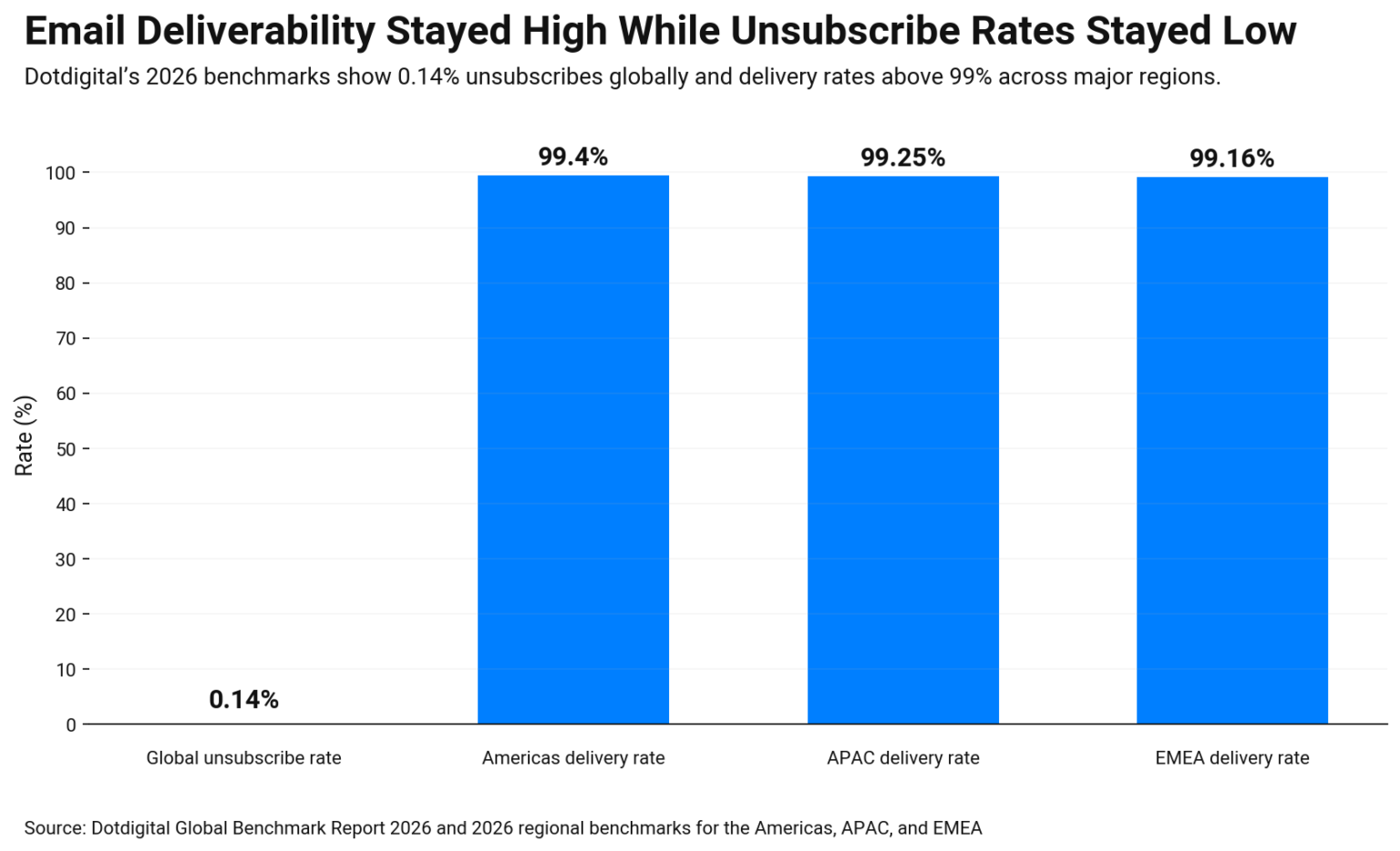
The global average unsubscribe rate is just 0.14%, while delivery rates remain above 99% in major regions
Email deliverability still sets the floor for every other metric. Dotdigital’s 2026 benchmark reporting shows a global unsubscribe rate of 0.14%, while regional delivery rates reach 99.4% in the Americas, 99.25% in APAC, and 99.16% in EMEA. At the same time, Validity’s 2026 deliverability benchmark report is built on trillions of data points and highlights inbox placement as a growing focus for marketers going into 2026. Strong email performance, then, depends not only on writing or design, but also on whether messages reliably reach the inbox in the first place.
Taken together, these figures show that email marketing in 2026 still works best when it is targeted and well-timed. Email open rates, email flows, and email deliverability all point in the same direction: brands get better results when they send fewer generic messages and build stronger journeys around behavior, trust, and timing.
PPC and Paid Ads Statistics in 2026
PPC and paid ads in 2026 are under more pressure to prove efficiency. Costs are harder to control, platform automation is more common, and marketers are paying closer attention to profitability instead of scale alone. As a result, paid media teams now need clearer measurement, tighter structure, and a stronger view of where automation helps and where it still creates risk.
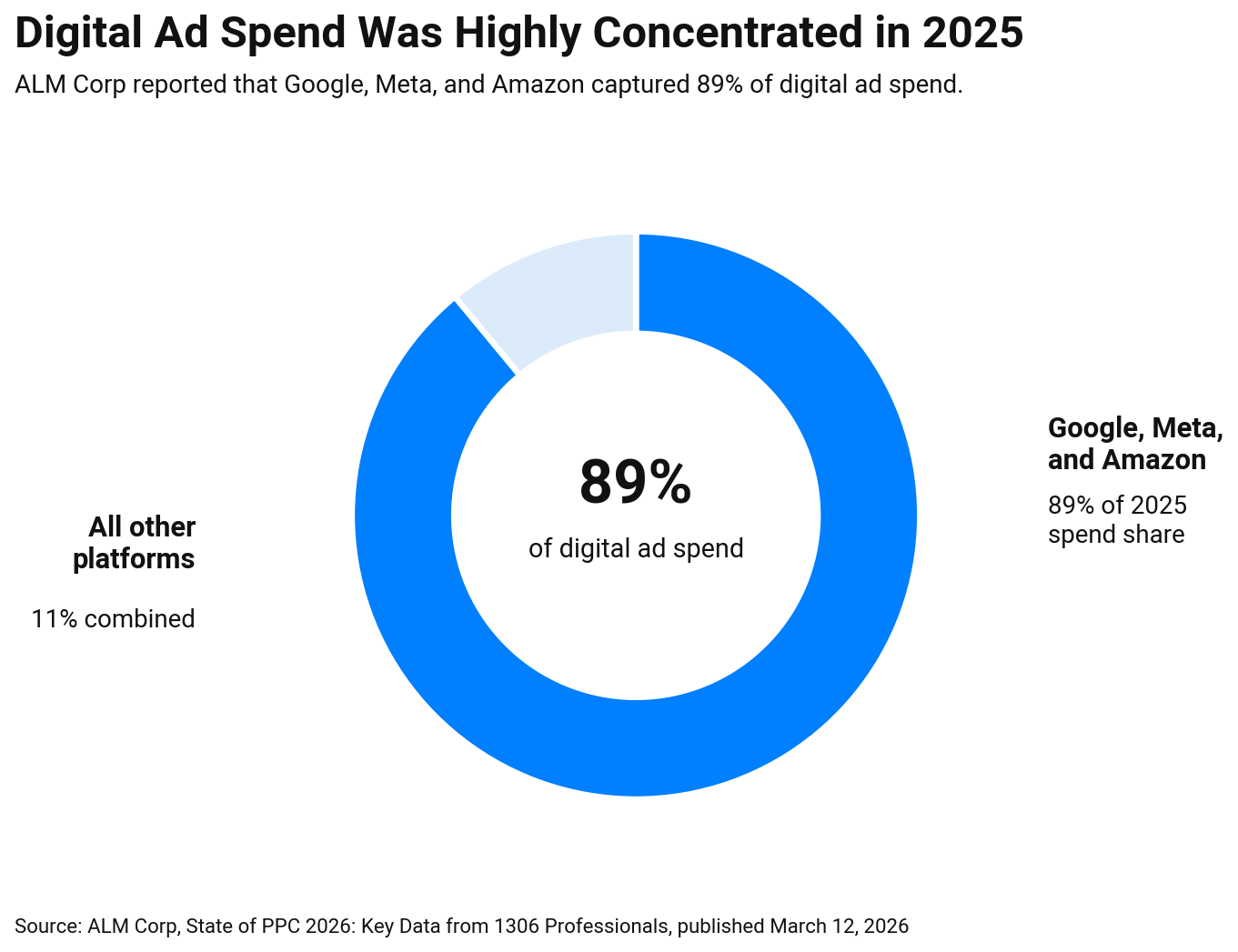
89% of digital ad spend in 2025 went to Google, Meta, and Amazon
Digital ad spend concentration is leaving marketers with a narrower platform field than many teams would like. In State of PPC 2026: Key Data from 1306 Professionals, ALM Corp found that Google, Meta, and Amazon absorbed almost all major paid media budgets, which shows how strongly performance marketing still depends on a small group of ad ecosystems. That creates less room for easy diversification and makes platform policy changes, automation shifts, and auction pressure more important for advertisers in 2026.
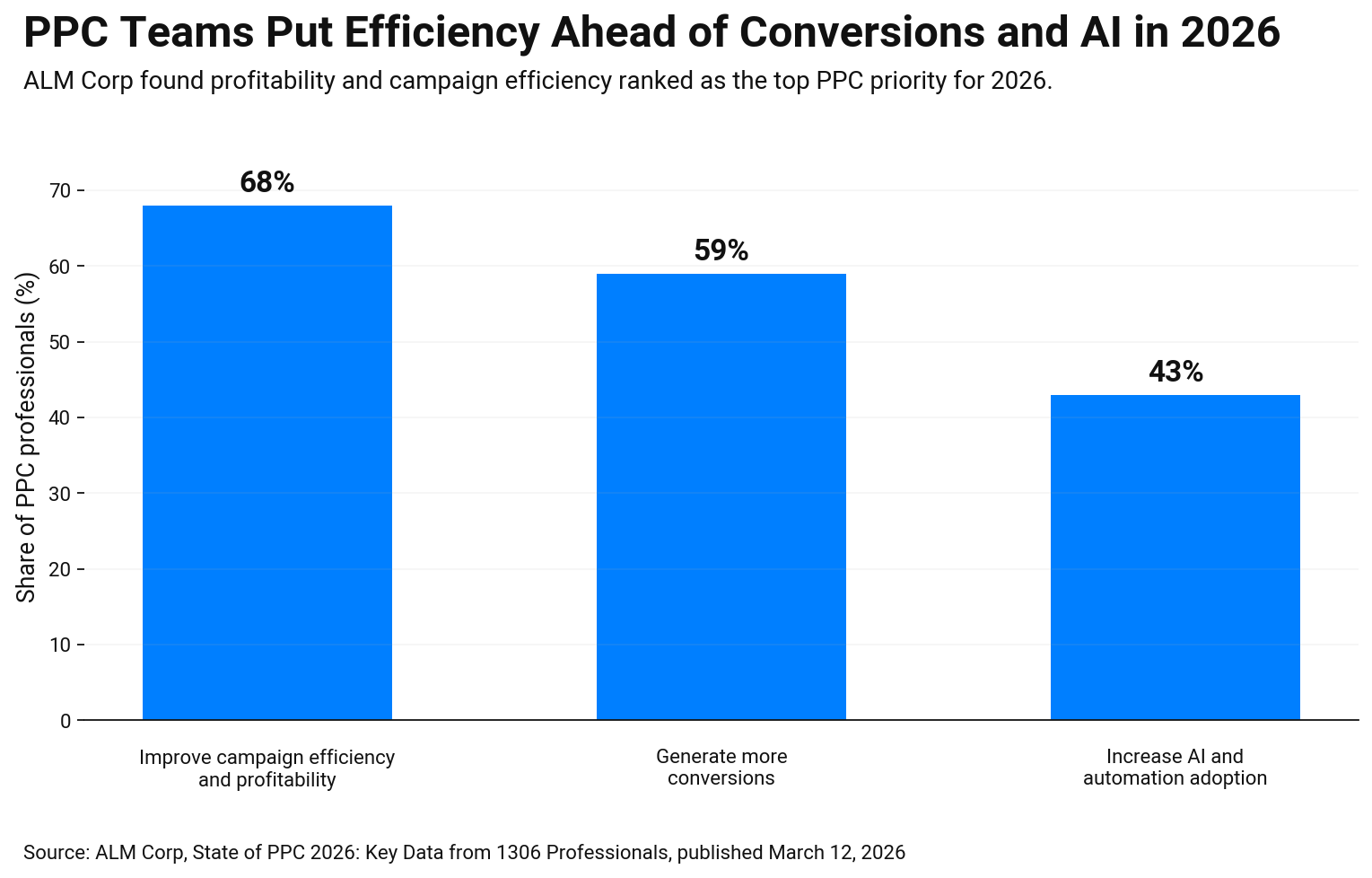
68% of PPC professionals say improving campaign efficiency and profitability is their top priority in 2026
Campaign efficiency and profitability are now sitting above experimentation for many paid teams. In State of PPC 2026: Key Data from 1306 Professionals, efficiency and profitability ranked ahead of generating more conversions and ahead of AI adoption itself. That ranking shows how the paid media conversation has shifted. Marketers still want growth, of course, but they are being pushed to show cleaner returns from the budget they already manage.
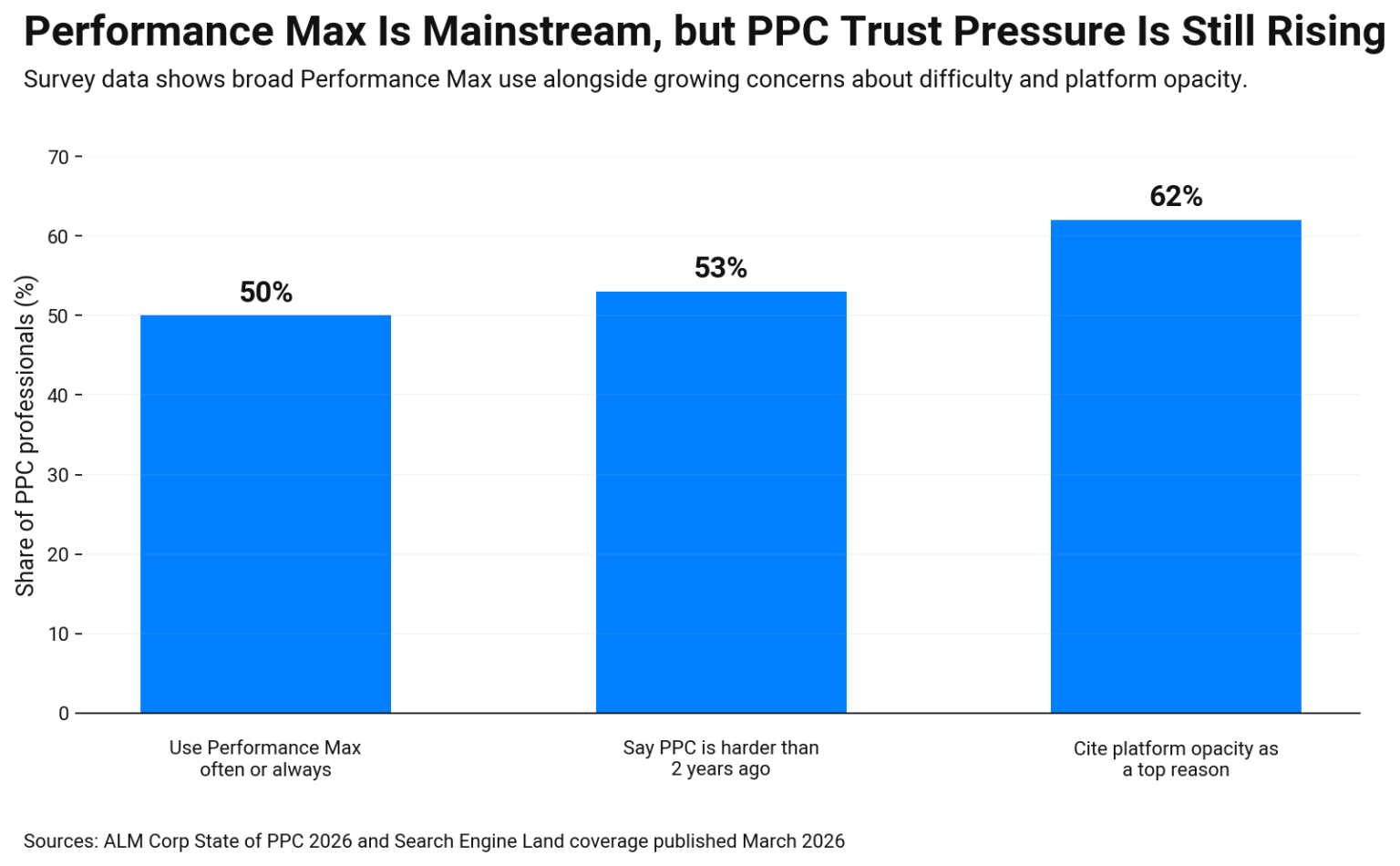
50% of respondents say they use Performance Max often or always
Performance Max adoption is now mainstream, even though trust in the format is still mixed. Search Engine Land’s March 2026 coverage of the same 1.3K-plus professional survey notes that PPC platforms are becoming harder to trust and that automation has not removed the daily pressure many teams face. That leaves advertisers in a familiar position: they are using automated campaign types heavily, yet they still need close oversight because platform opacity remains a real concern.
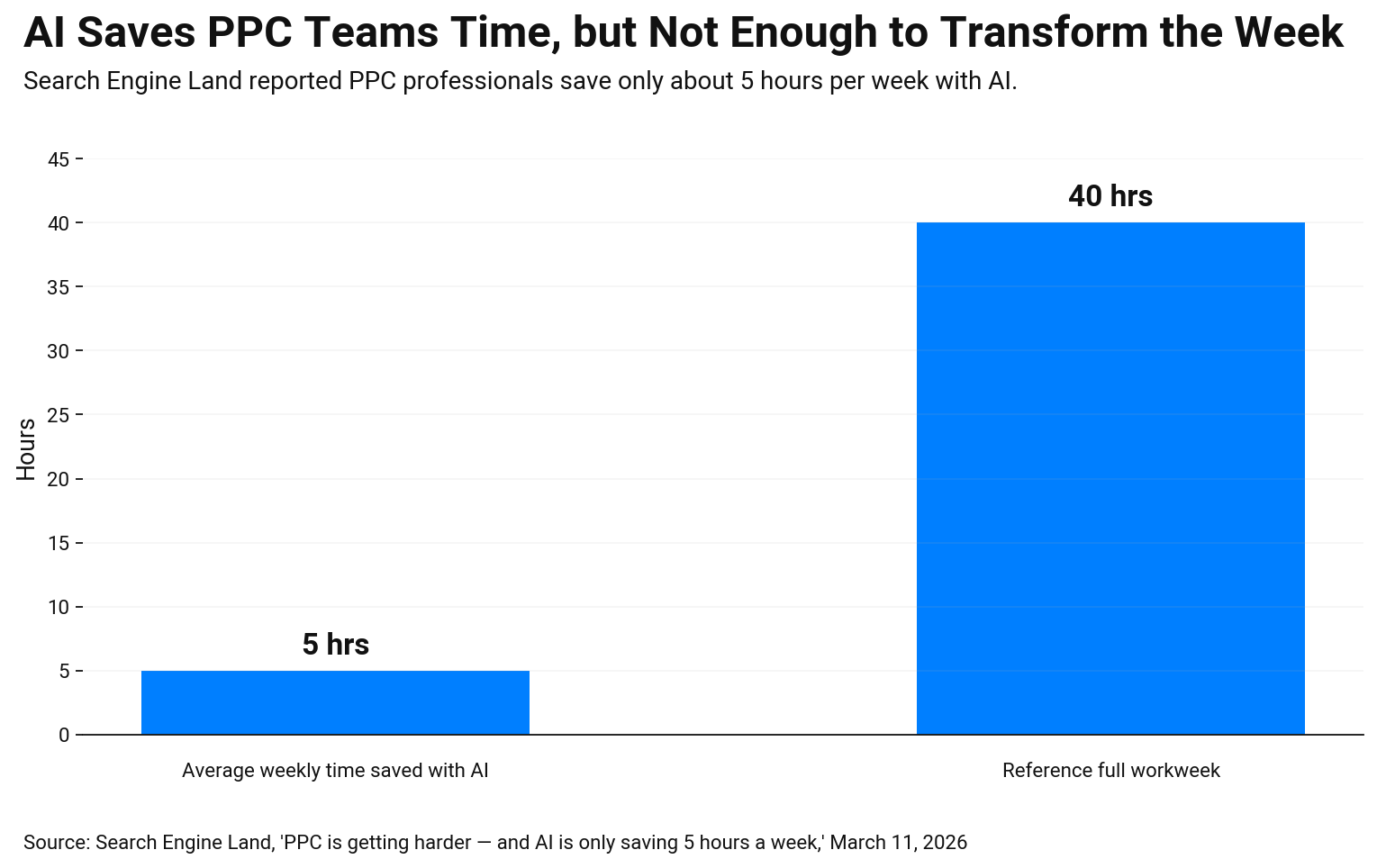
AI tools are saving PPC professionals only about 5 hours per week on average
AI time savings are helping, but not enough to transform paid media work on their own. In Survey: PPC is getting harder — and AI is only saving 5 hours a week, Search Engine Land reports that AI has not become the full operational rescue many expected. That matters because 2026 paid advertising is still shaped by budget pressure, reporting demands, creative testing, and platform complexity. AI can support the workflow, yet it is not removing the need for judgment.
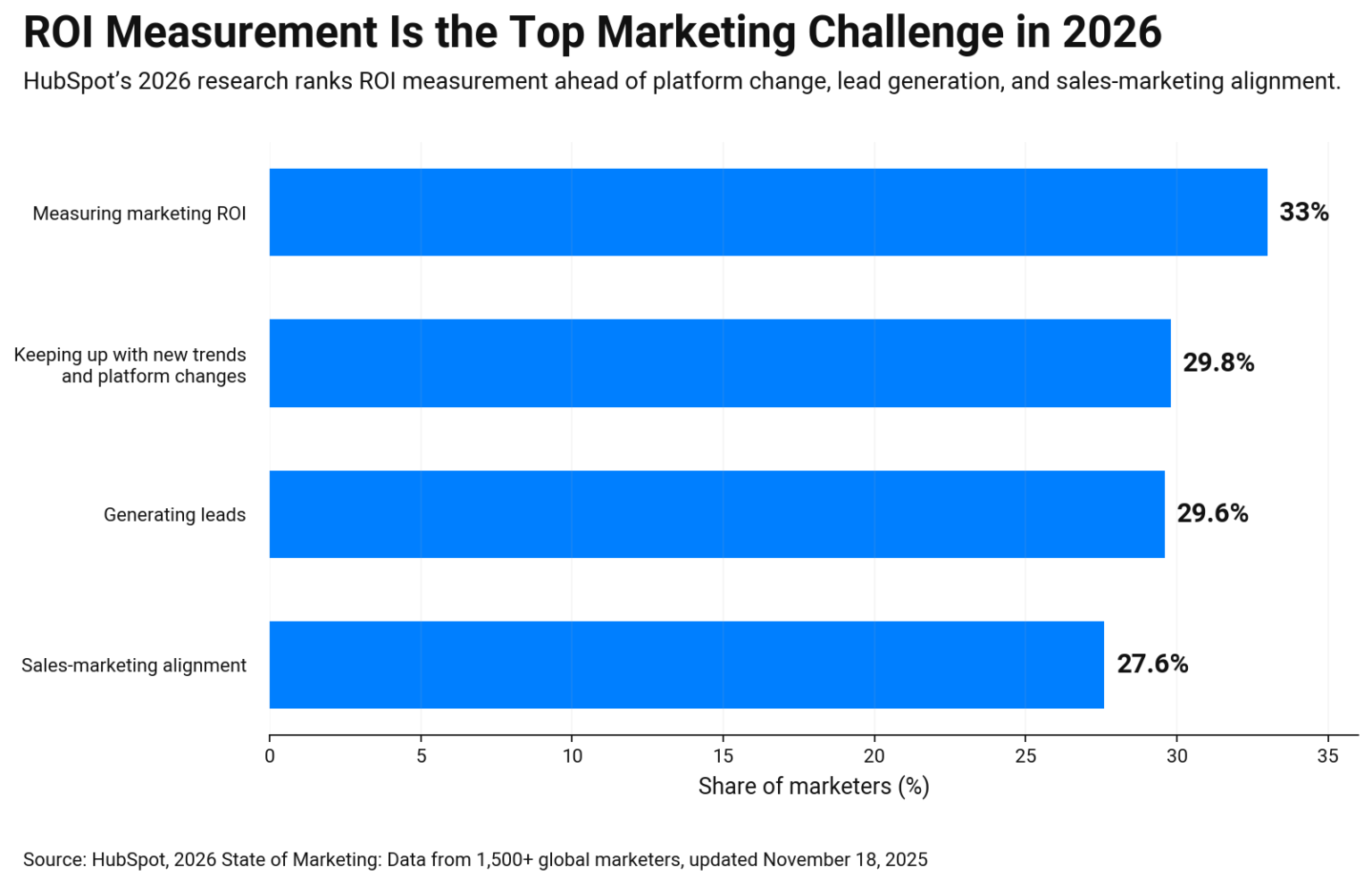
33% of marketers say measuring marketing ROI is their biggest challenge in 2026
Marketing ROI measurement continues to weigh on paid performance work because ad spend is easy to track, while full business impact is much harder to prove. In 2026, the state of marketing: Data from 1500+ global marketers, HubSpot reports that ROI measurement is the top challenge marketers face this year. That helps explain why paid media teams are becoming more careful with spend, attribution, and reporting standards instead of focusing only on campaign delivery metrics.
Taken together, these figures show that paid ads in 2026 are becoming more concentrated, more automated, and more accountable. Digital ad spend concentration, campaign efficiency and profitability, and marketing ROI measurement now shape how paid teams make decisions. Strong PPC work still depends on scale, but scale alone is not enough when budgets are under closer review and trust in platform automation remains uneven.
Ecommerce and Conversion Statistics in 2026
Ecommerce and conversion in 2026 are becoming harder to separate from user experience. Traffic still matters, of course, but growth now depends more on what happens after the visit starts. Acquisition is getting more expensive, buying journeys are more fragmented, and small points of friction can block revenue faster than before.
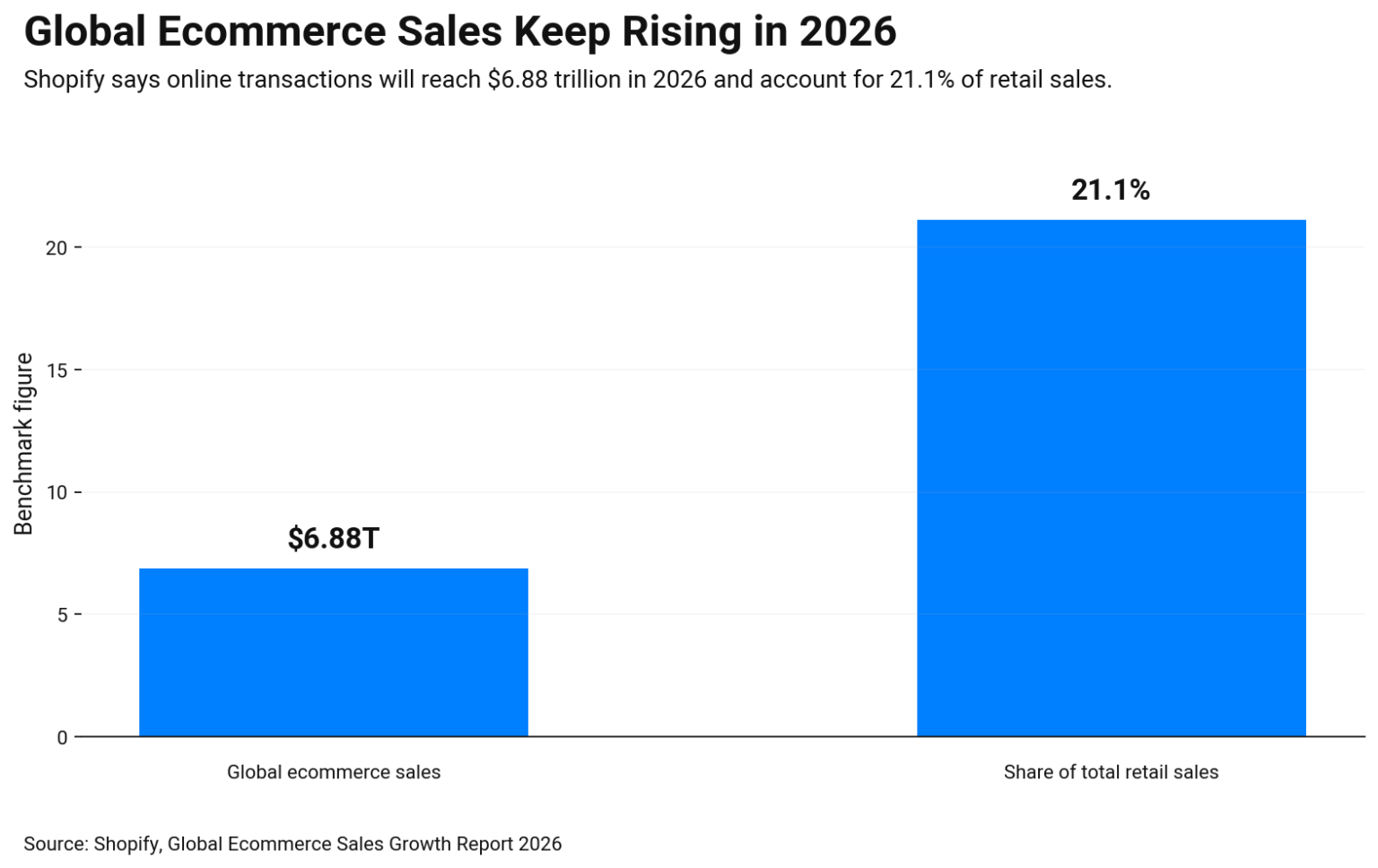
Online transactions are set to reach $6.88 trillion in 2026, up 7.2% from 2025
Global ecommerce sales are still growing, which means demand is there, but competition is rising with it. In Global Ecommerce Sales Growth Report (2026), Shopify says ecommerce will make up 21.1% of total retail sales this year. That gives brands more room to win online, yet it also means more businesses are fighting for the same attention, clicks, and purchase intent.
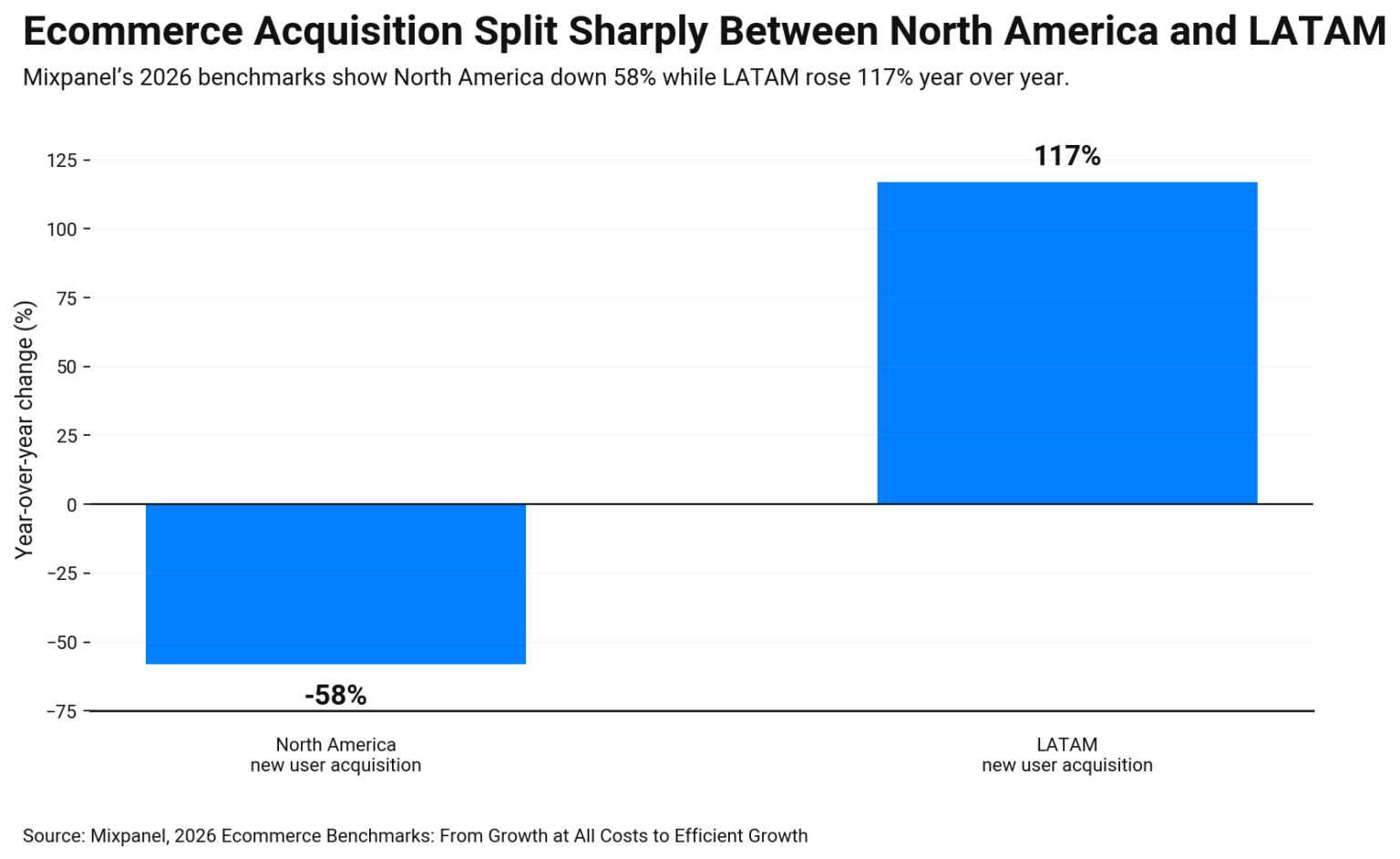
North America saw a 58% drop in new user acquisition in Mixpanel’s 2026 ecommerce benchmarks
New user acquisition is becoming less reliable as a stand-alone growth path in mature markets. In 2026 Ecommerce Benchmarks: From Growth at All Costs to Efficient Growth, Mixpanel shows that North America moved sharply in the opposite direction from LATAM, where acquisition grew 117% year over year. That contrast suggests many ecommerce teams are becoming more selective with spend and are putting more weight on activation quality and long-term value instead of chasing traffic at any cost.
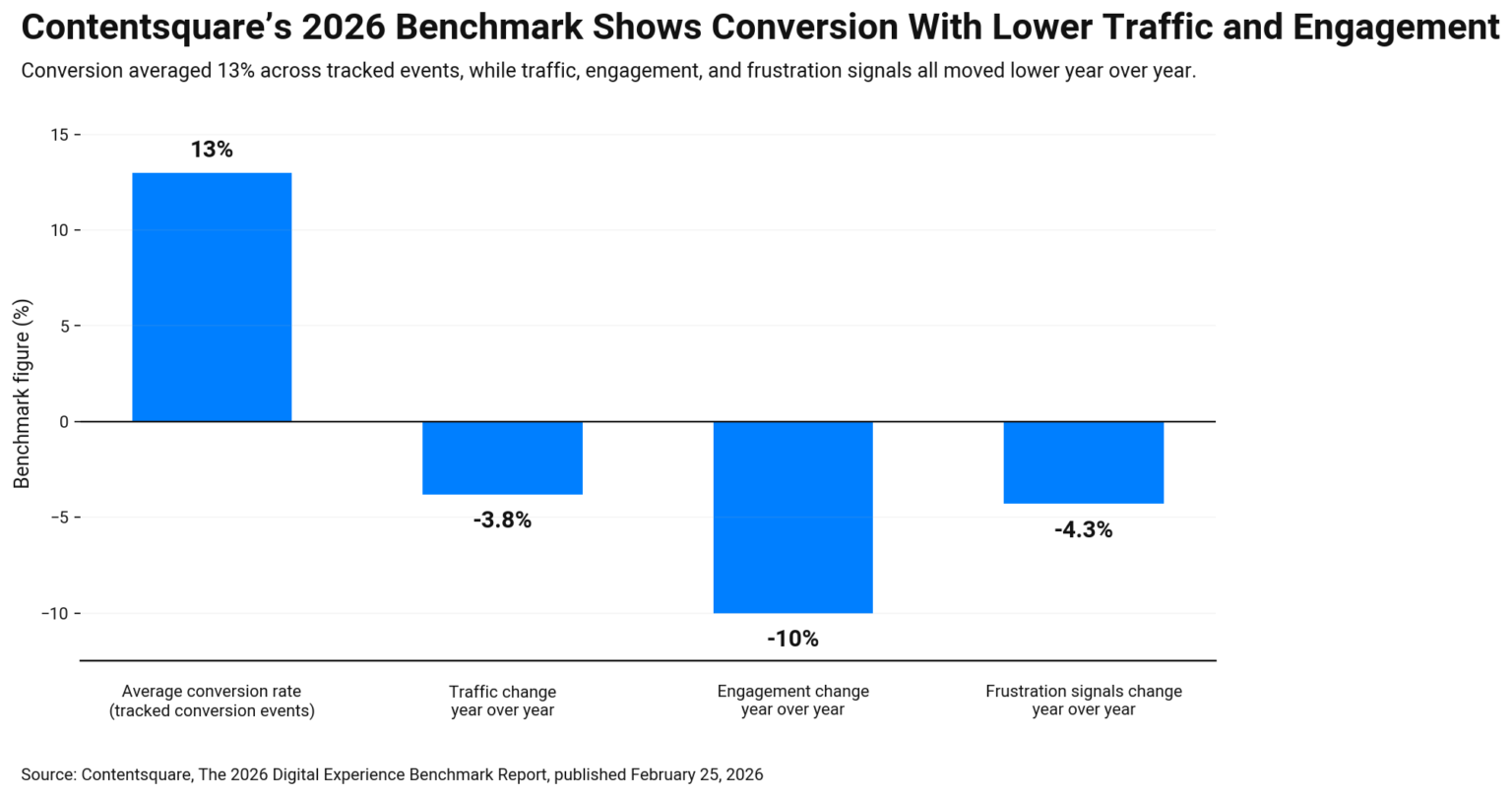
Contentsquare’s 2026 benchmark puts the average website conversion rate at 13% across tracked conversion events
Website conversion rate needs careful reading in 2026 because benchmarks often include more than completed purchases. In Digital Experience Benchmark 2026, Contentsquare defines conversion as any tracked event, such as a purchase or form submission, and the same dataset also shows traffic down 3.8%, engagement down 10%, and frustration up 4.3%. That combination points to a wider issue: visits are becoming harder to earn, while weaker experiences make each visit easier to lose.
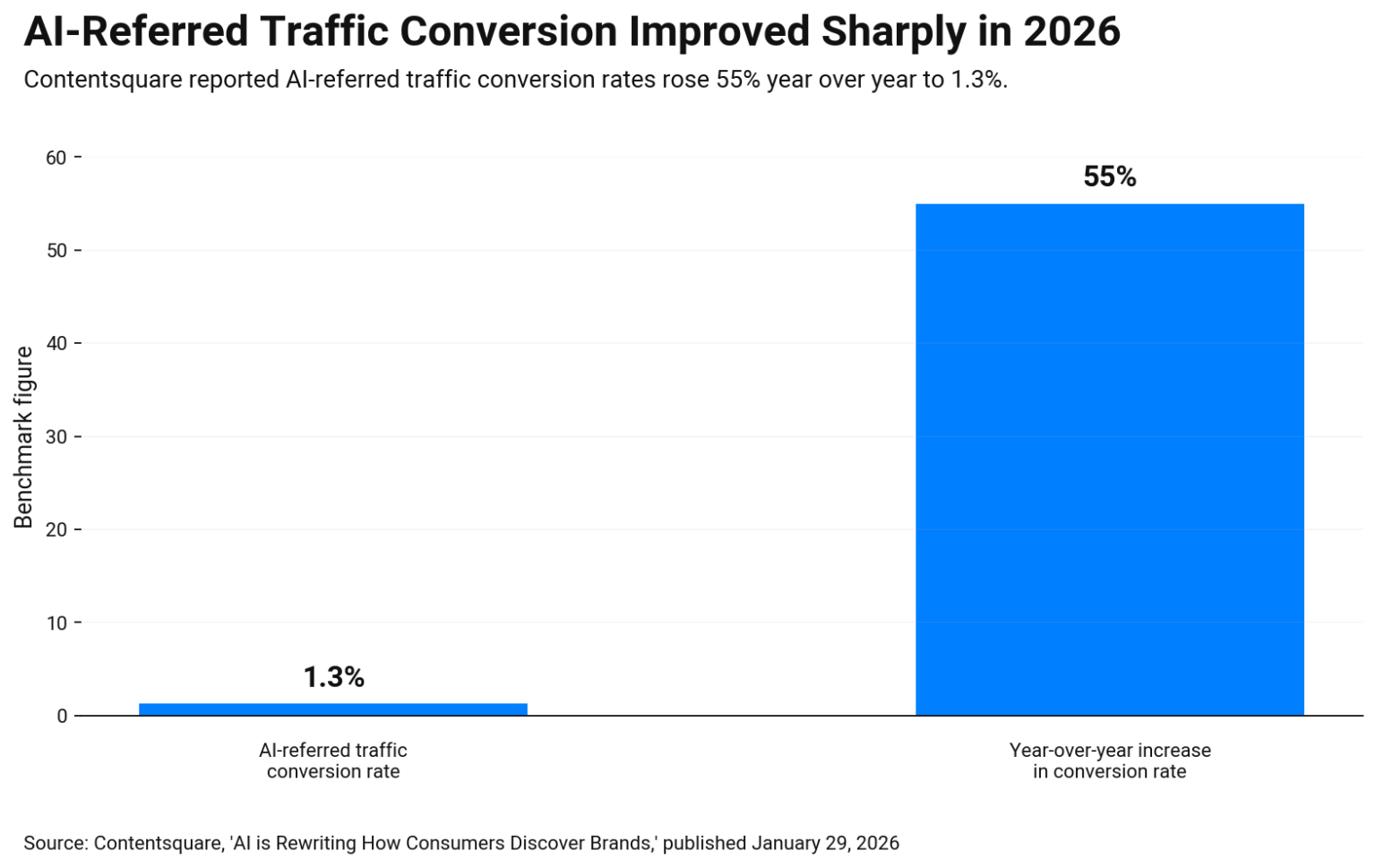
AI-referred traffic conversion rates rose 55% year over year to 1.3%
AI-referred traffic is starting to look more valuable than many brands expected. In AI is Rewriting How Consumers Discover Brands, Contentsquare reports that conversion performance from AI-influenced visits is improving and beginning to behave more like high-intent search traffic. That matters because discovery is spreading across new surfaces, and ecommerce brands now need to think about how product pages, category pages, and supporting content perform when users arrive from AI-assisted journeys.
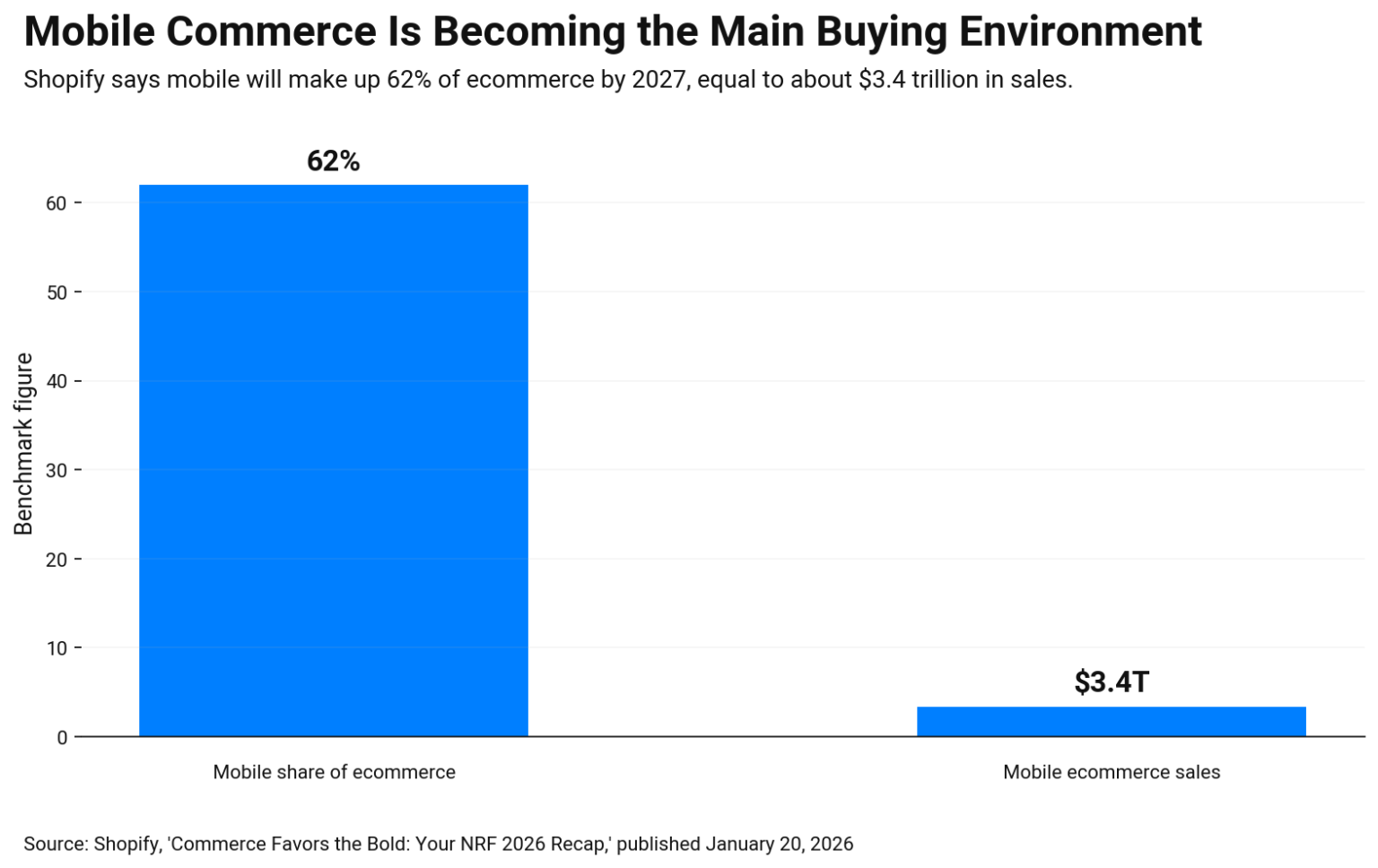
62% of ecommerce is expected to be mobile by 2027, representing $3.4 trillion in total sales
Mobile ecommerce is pushing brands to treat smaller screens as the main buying environment, not a secondary one. In Commerce Favors the Bold: Your NRF 2026 Recap, Shopify links this shift to Gen Z behavior and social commerce growth. That direction is close enough to reshape planning now, because a weak mobile experience can damage product discovery, trust, checkout flow, and repeat buying all at once.
Taken together, these figures show that ecommerce in 2026 is growing, but it is also getting less forgiving. Global ecommerce sales, new user acquisition, and AI-referred traffic all point to the same shift: brands need stronger experiences, clearer conversion paths, and better retention logic if they want growth that holds up under pressure.
AI in Marketing Statistics in 2026
AI in marketing in 2026 is moving from testing into daily execution. Teams are using it across content, media, research, and workflow support, yet stronger adoption is also bringing more pressure around trust, quality, and governance. That means AI is no longer a side tool for marketers. It is becoming part of the operating layer behind how campaigns are planned and delivered.
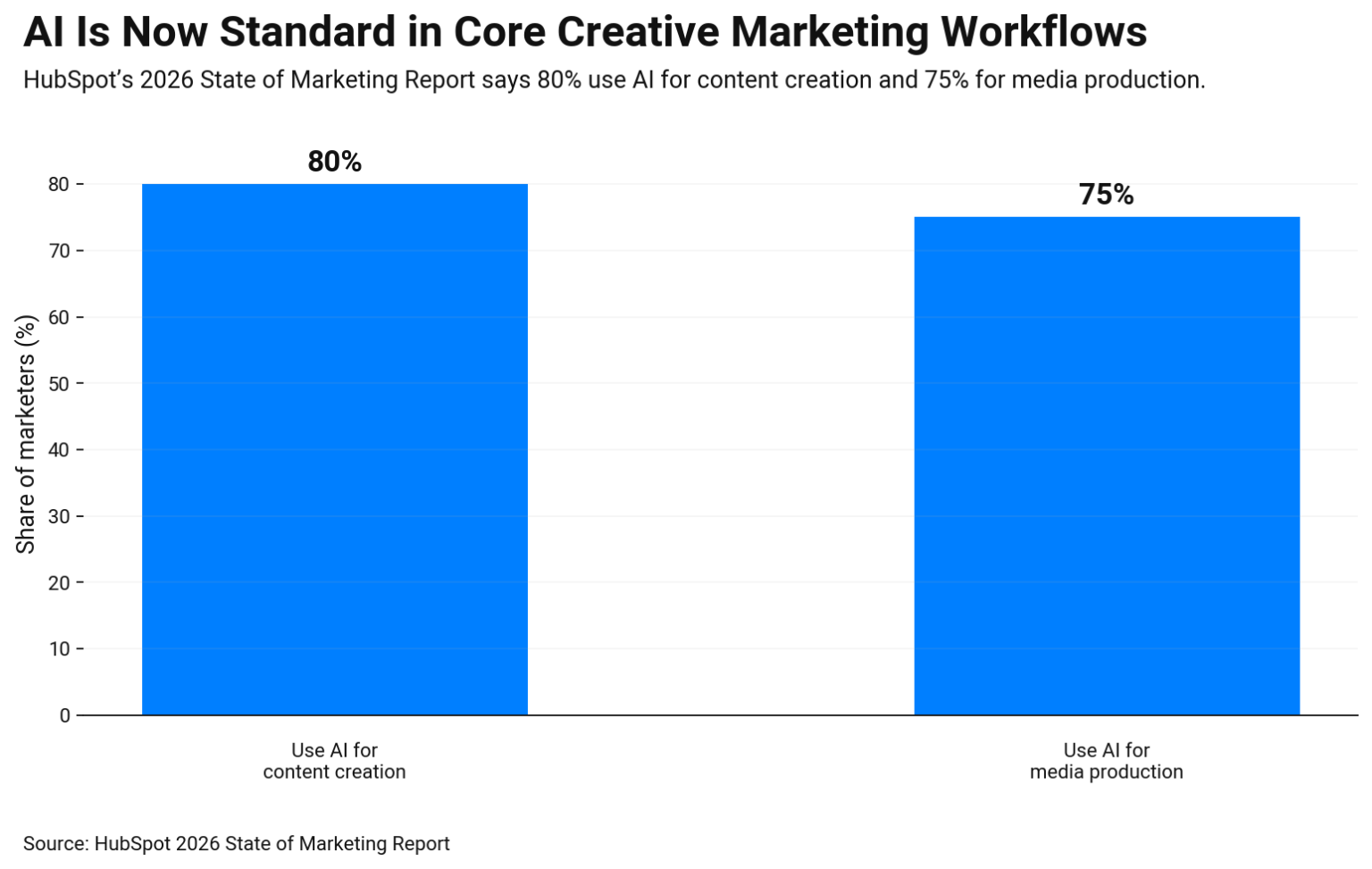
80% of marketers use AI for content creation, while 75% use it for media production
AI content creation is now part of normal marketing work rather than a niche experiment. In the 2026 State of Marketing Report, HubSpot shows that AI is already built into core creative workflows, especially for content and media tasks. That level of use suggests most teams are no longer asking whether AI belongs in marketing. They are deciding where it helps most and where human review still matters more.
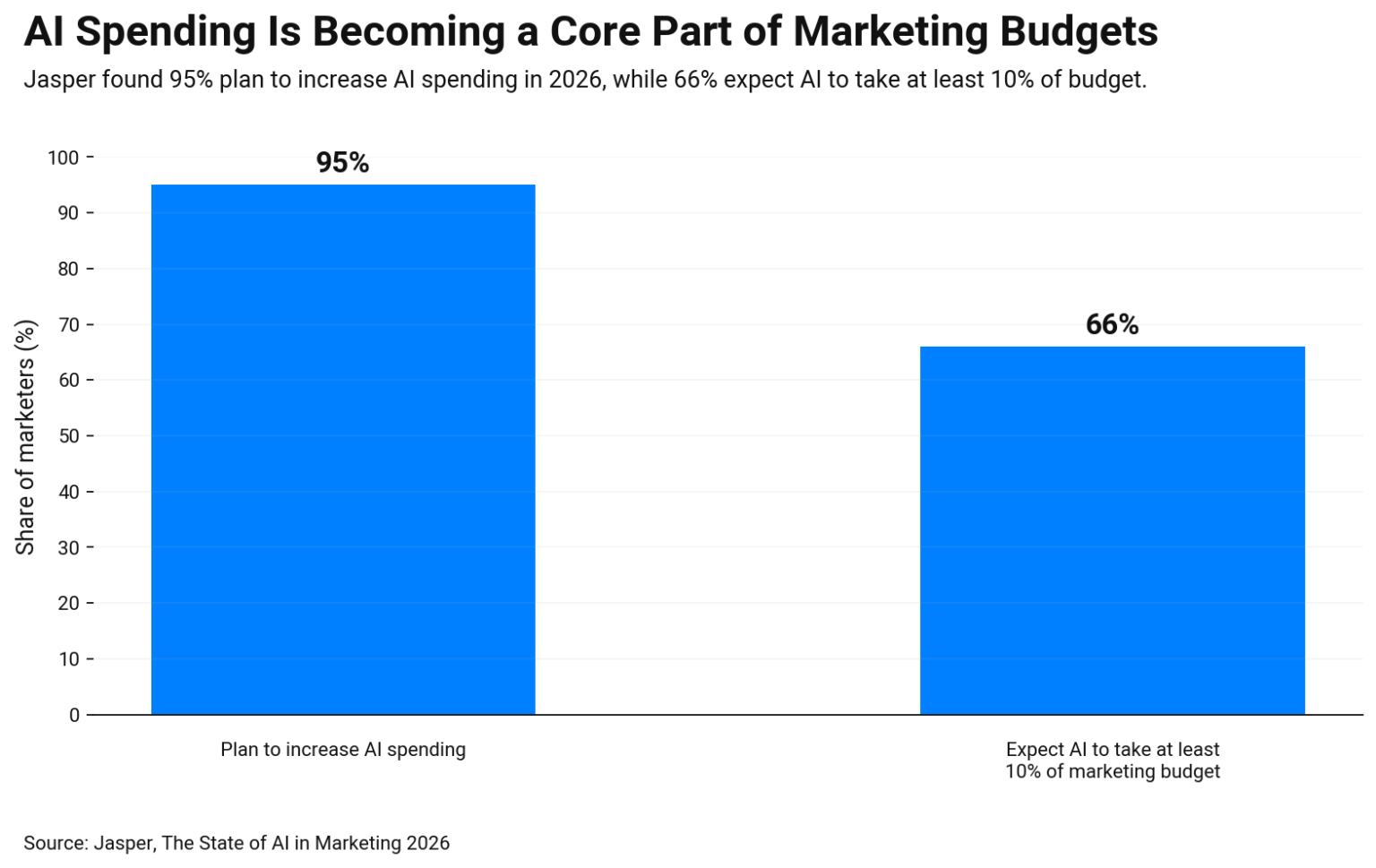
95% of marketers plan to increase AI spending in 2026, and 66% expect to allocate at least 10% of their marketing budget to AI
AI investment is rising because many teams now see these tools as long-term infrastructure. In The State of AI in Marketing 2026, Jasper reports that spending is growing even as governance and measurement remain difficult for many organizations. That points to a more serious phase of adoption. Marketers are no longer treating AI as a short trial. They are budgeting for it as part of ongoing operations.
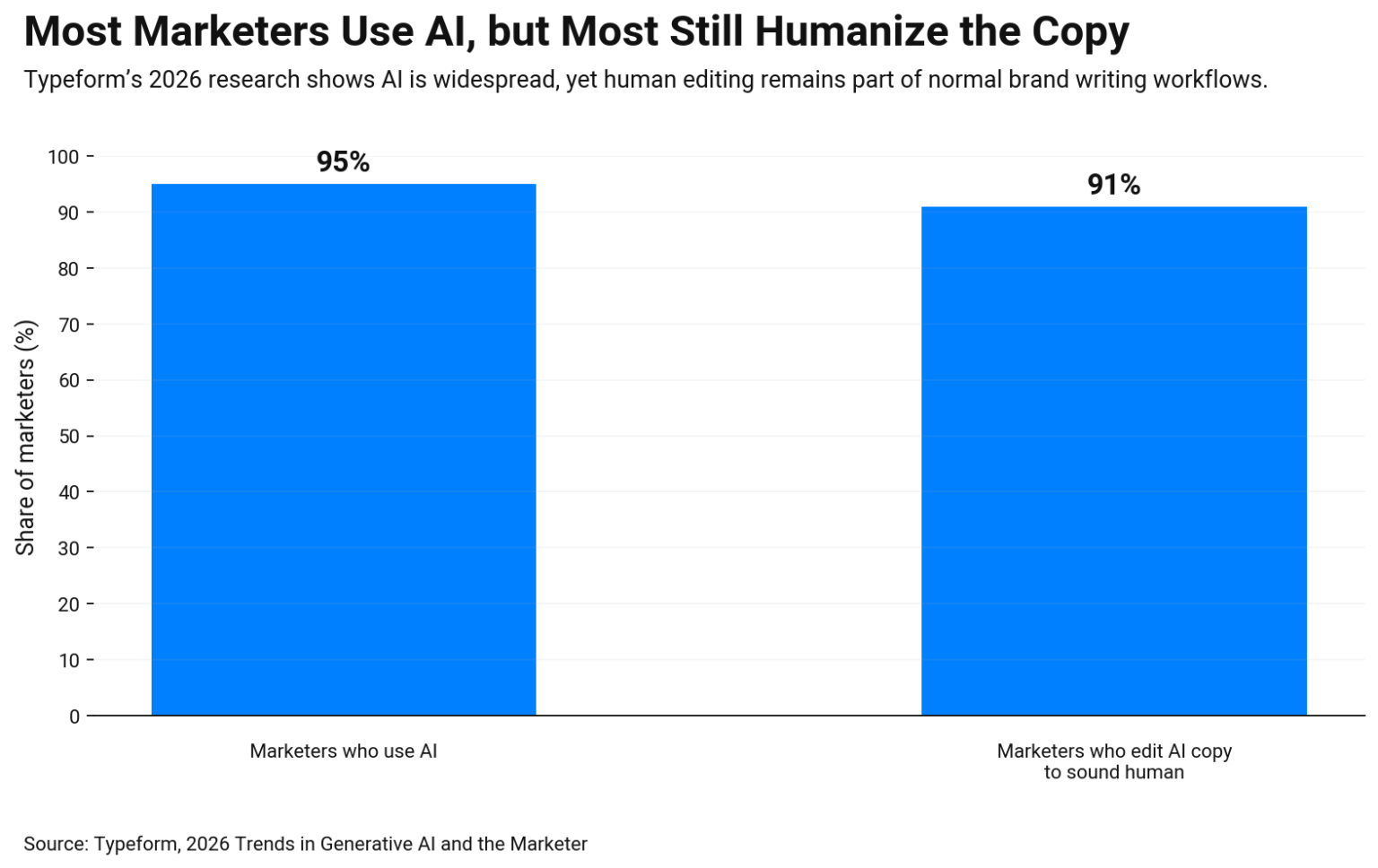
95% of marketers now use AI, but 91% say they at least sometimes edit AI copy to make it sound human
AI-generated copy still needs human judgment before it can represent a brand well. In 2026 Trends in Generative AI and the Marketer, Typeform found that adoption is extremely high, yet most marketers still revise AI writing for tone, clarity, and natural flow. That gap matters because speed alone does not create trust. Teams may use AI to move faster, but brand quality still depends on human shaping and audience awareness.
50% of consumers say they would rather buy from brands that avoid GenAI in consumer-facing content
Consumer trust is becoming one of the biggest limits on visible AI use. In Gartner Marketing Survey Finds 50% of Consumers Prefer Brands That Avoid Using GenAI in Consumer-Facing Content, Gartner shows that many buyers are still cautious when AI appears directly in brand messages. That makes transparency, editing standards, and content credibility more important in 2026, especially for businesses that publish large amounts of customer-facing material.
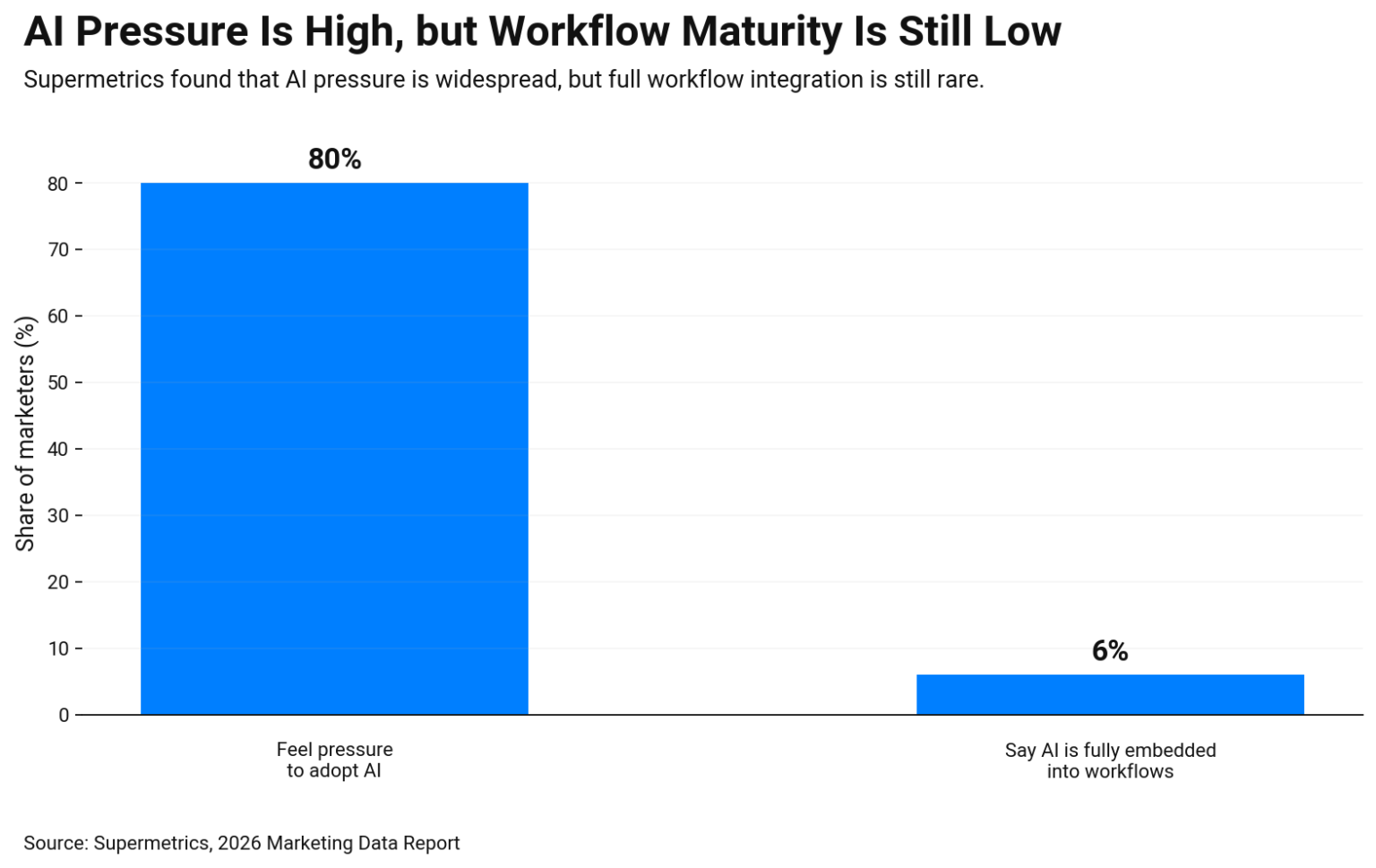
80% of marketers feel pressure to adopt AI, but only 6% say it is fully embedded into their workflows
AI workflow maturity is still much lower than adoption headlines suggest. In 2026 Marketing Data Report, Supermetrics found that many marketers feel pushed to use AI, yet only a small minority have actually built it deeply into day-to-day systems. That difference helps explain why many teams still struggle with process, ownership, and measurement. Using AI once is easy. Building it into a reliable workflow is much harder.
Taken together, these figures show that AI in marketing in 2026 is expanding fast, but it is not replacing judgment. AI content creation, AI investment, and AI workflow maturity point to the same reality: marketers are using AI widely, yet quality, trust, and operational discipline still decide whether that use creates real value.
Digital Marketing KPI and Measurement Statistics in 2026
Digital marketing measurement in 2026 is becoming harder to simplify into one dashboard. Teams still have more data than before, yet better reporting does not always mean better clarity. Because of that, marketers are paying closer attention to lead quality, conversion value, attribution strength, and how clearly performance connects to revenue.
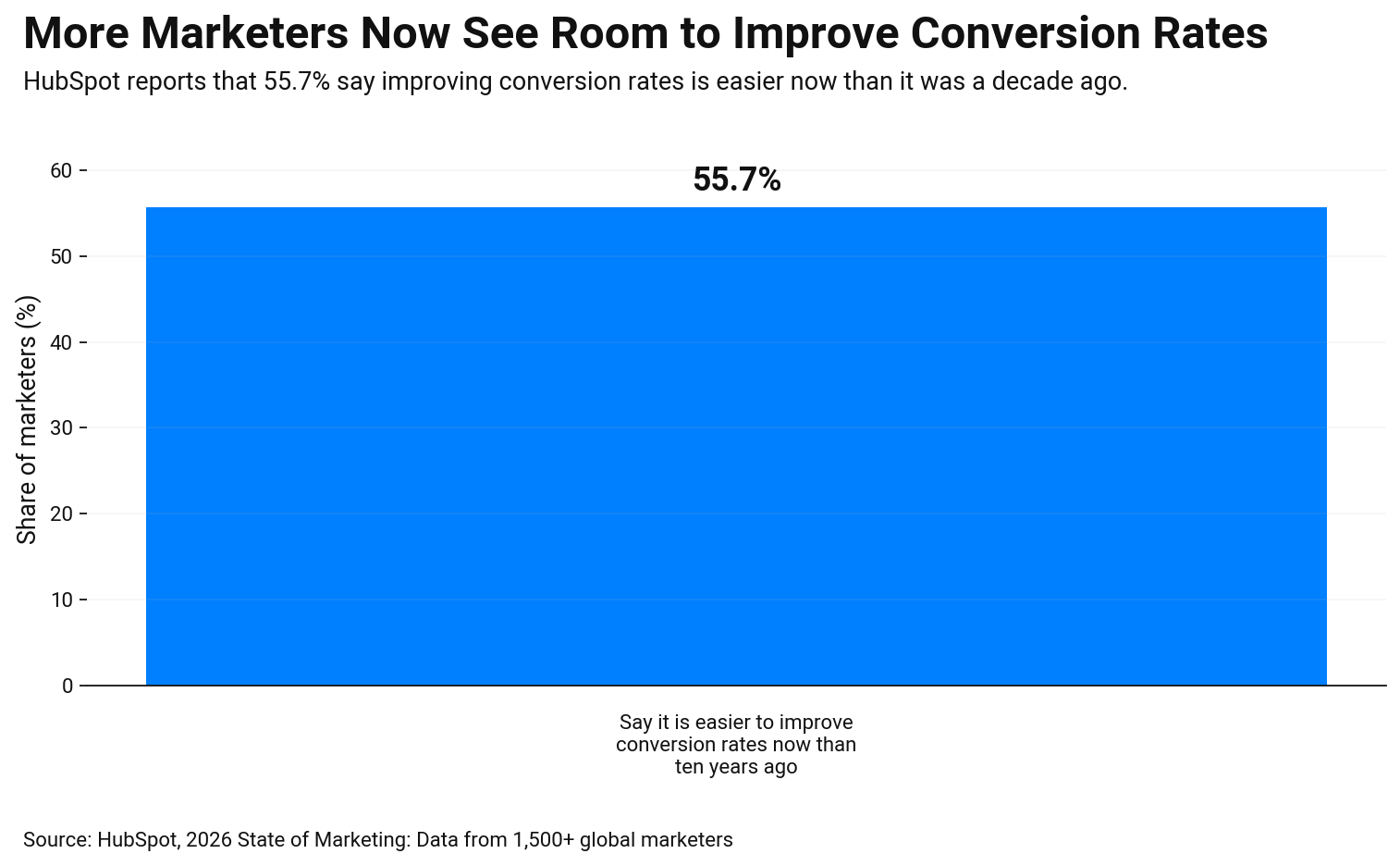
Nearly 56% of marketers say it is much easier to improve conversion rates now than it was ten years ago
Conversion rate improvement is getting more attention because traffic is harder to win and more expensive to replace. In 2026 Marketing Statistics, Trends, & Data, HubSpot shows that marketers see more room to improve results after the click, which fits the wider 2026 shift toward efficiency and stronger use of existing demand. That makes conversion work more central to digital marketing performance than before.
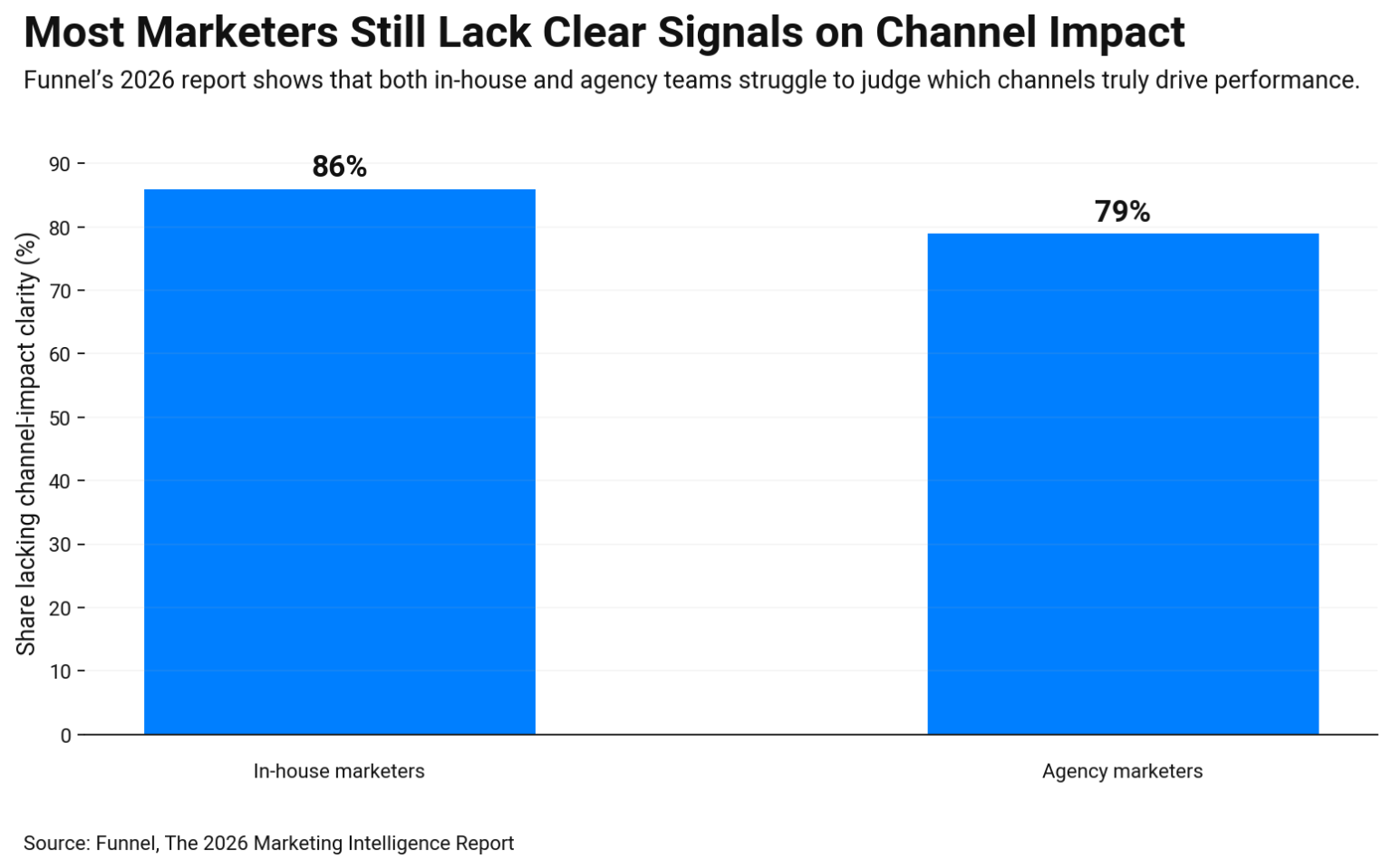
86% of in-house marketers and 79% of agency marketers say they do not have a clear signal through the noise when judging channel impact
Channel measurement clarity is still missing for many teams, even though reporting tools are more advanced. In The 2026 Marketing Intelligence Report, Funnel found that most marketers struggle to determine how each channel affects overall performance. When attribution is unclear, budget decisions become harder, reporting gets weaker, and strong channels can be undervalued.
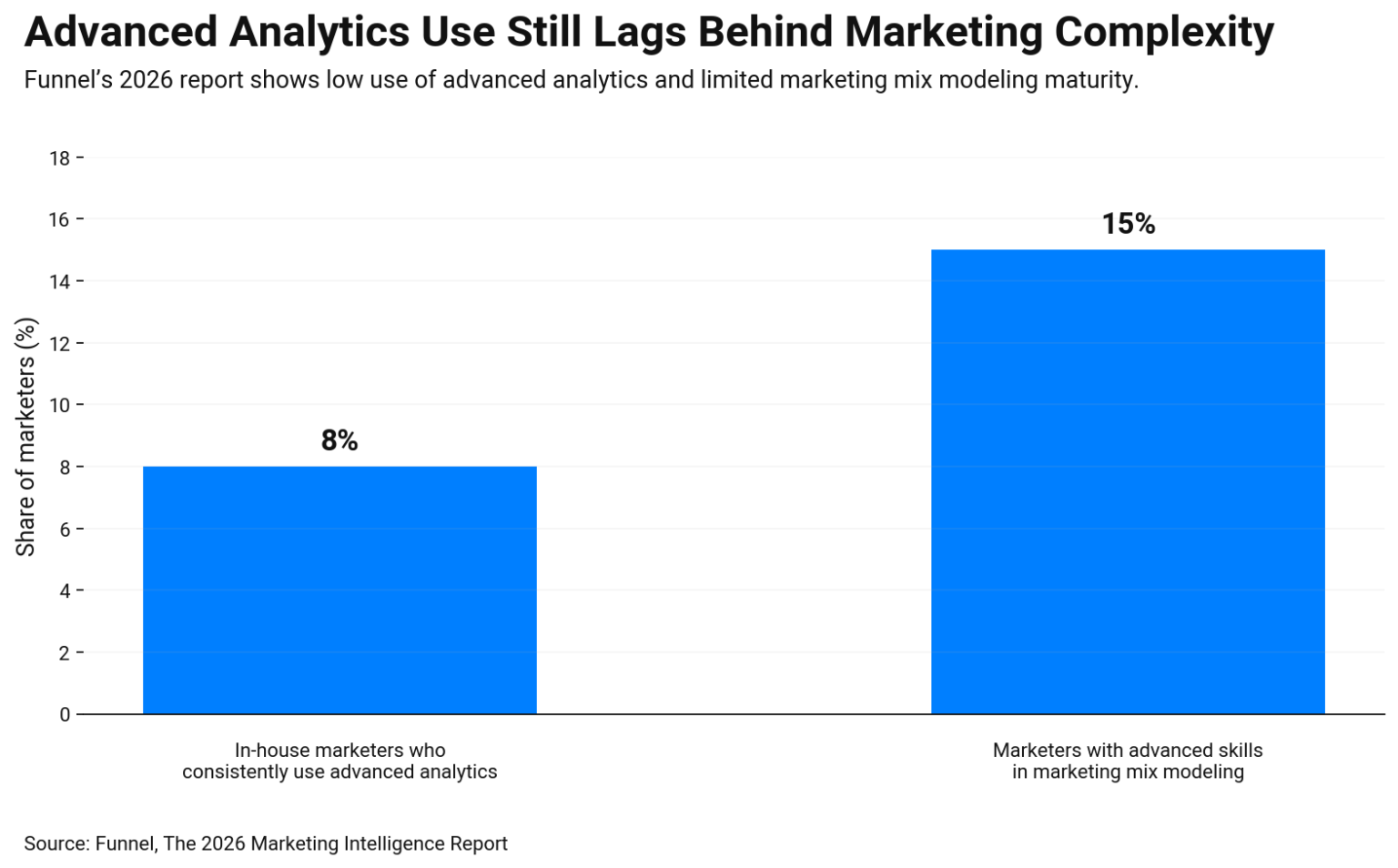
Only 8% of in-house marketers consistently use advanced analytics, while just 15% say they have advanced skills in marketing mix modeling
Advanced analytics use is still far behind the complexity of modern marketing. In The 2026 Marketing Intelligence Report, Funnel shows that methods such as marketing mix modeling, incrementality testing, and attribution modeling remain out of reach for most teams. That gap helps explain why many businesses still lean too heavily on surface metrics even when customer journeys have become more fragmented.
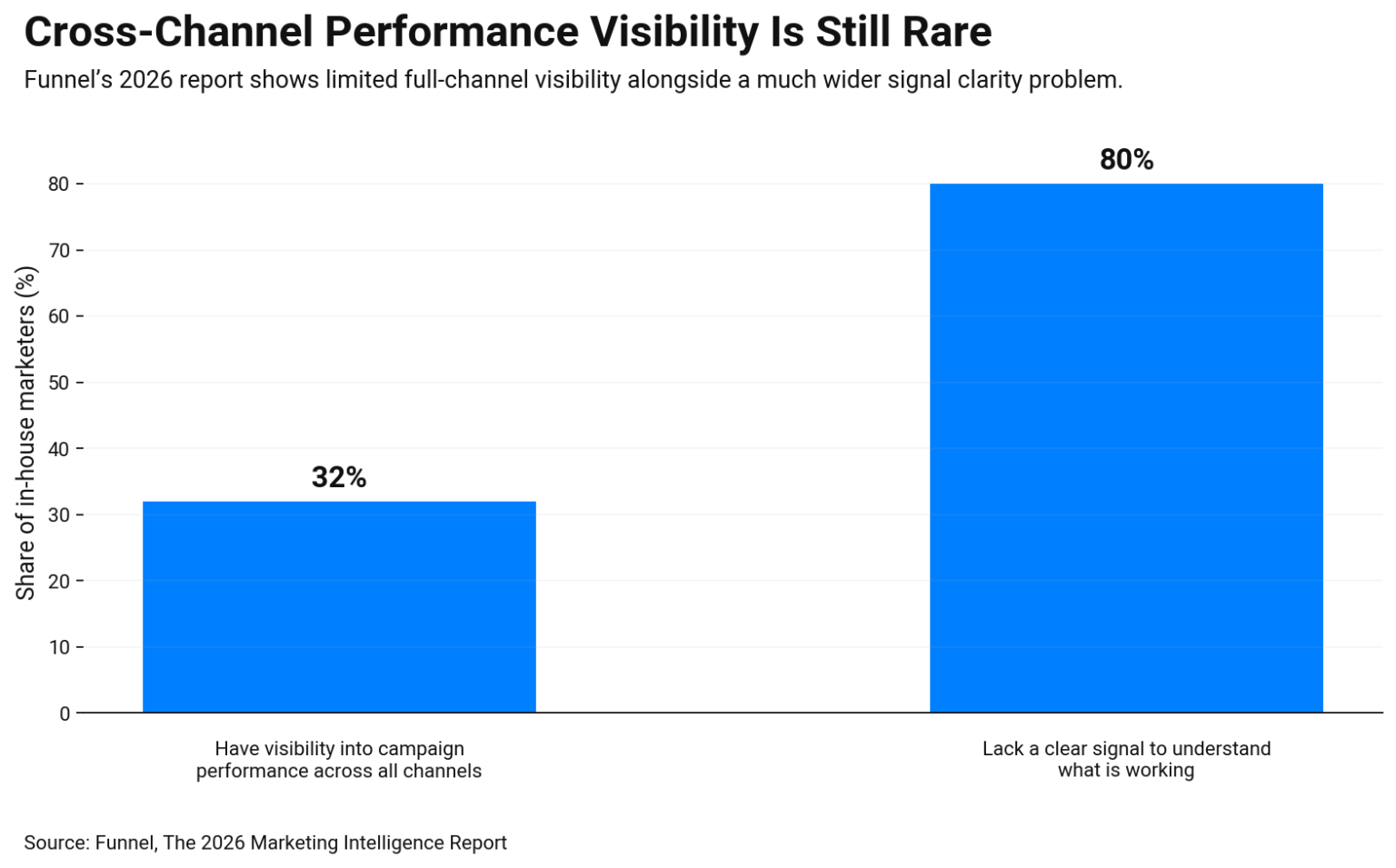
Only 32% of in-house marketers say they have visibility into campaign performance across all channels
Cross-channel visibility remains weak, which limits how well marketers can compare efforts and reallocate budget. Funnel’s 2026 report shows that full performance visibility is still rare, while more than 80% of marketers say they lack a clear signal that helps them understand what is working. Better measurement in 2026 depends as much on data structure and reporting discipline as it does on the tools themselves.
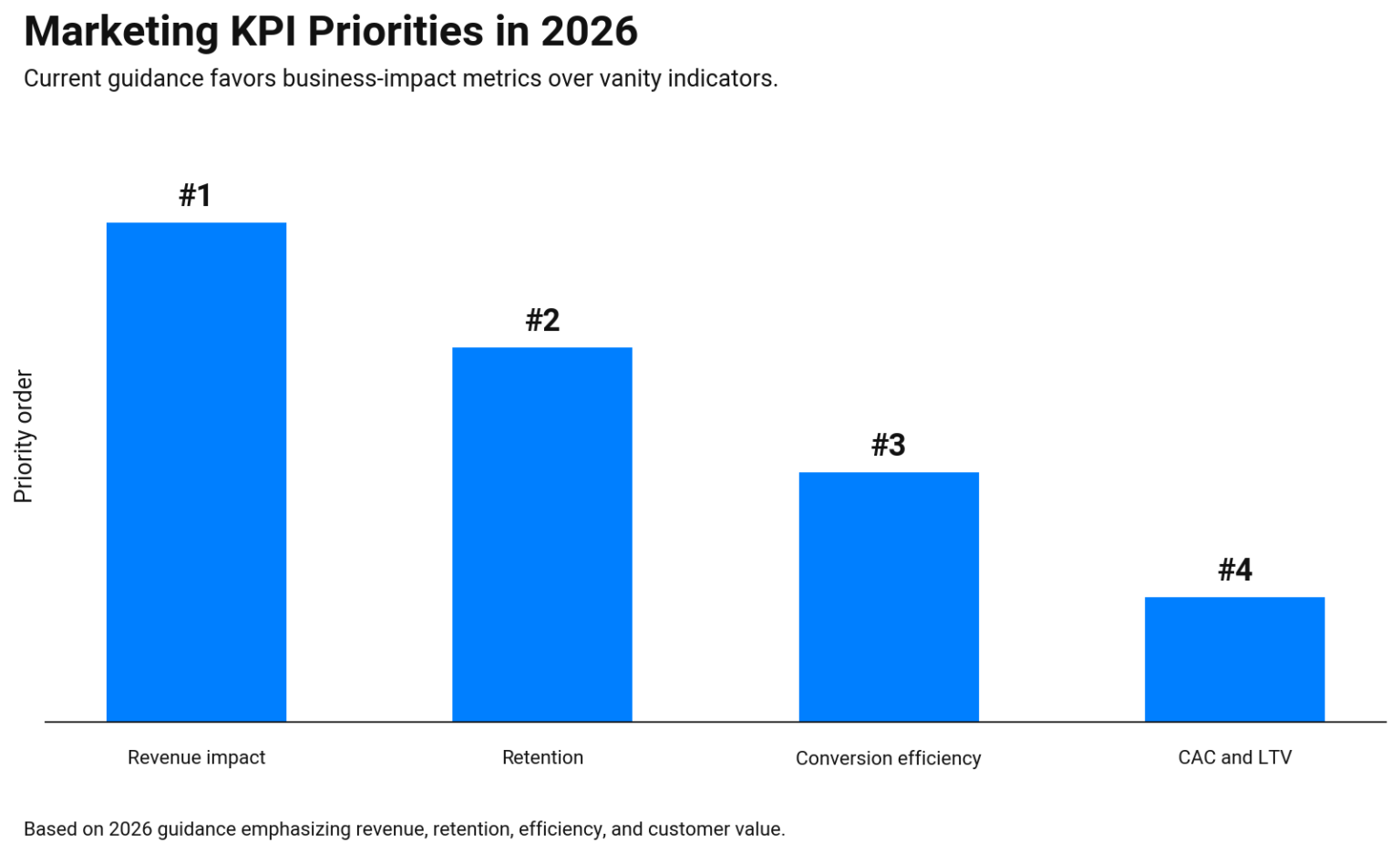
Marketing KPIs that matter most in 2026 are increasingly tied to revenue, retention, and conversion efficiency rather than vanity indicators
Marketing KPI selection is becoming more focused because leadership wants proof of business impact, not just activity. In Marketing KPIs: Essential Metrics to Track Performance in 2026, monday.com argues that lead quality, conversion efficiency, customer acquisition cost, and lifetime value give a stronger view of performance than follower counts or page views. Search Engine Land’s 2026 SEO guidance points in the same direction by warning against traffic growth without a revenue context.
Taken together, these figures show that measurement in 2026 is moving toward stronger business alignment. Conversion rate improvement, channel measurement clarity, and marketing KPI selection now matter more because marketing teams are being judged less by activity and more by what they can prove.
Emerging Trends and Technologies in Digital Marketing
Digital marketing in 2026 is being shaped by a mix of AI, search changes, and stronger pressure to build trust. AI workflows are now part of normal marketing operations, with HubSpot reporting that 80% of marketers use AI for content creation and 75% use it for media production. At the same time, AI is no longer the main thing that makes a brand stand out. HubSpot’s 2026 report points instead to sharper brand point of view, better relevance, and more human-led work that helps brands stay distinct in crowded markets.
Google AI features are also changing how people discover information. Google explains that AI features in Search can expand the way users explore topics, which means visibility is no longer tied only to classic blue-link rankings. As a result, marketers now need content that supports broader discovery, follow-up questions, and stronger topical coverage across a site.
Paid media automation is growing as well, but it is not removing the need for judgment. ALM Corp’s 2026 PPC report shows that campaign efficiency and profitability are now the top priority for many professionals, while automated formats like Performance Max are already widely used. Together, these shifts show a clear direction: smarter tools matter, but trust, clarity, and careful decision-making matter just as much.
Conclusion
Digital marketing in 2026 is moving toward stronger quality, clearer measurement, and smarter use of technology. Search is changing, social platforms shape discovery, email still delivers value, and paid ads demand closer control. At the same time, AI is becoming part of daily marketing work, but trust and relevance still decide what performs well. These statistics show one clear pattern: brands do better when they focus on useful content, better targeting, stronger user experience, and metrics that connect marketing activity to real business results in a more consistent way.
Digital Marketing Statistics Frequently Asked Questions
What are digital marketing statistics?
Digital marketing statistics are numbers that show how people, platforms, and brands behave online. They can help businesses understand trends, compare performance, and decide where to focus time, budget, and effort.
Why do digital marketing statistics matter in 2026?
Digital marketing is changing fast in 2026. Search behavior, AI use, social media activity, and paid ad performance are all shifting. Fresh statistics help businesses understand what is happening now instead of relying on old patterns.
Which digital marketing channel is most important in 2026?
There is no single channel that fits every business. SEO, social media, email, paid ads, and ecommerce all play different roles. The best choice depends on your goals, audience, budget, and how people usually discover your brand.
Is AI changing digital marketing in 2026?
Yes, AI is changing how marketers create content, plan campaigns, study data, and support daily work. Even so, human judgment still matters because brands need accuracy, trust, and content that sounds natural.
Are older digital marketing statistics still useful?
Older statistics can help with background context, but they should not guide 2026 planning on their own. Platform behavior, customer expectations, and technology change quickly, so current data gives a better view.
How often should marketers review digital marketing statistics?
Marketers should review key statistics regularly, especially when planning campaigns, updating strategy, or reviewing performance. In fast-moving areas like AI, paid ads, and social media, even a few months can make a difference.
