


Faustas Norvaisa
A Growth & Product Expert with 9 years of experience in revenue diversification, international expansion, SEO, and digital marketing. Passionate about scaling businesses and building global brands, he empowers companies to thrive with his motto, "sharing is caring.
Why Startups Fail Their First International Market Entry?
- Last time updated: 22nd of January, 2026
Why Startups Fail Their First International Market Entry is a question many founders ask only after money, time, and trust are already lost. Expanding into a new country sounds like growth, but it often hides risks that early teams underestimate. Different buyers, rules, pricing habits, and sales cycles can break even strong products.
Many startups move fast without a clear international market entry strategy or local validation. That mistake is expensive. This article explains why first market expansion fails, why it matters for revenue and survival, and what founders must understand before investing in global growth. Next, we’ll break down the most common failure patterns step by step.
Build your startup with confidence!
Table of Contents
Why Startups Fail Their First International Market Entry Due to Poor Market Research?
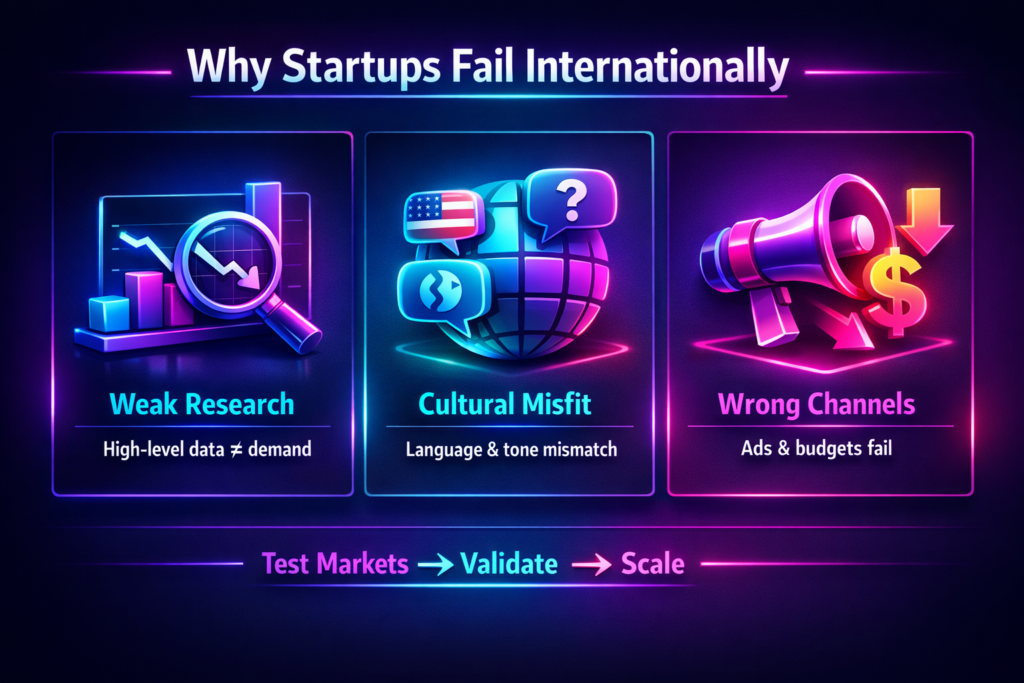
Reasons why startups fail their first international market entry often start with weak market research. Many founders assume that success at home will repeat abroad. In reality, customer needs, trust levels, and buying habits change across regions. What feels obvious in one market can feel risky or unnecessary in another.
Startups frequently rely on high-level data instead of real demand signals. Search volume, population size, or competitor lists do not show purchase intent. Without testing ads, messaging, or offers, teams enter markets where interest exists, but willingness to pay does not.
Language is another silent issue. Translation is treated as localization. But local tone, cultural meaning, and industry terms are ignored. This reduces conversion rates across websites, ads, and sales conversations.
Poor research also leads to wrong channel choices and fast budget loss. Proper validation through interviews, small-scale tests, and local insights prevents these early failures.
Pricing Mistakes That Kill International Expansion
After weak market research, pricing becomes the next silent failure point. Many startups enter a new country assuming pricing logic travels well. It doesn’t. Currency conversion is not a pricing strategy. Local income levels, buyer psychology, and competitor anchors matter far more than internal revenue targets.
Some markets expect negotiation. Others expect clear tiers. Subscription models that work in the US may struggle in parts of Europe or Asia where upfront value is questioned. When pricing feels misaligned, trust drops before the product is even tested.
Pricing also defines positioning. Too low can signal risk. Too high can block adoption entirely. Without local experiments, founders misread signals and blame demand instead of strategy.
This is where pricing issues often expose something deeper. Next, we’ll look at how product-market mismatch makes international growth fail even when interest exists.
How Product-Market Mismatch Makes International Market Entry Fail
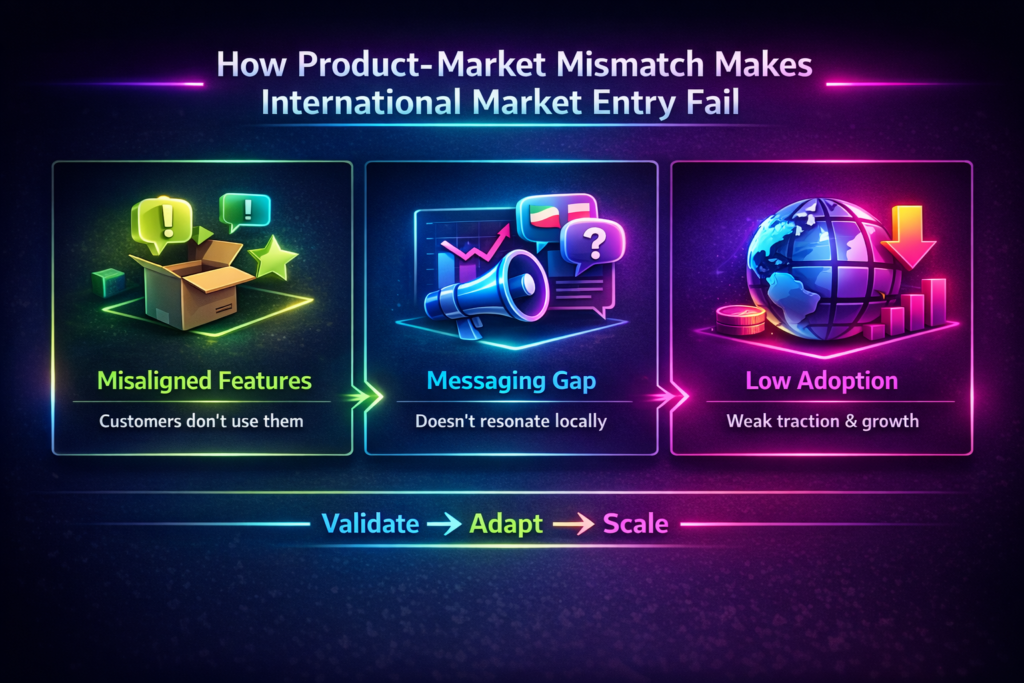
One of the biggest reasons startups fail their first international market entry is that they assume the product will work the same way abroad – without adapting it to local needs. In global markets, not understanding what customers truly value leads to poor traction, weak retention, and unsustainable growth. According to recently compiled 2025–2026 startup failure insights, a lack of product‑market fit remains the top reason startups fail, with roughly 42% of early ventures struggling because demand wasn’t strong enough for what they built.
This mismatch might look like features customers don’t use, messaging that doesn’t resonate, or solutions that don’t solve a real pain point. In new countries, cultural norms and buying habits amplify these issues. Without local validation, teams can spend heavily on marketing and still see slow adoption.
This gap isn’t just strategic; it’s often practical. In the next section, we’ll examine how operational and legal blind spots silently sabotage international launches even when product alignment seems promising.
Operational and Legal Blind Spots That Derail International Market Entry
Even with the right product and pricing, startups often stumble due to operational and legal blind spots when entering new markets. Overlooking these areas can delay launches, increase costs, and damage reputation. Understanding common pitfalls is crucial for founders planning international growth.
Regulatory Compliance and Legal Barriers
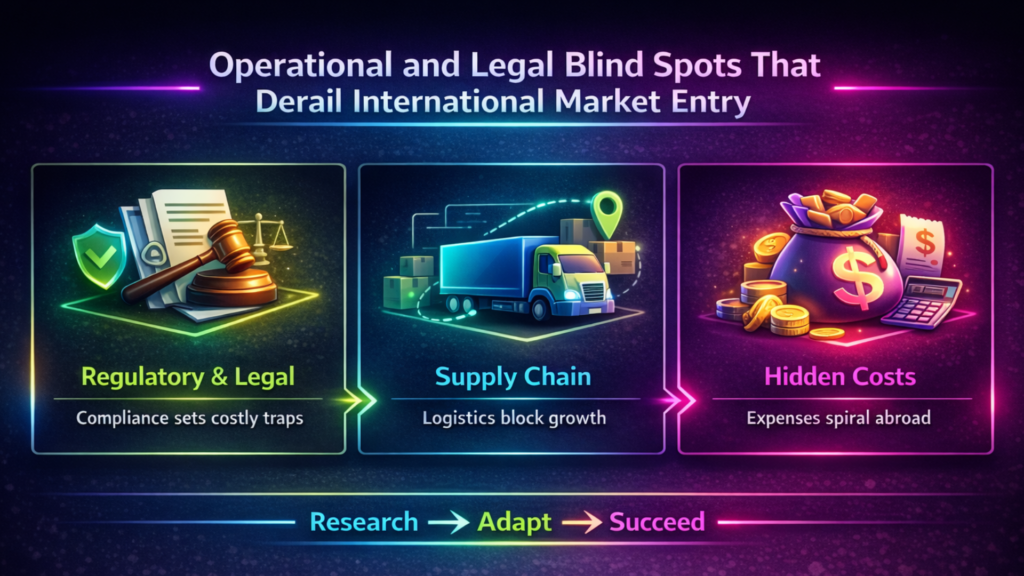
One of the biggest hidden risks is regulatory compliance. Every country has its own rules for taxes, labor laws, product certifications, and advertising standards. Ignoring these can lead to fines, forced product recalls, or even market bans. Startups often assume what worked at home will suffice abroad, but even minor oversights can escalate into major setbacks.
Supply Chain and Logistics Challenges
Supply chain inefficiencies are another frequent blind spot. Expanding internationally often requires new suppliers, warehousing, and shipping partners. Delays or errors can frustrate customers and hurt brand reputation. Operational complexity grows with distance, customs regulations, and local distribution practices, meaning simple processes at home may fail abroad.
Payment Systems and Currency Management
Handling local payment methods and currency is also critical. International buyers may prefer local payment gateways, wallets, or installments. Startups that only offer credit cards or foreign currency risk abandoned carts and lost revenue. Integrating systems that align with local habits is essential.
Team Structure and Local Expertise
A startup’s team can also create blind spots. Without local operational or managerial expertise, decision-making slows, strategy misaligns, and cultural nuances are missed. Hiring or consulting local talent helps prevent costly missteps.
Operational and Legal Risks Overview
| Blind Spot | Description | Risk Level |
|---|---|---|
| Regulatory compliance | Taxes, labor, product rules | High — fines, delays |
| Supply chain inefficiencies | Logistics, warehousing, shipping delays | Medium — customer churn |
| Payment & currency issues | Local payment preferences & conversion risks | High — lost sales |
| Team & management gaps | Lack of local leadership or expertise | Medium — strategic errors |
| Data privacy & security laws | GDPR, PDPA, or local equivalents | High — legal & trust issues |
Ignoring these factors can silently erode growth even when product-market fit seems solid. Operational planning, local legal consultation, and careful system audits are essential for a smooth launch.
In the next section, we’ll explore marketing and cultural misalignment, showing how even the best operations can fail to deliver if campaigns, messaging, and positioning don’t resonate with the new audience.
Marketing and Cultural Misalignment in International Market Entry
Even with a strong product, correct pricing, and solid operations, marketing misalignment and cultural misunderstandings are major reasons why startups fail their first international market entry. Expanding globally is more than translating content or running ads in a new country. Startups must understand local behaviors, values, and media preferences to engage customers effectively.
Misunderstanding Local Preferences
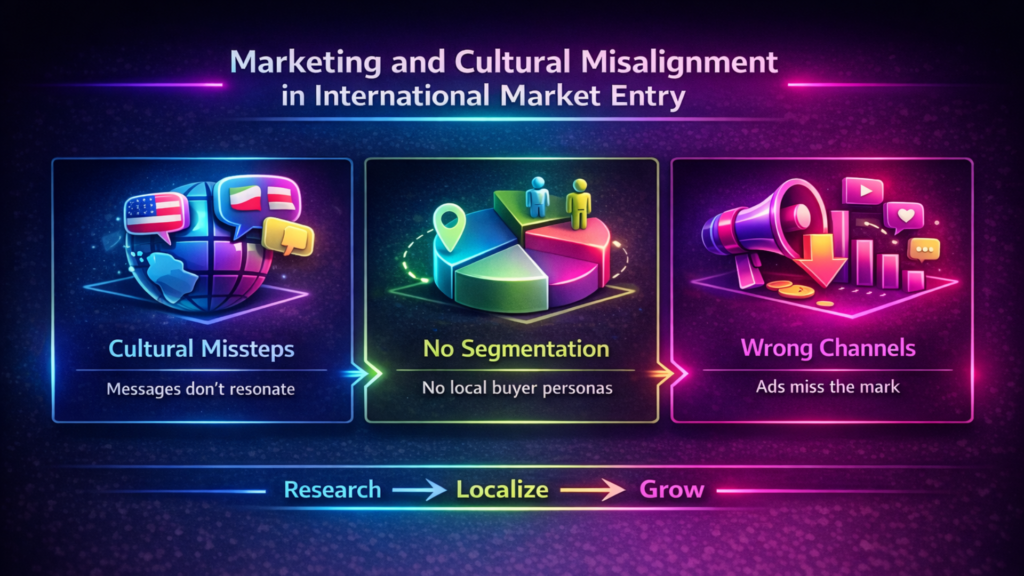
One of the most common pitfalls is assuming home-market messaging will resonate abroad. Words, visuals, or tone that work at home may confuse or alienate new audiences. For example, humor, idioms, or cultural references often do not translate well. Social media habits differ, too – platforms like Facebook, Instagram, or TikTok may dominate in one country while professional networks or messaging apps drive engagement in another.
Ignoring Market Segmentation
Startups often target the “general audience” instead of identifying local buyer personas. Without segmenting by income, age, occupation, or regional behavior, campaigns can miss their mark entirely. Localized content, tailored offers, and adjusted campaign timing improve engagement and conversion rates.
Failing in Multi-Channel Strategy
International expansion requires understanding channel effectiveness. Paid search may work in one market, but marketplaces, influencer partnerships, or local affiliates might drive higher ROI elsewhere. Relying on familiar channels from the home market can waste budgets and reduce visibility.
Common Marketing and Cultural Misalignment Issues
Before diving into specific mistakes, it’s important to understand how subtle misalignments can silently undermine international marketing. Even small differences in tone, visuals, or channel choice can drastically reduce engagement and trust. Startups often underestimate the local nuance required for messaging to resonate. The following chart highlights key areas where cultural and marketing misalignment commonly occurs, along with examples and their impact on international growth:
| Misalignment Issue | Example | Impact on International Growth |
|---|---|---|
| Messaging tone | Formal tone where casual is expected | Low engagement, brand confusion |
| Visuals & design | Colors or symbols with negative cultural meaning | Negative perception, lost trust |
| Content localization | Direct translation without cultural context | Confused audience, poor conversion |
| Channel selection | Using local-irrelevant platforms | Wasted budget, low reach |
| Campaign timing | Ignoring holidays, peak activity periods | Missed opportunities, low adoption |
Overlooking Social Proof and Local Validation
Startups also fail by neglecting social proof and local validation. Testimonials, reviews, and endorsements from local customers build trust. Without them, even high-quality products may appear risky or unfamiliar.
Importance of Iteration and Feedback Loops
Marketing and cultural misalignment is not solved at launch. Iterative testing, surveys, and early adopter feedback help startups refine messaging and campaigns. Small experiments before full-scale marketing reduce risks and optimize spend.
Connecting Marketing to Growth
Marketing misalignment directly affects adoption, retention, and revenue. Even if operations and product fit are solid, campaigns that ignore culture or local preferences limit the startup’s ability to scale. By combining research, local expertise, and adaptive campaigns, startups can overcome these challenges.
In the next section, we’ll discuss financial and funding mistakes that often compound these operational, product, and marketing failures, showing how international expansion risks multiply when budgets are mismanaged.
Funding Mistakes That Undermine International Market Entry
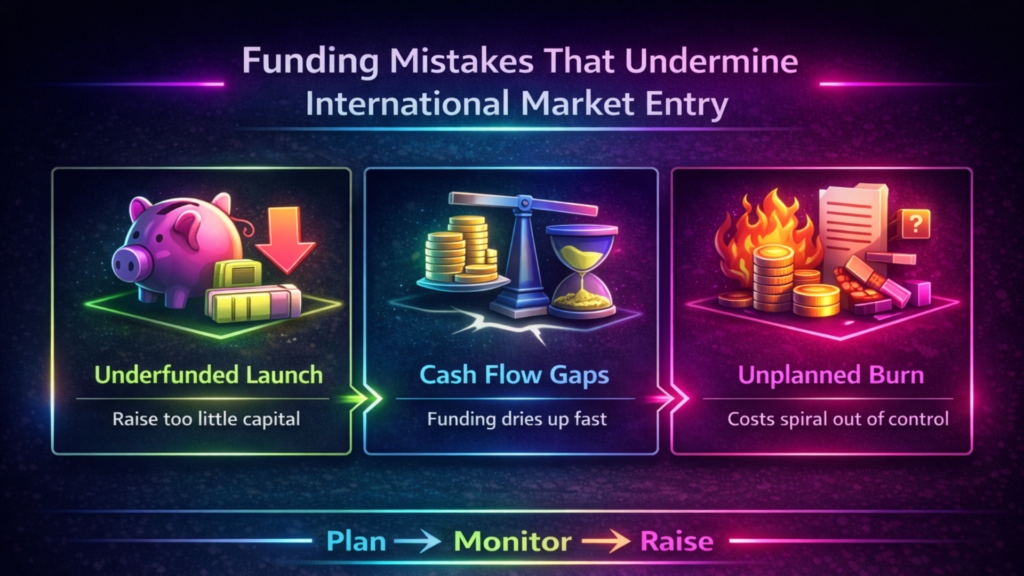
One of the most painful reasons startups fail their first international market entry is financial missteps. Money fuels growth, especially when expanding into new countries. Many founders misunderstand how much funding they need, where to allocate it, and how to plan for longer cash runways. Mistakes here aren’t just about running out of money. They affect hiring plans, marketing spend, product development, and operational readiness.
A key issue is that startups often raise too little capital before launching internationally. They underestimate the costs of localization, legal work, logistics, and extended sales cycles. They also assume venture capital or angel funding will always be available. According to startup failure insights from late 2025, 29% of startups fail because they run out of funding or cannot secure new capital when they need it most.
Overspending Before Validation
Even well-funded startups can fail if they misuse money. Overspending on broad marketing campaigns before validating demand, hiring sales teams too early, or committing to long-term leases stretches cash too thin. When revenue doesn’t flow as quickly as planned, operations become vulnerable, and founders face impossible trade-offs between growth and survival.
Good funding strategy for international expansion requires conservative forecasting, planning for multiple funding rounds, and aligning spend with clear milestones. Early traction and measurable results help maintain investor confidence. Without disciplined financial planning, even strong teams and products can fall short once the runway runs out.
In the next section, we’ll explore team and leadership mistakes, showing how misaligned roles and weak management amplify the risks of international expansion.
Real Case Studies of International Market Entry Failure
International expansion can fuel explosive growth, or it can drain time, money, and morale when leaders underestimate critical risks. To bring the insights in this article to life, below are two real case studies: one from the global tech giant Google and one from aboveA’s own international project experience.
Case Study 1: Google’s Struggle to Break Into the South Korean Market
Even the biggest brands can struggle when they misread the market they’re entering. Google’s attempt to gain traction in South Korea’s search engine market is one of the most instructive examples of international expansion challenges, despite the company’s global brand power.
In South Korea, Google failed to unseat strong local competitors like Naver because of a combination of product misalignment and competitive misunderstanding. Naver had a deep understanding of local user behaviours and preferences that Google did not match. Additionally, Google’s product and monetisation approach did not resonate with Korean users, who preferred locally optimised features and community elements tailored to their culture.
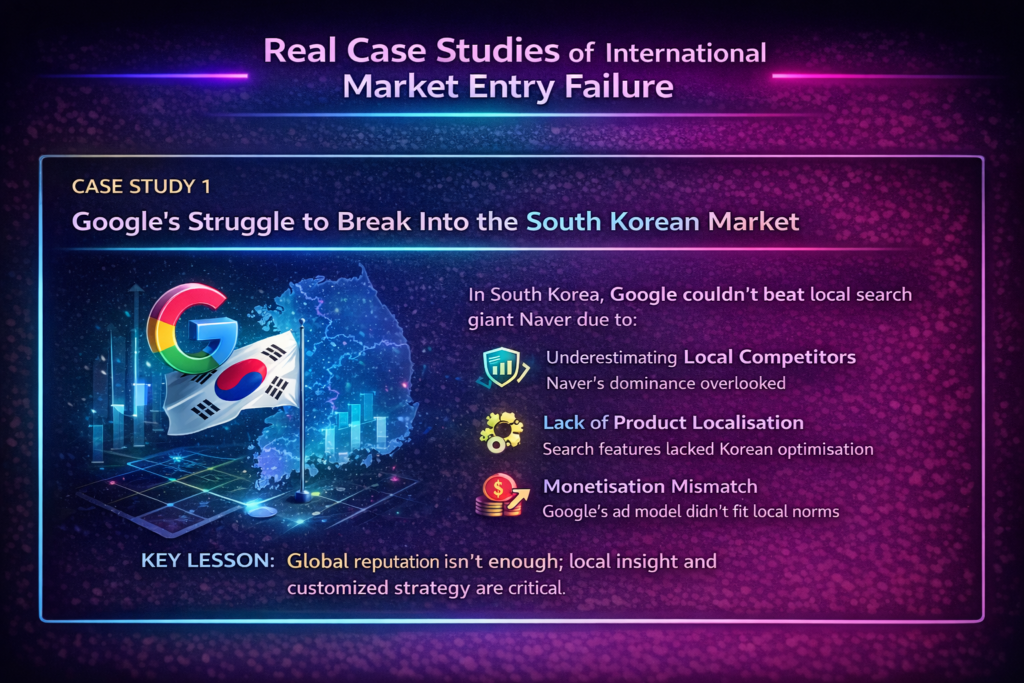
Key lessons from this failure include:
Underestimating local competitors. Naver’s entrenched market position worked against Google’s standard global approach.
Lack of product localisation. Google’s core search product lacked features customised to the Korean language, purchasing behaviour, and content ecosystem.
Mismatch in monetisation strategy. Google’s ad models did not align with local digital advertising norms, slowing revenue growth.
Google’s experience in South Korea shows that global reputation alone doesn’t guarantee local success – deep local insight and tailored product strategy are essential.
Case Study 2: aboveA’s European Expansion Challenge
At aboveA, one of our earlier international initiatives provides an example of international expansion mistakes that even experienced teams can make – especially when entering a highly regulated and competitive European market.
In 2025, aboveA launched a pilot growth strategy targeting medium‑sized technology firms across multiple EU countries. While initial demand signals were positive, several challenges slowed growth and required a major strategy pivot.
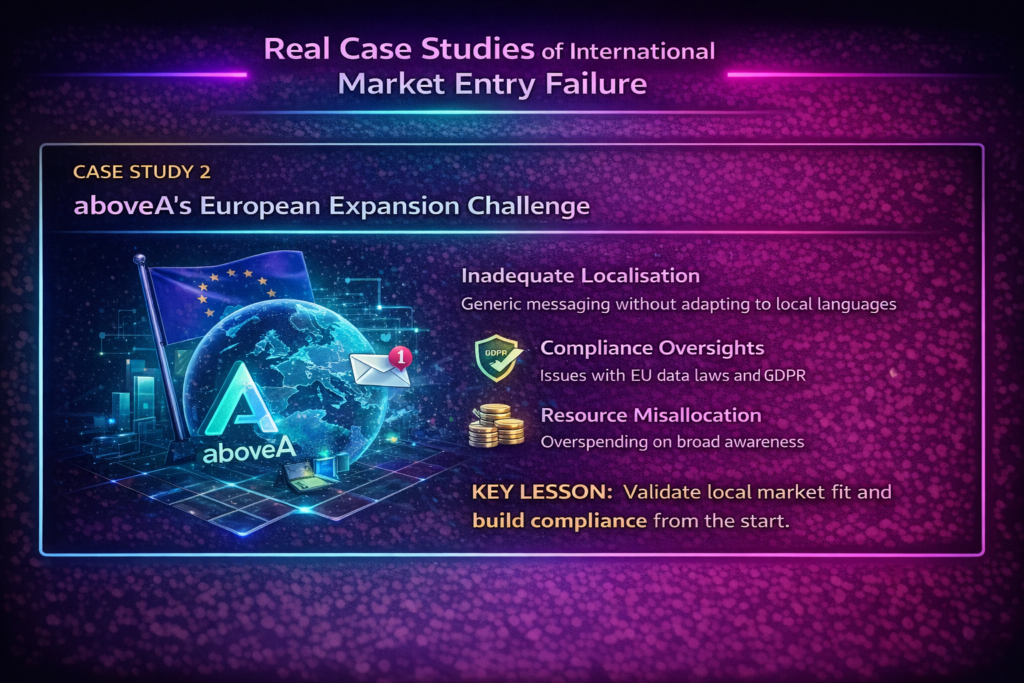
What made this case particularly instructive were the following outcomes:
Inadequate localisation of messaging and channels. Initial campaigns relied on generic English content that underperformed compared to messages adapted to local languages and cultural nuances.
Compliance oversights in early planning. Privacy and data regulations across the EU, including GDPR requirements for data storage and consent, required expensive revisions to onboarding workflows and user data handling.
Resource allocation imbalance. Too much budget was spent on broad awareness campaigns before product‑market validation at a regional level, which reduced early ROI and stretched available funding.
From these challenges, aboveA learned the importance of local market validation before scaling, and the need to build tailored compliance and localisation processes upfront rather than reactively.
Conclusion: Key Takeaways on International Market Entry
Why startups fail their first international market entry comes down to predictable patterns: poor market research, pricing missteps, product-market mismatch, operational blind spots, marketing misalignment, and funding errors. Even strong teams and products are vulnerable without local validation, careful planning, and adaptable strategies.
Real-world cases, from Google’s South Korea experience to aboveA’s European expansion, show that understanding customers, regulations, and culture is critical. Startups that combine thorough research, tested strategies, and iterative learning increase their chances of success abroad. Avoid assumptions, plan meticulously, and treat each market as unique: expansion is not one-size-fits-all.
Grow Your Startup with Us!
aboveA Startup Incubator
Turn ideas into real businesses. aboveA Startup Incubator equips founders with practical tools, mentorship, and structured guidance to develop, validate, and launch their startups with confidence. Learn to scale, avoid common mistakes, and access resources designed for real-world success.
aboveA Project Accelerator
Let’s talk about your next project. aboveA Project Accelerator helps professionals and founders plan, test, and execute their upcoming projects. Get hands-on consulting, expert feedback, and actionable strategies to move from concept to implementation faster and more efficiently.
aboveA Product Launch and Market Entry Program
Launch with impact. Let us guide your startups through every step of introducing a product to new markets. From market research and validation to marketing strategies and operational readiness, founders gain the knowledge and support needed for a successful international market entry.
FAQ: International Market Entry Challenges for Startups
Why do most startups fail when entering a new country?
Startups often fail because they assume what works at home will work abroad. Differences in customer needs, pricing expectations, culture, and competition require tailored strategies for each market.
How can I avoid product-market mismatch in international expansion?
Conduct local market research, validate demand with pilots, adapt your product features to local preferences, and gather early feedback before scaling.
What are common funding mistakes when expanding internationally?
Underestimating costs, overspending before validating demand, and relying on uncertain future funding are frequent errors that can jeopardize international growth.
How important is cultural adaptation in marketing for global markets?
Cultural adaptation is critical. Messaging, visuals, and channels must resonate with local habits and values to drive engagement and adoption.
Can legal and operational blind spots really derail an international launch?
Yes. Ignoring regulations, compliance, logistics, or local team structure can lead to fines, delayed launches, poor customer experiences, and wasted resources.
