
Chaophya Nillawan
A content writer at aboveA focused on go-to-market strategy, international expansion, and startup growth across Europe and Southeast Asia. With a psychology background, he helps businesses build trust, enter new markets, and become more fundable.
Startup Grants and Funding Singapore 2026: Grants, VC, accelerators, and growth capital
- Last time updated: 20th of May, 2026
Startup grants and funding sources in Singapore in 2026 include more than just limited venture capital. Founders nowadays have a lot to choose from, including Startup SG programmes, MAS fintech support, Enterprise Singapore grants, accelerators, angel investors, co-investment schemes, loans, and overseas market-entry support. The actual task here is to choose the right option. Also, making adequate applications or investor outreach that aligns with a startup’s vertical.
In this guide, I will explain which sources Singapore startups can use today, what each option supports, and how founders should match capital to their stage, sector, and growth plan.
Turn your startup into a profitable enterprise!
Table of Contents
Which Singapore startup funding source fits your stage?
Singapore startup funding in 2026 works best when founders match the source to the company’s stage. A new founder might need mentorship, first validation, or a small grant. A deep tech team might need proof-of-concept support, research partners, or co-investment. A fintech startup will likely need stronger compliance, product, and market proof before applying for sector-specific support. A scaleup might look at VC, venture debt, or overseas expansion grants instead. This matters because each source tests a different kind of readiness. Applying too early, or to the wrong programme, can waste time and weaken the story. Next, we should look at why Singapore’s funding market is worth serious attention.
Why does Singapore’s 2026 funding market deserve attention?
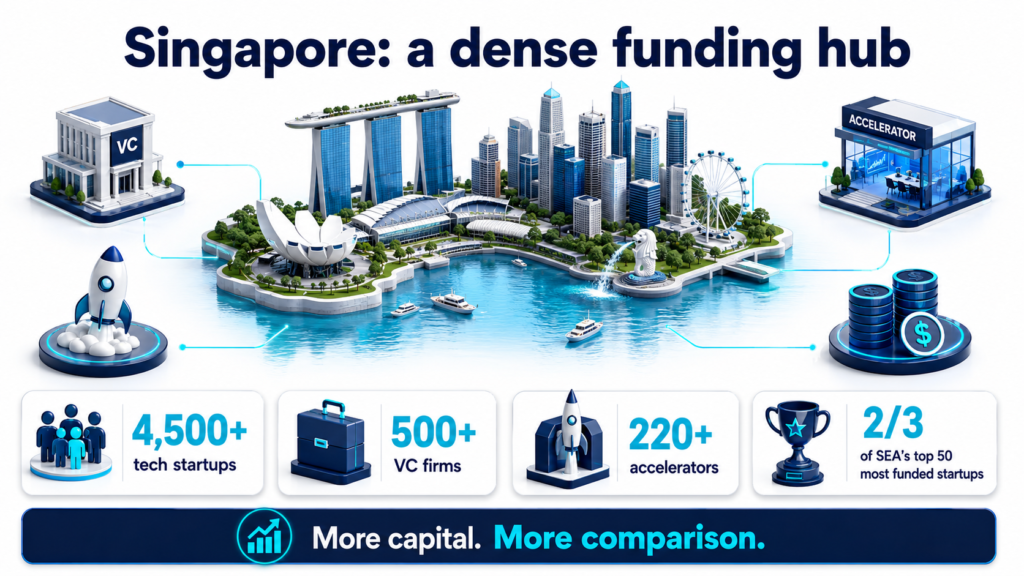
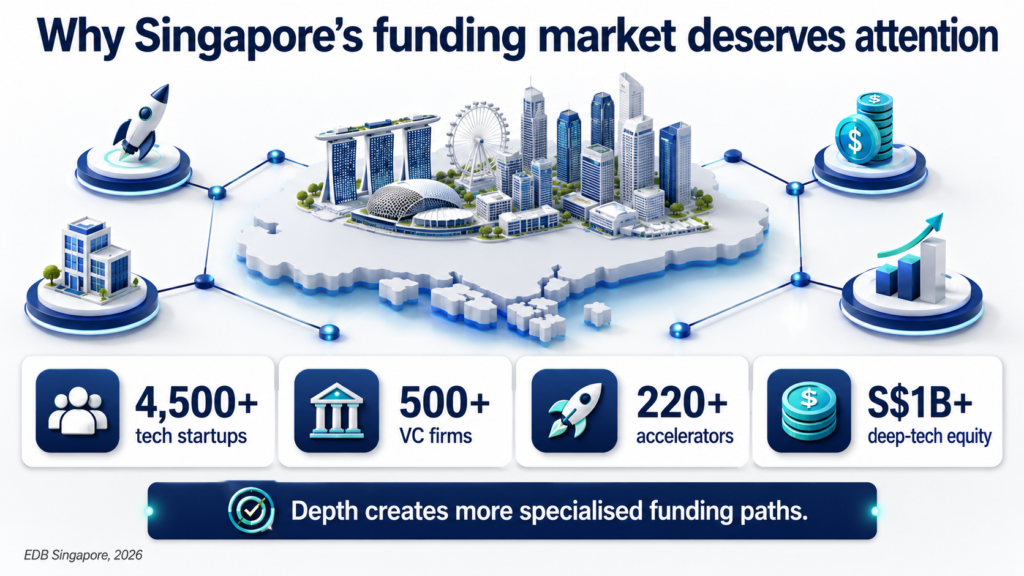
The Singapore startup funding market in 2026 deserves attention because capital is still flowing, but it is concentrating around stronger companies. In Q1 2026, Southeast Asia tech funding reached US$2.8 billion, while Singapore-based firms captured 93% of that total. That shows Singapore is not only a local startup base. It is a regional funding hub where investors, grants, accelerators, and market-entry programmes connect. However, this also raises the bar for founders. More visibility means more comparison. A startup should show why its sector, traction, and funding route fit the opportunity before approaching any source. The next section should map the main programmes.
Which Singapore startup funding programmes should founders compare first?
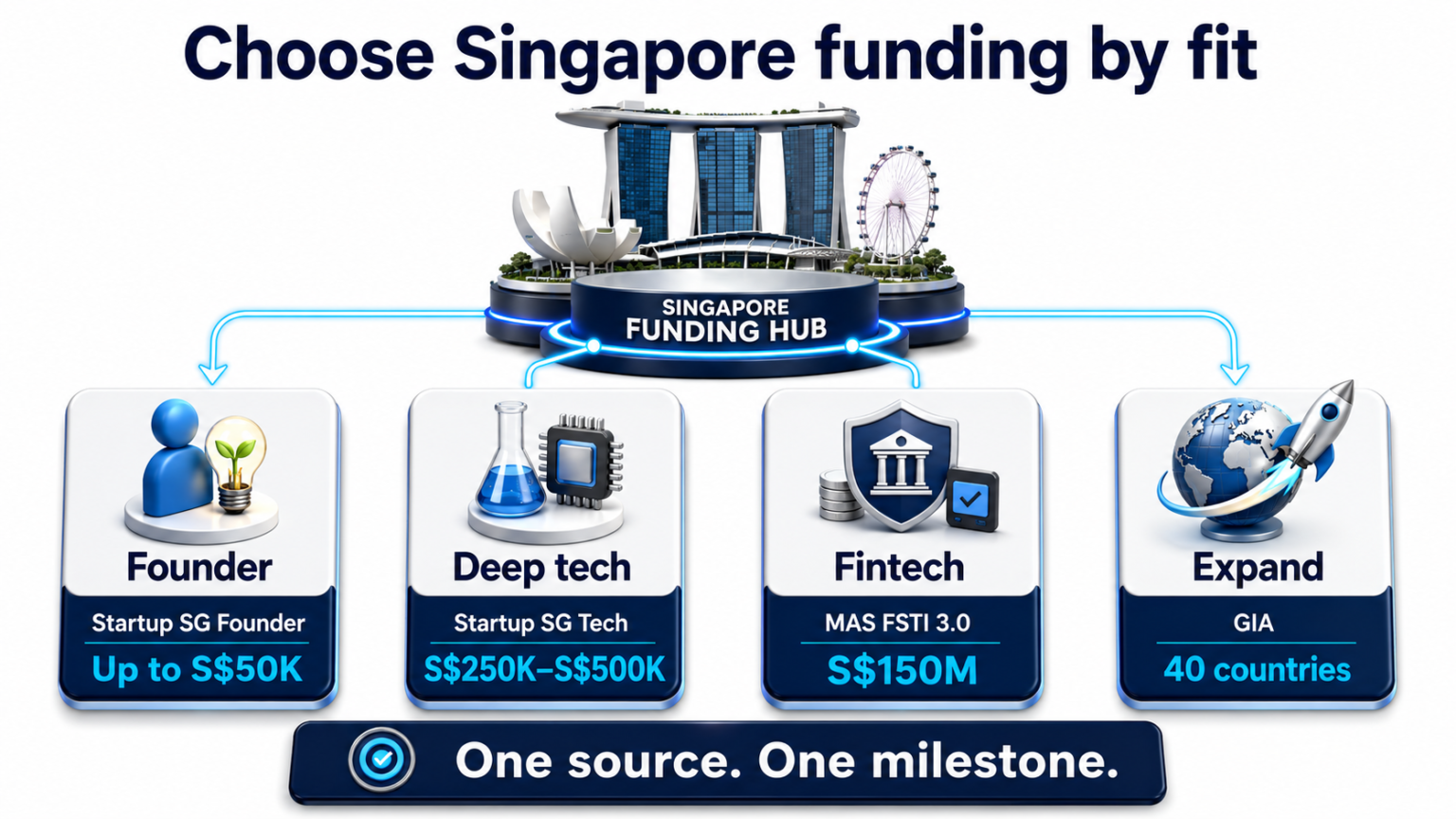
Singapore startup funding programmes in 2026 should be compared by use case, not popularity. Startup SG covers several routes, including Founder for first-time entrepreneurs, Tech for proprietary technology commercialisation, Equity for co-investment, Loan for financing, and Network for ecosystem connections.
| Programme | Best fit | What founders should prepare |
|---|---|---|
| Startup SG Founder | First-time founders | Business concept, team strength, early market value |
| Startup SG Tech | Deep tech startups | POC or POV plan, proprietary technology proof |
| Startup SG Equity / SEEDS | High-potential tech startups | Co-investor interest, growth case, sector fit |
| Startup SG Loan | Operational or growth financing | Repayment logic, cashflow, business use |
| Startup SG Network | Partnership and visibility | Clear profile, collaboration goals, market story |
SEEDS Capital also supports Singapore-based startups developing nascent technologies and innovative solutions, with more than 50 co-investment partners and over 100 deep tech startups in its portfolio. This gives founders a useful starting point. The right programme should support the next proof point, not only the largest possible cheque.
Which non-dilutive funding sources can Singapore startups use?
Singapore non-dilutive funding in 2026 can support startups that need capability building, overseas market entry, or sector-specific innovation before giving up equity. Enterprise Singapore’s EDG supports projects that help companies upgrade, innovate, grow, and transform, with up to 50% support for eligible local SME costs. MRA is more expansion-focused, capped at S$100,000 per company per new market, with enhanced support of up to 70% for SMEs from 1 April 2026. MAS also extended the FSTI scheme until 16 July 2026 for financial-sector innovation.
Founders should compare grants by purpose:
- EDG fits business capability, innovation, productivity, and market-access projects.
- MRA fits overseas promotion, business development, and market setup.
- FSTI fits fintech, financial innovation, and advanced technology use cases.
The practical point is simple. A grant application should not describe every company’s ambition. It should explain one project, one budget, one outcome, and one reason the funding route fits. This keeps the request easier to assess and harder to dismiss quickly. Next, sector-specific sources deserve attention because fintech, AI, and deep tech startups face different checks.
Which fintech and AI funding sources fit Singapore startups?
Fintech and AI funding in Singapore in 2026 should be matched to the product’s regulatory risk, data use, and commercial stage. MAS says the FSTI scheme has been extended until 16 July 2026, with tracks covering innovation acceleration, AI and data analytics, ESG fintech, and industry-wide projects.
That makes it relevant for startups building tools for financial institutions, compliance, payments, fraud detection, data infrastructure, or decision support. A fintech founder should prepare more than a product demo. The application story should explain the use case, customer need, security controls, data handling, and expected industry value. AI founders should also show how the model will be tested and governed. Next, deep tech and co-investment routes need closer review.
How can deep tech startups use co-investment in Singapore?
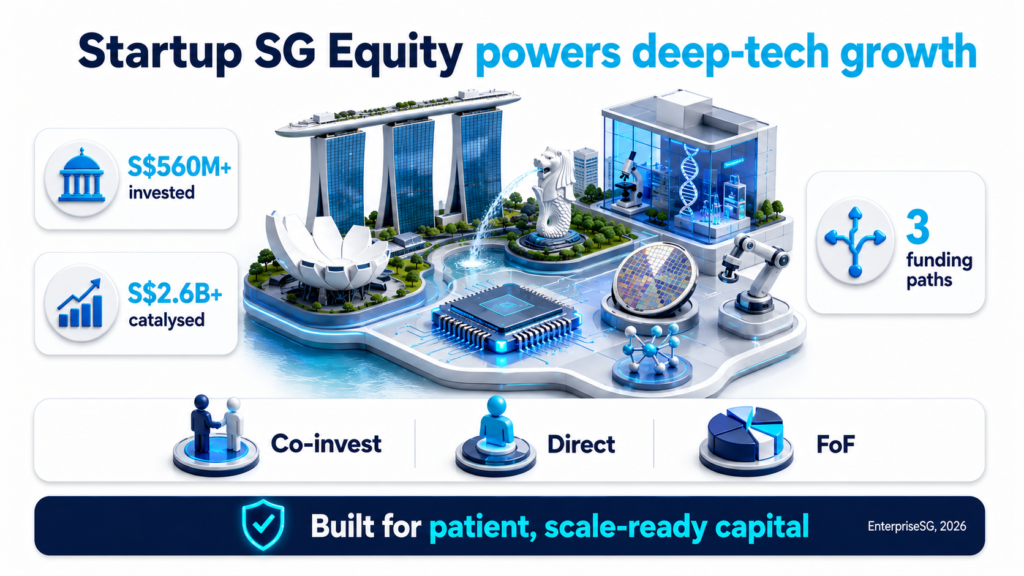
Startup SG Equity in 2026 is especially relevant for deep tech startups that need patient capital, private investor support, and a longer time to commercialise. Enterprise Singapore says S$1 billion has been set aside to expand Startup SG Equity for early- and growth-stage deep tech companies, not only very early startups. SEEDS Capital also says it has more than 100 deep tech startups in its portfolio and more than 50 co-investment partners, including VC firms and corporate investment arms.
This route fits startups working in areas such as advanced manufacturing, healthtech, sustainability, semiconductors, AI, and other research-heavy sectors. Founders should prepare technical proof, commercial use cases, investor interest, and a clear path from R&D into market adoption. Next, we should look at VC and angel funding in Singapore.
Which VC and angel funding routes fit Singapore startups?
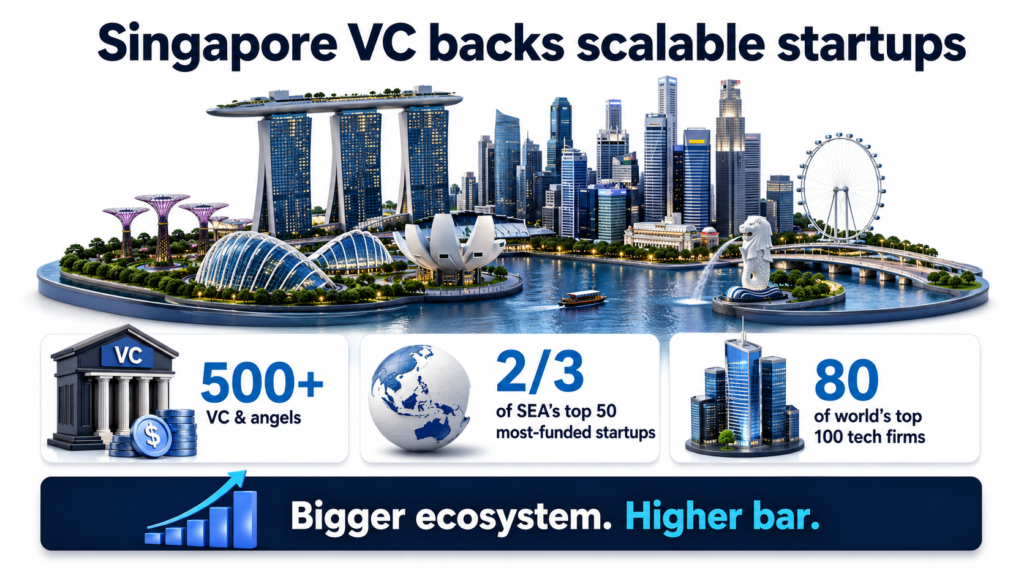
Singapore VC and angel funding in 2026 should fit startups that can show market demand, not only ambition. This matters because Southeast Asia’s headline funding numbers can look strong while deal access stays harder. DealStreetAsia reported that Southeast Asian startups raised US$2.81 billion across 98 equity deals in Q1 2026, but that was also the lowest quarterly deal count in at least eight years. The total was heavily shaped by DayOne’s US$2 billion Series C round, which means founders should not read the market as easily.
Why do VC funds need stronger proof?
Venture capital in Singapore is more realistic when the startup can show a large market, strong timing, repeatable sales logic, and a clear path across Southeast Asia or beyond. TechNode Global, citing Tracxn, reported that late-stage funding in Southeast Asia reached US$2.2 billion in Q1 2026, up 243% from Q4 2025, while enterprise applications, enterprise infrastructure, and fintech were top-performing sectors.
That creates a useful signal for founders. VC funds are still active, but they are looking harder at companies that can scale, serve serious buyers, or sit inside stronger categories. A startup should prepare traction data, customer proof, pricing logic, retention notes, and a clear use of funds before pitching.
When do angel investors make more sense?
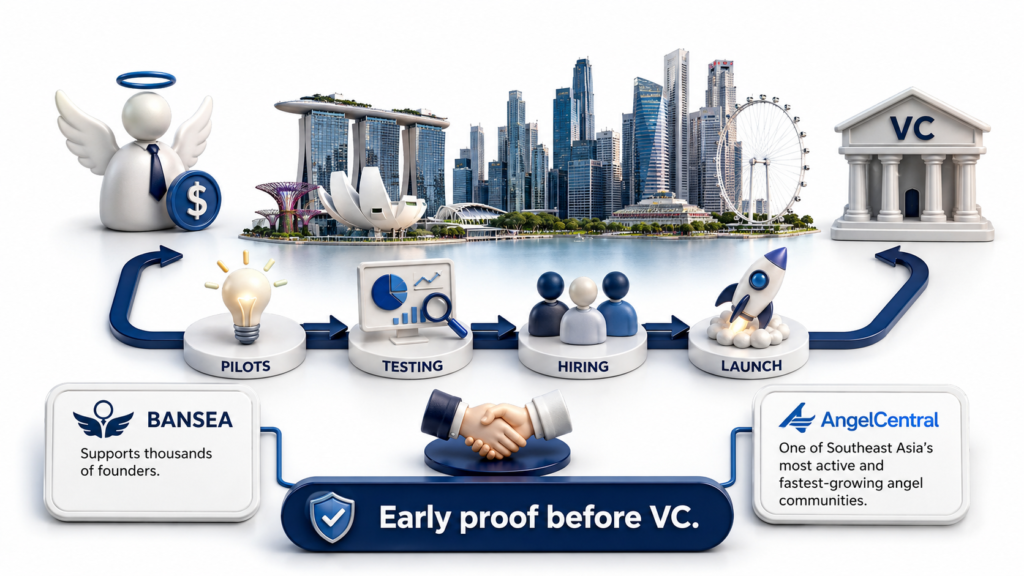
Angel investors in Singapore can fit earlier teams that have strong founder insight but are not ready for institutional VC. Angels can support first pilots, product testing, hiring, and early market entry. AngelCentral says it has trained more than 1,000 angel investors, featured more than 1,000 startups, and helped members invest more than US$38 million into startups.
BANSEA is also relevant because it has operated since 2001 and positions itself as one of Asia’s oldest angel investment networks.
How should founders approach investors?
Singapore startup founders should not send the same pitch to angels and VC funds. Angels often care about founder quality, first demand, and practical next steps. VC funds will push harder on market size, speed, defensibility, and return potential. The next section should look at accelerators and venture builders because some founders need structure before investor capital.
Which accelerators and venture builders can support Singapore startups?
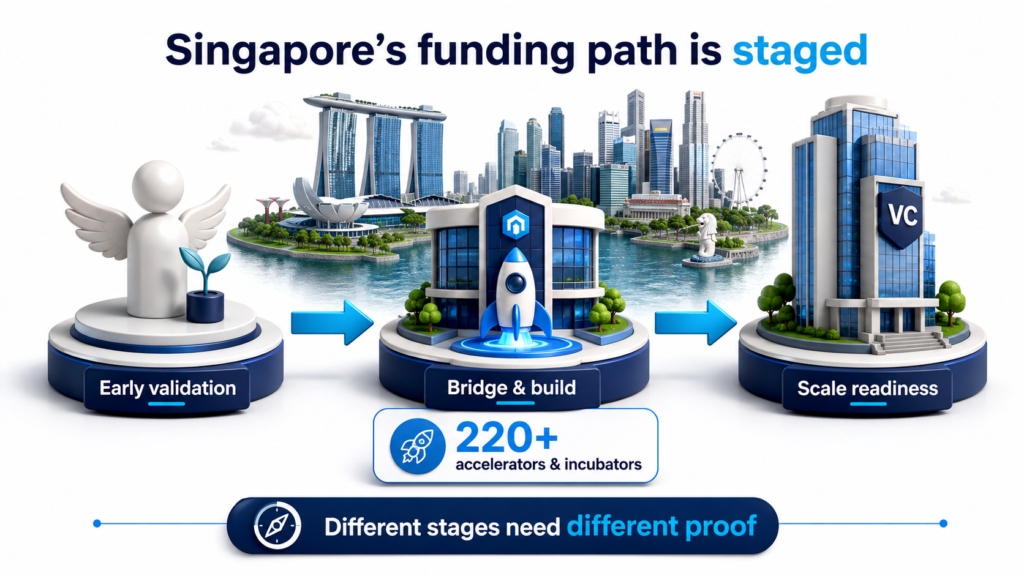
Singapore startup accelerators in 2026 can help founders move from early proof to funding-ready growth. They are useful when the startup needs structure, investor access, market feedback, technical guidance, or stronger go-to-market support before raising. However, founders should not treat every programme as equal. Some support idea-stage teams. Others expect post-MVP traction, users, pilots, or revenue.
Which founders fit Antler Singapore?
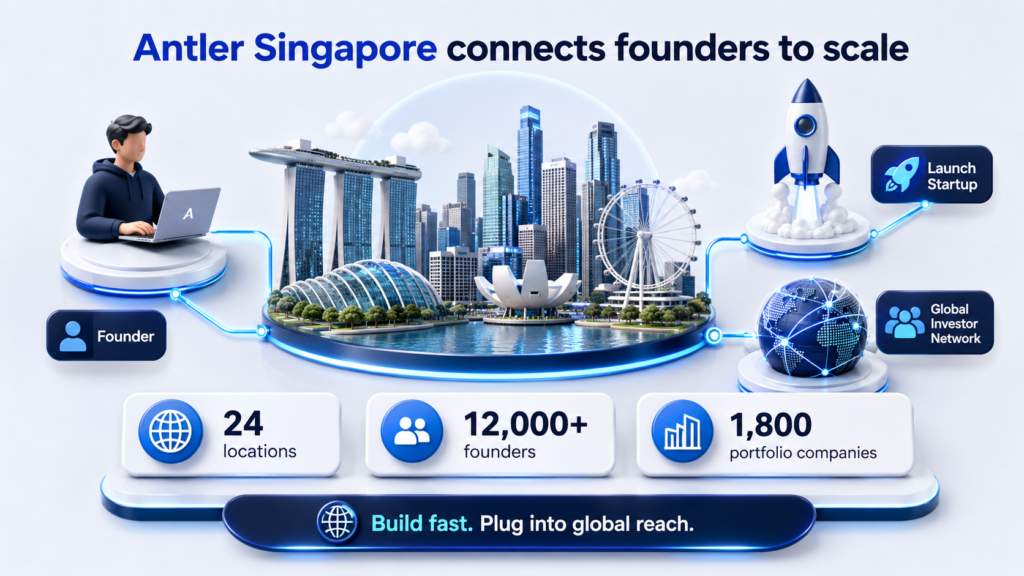
Antler Singapore fits founders who want an intense venture-building route with early capital attached. Antler says its Singapore residency starts with a US$150,000 investment after six weeks, structured as US$100,000 for 10% equity and US$50,000 through an uncapped SAFE with MFN terms. It also states that founders can access up to US$400,000 at inception, while Antler Elevate can invest up to US$25 million from Series A onward. That makes Antler useful for founders who already have an idea, can move fast, and want capital plus a global investor network.
How does BLOCK71 support earlier teams?
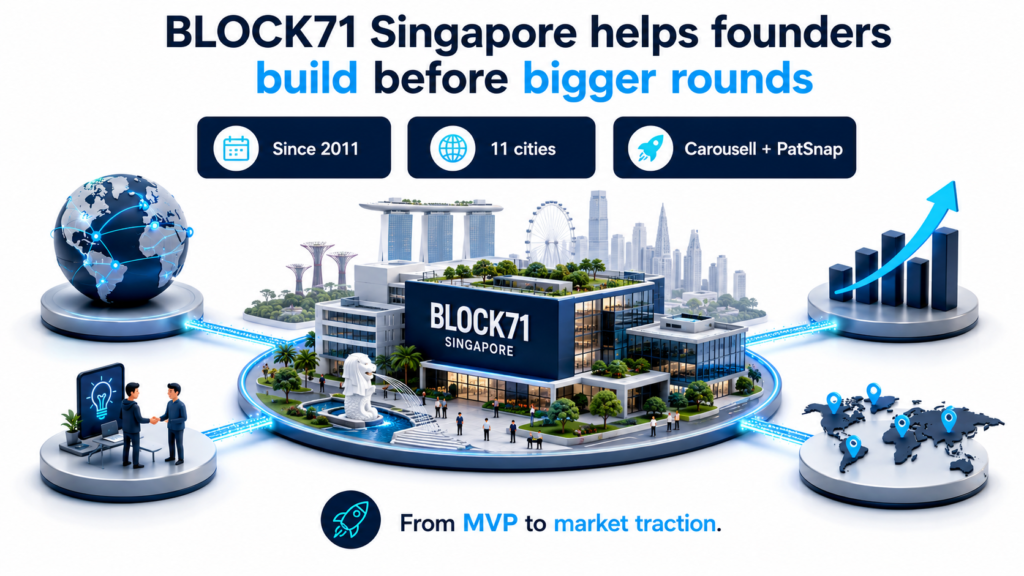
BLOCK71 Singapore is useful for founders who need incubation, market access, and ecosystem support before a larger raise. BLOCK71 says its Singapore base supports pre-seed to Series A founders through tailored incubation, acceleration, global market access, corporate innovation support, deep tech help, and collaborative spaces. It also states that BLOCK71 Singapore has supported over 1,600 ventures and operates three Singapore hubs, which makes it relevant for founders still testing ideas, refining an MVP, or chasing traction.
Which AI startups should look at AI Accelerate?
AI Accelerate Singapore fits startups that already moved beyond the idea stage. The programme is run by BLOCK71 Singapore and Microsoft, supported by Enterprise Singapore through Digital Industry Singapore. It is a 10-week programme focused on product refinement, investor feedback, partner access, and funding-ready growth. Qualified startups can access up to S$400,000 for Proof-of-Concept projects or up to S$800,000 for Proof-of-Value projects through Startup SG Tech. To qualify for AI Accelerate 2026, startups should be post-MVP, with users, pilots, or revenue.
Microsoft, Enterprise Singapore, and NUS Enterprise also announced a wider collaboration to fast-track up to 150 qualified AI startups over three years, with a stronger go-to-market layer for product-market fit, commercialisation, and regional or global scaling.

Where does SGInnovate fit?
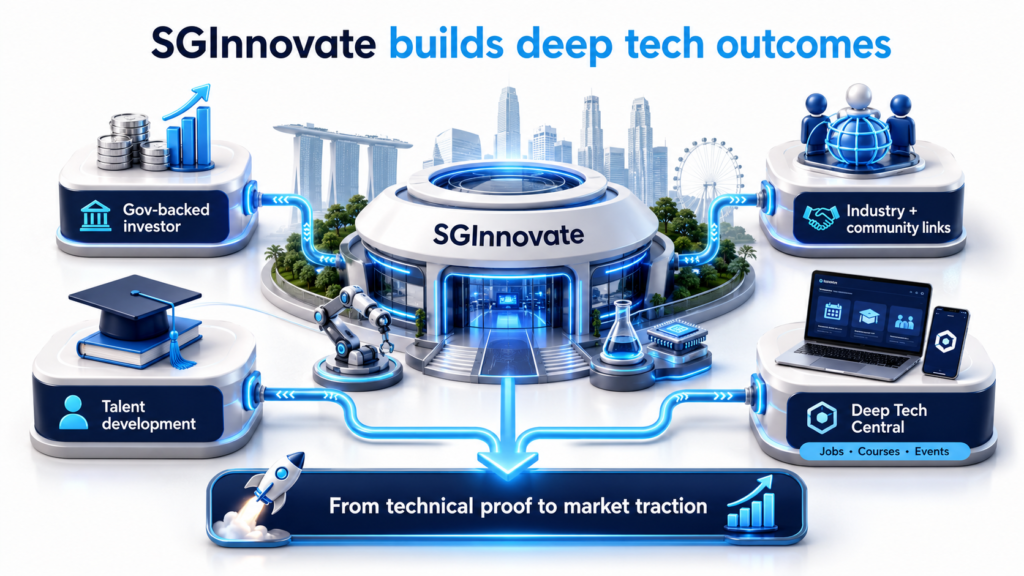
SGInnovate fits deep tech founders who need more than general startup mentoring. Its platform highlights deep tech startup growth and funding, investments, talent development, industry partners, and a deep tech community of 190,000+. That makes it more relevant for startups in areas such as AI, biotech, quantum, robotics, and research-heavy technology.
Founders should choose accelerators by outcome. The right programme should create traction, technical proof, investor access, or market entry support. Next, overseas expansion funding deserves attention because many Singapore startups use the city as a regional and global launchpad.
Which funding sources help Singapore startups expand overseas?
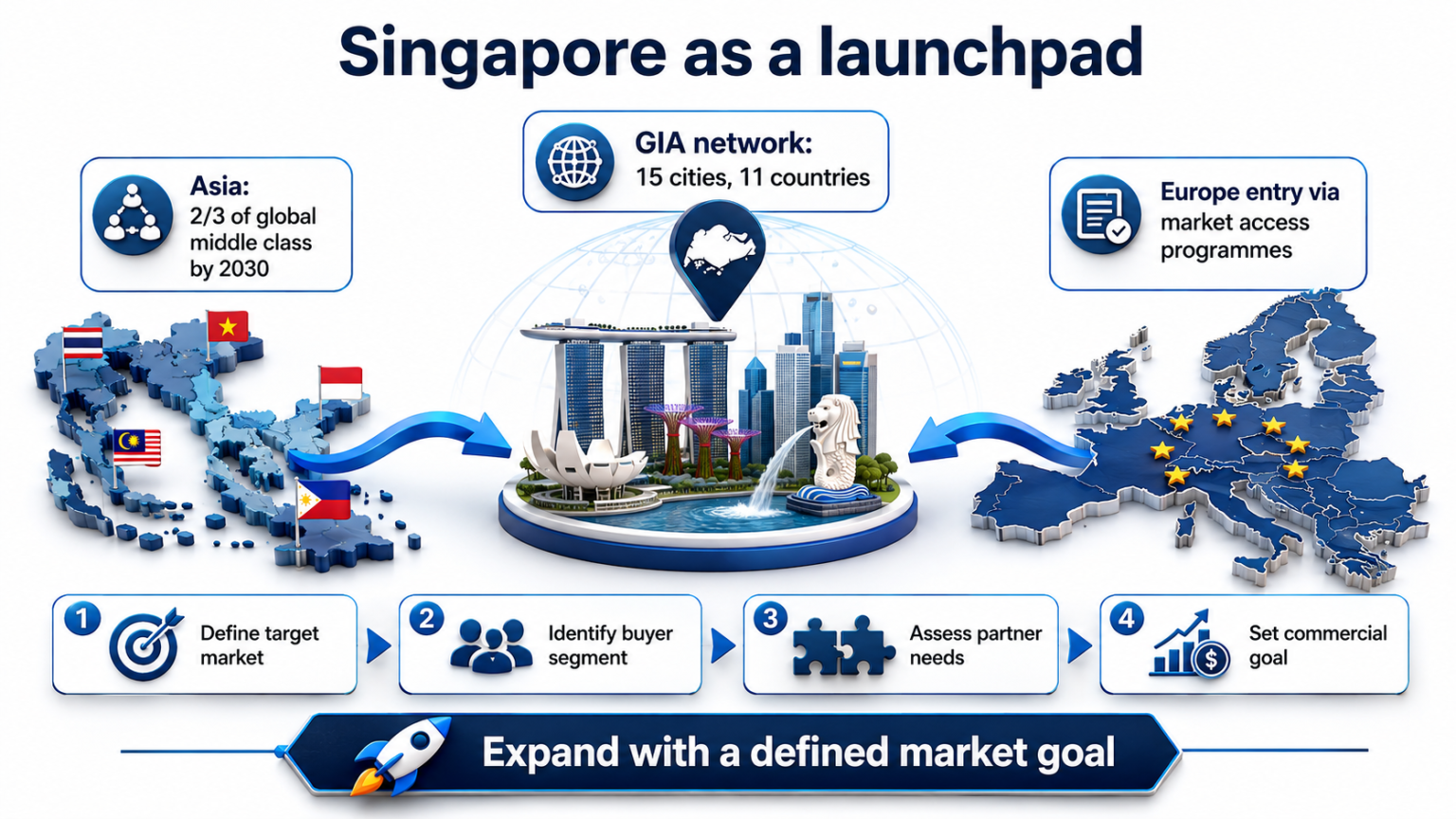
Singapore startup expansion funding in 2026 matters because many local startups use Singapore as a base for Southeast Asia, Europe, and wider global growth. The Market Readiness Assistance grant supports overseas market promotion, business development, and market setup. Enterprise Singapore states that support is capped at S$100,000 per company per new market, with enhanced support of up to 70% for SMEs from 1 April 2026.
The Global Innovation Alliance works differently. It helps Singapore-based startups expand overseas through acceleration programmes, workshops, mentorship, and connections with potential clients and partners. The GIA Munich programme, for example, is designed for Singapore tech startups expanding into Europe.
Founders should choose overseas funding only after defining the market, buyer segment, local partner needs, and expected commercial result. Next, the article should compare how founders can choose the right source overall.
Which other Singapore grants and capital sources should founders check?
Singapore startup grants and capital sources go beyond Startup SG, VC, and accelerators. Founders should also check funding routes that support cash flow, R&D manpower, productivity tools, social impact, and innovation tax relief. These are not always “startup-only” schemes, but they can still help incorporated startups reduce costs or fund specific work.
| Source | Best fit | What it can support |
|---|---|---|
| Enterprise Financing Scheme | SMEs needing loans | Working capital, trade, fixed assets, venture debt, projects |
| PSG | Operational SMEs | IT tools, equipment, automation, productivity upgrades |
| A*STAR T-Up | R&D-heavy SMEs | Research scientist or engineer secondment for up to two years |
| Enterprise Innovation Scheme | Innovation-led firms | Enhanced tax deductions or cash payout for R&D, IP, innovation, training |
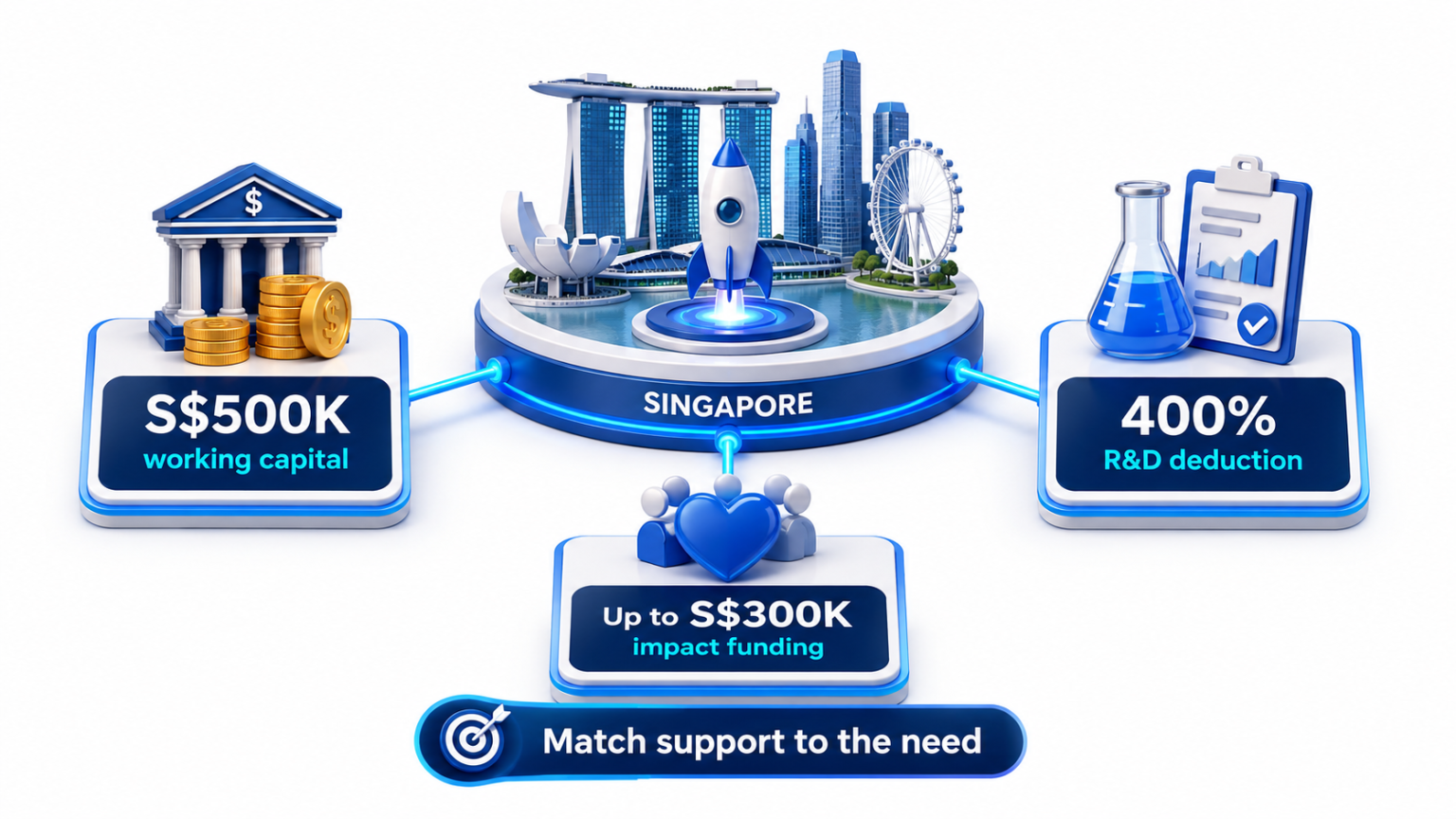
| raiSE VentureForGood | Social enterprises | Growth-stage social impact funding up to S$300,000 |
| GoBusiness directory | Broad grant search | Central place to compare official grants and support schemes |
Enterprise Singapore’s Enterprise Financing Scheme covers seven financing areas, including working capital loans, venture debt loans, trade loans, fixed asset loans, green loans, project loans, and M&A loans. The SME Working Capital Loan has a maximum loan quantum of S$500,000 per borrower and a maximum repayment period of five years.
PSG is useful when a startup needs approved IT solutions or equipment to improve productivity. Enterprise Singapore states that PSG supports up to 50% of eligible costs for local SMEs and can provide up to S$30,000.
ASTAR’s T-Up programme can help startups that lack internal technical depth. It secures ASTAR scientists and research engineers into local SMEs’ R&D projects for up to two years, with eligible SMEs able to apply for up to 70% grant support from Enterprise Singapore to offset qualifying costs.
The Enterprise Innovation Scheme also matters because it supports innovation through tax relief, not direct grant funding. IRAS states that qualifying R&D undertaken in Singapore can receive a total 400% tax deduction on the first S$400,000 of qualifying R&D expenditure, with the scheme aligned up to YA2028.
For social impact startups, raiSE’s VentureForGood grant supports growth-stage Social Enterprise members with up to S$300,000 in funding.
This section should come before the overseas expansion section because it fills the missing middle: not every founder needs VC, Startup SG Equity, or an accelerator. Some need cashflow support, R&D help, productivity funding, tax relief, or social impact capital first.
Which other Singapore grants and capital sources should founders check?
Singapore startup grants and capital sources should also include support that is not always branded as startup funding. Some founders need working capital, productivity tools, R&D help, tax relief, or social impact funding before they are ready for VC or larger co-investment. These routes can support practical gaps inside the business, especially when the startup is still building operations, testing technology, or improving delivery. Founders should check whether the source funds a clear business need, not just whether the programme sounds attractive. After this, overseas expansion funding becomes important for startups using Singapore as a launchpad.
Which funding sources help Singapore startups expand overseas?
Singapore startup expansion funding in 2026 can help founders test new markets before they spend too much on travel, sales, or local setup. The Market Readiness Assistance grant supports overseas promotion, business development, and market setup, with support capped at S$100,000 per company per new market and up to 70% support for SMEs from 1 April 2026.
The Global Innovation Alliance also helps Singapore-based startups expand overseas through workshops, mentorship, and connections with clients or partners. Its GIA+ Initiative can cover up to 50% of qualifying costs, capped at S$35,000 for general tech and S$50,000 for deep tech programmes.
Founders should choose overseas support only after defining the target country, buyer segment, partner needs, and expected commercial result.
Why do Singapore startups fail when pursuing funding?
Singapore startup funding failures in 2026 often come from poor source fit, weak proof, and incomplete preparation. Grants, VC, accelerators, and loans do not reject founders for the same reason. A grant can fail because the documents are incomplete. Enterprise Singapore states that incomplete EDG applications will be rejected and can only be resubmitted with complete documents.
VC has a different problem. In Southeast Asia, startups raised US$2.81 billion across 98 equity deals in Q1 2026, but DealStreetAsia reported that this was the lowest quarterly deal count in at least eight years. That means fewer companies are getting funded, even when total funding looks strong.
The stage gap is also clear. Tracxn data reported by Singapore Business Review showed that seed funding fell 30% to US$105 million, while late-stage funding rose 243% to US$2.2 billion in Q1 2026. This shows why early founders need stronger proof before approaching investors.
Startups can also fail because they underestimate programme selectivity. The Wall Street Journal reported that Antler invests in only 2.7 of every 1,000 founding applicants, which shows how competitive even founder-first programmes can be.
Founders should therefore check four things before applying: whether the source fits the stage, whether the documents are complete, whether the proof supports the claim, and whether the funding request connects to one clear milestone. The next section should show how to prepare those materials before applying or pitching.
How should founders choose the right Singapore funding source?
Singapore startup funding sources should be chosen by stage, sector, proof level, and capital purpose. A first-time founder might need Startup SG Founder, mentoring, or accelerator support. A deep tech team might need Startup SG Tech, co-investment, or research help. A fintech startup should check MAS-linked support and prepare stronger compliance proof. A company expanding overseas can look at MRA or GIA routes.
The key is to connect one funding source to one business milestone. If the startup needs customer validation, choose a route that supports testing. If it needs scale, choose a capital that rewards traction. This keeps the funding plan focused and helps founders avoid weak applications, poor investor fit, and wasted time.
What should founders prepare before applying or pitching?
Singapore startup funding applications should be built around proof, not only ambition. Founders should prepare a short funding route map that explains why the chosen source fits the company’s stage and goal. They also need a clear pitch deck, use-of-funds plan, financial forecast, customer evidence, product roadmap, and market-entry logic where relevant. Grant applications should include project scope, budget, timeline, delivery plan, and expected outcomes. Investor pitches should show traction, market size, pricing logic, sales process, team strength, and the next milestone after funding. Fintech, AI, and deep tech teams should also prepare compliance notes, technical proof, data handling details, and risk controls. Strong preparation makes the funding request easier to judge. It also helps founders find gaps before reviewers, investors, or programme managers notice them first.
Conclusion: Startup funding sources Singapore 2026
Startup funding sources Singapore 2026 give founders many routes, from Startup SG and MAS-linked support to VC, angels, accelerators, grants, loans, and overseas expansion programmes. The strongest choice depends on stage, sector, ownership goals, and proof. Founders should avoid chasing every available source. A better approach is to choose the route that supports the next milestone and prepare evidence before applying or pitching. A stronger fit makes the funding process clearer, faster, and easier to defend.
Grow Your Startup with Us!
aboveA Startup Incubator
Turn ideas into real businesses. aboveA Startup Incubator equips founders with practical tools, mentorship, and structured guidance to develop, validate, and launch their startups with confidence. Learn to scale, avoid common mistakes, and access resources designed for real-world success.
Startup Fundraising Readiness Services
Our startup fundraising readiness services can turn scattered traction, unclear positioning, weak credibility, and early market signals into a clearer investment case. We help startups prepare the proof, story, visibility, and go-to-market logic needed before serious investor conversations begin.
aboveA Product Launch / Market Entry Program
Launch with impact. Let us guide your startups through every step of introducing a product to new markets. From market research and validation to marketing strategies and operational readiness, founders gain the knowledge and support needed for a successful international market entry.
FAQ: Startup funding sources Singapore 2026
Startup funding sources Singapore 2026 raise practical questions about grants, investors, accelerators, eligibility, overseas expansion, and funding-route fit.
What are the main startup funding sources in Singapore in 2026?
The main sources include Startup SG, Enterprise Singapore grants, MAS-linked fintech support, VC funds, angel investors, accelerators, loans, co-investment, and overseas expansion programmes.
Which Singapore startup grant fits first-time founders?
First-time founders should usually check Startup SG Founder, especially when they need early validation, mentorship, business structure, and support before approaching investors.
Which funding sources support deep tech startups in Singapore?
Deep tech startups can review Startup SG Tech, Startup SG Equity, SEEDS Capital, SGInnovate, AI Accelerate, research support, and co-investment routes.
Can Singapore startups get funding without giving up equity?
Yes. Startups can explore grants, public support schemes, productivity funding, innovation support, tax relief, loans, and overseas expansion grants before considering equity funding.
When should Singapore startups approach VC or angel investors?
Startups should approach investors when they can show customer demand, market size, traction, pricing logic, team strength, and a clear milestone after funding.
What should founders prepare before applying for funding?
Founders should prepare a pitch deck, financial forecast, use-of-funds plan, customer proof, market logic, compliance notes, project scope, and delivery timeline.
Which funding sources help Singapore startups expand overseas?
Singapore startups can review MRA, GIA programmes, overseas accelerators, trade support, partner networks, and market-entry grants when expansion plans are already specific.
Why do Singapore startup funding applications fail?
Applications often fail because the funding source does not match the stage, documents are incomplete, proof is weak, or the funding request lacks one clear milestone.
