
Faustas Norvaisa
A Growth & Product Expert with 10 years of experience in revenue diversification, international expansion, SEO, and digital marketing. Passionate about scaling businesses and building global brands, he empowers companies to thrive with his motto, "sharing is caring.
Startup funding in Singapore 2026: How to prepare and raise capital
Startup funding in Singapore in 2026 is not just limited to finding investors, grants, or venture capital firms. This year, many startups are facing fierce competition and demand to prove that their startup fits the funding stage they are trying to reach. Pre-seed founders need validation. Seed founders need early traction. Series A and Series B companies need stronger growth evidence, cleaner reporting, and a sharper proof portfolio.
This guide explains how Singapore’s funding routes work, what founders should prepare for at each stage, and why investors are asking harder questions in 2026. You will also learn how to build proof before outreach, avoid weak fundraising moves, and choose the right funding path.
Build fundable startup smarter with aboveA
Table of Contents
Startup funding in Singapore is stage-specific
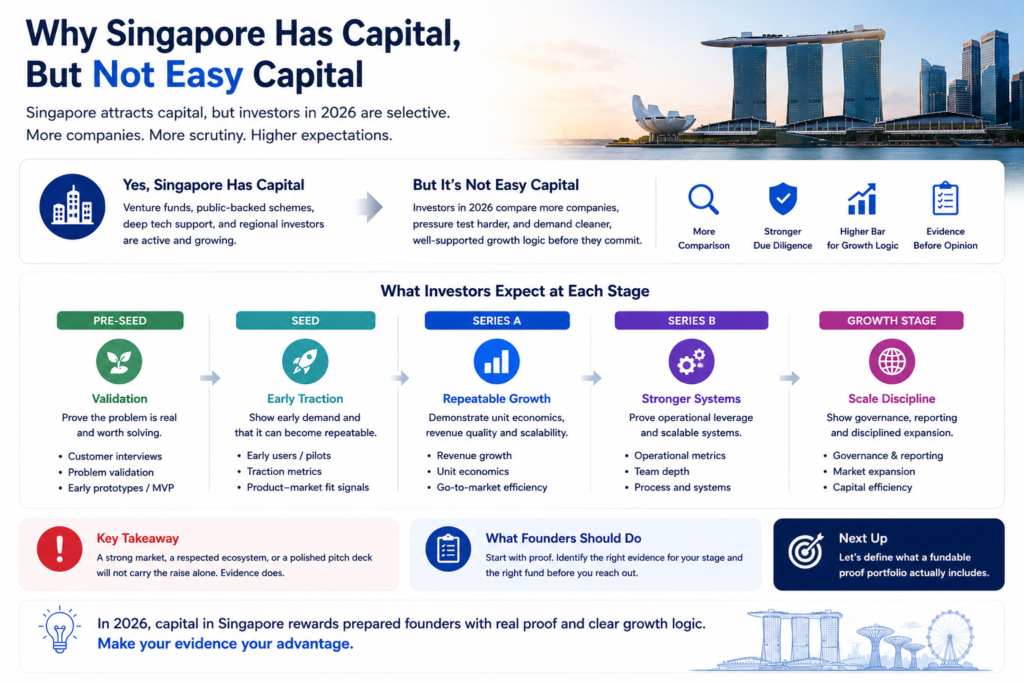
In 2026, startup funding in Singapore is stage-specific because each round demands different information. For example, pre-seed capital often investigates if the problem is real and if a startup can prove it. Seed funding wants to see if a startup shows early demand and that it is becoming repeatable. Series A has a strong focus on growth quality, revenue logic, and team depth. Series B and growth funding are looking for stronger systems, governance, and evidence of expansion.
Because of that, founders must not use one pitch for every route. With every stage, the funding pitch and story must change. Also, different supporting data and documentation will be needed likewise. That said, in the following section, we will look at why Singapore has serious capital, yet still rewards disciplined founders with cleaner proof and market evidence in 2026.
Why Singapore has capital, but not easy capital
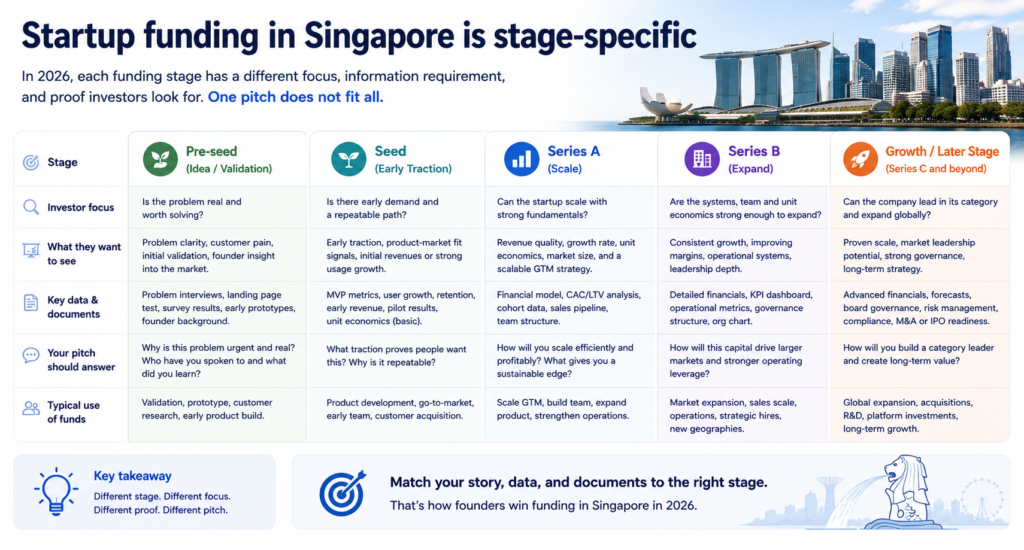
If your startup is looking for funding in Singapore for 2026, you must not treat opportunities as easy money. Yes, Singapore city attracts venture funds, public-backed schemes, deep tech support, and regional investors. Yet, every serious route still demands evidence. That pressure is growing since investors in 2026 are comparing more companies, pressure testing, and looking for cleaner and well-supported growth logic before they commit.
Thus, a strong market, a respected ecosystem, or a polished pitch deck will not carry the raise alone. Pre-seed teams need validation. Seed teams need early traction. Series A teams need repeatable revenue signals. Growth-stage companies need governance, reporting, and scale discipline.
That is why Singapore fundraising must start with a well-argumented proof in a proposal. Before outreach, founders ought to discern which evidence matches their stage and fund. Next, we will define what a fundable proof portfolio actually includes.
What a fundable proof portfolio means
Moreover, a fundable proof portfolio in Singapore must present the evidence. It is not a single pitch deck articulating a business idea alone. It must be a connected set of signals that shows the startup understands its market, stage, risks, and next milestone. Including evidence that is not Googled, but well done in pilot conversations, testing, with correct summaries and proof of their legitimacy. If we think structurally, it should tap into the following proof areas:
| Proof area | What it should show | Useful evidence |
|---|---|---|
| Market proof | The problem is real and worth solving | Interviews, survey notes, search demand, buyer pain points |
| Product proof | The offer works beyond an idea | MVP, prototype, demos, usage data, product feedback |
| Traction proof | Demand is moving from interest to action | Paid pilots, waitlists, sales calls, early revenue |
| Team proof | The founders can execute the plan | Founder history, skill gaps, advisors, hiring plan |
| Funding proof | Capital will unlock a clear milestone | Budget, runway, use of funds, 6–12 month targets |
A correctly executed portfolio can help investors review the company faster. It will also make founders look honest. If one proof area is weak, the pitch should explain how the next funding stage will fix it. That being said, we will look now at pre-seed funding in Singapore and how founders can prove the problem first.
Pre-seed funding in Singapore: prove the problem first
Pre-seed funding in Singapore should be treated as validation capital. At this stage, founders are not proving that the company can scale across Asia yet. They are proving that the problem is real, the first users care, and the team can test fast without wasting capital. This is where many early startups lose focus. They speak like growth companies before they have enough proof. Instead, the pre-seed story should stay sharp: what problem exists, who feels it most, and what early evidence supports the solution?
Show founder-market fit
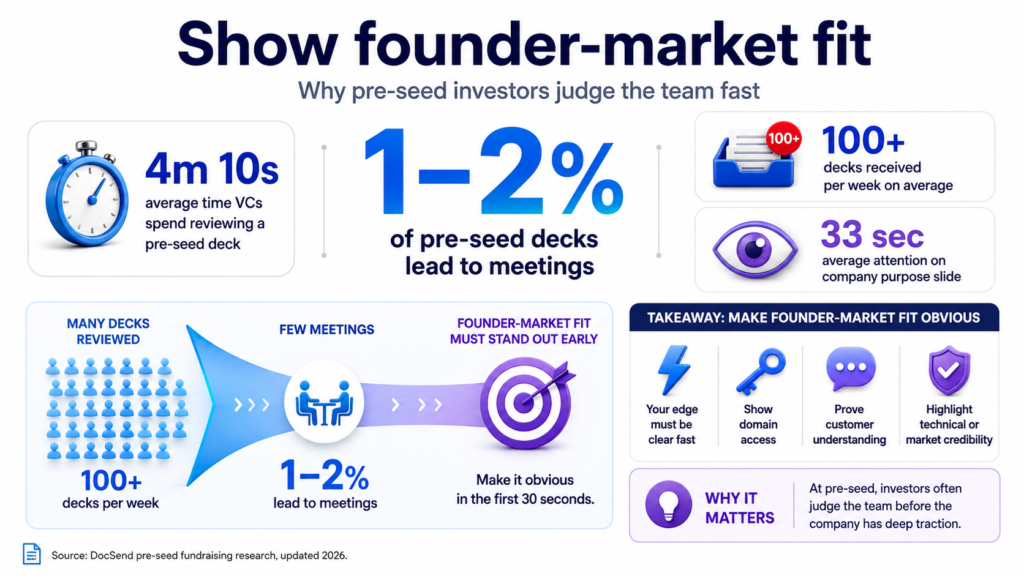
Founder-market fit matters because pre-seed investors are still judging the team as much as the product. The business is early, so the founder’s background, customer access, technical skill, and learning speed carry weight. This is also reflected in Startup SG Founder criteria. A 2026 Startup SG Founder guide notes that Accredited Mentor Partners assess applicants based on business uniqueness, feasibility, team strength, and market potential.
For Singapore founders, this means the pitch should explain why this team understands the problem better than a generic competitor. Work history, domain access, research experience, or direct customer exposure can all support that case. The founder should not only say the problem exists. They should show why they are the right person to test it.
Build early validation before pitching
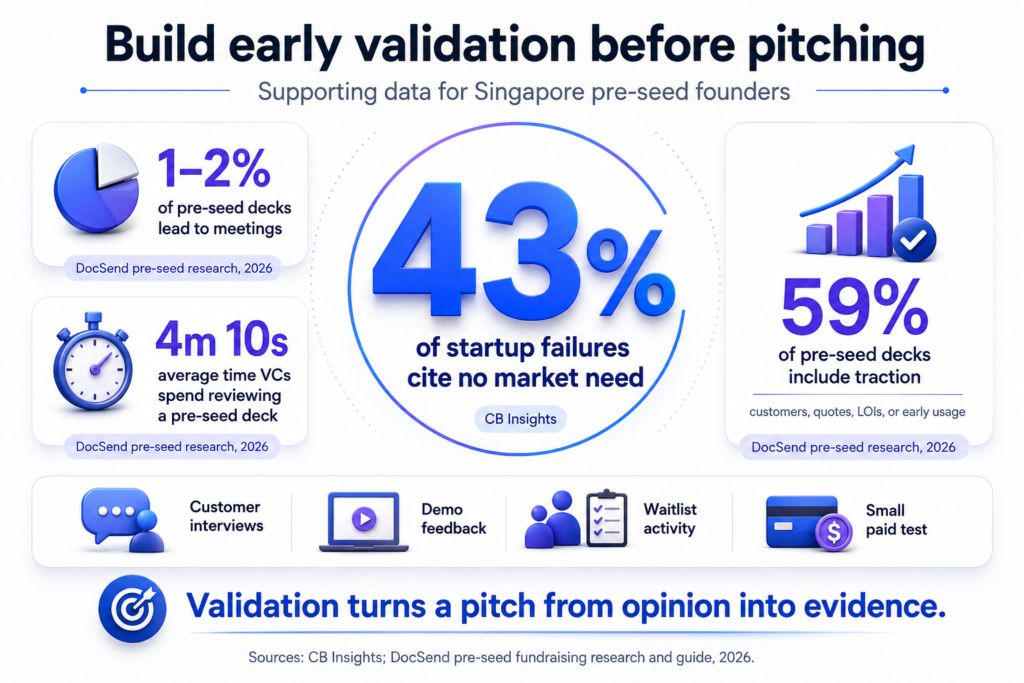
Early validation does not need to be large. It needs to be specific. Founders can prepare customer interview notes, demo feedback, prototype usage, survey findings, waitlist activity, or one small paid test. These signals show that the startup is learning from the market, not only building from an internal idea.
That matters because Singapore’s early support routes are designed around validation. SMU’s Startup SG Founder Grant page says successful grant recipients receive support on a 1:1 ratio, with grant amounts from S$20,000 to S$50,000. A founder applying for that kind of support should show what the money will test next. The best pre-seed story connects early proof, learning, and the next milestone.
Keep the use of funds realistic
Use of funds should stay focused at pre-seed stage. A small early round should support validation, MVP development, first hires, technical testing, customer discovery, or pilot work. It should not promise fast regional expansion before the product has enough proof.
Singapore’s 2026 funding direction also shows why focus matters. Enterprise Singapore said Startup SG Equity was created to address early-stage funding gaps in local technology startups, and its 2026 expansion adds S$1 billion for early-stage and growth-stage deep tech investment. This does not mean every startup gets funded. It means stronger proof, stage fit, and realistic milestones matter even more.
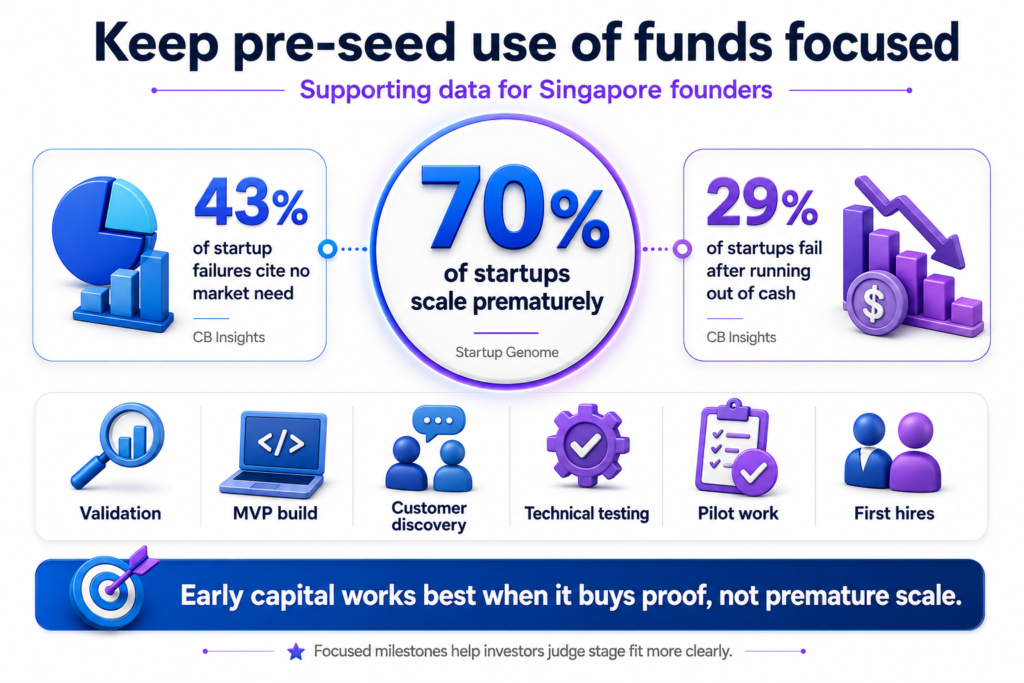
Consequently, pre-seed funding is not about looking fully mature. What you need to do is to show that the startup team can understand and articulate the risk and has a serious plan to reduce it. If the problem, first users, and testing path are clearer, the startup will be better prepared for seed funding, where traction needs to become more visible.
Seed funding in Singapore: prove early traction
Seed funding in Singapore should show that early validation is turning into measurable demand. At this stage, investors are not only asking whether the problem exists. They are checking whether users are returning, paying, referring, or moving through a clear sales process. This matters in 2026 because Southeast Asia’s funding market is still selective. DealStreetAsia reported that Q1 2026 had 98 equity deals, the lowest quarterly deal count in at least eight years, even though capital volume was lifted by one very large Singapore round.
Show traction quality, not only traction size
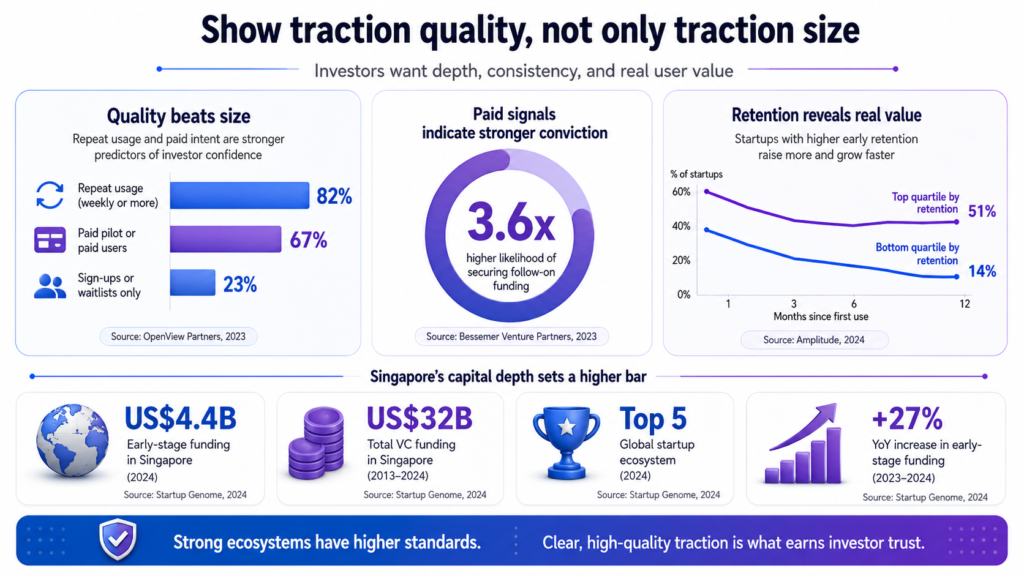
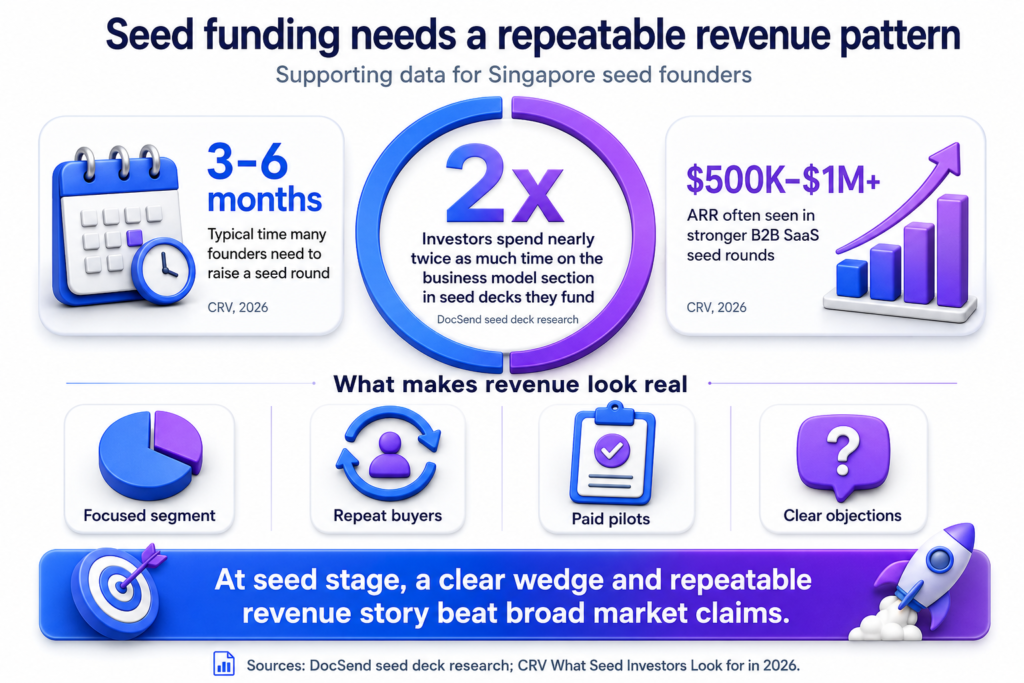
Seed investors look beyond big-sounding numbers. A waitlist can help, but it is weaker than repeat usage. Free users can show interest, but paid pilots tell a stronger story. Founders should explain which users came back, what they used, what they paid for, and why they stayed. Singapore’s ecosystem has depth, so weak evidence stands out faster. Startup Genome lists Singapore with US$4.4 billion in early-stage funding and US$32 billion in total VC funding, which shows serious capital depth, but that depth raises expectations for cleaner proof.
Connect early revenue to a clear market wedge
Seed funding works better when revenue has a pattern. Founders should show which buyer segment reacts first, how the startup reaches them, and what objections are appearing during sales. A small but focused wedge is stronger than broad claims about every industry. For B2B companies, this could mean one vertical, one buyer role, or one use case. For consumer startups, it could mean a specific community, price point, or behavior. The goal is to show that early revenue is not random. It is coming from a market path the team can keep testing.
Explain how the next cheque changes the company
Seed investors want to know what the next cheque unlocks. The answer should be specific: better product reliability, more sales capacity, stronger onboarding, first senior hire, deeper technical validation, or a larger pilot pipeline. Enterprise Singapore said Startup SG Equity was created to address early-stage funding gaps in local technology startups, and its 2026 expansion added S$1 billion for early and growth-stage deep tech investment.
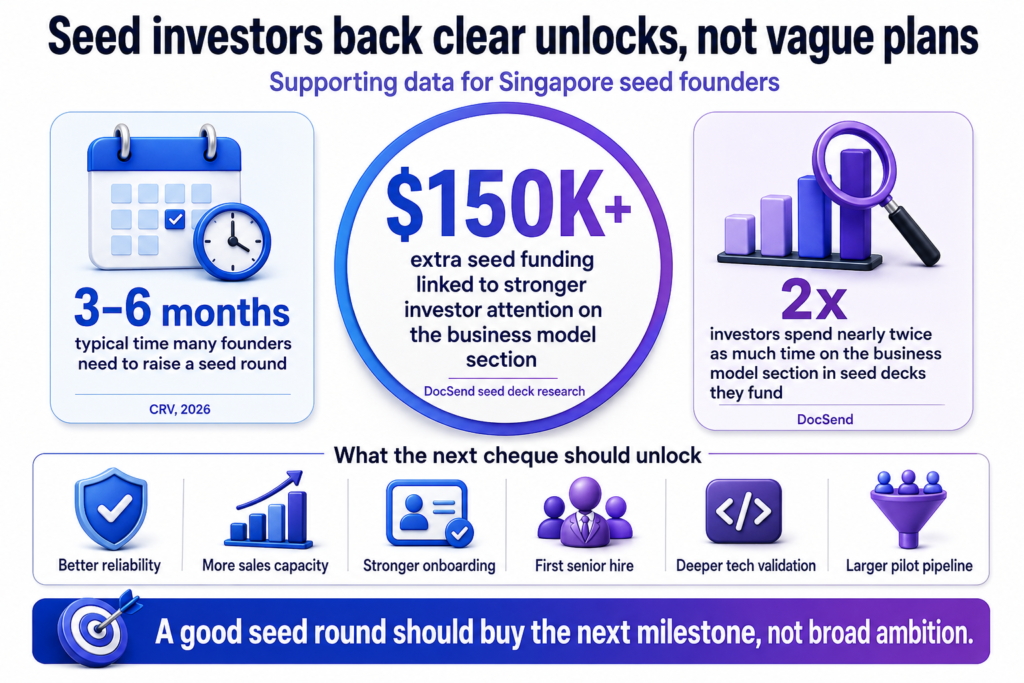
Seed funding is the bridge between validation and repeatable growth. Once traction becomes clearer, founders can prepare for Series A, where investors expect stronger metrics, better reporting, and a growth engine that can scale beyond early wins.
Series A funding in Singapore: prove repeatable growth
Series A funding in Singapore should prove that the startup has moved beyond early traction. At this stage, investors are not only checking whether customers care. They are checking whether the company can grow with structure, discipline, and clearer market control. The proof portfolio needs to show repeatable sales, stronger retention, better reporting, and a team that can scale without every decision sitting with the founder. In 2026, this matters because Singapore still has funding activity, but capital is moving with sharper filters.
Show that growth has a repeatable pattern
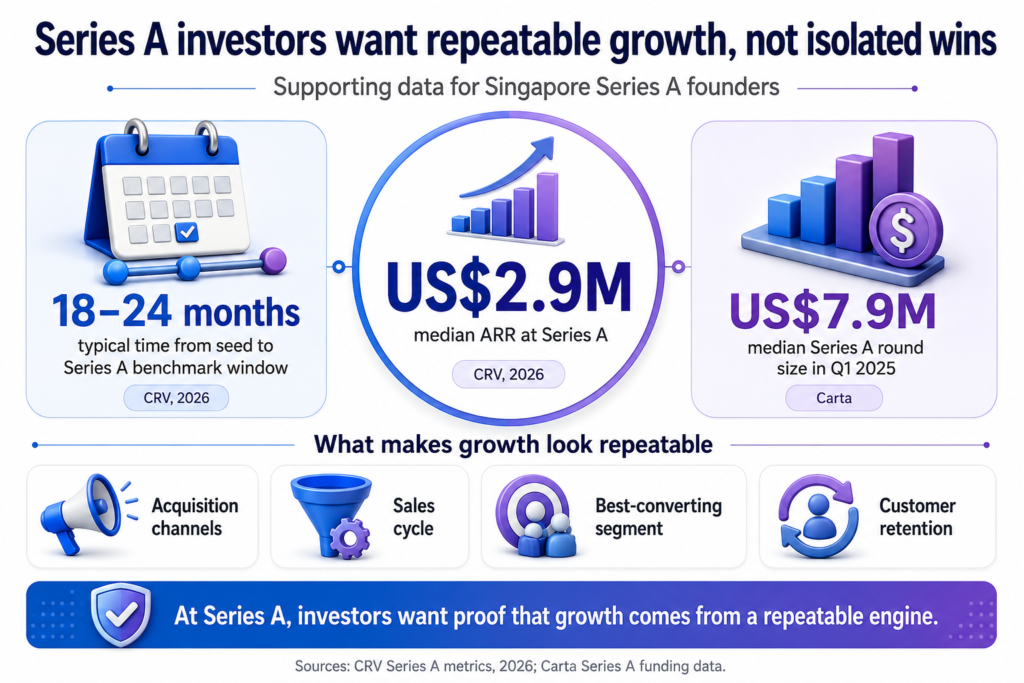
Series A investors want to see where growth is coming from and whether it can continue. A few large wins help, but they do not prove repeatability alone. Founders should explain which channels bring customers, how long sales take, which buyer segment converts best, and why customers stay.
Fresh 2026 funding data support this discipline. Tracxn’s Singapore startup tracker reported that, up to April 2026, Singapore startups raised US$2.64 billion across 49 equity funding rounds, compared with US$2.5 billion across 93 rounds in the same period of 2025. That means funding value rose, while deal count dropped. For Series A founders, the message is clear: investors are writing fewer cheques, so each company needs stronger evidence.
Build the operating case, not only the revenue case
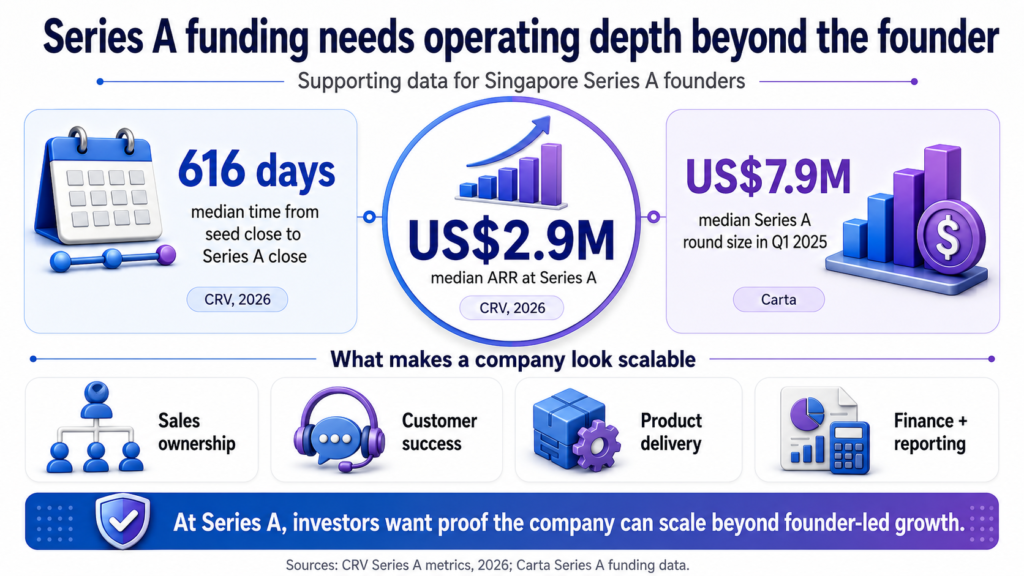
Series A funding also checks whether the company can operate beyond founder-led growth. Investors want to understand sales ownership, customer success, product delivery, finance controls, hiring needs, and reporting habits. If the founder still owns every major customer conversation, the business looks harder to scale.
This connects with Singapore’s wider 2026 funding policy discussion. MAS announced a Growth Capital Workgroup in February 2026 to study financing across deal origination, capital raising, capital mobilisation, and capital recycling. That shows growth funding is being treated as an ecosystem issue, not only a startup issue.
Make the AI and technology story credible
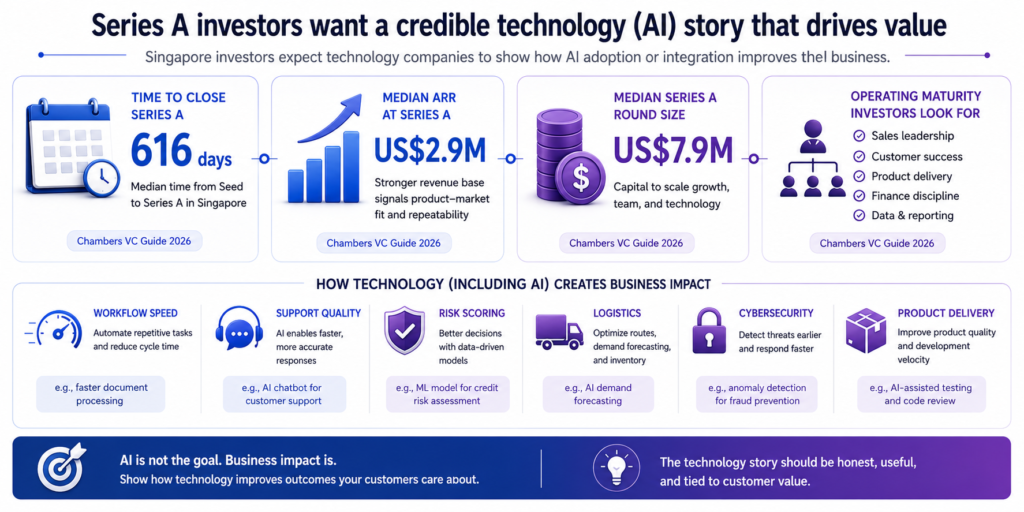
Series A startups in Singapore also need to explain how technology strengthens the business model. Chambers’ 2026 Singapore venture capital guide says investors increasingly expect technology companies to have a credible AI adoption or integration story, especially where it improves defensibility, margins, scalability, or team quality.
This does not mean every startup should call itself an AI company. It means the technology story should be honest, useful, and tied to customer value. If AI improves workflow speed, support quality, risk scoring, logistics, cybersecurity, or product delivery, the deck should show that clearly.
Connect the round to stronger market position
Series A investors want to know what the funding changes. The round could support senior hiring, enterprise sales, product reliability, compliance, regional expansion, or stronger technical infrastructure. However, each use of funds should connect to measurable progress.
KPMG’s Q1 2026 Asia venture outlook says AI, semiconductors, robotics, alternative energy, and infrastructure remain priority areas, while government and corporate capital continue playing a major role. That makes positioning important. A Series A startup should show why it fits a real market direction, not only why it wants more capital.
Series A funding is where early traction becomes a growth system. Once founders can prove repeatability, operating strength, and market fit, they can prepare for Series B and growth funding, where investors examine scale, governance, and long-term defensibility more closely.
Series B and growth funding in Singapore: prove scale readiness
Series B and growth funding in Singapore should show that the company is ready for a larger operating stage. Investors are not only checking revenue now. They are checking whether the startup can enter new markets, manage larger teams, report clearly, and defend its position against stronger competitors. The proof portfolio needs to look less like a pitch and more like a controlled growth system.
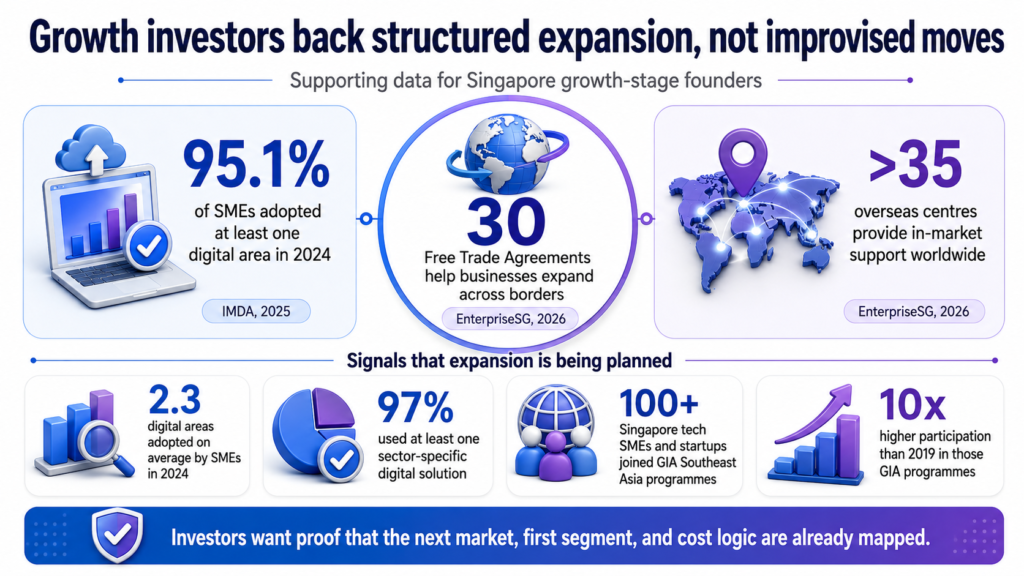
Prove market expansion discipline
Growth investors want to know whether expansion is planned or improvised. Founders should show which country comes next, why that market fits, what customer segment comes first, and which cost areas are already understood. Singapore’s Market Readiness Assistance Grant gives a useful benchmark for how structured expansion planning works. From 1 April 2026, eligible SMEs can receive up to 70% support, capped at S$100,000 per company per new market, across overseas promotion, business development, and market setup.
Show stronger round discipline
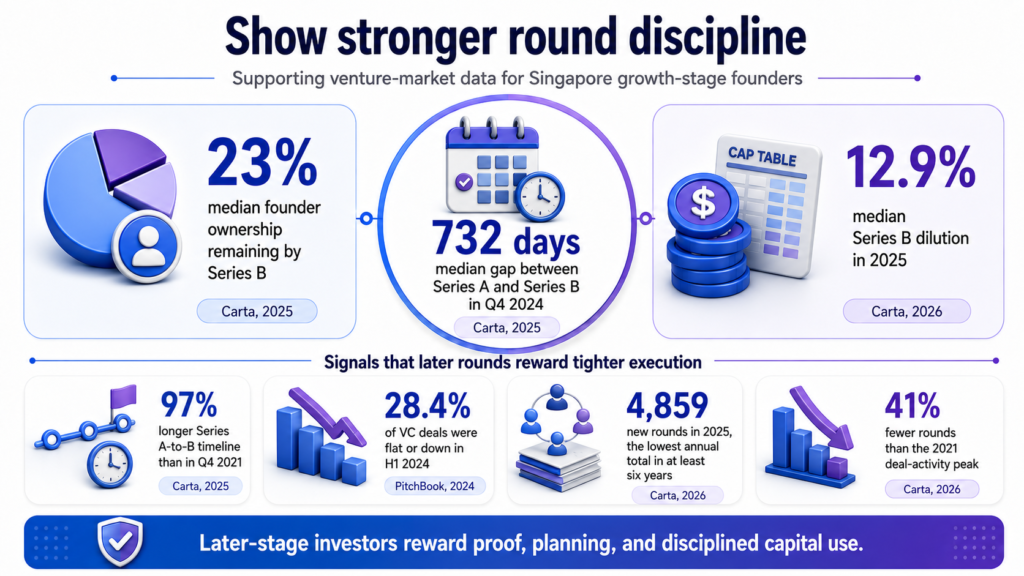
Series B rounds carry more weight because later investors look closely at terms, milestones, and the next financing event. Chambers’ 2026 Singapore venture capital guide notes that each round is increasingly tied to long-term governance, economic terms, and concrete milestones, with less room for aspirational valuation growth between rounds.
That means founders should prepare board materials, forecast logic, revenue quality notes, hiring plans, and risk controls before serious outreach begins.
Build institutional confidence
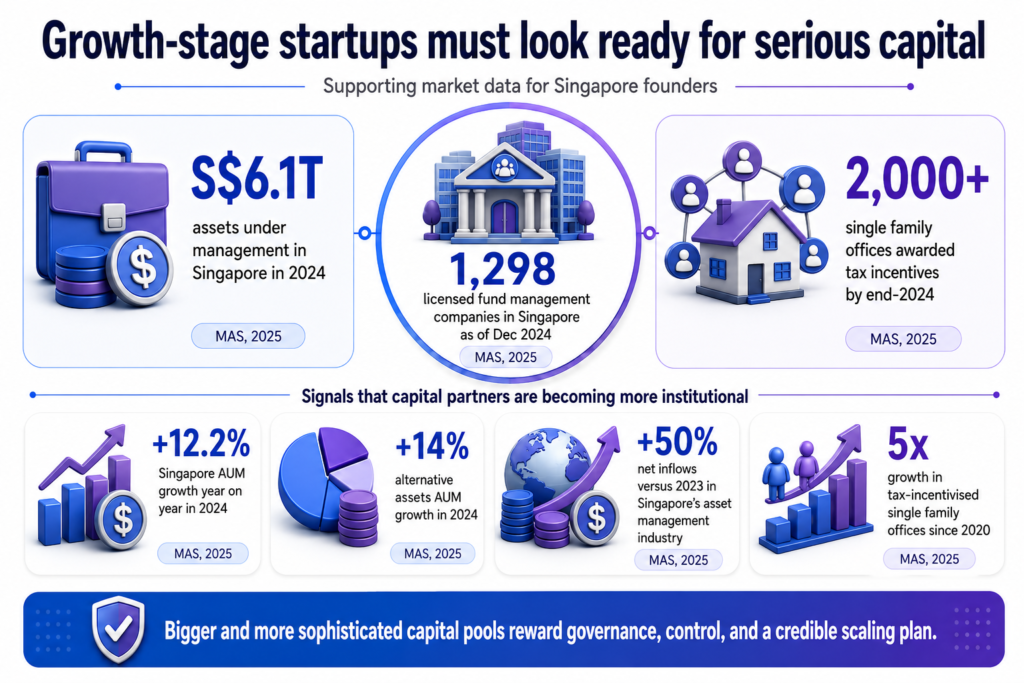
Growth-stage startups need to look ready for more serious capital partners. The Singapore Venture & Private Capital Association’s 2026 guide describes Singapore’s private capital ecosystem as expanding in reach, impact, and sophistication, with a stronger focus on governance and sustainable growth.
Series B funding is not only about raising more money. It is about proving that the company can scale with control. Next, the article can move into deep tech funding, where long development cycles, IP, and technical validation change the funding story.
Deep tech funding in Singapore: prove technical and commercial readiness
Deep tech funding in Singapore requires more than a strong invention. Founders need to prove that the technology can move from research into a real market. Investors and public-backed programmes look for technical feasibility, defensible IP, commercial use, and a team that can handle longer development cycles.
| Funding need | What funders check | Proof founders should prepare |
|---|---|---|
| Proof of concept | Can the science or technology work? | Technical roadmap, test results, research notes, prototype scope |
| Proof of value | Can the technology solve a market problem? | Pilot plan, industry use case, buyer feedback, deployment path |
| IP strength | Is the edge hard to copy? | Patent status, proprietary models, trade secrets, research ownership |
| Commercial path | Can this become a scalable company? | Pricing logic, customer segment, market size, partner interest |
Startup SG Tech supports commercialisation through Proof-of-Concept and Proof-of-Value funding for proprietary technology startups. SGInnovate also focuses on deep tech growth by combining investment capital, talent development, and ecosystem support.
For founders, the lesson is clear. A deep tech pitch should not only explain what is advanced. It should show what can be tested, protected, sold, and scaled.
Where founders can look: Startup SG, SEEDS, angels, VC, accelerators
Startup funding in Singapore should be searched by stage, not by a random list of names. Early founders can start with Startup SG, founder grants, accelerators, and angel networks because these routes often support validation, mentorship, and first market access. Technology startups with stronger IP, deep tech, or research-led products should also review SEEDS Capital and Startup SG Equity, especially when private co-investment fits the plan.
Seed and Series A companies should look beyond grants. Venture capital, corporate investors, sector-focused funds, and regional accelerators can help when the startup already has traction, revenue logic, and a clearer growth path. Angels still matter, but the round structure needs discipline.
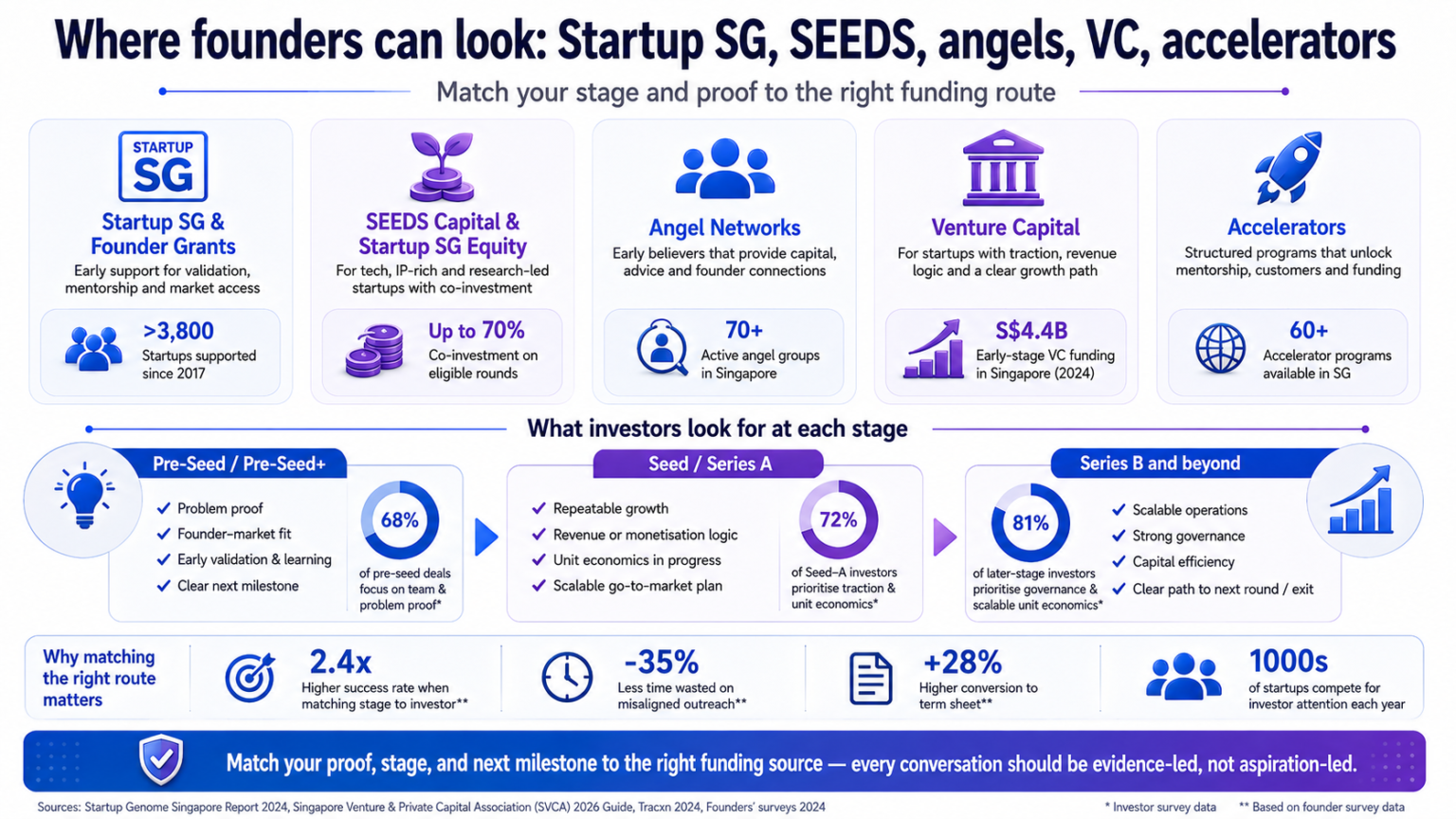
The best route depends on what the company can prove today. A pre-seed team should show problem proof and founder-market fit. A Series A team should show repeatable growth. Before outreach, founders should match the funding source to the proof portfolio, stage, sector, and next milestone. This prevents wasted applications and keeps each conversation tied to evidence, not vague ambition, especially when investors are comparing many startups.
Common mistakes founders make when raising in Singapore
Common mistakes founders make when raising in Singapore often come from treating every funding route the same. A grant application, angel pitch, and VC deck all ask for different proof. When founders rush, the story becomes too broad, while the evidence stays too thin.
The most common mistakes include:
- pitching regional expansion before proving one strong customer segment
- using vanity metrics instead of revenue, retention, or pilot results
- applying to Startup SG routes without checking eligibility
- sending the same deck to angels, VCs, and accelerators
- hiding weak points around the runway, hiring, regulation, or sales cycles
These gaps slow the rise because investors must work too hard to understand the risk. In Singapore, where capital exists but filters are sharp, preparation matters. Founders should match each funding route to their stage, proof portfolio, and next milestone. Next, the article can move into a practical funding-readiness checklist before outreach.
Funding-readiness checklist before outreach
Startup funding readiness in Singapore should be checked before any investor email, grant form, or accelerator application goes out. Start with the round. Know whether you are raising pre-seed, seed, Series A, or growth capital, because each stage needs different proof.
Then review the core materials. Your deck, financial model, traction summary, cap table, product links, founder profiles, and use-of-funds plan should all support one story. Remove slides that sound impressive but do not address investor risk. Before outreach, check these items:
- clear customer problem
- proof of demand
- stage-fit funding target
- clean runway plan
- realistic milestones
- visible founder credibility
- updated website and public profiles
Finally, test the pitch with someone outside the team. If they cannot explain the business back clearly, fix the story before sending it wider.
Why discoverability and credibility affect investor trust
Discoverability and credibility affect investor trust because funders rarely judge a startup from the deck alone. Before a serious call, they often search the company, founder, product, market mentions, LinkedIn profiles, website pages, and public proof. If those signals are weak or inconsistent, doubt grows before the conversation starts.
This matters even more in Singapore, where founders compete inside a mature funding environment. A startup can have real traction, but poor public proof can make the business look smaller, less prepared, or harder to verify. Investors want to see that the company exists beyond a pitch file. They look for founder visibility, clear positioning, customer signals, useful content, updated profiles, and proof that the startup understands its market.
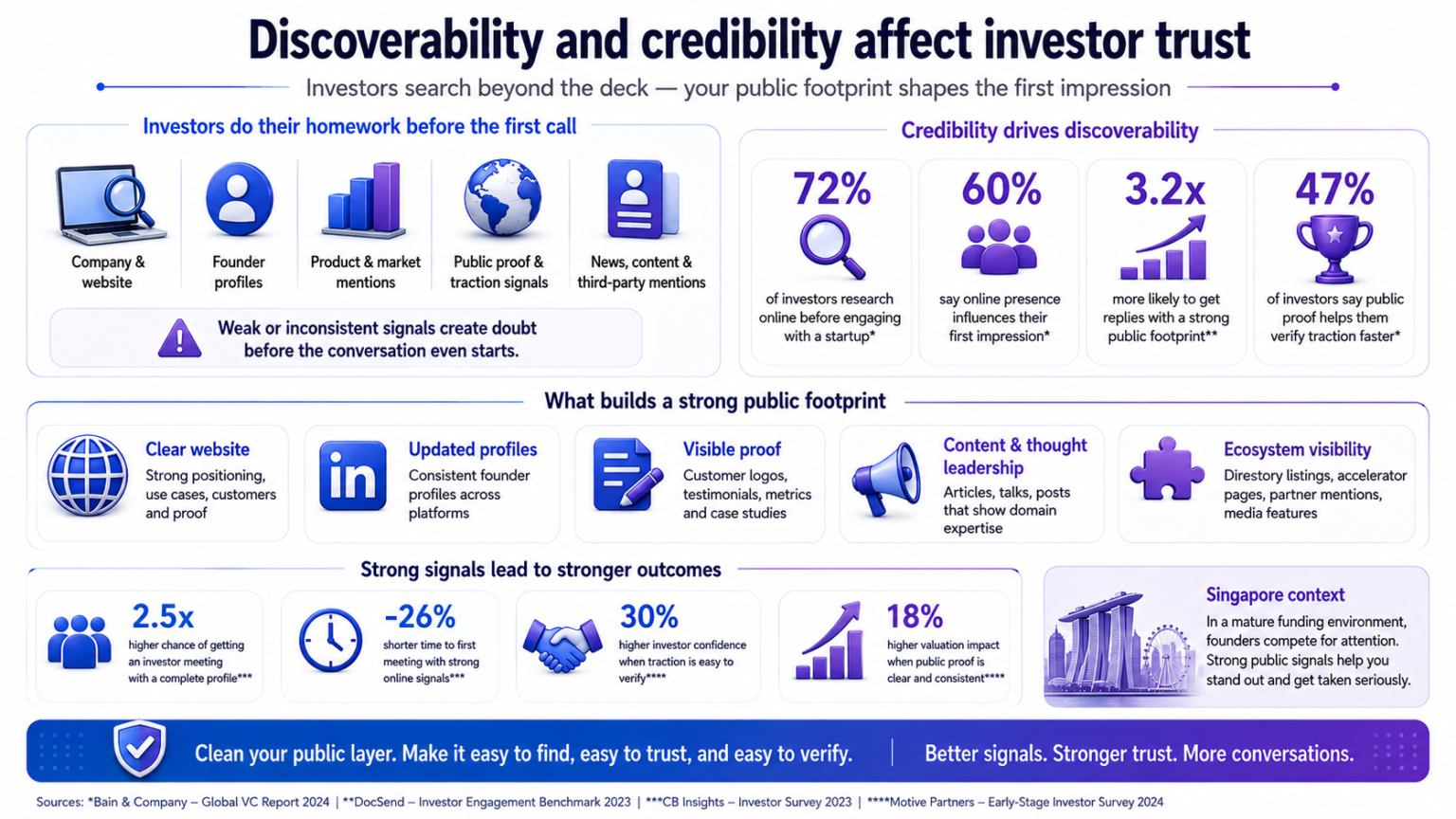
Credibility also supports discoverability. When a company appears in relevant directories, accelerator pages, partner mentions, media features, or expert content, investors can connect the story faster. That does not replace financial proof, but it strengthens the first impression.
Before outreach, founders should clean the public layer. A clear website, consistent profiles, and visible proof make every funding conversation easier to start with confidence.
Conclusion
Startup funding in Singapore works best when founders treat capital as a proof test, not a shortcut. Grants, angels, venture funds, accelerators, and deep tech routes all ask for different evidence. Pre-seed teams need validation. Seed teams need traction. Series A and growth-stage companies need repeatable systems, stronger reporting, and market discipline. Before outreach, founders should build a clear proof portfolio, clean their public credibility layer, and match each funding route to the right milestone. When the story, numbers, website, and investor materials support one direction, fundraising becomes sharper, calmer, and easier to trust for serious Singapore investors in 2026.
Frequently asked questions for startup funding in Singapore for 2026
Startup funding in Singapore creates stage-specific questions for founders comparing grants, VC, angels, accelerators, and investor-ready proof in 2026 today.
What is the best startup funding route in Singapore?
The best route depends on stage, sector, and proof level. Early founders often start with grants or angels, while stronger traction fits VC or strategic investors.
How can pre-seed startups raise funding in Singapore?
Pre-seed startups should prove the problem first. Customer interviews, MVP plans, founder-market fit, early users, and validation notes make the funding story stronger.
What do Singapore investors check before funding startups?
Singapore investors check traction quality, revenue logic, market size, team strength, use of funds, runway, customer demand, and whether growth can repeat.
Why does credibility matter before startup fundraising?
Credibility matters because investors check more than the deck. Clear websites, founder profiles, public proof, and customer signals help reduce doubt before outreach.
