

Faustas Norvaisa
A Growth & Product Expert with 9 years of experience in revenue diversification, international expansion, SEO, and digital marketing. Passionate about scaling businesses and building global brands, he empowers companies to thrive with his motto, "sharing is caring.
Korean Brands Expanding to Europe: Distributor vs Importer vs Direct
- Last time updated: 24th of January, 2026
Korean brands expanding to Europe often assume the first step is finding a distributor. In reality, Europe rewards proof, clarity, and low-risk adoption before it rewards new partnerships.
The real decision is not “partner or no partner.” It is which route reduces buyer risk while you keep control of learning: direct selling, importer-led entry, or distributor scaling.
This article explains how European buyers evaluate unfamiliar suppliers, why exclusivity too early becomes a trap, and how to run a pilot-first approach that creates reusable proof. Next, we’ll define the three routes clearly and show when each one wins.
Partner up with aboveA to Expand to the EU market!
Table of Contents
Korean Brands Expanding to Europe: Why Importer-Led Entry Often Works Earlier?
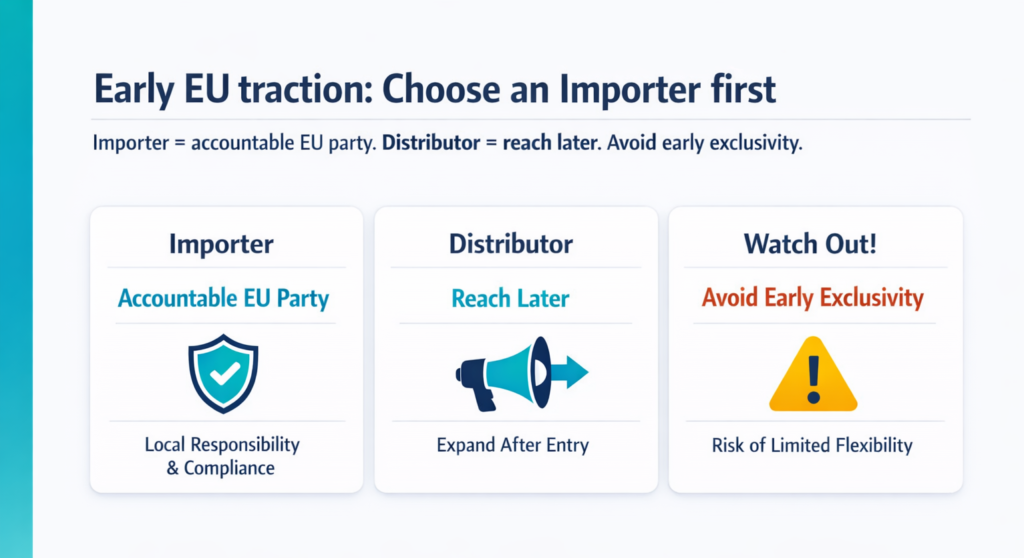
Korean brands expanding to Europe often chase a distributor first, but early traction usually depends on reducing procurement risk, not maximizing reach. In many EU categories, the buyer’s first question is not “Can you ship?” It’s “Who is accountable inside Europe if something goes wrong?” That’s why you must understand clearly the EU importer and distributor roles.
That’s where an EU importer can outperform a distributor in the early stage. Importers are typically positioned as the first party placing non-EU products on the EU/EEA market, while distributors make products available after they’ve already been placed on the market. This difference often translates into stronger “safe-to-trial” comfort for buyers, because documentation, traceability, and responsibility lines feel clearer.
By contrast, distributor conversations frequently drift into exclusivity too early. That can lock you into a relationship before you have signaled, and EU distribution structures also sit under competition/vertical restraint considerations, which makes “exclusive” more sensitive than many exporters expect.
Next, we’ll define direct vs importer vs distributor roles so you choose based on function, not job titles.
Korean Brands Expanding to Europe: Direct vs Importer vs Distributor Roles
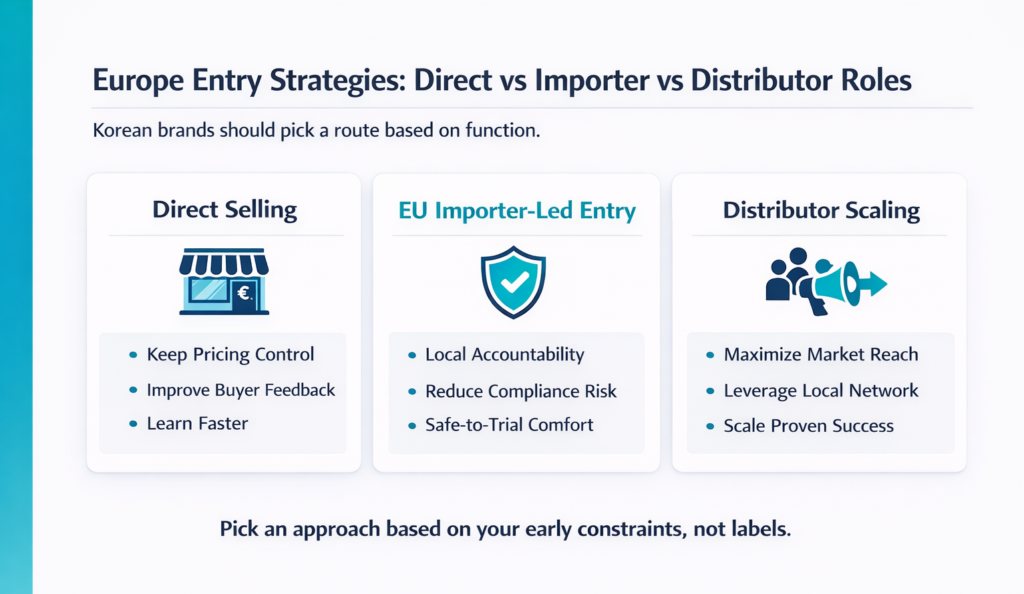
Korean brands expanding to Europe should pick a route based on function, not labels. The three common paths, direct selling, EU importer-led entry, and distributor scaling, solve different constraints.
Direct selling fits when buyers can evaluate the offer remotely, and a pilot is easy to approve. It keeps pricing control with you, shortens the learning loop, and surfaces real procurement objections instead of filtered feedback.
EU importer-led entry helps when the purchase needs clearer accountability inside Europe. In many categories, an importer of record reduces friction by making documentation, traceability, and responsibility lines feel safer to internal stakeholders. That “safe-to-trial” confidence often matters more than extra reach early on.
Distributor scaling works best after signal exists. Distributors amplify what already converts, but many will ask for exclusivity or territory control to justify effort. If you go distributor-first, you risk losing visibility into why deals stall and letting someone else shape your positioning.
Next, we’ll cover exclusivity traps and the early warning signs before you sign any European partner agreement.
Expanding to Europe as Korean Brand: Exclusivity Traps to Avoid
Korean brands expanding to Europe should treat exclusivity as a late-stage reward, not the price of entry. The classic failure is signing an exclusive distribution agreement (EU) before you’ve validated demand, because it hands over leverage while you still don’t know what European buyers actually need to approve a trial.
A second trap is mixing up roles. A sales agent vs importer decision is not cosmetic: an EU importer/importer of record can reduce procurement fear by clarifying accountability, while a distributor often prioritizes territory control. If a partner pushes exclusivity but can’t define target accounts, a weekly activity cadence, and pipeline visibility, you’re not buying distribution; you’re granting a monopoly on your learning.
Also watch for “we’ll discount to enter fast.” Pricing chaos weakens supplier evaluation outcomes and makes buyer due diligence harder, especially when European teams compare vendors side by side. If your category relies on compliance signals (for example, CE marking compliance where relevant), exclusivity doesn’t solve trust gaps; it hides them until deals stall.
Next, we’ll map the proof package that makes European procurement comfortable, approving the first pilot.
Expanding to Europe as Korean Business: The Proof Package Buyers Need Before a Trial
Korean businesses exploring the European market win faster when they stop selling “potential” and start supplying what European procurement can approve. Think of this as a supplier evaluation bundle: the goal is to make the first test feel safe, justified, and easy to defend internally.
Here’s what that proof package should include:
Outcome proof: short results summary, repeat-order signal, performance evidence, or credible references.
Commercial clarity: pricing logic, responsibilities, lead times, and a simple warranty/returns stance.
Due diligence readiness: clean specs, traceability basics, and the documents buyers usually request during buyer due diligence.
Compliance signal (category-dependent): where relevant, show readiness for CE marking compliance or other required EU standards—without turning it into a legal deep dive.
Pilot design: clear scope, timeline, and success criteria so the first step is a low-risk trial, not a long negotiation.
This bundle matters because it turns “interesting” into “approvable.” It also protects you from premature exclusive distribution agreement (EU) pressure, because you can generate demand signal before negotiating territory control.
Next, we’ll outline a pilot-first sequence that creates reusable proof before you scale importers or distributors.
Pilot Before Distribution: Korean Brands Expanding to Europe
Korean brands’ penetration into the EU should treat the first phase as demand validation, not “market entry.” The aim is to create proof that European procurement can approve, before you sign any exclusive distribution agreement (EU).
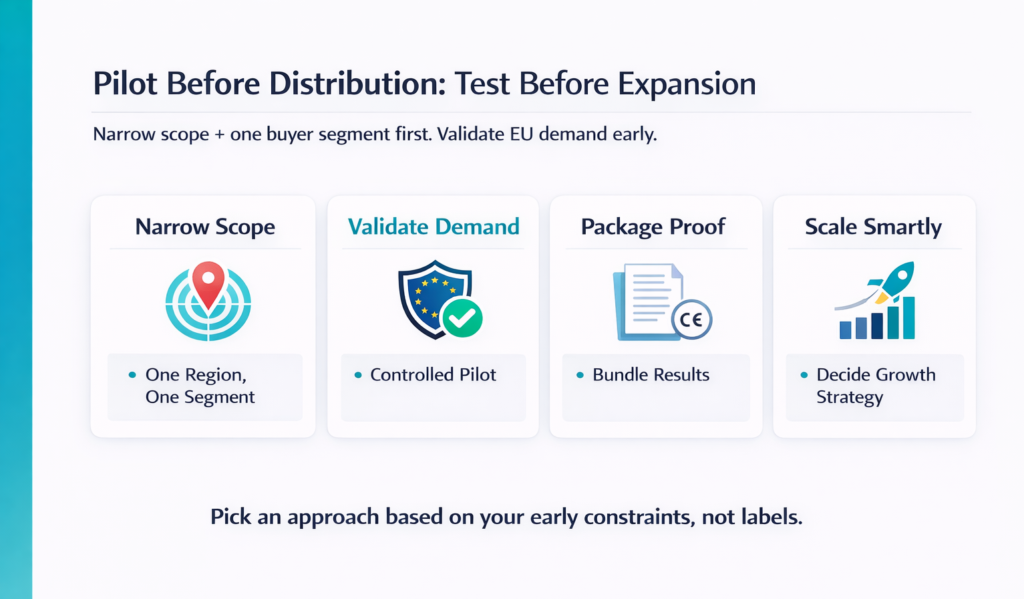
Koreans should also start by narrowing to one region and one buyer segment, so feedback stays comparable. Then run buyer-led conversations focused on supplier evaluation: disqualifiers, internal approval steps, and what “safe-to-trial” means in your category. When patterns repeat, move into a controlled pilot with a clear scope, timeline, and success criteria. That pilot becomes your reusable asset.
Afterward, package the result into a due diligence-ready bundle: outcomes, commercial clarity, documentation hygiene, and category signals such as CE marking compliance where relevant. Only then decide how to scale. If accountability inside Europe is the friction, an EU importer/importer of record can help. If demand is repeatable, distributors can amplify it without hiding market feedback.
How Korean Business Should do a Pilot-First Sequence?
Before uniting with European partners as a Korean business, you should treat the first phase as demand validation, not “market entry.” The aim is to create proof that European procurement can approve, before you sign any exclusive distribution agreement (EU).
Start by narrowing to one region and one buyer segment, so feedback stays comparable. Then run buyer-led conversations focused on supplier evaluation: disqualifiers, internal approval steps, and what “safe-to-trial” means in your category. When patterns repeat, move into a controlled pilot with a clear scope, timeline, and success criteria. That pilot becomes your reusable asset.
Afterward, package the result into a due diligence-ready bundle: outcomes, commercial clarity, documentation hygiene, and category signals such as CE marking compliance where relevant. Only then decide how to scale. If accountability inside Europe is the friction, an EU importer/importer of record can help. If demand is repeatable, distributors can amplify it without hiding market feedback.
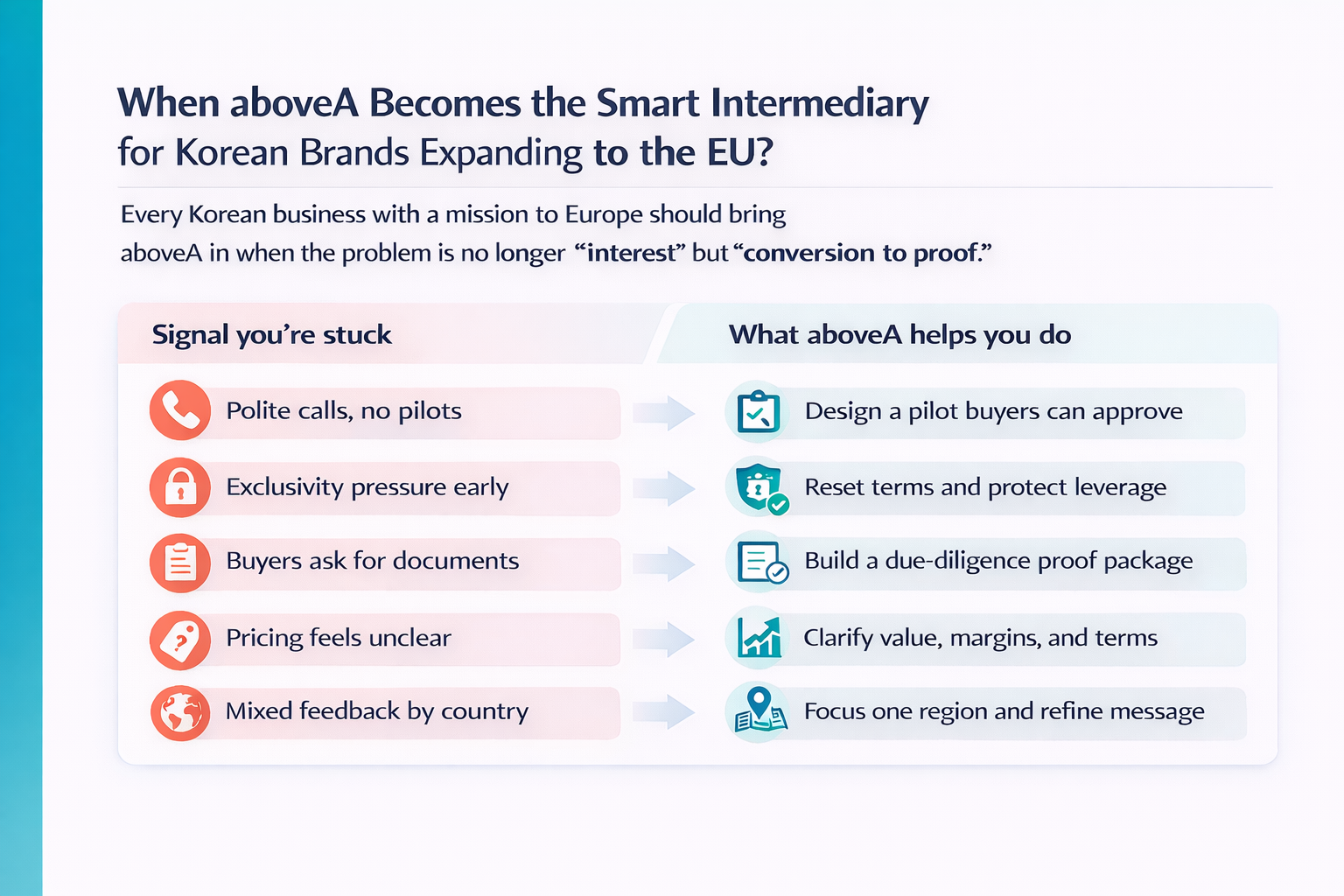
When aboveA Becomes the Smart Intermediary for Korean Brand Expanding to the EU?
Every Korean business with a mission to Europe should bring aboveA in when the problem is no longer “interest,” but “conversion to proof.” At that stage, the risk is signing the wrong partner, accepting the wrong pricing logic, or losing visibility into what European buyers need for supplier approval.
| Signal you’re stuck | What aboveA helps you do |
|---|---|
| Polite calls, no pilots | Design a pilot buyers can approve |
| Exclusivity pressure early | Reset terms and protect leverage |
| Buyers ask for documents | Build a due-diligence proof package |
| Pricing feels unclear | Clarify value, margins, and terms |
| Mixed feedback by country | Focus one region and refine message |
This keeps decisions reversible while you learn what converts.
The goal is not to “find a distributor fast.” It’s to build a repeatable entry motion: clear positioning, measurable demand signal, and a proof bundle that speeds procurement decisions. Once that signal exists, aboveA can support importer or distributor talks from a position of evidence, so you keep control while gaining reach.
Importer of Record vs Distributor as Korean Company Penetrating the EU
Many Korean brands ready to sell in Europe often say, “We need distribution,” but the more accurate question is: Do you need EU accountability first, or do you need sales reach first? In many categories, early traction depends on how fast you can pass supplier evaluation and make the first trial feel safe. That’s why the importer route (especially an importer of record) can outperform a distributor in the early stage, even if your long-term plan includes distribution.
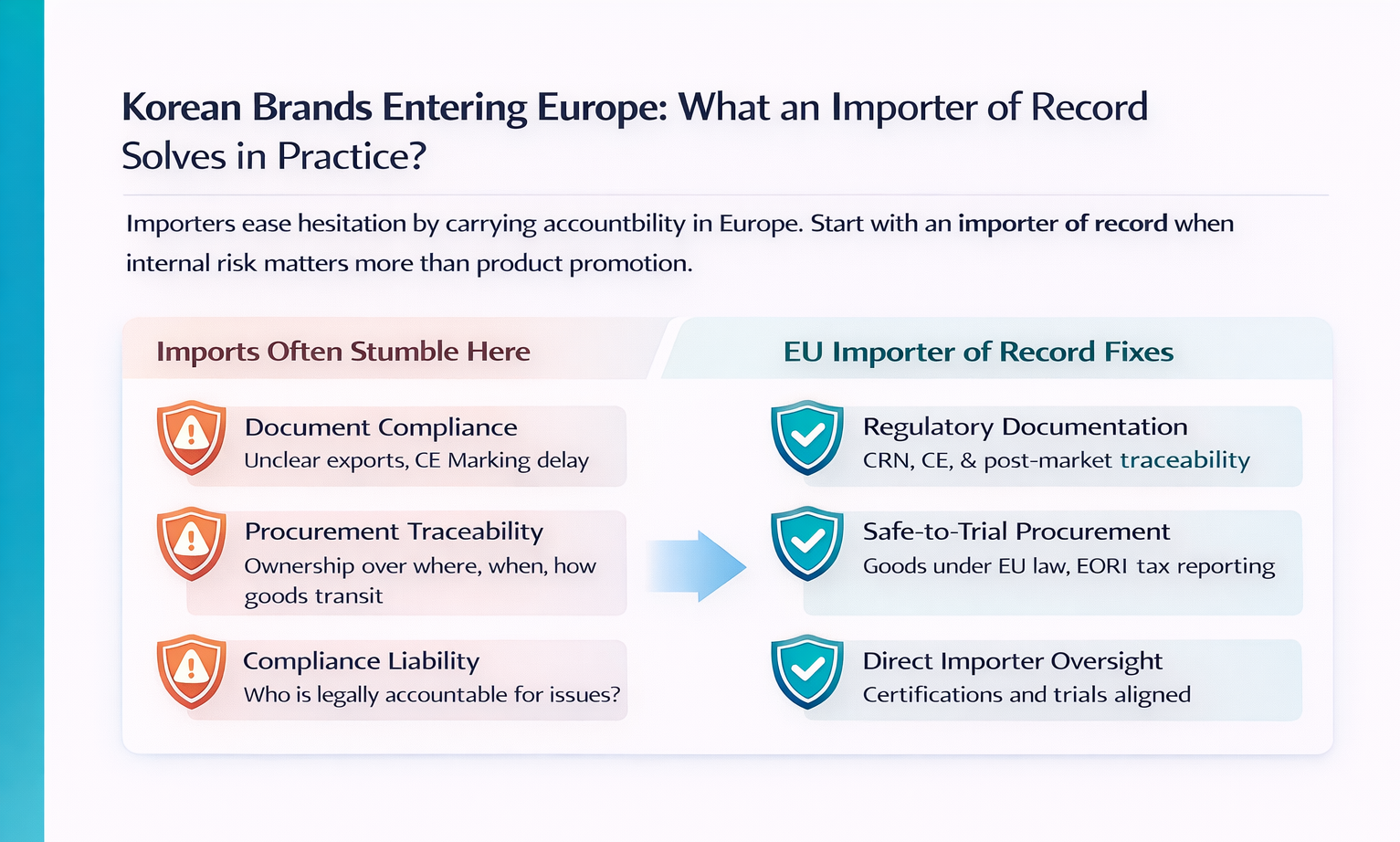
Korean Brands Entering Europe: What an Importer of Record Solves in Practice?
An EU importer / importer of record is useful when the buyer’s hesitation is not product interest, but internal risk. European procurement teams often worry about documentation readiness, traceability, and who carries responsibility if something goes wrong. When an importer is in place, the purchase can feel easier to approve because the responsibility line within Europe is clearer. This can reduce friction during buyer due diligence, because you can present a cleaner “we know how Europe expects suppliers to operate” story.
Importer-led entry also protects you from a common early mistake: giving away control before you’ve learned what converts. Many distributor conversations drift toward territory exclusivity or heavy discounting “to enter fast.” If you are still refining positioning, value framing, or terms, that pressure can lock you into the wrong structure. Importers can help you reach a first set of trials without forcing you into an exclusive distribution agreement (EU) before demand is proven.
When a Distributor Becomes the Better Move for Korean Businesses?
Distributors become powerful after Korean exporters have a signal – meaning repeatable intent, pilots, and a clear buyer profile. At that point, a distributor can amplify what already works: they bring account coverage, local language selling, and relationship access across many targets. The key is that distributors scale demand; they rarely create it from zero.
Before choosing a distributor, ask whether you can keep visibility into what’s happening. If you can’t see pipeline activity, objections, and where deals stall, you lose learning and pricing control. A good distributor relationship is measurable: defined account focus, agreed messaging, clean commercial logic, and a clear reporting rhythm. That structure prevents “we’ll try” from turning into months of silence.
To close this chapter, the rule is simple: use an importer of record when Europe needs accountability to approve a trial, and use distributors when you have proven conversion and want scale without losing control. Next, we’ll map how European procurement evaluates new suppliers so you can build the right proof package.
What Korean Businesses Should Check First With European Procurement?
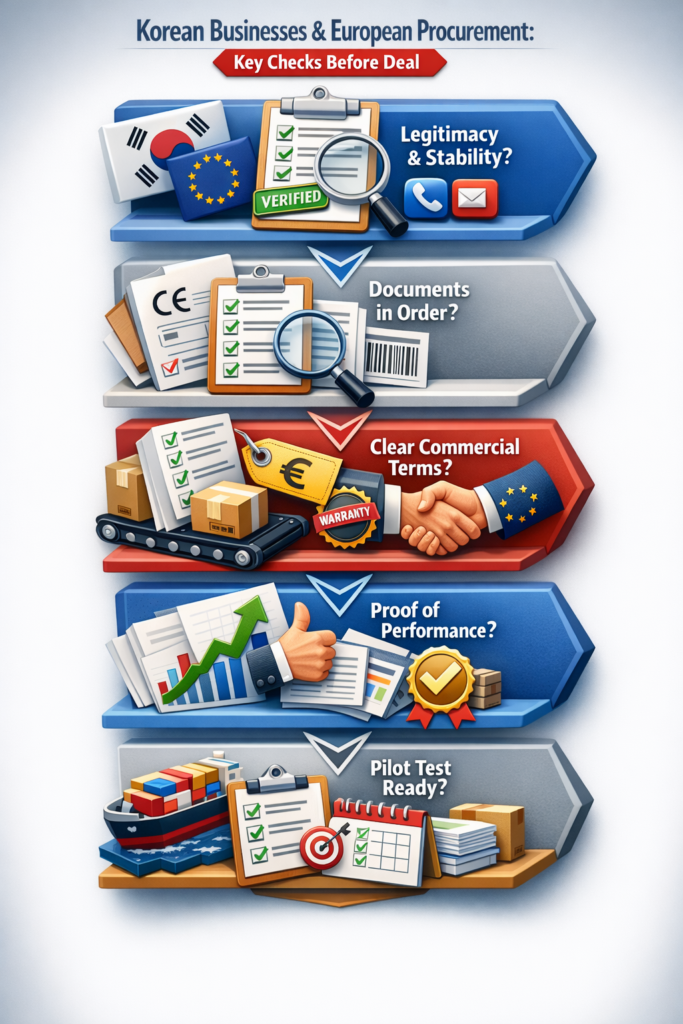
Korean exporters before getting to the EU often stall not because the product is weak, but because procurement can’t justify the risk fast enough. Below is the “behind-the-scenes” checklist European teams tend to apply – whether they say it out loud or not.
1. Legitimacy and Supplier Stability Issues Between the EU and Korean Businesses
Procurement first checks if you look real, reachable, and consistent. That means clear company identity, stable points of contact, predictable response times, and the same story across decks, emails, and documents. If basic facts feel scattered, the buyer assumes delivery will be too.
2. Documentation and Due Diligence Readiness Before Selling in Europe
Next comes buyer due diligence. They want clean specs, traceability basics, and documents that match how their internal review works. This is where many exporters lose momentum, not from refusal, but from endless back-and-forth that makes the purchase feel heavy.
3. Korean Brand Commercial Clarity That Feels “Approachable”
Europe rewards clean terms. Pricing logic, responsibilities, lead times, warranty stance, and escalation paths should feel simple enough to forward internally. If commercial details feel improvised, procurement delays because uncertainty becomes their personal risk.
4. Korean Business Must Have Proof That Supports a Trial Decision
Procurement needs proof that reduces downside: outcomes, repeat-order signals, performance evidence, or credible references. The proof must be decision-friendly, not promotional. A buyer should be able to paste it into an internal thread and get a “yes, let’s test.”
5. Korean Brands Must Have a Pilot Structure Procurement Can Approve
Finally, they evaluate whether the first step is contained. A good pilot has a clear scope, timeline, and success criteria. This is also where some teams quietly use an intermediary like aboveA to pressure-test positioning, structure conversations, and shape a pilot that creates reusable evidence without overcommitting.
Penetrate European Markets With Ease!
Korean brands expanding to Europe win by sequencing decisions, not chasing a distributor first. European procurement approves suppliers that feel low-risk: clear documents, consistent terms, credible proof, and a contained pilot. Use an EU importer when accountability friction blocks trials, and use distributors only to scale what already converts. Avoid exclusivity until activity and pipeline are measurable. Some teams use aboveA as a neutral intermediary to shape pilots, package proof, and negotiate partners with leverage with confidence.
Korean Brand Expansion to Europe Frequently Asked Questions
Can Korean brands expanding to Europe sell without a local office?
Yes. Many sell remotely by using a proof package, clear terms, and a contained pilot. Europe’s barrier is usually approval risk, not physical presence.
Do Korean brands expanding to Europe need a distributor from day one?
Not always. Distributors scale what already converts. If demand isn’t proven, you may lose visibility and leverage. Validate the signal first, then scale partners.
What is the difference between an EU importer of record and a distributor?
An importer of record supports accountability and documentation confidence when placing products on the EU market. A distributor focuses on sales reach after the product is already market-ready.
How can aboveA help Korean brands expanding to Europe without overcommitting?
aboveA helps validate demand, structure buyer conversations, and design pilots that create reusable proof. Then partner talks become evidence-led, not based on hope or exclusivity pressure.
When should Korean brands expanding to Europe accept exclusivity?
Only after measurable activity exists: defined target accounts, reporting cadence, real pipeline, and pilots or procurement steps in motion. Exclusivity without evidence usually becomes dependency.
