
Project details
Client: B2B services company (survival-mode growth)
Location: US + EU
Industry: Professional services for SaaS and tech teams
Goal: Rebuild a predictable demand engine and stabilize pipeline through conversion-first funnel design, clean tracking, and commercial-intent acquisition.
The client was a growing B2B services firm with strong delivery outcomes but unstable demand. Their pipeline was inconsistent, paid spend was leaking, and the website wasn’t converting qualified traffic into booked calls. Tracking was unreliable, reporting contradicted itself, and the founder team was operating under constant pressure. aboveA rebuilt the growth system from the ground up – aligning positioning, funnel structure, measurement, and acquisition so demand became repeatable instead of random.
Services Provided:
-
Demand generation strategy and ICP positioning
-
Offer and messaging rebuild for high-intent buyers
-
Conversion rate optimization (CRO) and funnel redesign
-
Landing page system for commercial intent queries
-
GA4 setup, Google Tag Manager implementation, and attribution cleanup
-
Paid search restructuring for qualified lead generation
-
Commercial SEO architecture (solution pages, use-case pages, decision-stage content)
-
Reporting dashboards and weekly optimization cadence tied to pipeline outcomes
Top Challenges:
-
Weak pipeline and inconsistent lead quality
-
Wasted spend due to broad targeting and misaligned landing pages
-
Low website conversion rate and unclear next-step journeys
-
Messy tracking, duplicate events, and broken attribution
-
Founder stress caused by unreliable reporting and unclear priorities

Services Employed
Competitor research
We’ll investigate market saturation for your specific services, dissect competitor structures, pricing models and value propositions.
Performance Tracking
We track advanced metrics to deliver insights on user interactions and site performance, helping to optimize strategies for better results and growth
Lead Generation Systems
We build automated lead generative systems that target and engage potential customers, streamline prospecting, and optimize conversion rates
Marketplace SEO Services
SEO built to scale listings, categories, and location-based pages while controlling crawl efficiency and duplicate URLs.
Survival to Predictable Demand: Rebuilding a B2B Growth System for Qualified Leads
- Last time updated: 31th of January, 2026
This case study shows how aboveA rescued a B2B services company stuck in survival mode. We fixed positioning, rebuilt conversion paths, cleaned GA4 and Tag Manager tracking, and aligned SEO plus paid search to commercial intent. The result was predictable demand, lower cost per lead, and a calmer founder team.
The Challenge: Weak pipeline, wasted spend, low conversions
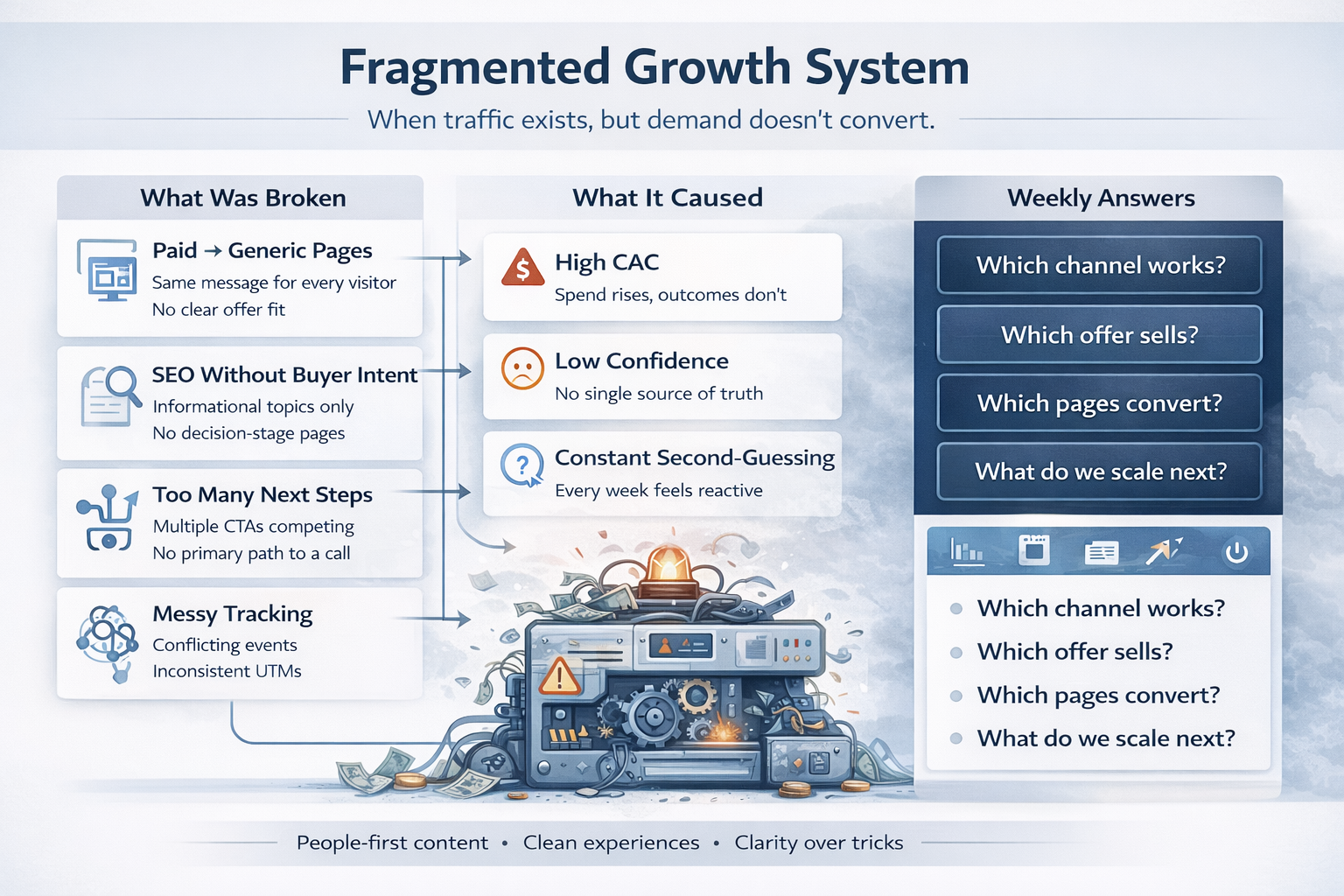
The business wasn’t failing because of one issue. It was failing because the entire growth system was fragmented. Paid traffic went to generic pages with weak positioning.
SEO content existed, but it didn’t map to commercial-intent keywords or decision-stage searches. The website had multiple “next steps,” but no clear path to a booked call. On top of that, tracking was messy: GA4 events conflicted, UTMs weren’t standardized, and the team couldn’t explain where qualified opportunities actually came from.
In practical terms, they had classic survival-mode symptoms: high CAC, low confidence, and constant second-guessing. The founders needed a system that answered simple questions every week: which channel works, which offer sells, which pages convert, and what to scale next. Google’s guidance is consistent here: the goal is useful, reliable, people-first content and clean site experiences. Not tactics that try to manipulate rankings.
Solutions Implemented to Make Demand Predictable
We rebuilt growth in the order that reduces chaos: offer clarity → conversion path → measurement → acquisition. That sequencing matters if you want visibility in modern search and AI-driven discovery, because AI features reward clear structure and reliable signals.
1. ICP positioning and offer clarity for high-intent buyers
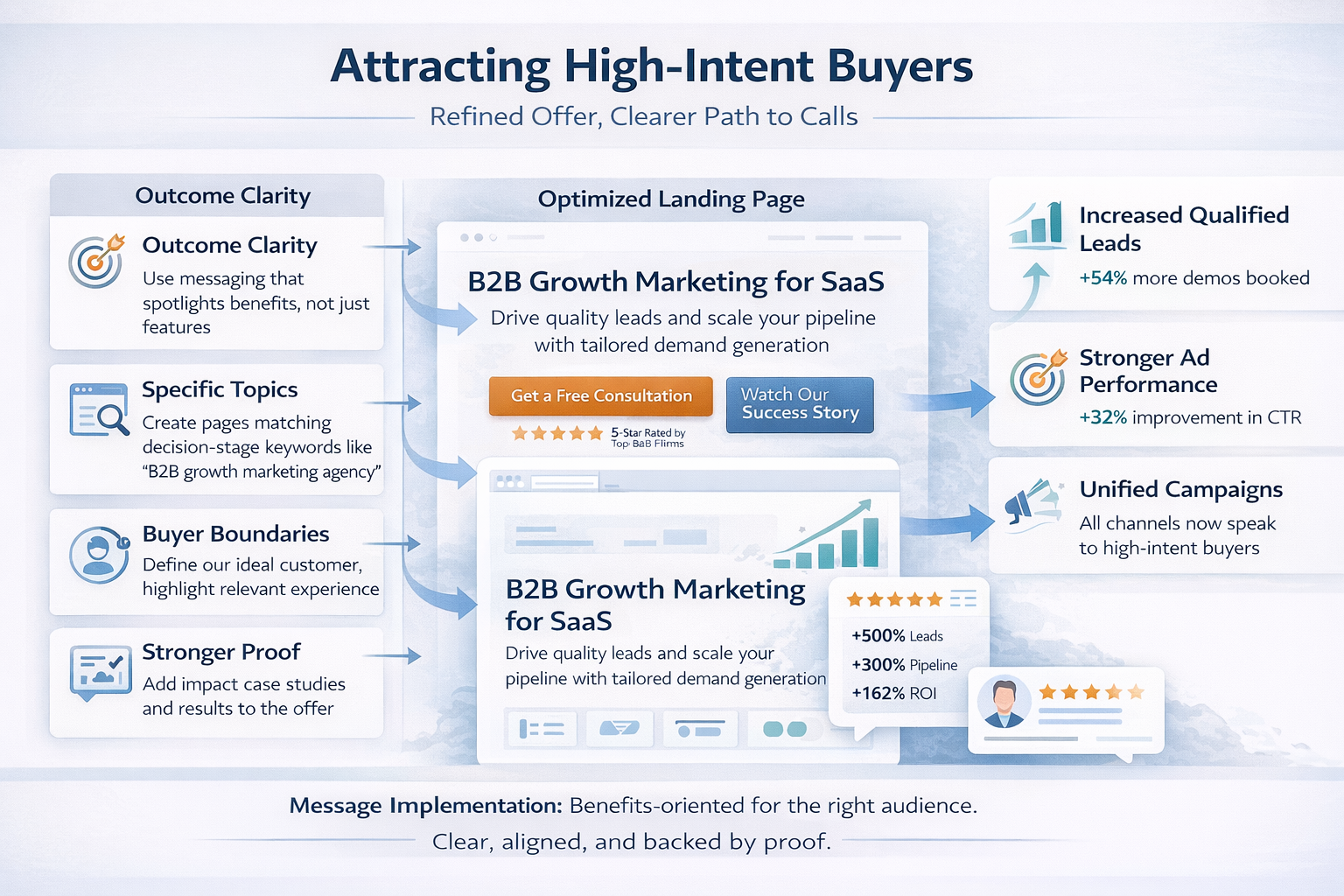
First, we tightened the offer to match what buyers search for when they’re ready to evaluate. That meant clearer outcomes, tighter boundaries, stronger proof, and landing page messaging aligned to searches like growth marketing agency for B2B, demand generation services, and pipeline generation for SaaS.
The goal wasn’t “more traffic.” The goal was the right traffic that turns into sales conversations.
This immediately reduced confusion-driven bounce because the message became specific: who it’s for, what it fixes, and what happens next. It also made ads and content easier to create because every channel finally spoke the same language.
2. Funnel rebuild with conversion rate optimization
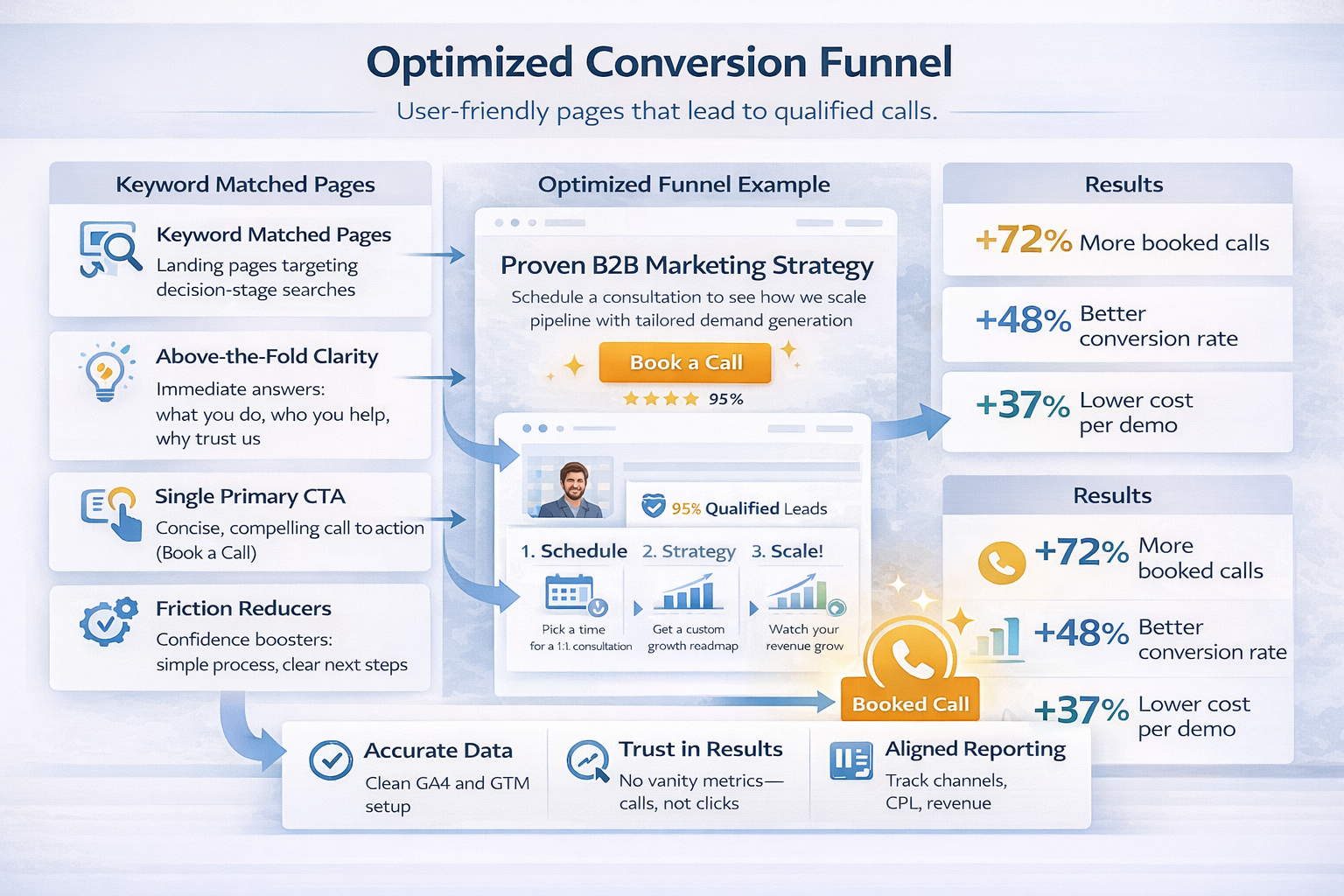
Next, we rebuilt the conversion journey with conversion rate optimization (CRO) logic: each page had one job, one primary CTA, and one clear route to “Book a Call.” We redesigned core pages with above-the-fold intent (what you do + who you help + proof), added friction reducers (process clarity, timelines, what happens after booking).
On top of that, we made conversion-focused pages that match decision-stage searches, like marketing strategy consultation, growth audit, and lead generation funnel.
This turned the website into a working sales asset instead of a brochure. The founders no longer relied on heroic follow-ups to “save” deals that the site should have qualified in the first place.
3. GA4 + Tag Manager cleanup and reporting the founders could trust
Then we fixed the measurement. We implemented a clean GA4 setup, rebuilt events through Google Tag Manager implementation, removed duplicate conversions, and standardized UTMs so attribution stopped changing every time someone launched a campaign.
We also aligned reporting with outcomes that matter, booked calls, qualified leads, and sales-stage movement, so performance wasn’t judged by vanity metrics.
This approach follows Google’s broader principle: clarity, reliability, and usefulness beat manipulation. If your tracking lies, you can’t create “helpful” decisions, and you can’t scale confidently.
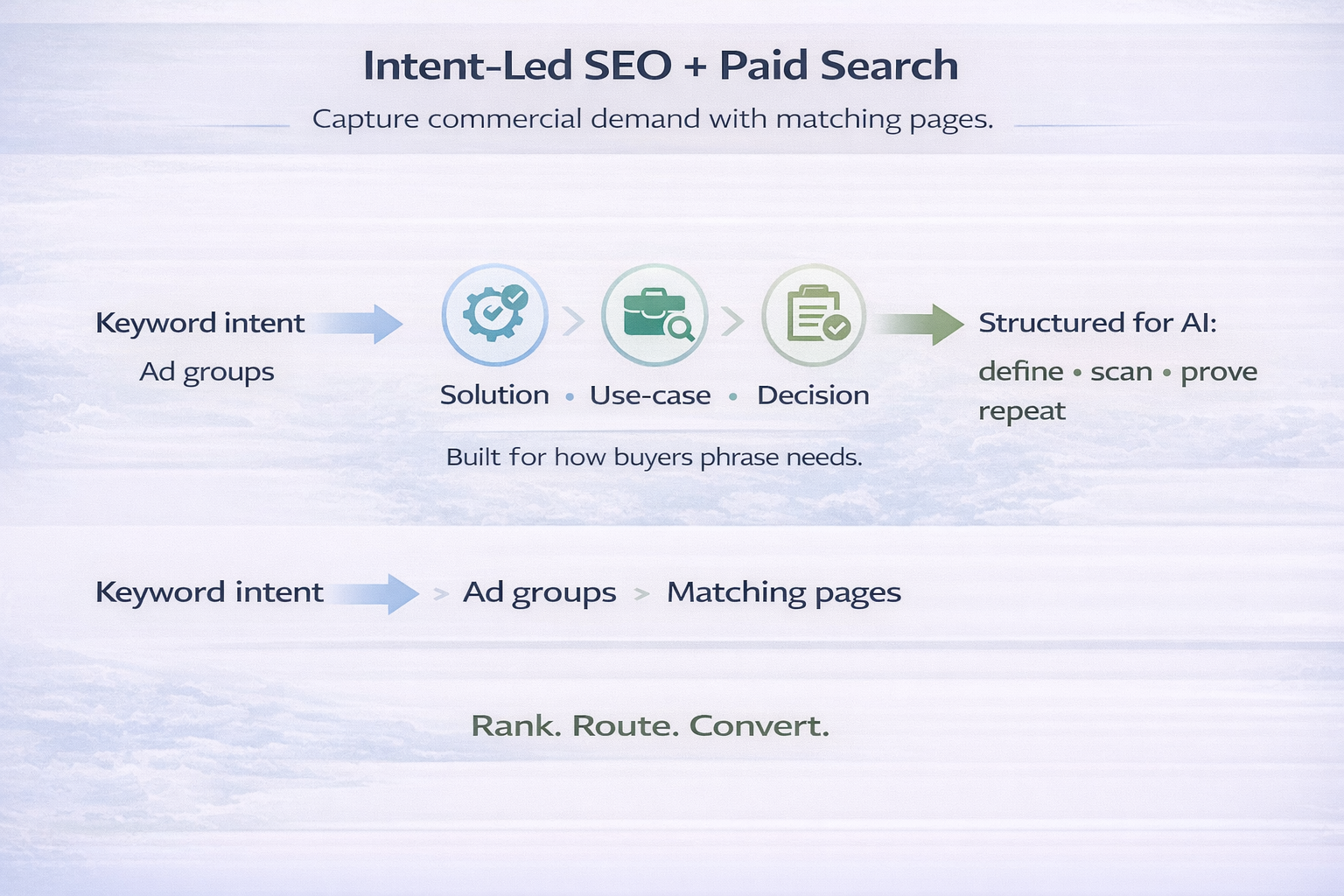
4. Intent-led SEO + paid search to capture commercial demand
Only after the foundation was stable did we scale acquisition. We rebuilt paid search around high-intent keywords and routed each ad group to a matching landing page.
In parallel, we restructured SEO around commercial page types: solution pages, use-case pages, and decision-stage content designed to match the way buyers phrase needs in search.
We also formatted key pages so they can be understood in AI-driven experiences (clear definitions, scannable sections, proof blocks, and consistent language). Google’s own documentation on AI features makes the same point: build content that’s clear and helpful, with structure that systems can understand.
How we proved it worked?
We proved it worked by treating every change like an experiment, not a guess. First, we locked clean attribution with GA4 setup and Google Tag Manager implementation, then measured outcomes tied to B2B lead generation and pipeline generation (not vanity traffic).
We used channel-by-channel baselines, page-level conversion checkpoints, and CRM outcomes to confirm whether conversion rate optimization (CRO) and demand generation strategy changes were moving real revenue signals.
| Proof checkpoint | What we measured | What “good” looked like |
|---|---|---|
| Intent match | Search queries → landing page alignment (e.g., demand generation services, lead generation funnel, growth audit) | Lower bounce + higher scroll depth on high-intent pages |
| Conversion lift | Landing page conversion rate by channel | Consistent week-over-week improvement, not spikes |
| Lead quality | MQL → SQL rate by page type | More sales-ready leads from commercial pages |
| Cost efficiency | CPL and cost per qualified lead | Lower CPL without lowering lead quality |
| Pipeline impact | Opportunities influenced by organic + paid | Steady pipeline contribution each month |
| Tracking integrity | Duplicate events, UTM hygiene, source accuracy | One “source of truth” founders can trust |
This approach also kept us aligned with Google’s guidance: we added clarity and structure instead of keyword stuffing, so the site earned relevance through usefulness and proof, not repetition.
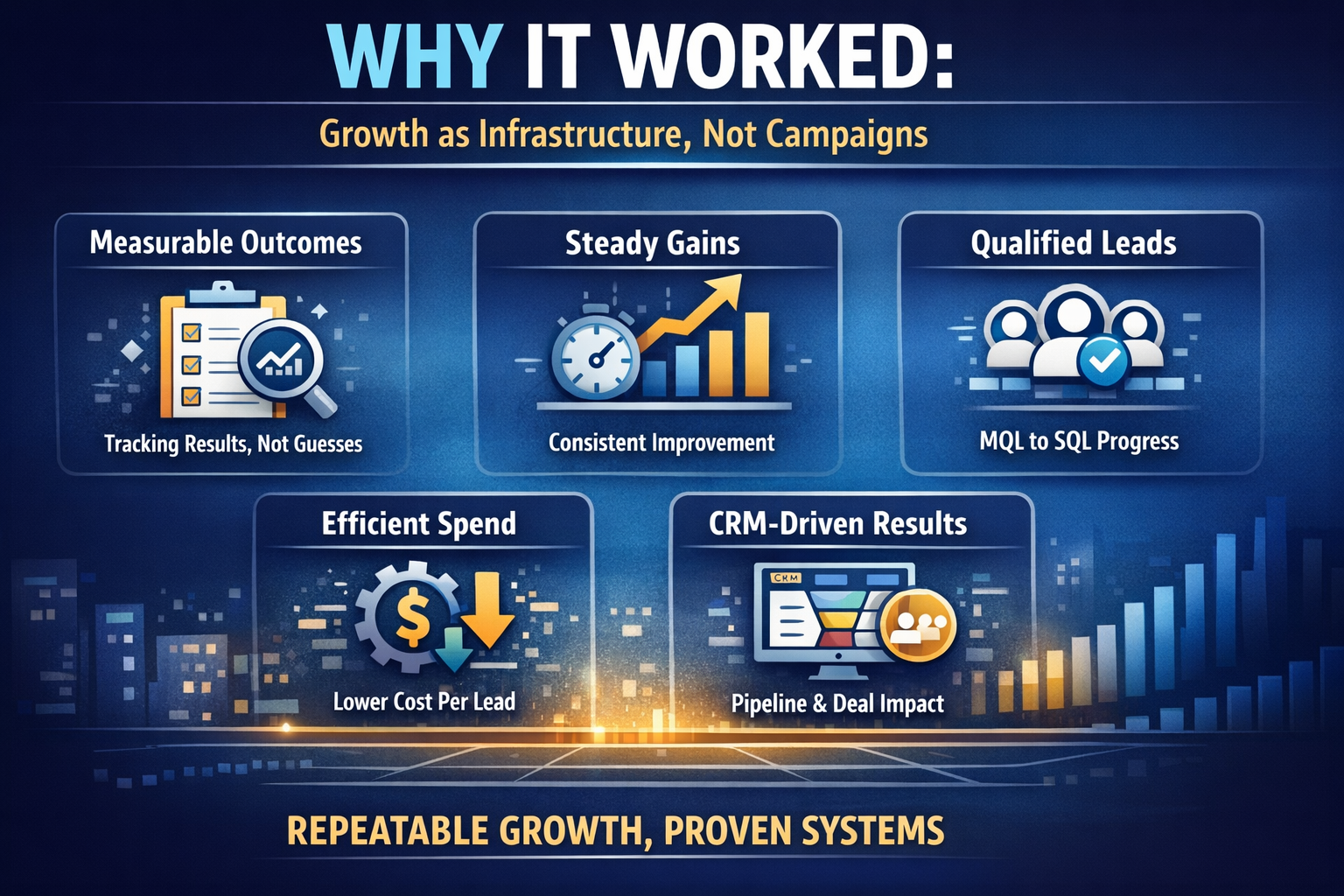
Why it worked? Growth as infrastructure. Not campaigns
We proved it worked by treating every change like a controlled test, not a guess. First, we fixed measurement with a clean GA4 setup and Google Tag Manager implementation, then tracked outcomes tied to B2B lead generation, pipeline generation, and conversion rate optimization (CRO). Instead of celebrating clicks, we judged success by whether demand became predictable and whether the founders could finally trust the numbers.
-
We aligned commercial search intent to the right pages (demand generation services, lead generation funnel, growth audit, B2B growth marketing agency) and watched bounce rate drop while CTA clicks rose.
-
We measured conversion rate by landing page and channel, looking for steady weekly gains rather than random spikes.
-
We tracked lead quality through the funnel (MQL to SQL), so “more leads” never replaced “better leads.”
-
We monitored cost per qualified lead to confirm paid spend was getting more efficient, not just louder.
-
We connected reporting to CRM outcomes, so pipeline influence and deal movement were visible, not assumed.
-
We audited tracking integrity, weekly UTM hygiene, duplicate events, and attribution consistency until the dashboard became a single source of truth.
To make progress fast without chaos, we ran short iteration loops. One focus per week, one measurable outcome, and clear stop/scale decisions. That’s how the team regained clarity and confidence, while the growth system became repeatable instead of stressful.
Clear value exchange
If your pipeline feels unstable, aboveA rebuilds the growth system so demand becomes measurable and repeatable, through CRO, GA4 + GTM tracking, SEO for commercial intent, and paid search aligned to decision-stage queries. You bring a real offer and focus. We bring structure, proof, and a system you can run every month.
If your pipeline feels random, we’ll rebuild the growth system - positioning, funnel, tracking, and acquisition. So qualified leads become repeatable
Project Heroes:

Vita Klimaite
head of Growth

Amber Maritz
SEO Specialist

Nusta Berdzenishvili
Market Development Specialist

Faustas Norvaisa
CEO
Frequently Asked Questions for Predictable Demand and Growth System Rebuilds
What does “survival mode” look like in B2B growth?
It usually means a weak pipeline, inconsistent lead quality, wasted ad spend, low website conversions, and reporting that can’t be trusted. Teams react daily instead of executing a clear demand generation plan.
What is a “growth system rebuild” in marketing?
A growth system rebuild fixes the full chain: ICP positioning, offering clarity, funnel structure, tracking, and acquisition. The goal is predictable lead generation, not one-off campaign spikes.
How do you make demand predictable in B2B lead generation?
You align commercial intent keywords with the right landing pages, improve conversion rate optimization (CRO), and measure lead quality through the CRM. Predictability comes from repeatable processes, not more channels.
What tracking setup is required for reliable marketing decisions?
A clean GA4 setup, Google Tag Manager implementation, consistent UTM rules, and conversion events tied to real outcomes like booked calls and qualified leads. Without this, optimization becomes guesswork.
Do you fix SEO or paid ads first when pipeline is weak?
Neither first. We fix the offer and the funnel first, then measurement, then scale SEO and paid search. Otherwise, you amplify broken pages and pay more for the same poor conversions.
How do you prove improvements are real, not random?
We use baselines, page-level conversion tracking, channel comparisons, and CRM validation. If lead quality improves and pipeline contribution stays consistent month to month, the system is working.
