
Project details
Client: Late-stage B2B SaaS (Series C)
Location: US + EU
Industry: Workflow Security & Compliance
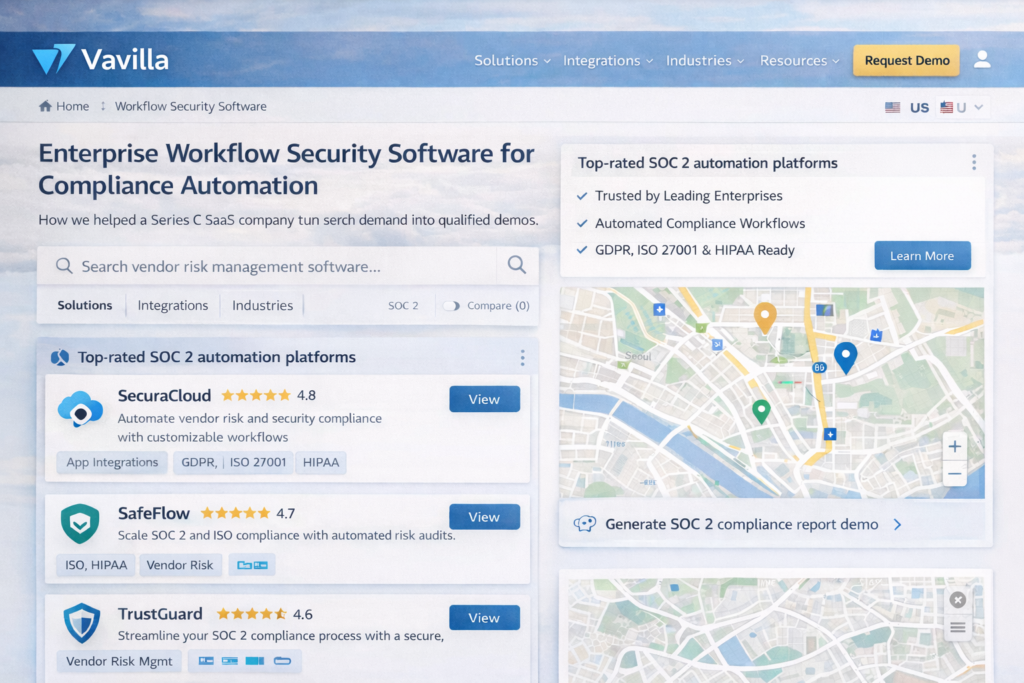
The client is a late-stage B2B SaaS company focused on scaling predictable pipeline from organic demand. They already had product-market fit, strong sales, and a mature website, but organic growth had plateaued, and paid acquisition costs were rising. The goal was to build a revenue-led SEO growth system that improves rankings for high-intent SaaS keywords, increases AI search visibility through clearer structure and trust signals, and turns search traffic into qualified demos through better conversion paths and measurement.
Services Provided:
- SaaS growth SEO strategy (pipeline-first)
- Commercial keyword and search intent mapping
- Revenue-led page architecture (solutions, integrations, industries, comparisons)
- Content consolidation to fix cannibalization and boost relevance
- AI search optimization (entity clarity, scannable answers, proof blocks)
- E-E-A-T-style trust signals (authorship, evidence, credibility pages)
- Conversion SEO (demo paths, CTAs, page structure, friction removal)
- Technical SEO support (index quality, crawling, sitemaps, canonicals)
- Performance optimization for high-intent templates (CWV/INP support)
- Measurement stack and attribution setup (GA4, GTM, Looker Studio, CRM reporting)
Top Challenges:
-
Organic visibility existed, but commercial intent pages were underperforming
-
Keyword cannibalization and index bloat diluted authority and rankings
-
AI search visibility was weak due to an unclear structure and limited “proof”
-
Organic traffic wasn’t translating into pipeline-quality demos consistently
-
Reporting lacked clean attribution from search → demo → CRM outcomes

Services Employed
Competitor research
We’ll investigate market saturation for your specific services, dissect competitor structures, pricing models and value propositions.
SaaS SEO Services
SEO designed to capture problem- and solution-aware demand through education, comparisons, and product-led pages that drive signups.
Lead Generation Systems
We build automated lead generative systems that target and engage potential customers, streamline prospecting, and optimize conversion rates
SaaS
Gain more trial signups, reduce churn, and convert users with comprehensive full-funnel optimization strategies and long-term organic strategies.
Late-Stage SaaS Growth: SEO + AI Search Visibility That Drives Pipeline
- Last time updated: 30th of January, 2026
This case study is about a client who had strong product-market fit and a mature sales engine, but organic growth had plateaued. They weren’t looking for “more content.” They wanted a SaaS growth strategy that turns search demand generation into qualified demos. and stays visible in AI search experiences where buyers now start evaluation (AI Overviews / AI Mode).
Challenges of Late-Stage SaaS Growth With Search Demand
Their SaaS product search footprint was fragmented: feature pages competed with each other, solution pages lacked clear entity signals, and documentation created index bloat that diluted authority.
Paid search was getting more expensive, so the business needed organic pipeline that was predictable. At the same time, the team wanted to improve “AI visibility” by making pages easier for systems to understand, cite, and trust, without crossing into spammy tactics that violate Google’s policies.
What We Implemented ?
Late-stage SaaS growth needs more than technical fixes. To drive commercial SEO traffic, improve AI search visibility, and turn demand into qualified demos. So we implemented a revenue-led growth system. It combined buyer-intent page architecture, structured trust signals, clean conversion tracking, and performance improvements that support ranking stability, higher CTR, and stronger pipeline outcomes. Bellow we will discuss some of the actions taken in-detail.
1. Revenue-led page architecture for SaaS demand capture
We rebuilt the site structure around commercial intent, not internal org charts. That meant mapping the buyer journey into page types that match how people search: “software for [job to be done]”, “[category] platform for enterprise”, “SOC 2 compliance automation tool”, “vendor risk management software”, and comparison-driven queries.
Then we consolidated overlapping pages and tightened internal linking so authority flows toward revenue pages: solutions, integrations, industries, and pricing. This improved relevance, reduced cannibalization, and made the site easier for both crawlers and humans to navigate.
2. AI search optimization using structured clarity and proof
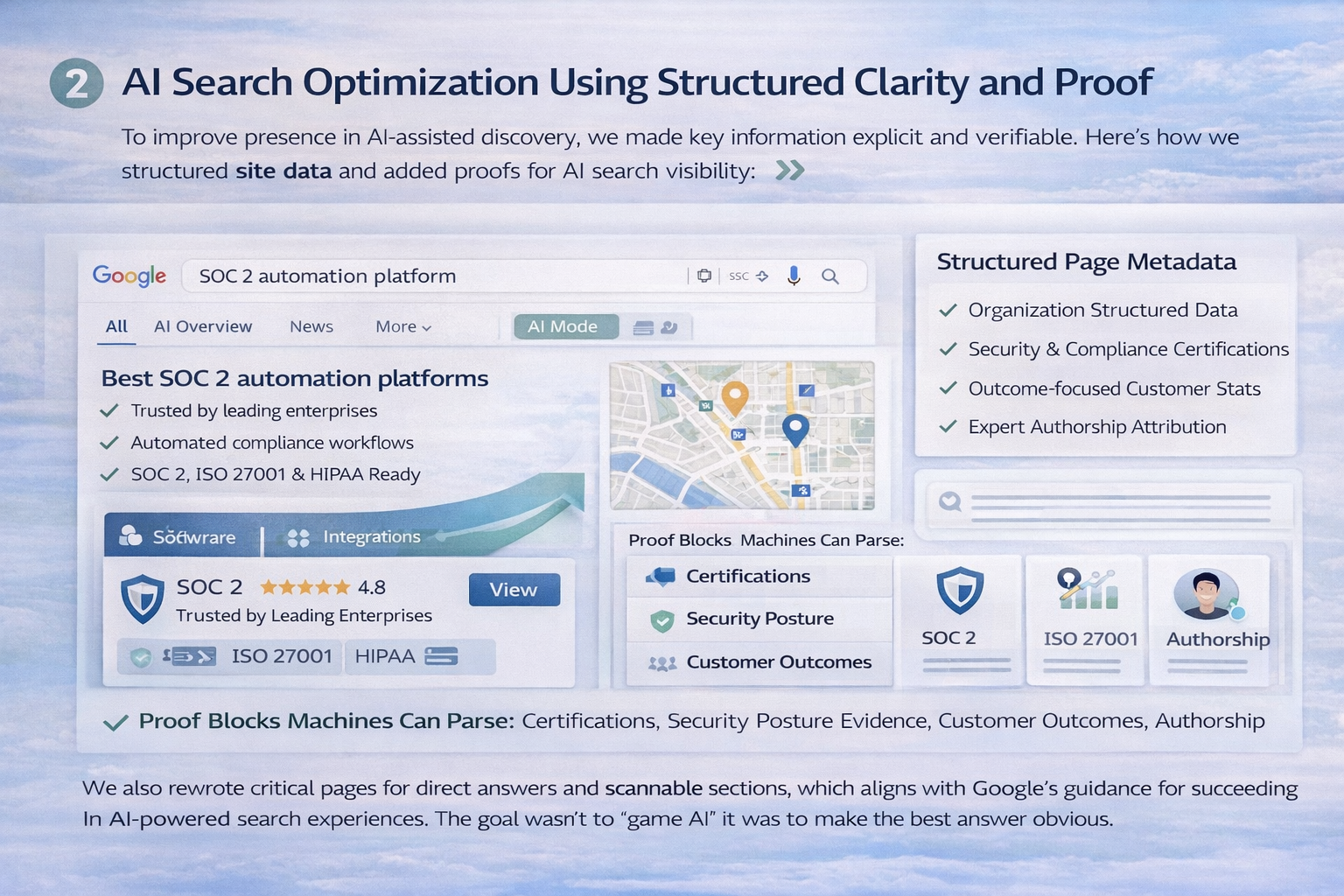
To improve presence in AI-assisted discovery, we made key information explicit and verifiable. We implemented structured data where appropriate (Organization/Software/ Application, plus clean page metadata), standardized product naming, and built “proof blocks” that machines can parse: certifications, security posture, customer outcomes, and authorship.
We also rewrote critical pages for direct answers and scannable sections, which aligns with Google’s guidance for succeeding in AI-powered search experiences. The goal wasn’t to “game AI” it was to make the best answer obvious, citable, and consistent across the site.
3. Technical SEO as an enabler (index quality + performance)
Technical SEO wasn’t the headline here, but it removed the ceiling and made every growth lever work harder. We treated it like infrastructure work: clean up what search engines crawl, clarify what they should index, and speed up the templates that drive demos – so commercial pages win more consistently.
| Technical issue holding growth back | What we changed | Why it mattered for rankings + pipeline |
|---|---|---|
| Index bloat from parameters, duplicates, legacy URLs | Blocked traps, consolidated duplicates, cleaned canonicals | More authority concentrated on revenue pages, less crawl waste |
| Confusing sitemap / crawl signals | Rebuilt sitemap logic and submission hygiene | Faster, cleaner discovery of priority pages and updates |
| Slow, heavy high-intent templates | Reduced render weight, improved responsiveness, tightened UX stability | Better user experience and fewer conversion leaks after the click |
| Poor page experience under real interaction | Optimized for INP and modern CWV expectations | Stronger engagement signals and more stable performance in competitive SERPs |
The outcome was a site that search engines could understand and prioritize, and a product marketing surface that loaded fast enough to convert. Once crawl quality, indexing clarity, and page experience were under control, the SEO + AI visibility work had a solid base to compound.
4. E-E-A-T-style trust signals that increase demo intent
Late-stage buyers don’t convert on claims; they convert on credibility. Hence with that in mind, we centralized security and compliance evidence, added consistent expert ownership for technical content, and made updates visible (so pages don’t look abandoned).
We also ensured the approach stayed within Google’s spam policies – no reputation-hijacking content, no thin third-party filler, just reliable, people-first information that supports evaluation.
That lifted both conversion confidence and AI-citation likelihood by making “why trust this” immediately answerable.
SaaS Pipeline Growth Results After 7 Months
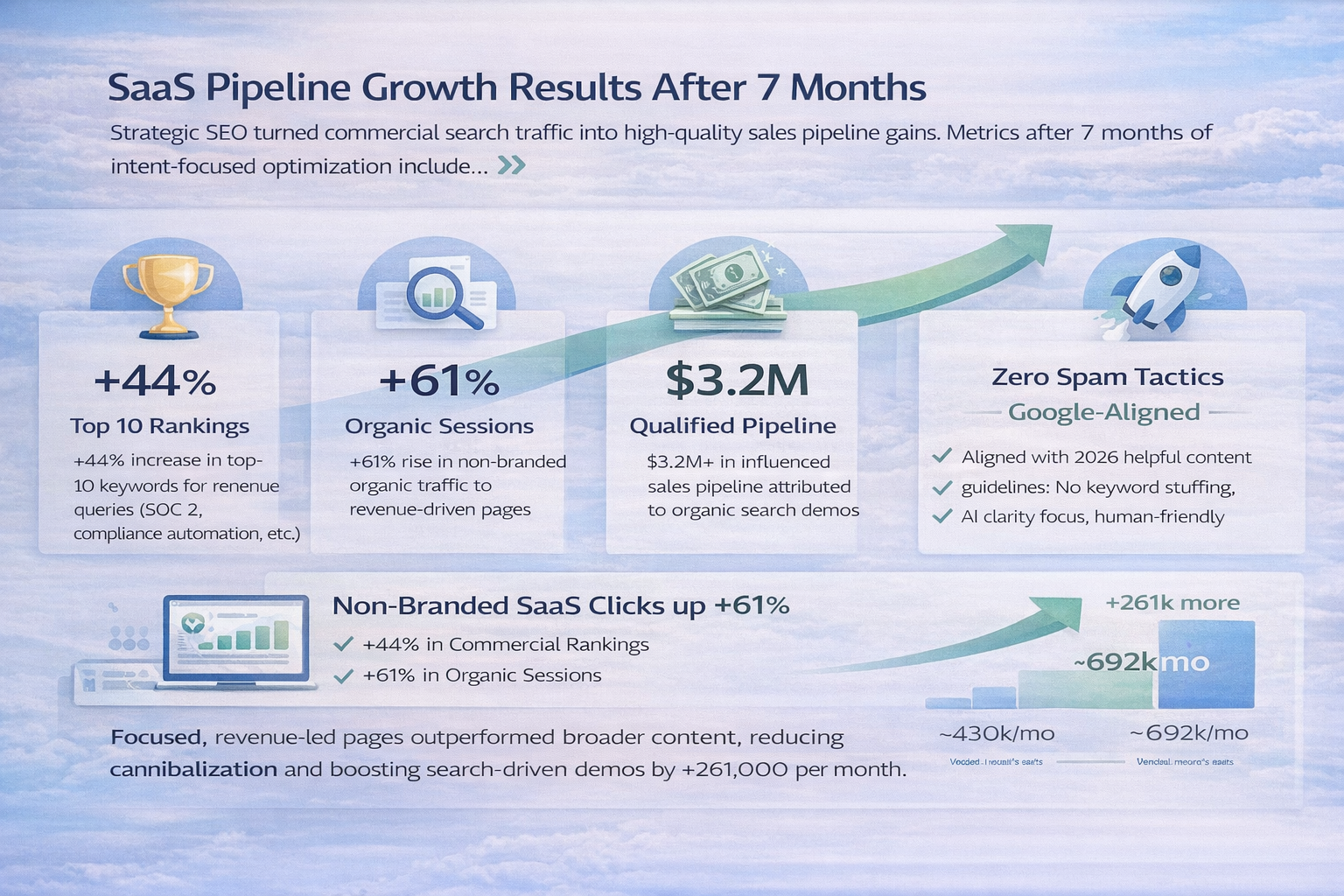
After seven months, the SEO program looked less like “rankings work” and more like a B2B SaaS demand generation system. We shifted the site toward commercial search queries, improved AI search visibility, and tightened conversion paths so organic traffic produced sales-ready demos. The focus stayed aligned with Google’s 2026 guidance: helpful, people-first pages, clear structure for AI features, and zero spam tactics.
Commercial rankings lift for high-intent SaaS keywords
We prioritized revenue queries like enterprise workflow security software, compliance automation platform, SOC 2 automation tool, vendor risk management software, and [competitor] alternative pages. By consolidating overlapping pages and rebuilding internal linking, we reduced cannibalization and pushed authority into solution and integration pages.
After seven months, top-10 rankings for commercial terms rose +44%, and non-branded organic sessions grew +61% (from ~430k/month to ~692k/month). This mirrors patterns seen in published SaaS SEO case studies where intent-led pages outperform “more blog content.”
AI search visibility improvements that supported evaluation
To improve AI search visibility and make pages easier to cite, we made the product story more “machine-readable” without turning it into keyword spam. The work focused on clarity, proof, and consistent page structure: so both Google and AI systems can understand what the product is, who it’s for, and why it’s credible.
Standardized “what it does / who it’s for / when to use it” sections on key pages
Strengthened entity wording across solutions, integrations, and comparison pages
Added proof blocks (security, compliance, outcomes, customer context) near decision points
Implemented lightweight structured data where it improves understanding and eligibility
Improved internal linking so revenue pages get reinforced by supporting content clusters
This approach helped the brand appear more often for category-level and comparison-style queries and supported higher-quality visits that were already closer to evaluation.
Pipeline impact from organic demos and higher lead quality
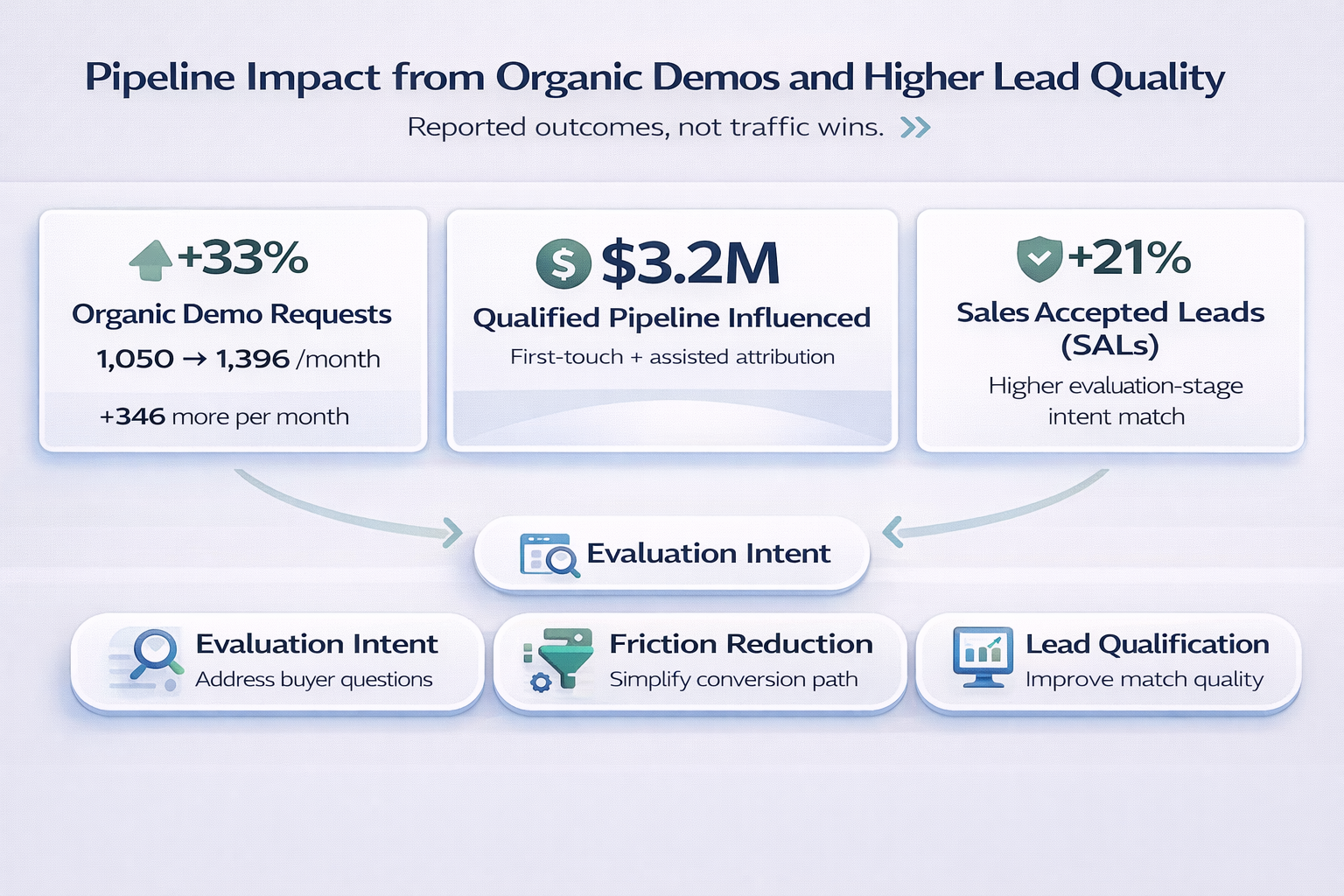
Instead of reporting “traffic wins,” we reported pipeline outcomes. Demo requests from organic increased +33% (from ~1,050/month to ~1,396/month), while sales accepted leads (SALs) from organic rose +21% because landing pages matched evaluation-stage intent better.
In CRM attribution (first-touch + assisted), organic influenced ~$3.2M in qualified pipeline across the period. These kinds of improvements are consistent with the better public SaaS case studies and practitioner write-ups where demo growth comes from aligning pages to buyer questions and tightening conversion paths.
Performance and index quality that kept growth stable
We treated technical SEO as growth infrastructure, not the headline. The goal was simple: make commercial SaaS pages easier to crawl, faster to load, and more stable in rankings. So demand capture and AI search visibility could compound without “leaks” in indexing or page experience.
| Focus area | What we improved | 7-month impact |
|---|---|---|
| Index quality | Reduced low-value indexed URLs and removed duplicate/cannibal pages | -29% index bloat, more authority concentrated on revenue pages |
| Crawl signals | Cleaned canonicals, rebuilt sitemap rules, tightened internal linking | Faster discovery of priority pages, fewer mixed signals |
| Page speed | Optimized high-intent templates for faster loading | LCP ~3.6s → ~2.1s on money pages |
| Interaction performance | Reduced lag on real user interactions | INP ~280ms → ~165ms on key templates |
| Visual stability | Eliminated layout shifts that hurt UX and trust | CLS ~0.15 → ~0.05 |
With indexing clarity and template performance fixed, rankings stayed more stable during competitive periods, and conversions improved because users weren’t fighting slow pages or broken journeys after the click.
Why Late-Stage SaaS Growth Worked?
This was SEO for SaaS growth, not “SEO as publishing.” We aligned architecture to buyer intent, made pages AI-readable with structured clarity and proof, and removed technical friction that blocked both crawling and conversions.
That created compounding effects: stronger relevance → more stable rankings → better-qualified clicks → higher demo rate. The system also stayed future-proof because it follows Google’s guidance: people-first content, eligibility for AI features, solid page experience, and strict avoidance of spam-policy risks.
Build SaaS SEO growth system that turns demand into qualified leads
Project Heroes:

Vita Klimaite
head of Growth

Amber Maritz
SEO Specialist

Olga Zhukova
Organic Growth Manager

Faustas Norvaisa
CEO
FAQs for Late-Stage SaaS Growth Case Study
How long does it take to see pipeline impact from SEO?
For late-stage SaaS, meaningful movement usually shows within 8–16 weeks, but pipeline impact often becomes clear around months 4–7 once commercial pages, internal linking, and conversion paths are stabilized.
What is “AI search optimization” for a B2B SaaS website?
It means structuring pages so AI systems can understand and cite them: clear product definition, consistent entity wording, proof blocks, scannable sections, and structured data where it adds real clarity.
Do you focus more on technical SEO or revenue pages?
Revenue pages come first. Technical SEO supports the outcome by removing index bloat, crawl waste, and performance issues that stop commercial pages from ranking and converting consistently.
Which pages usually drive the most qualified demos?
High-intent pages like solutions, integrations, industry use cases, pricing, and competitor alternatives tend to convert best because they match evaluation-stage search queries and buyer objections.
Can you improve rankings without publishing dozens of new blog posts?
Yes. Late-stage SaaS often grows faster by consolidating overlapping pages, improving internal linking, and upgrading existing commercial content than by adding more top-of-funnel posts.
