
Project details
Client: Early-stage startup (2 founders)
Location: South Korea
Industry: Food tech / food discovery / delivery
Goal: Launch an MVP for halal + vegetarian food discovery
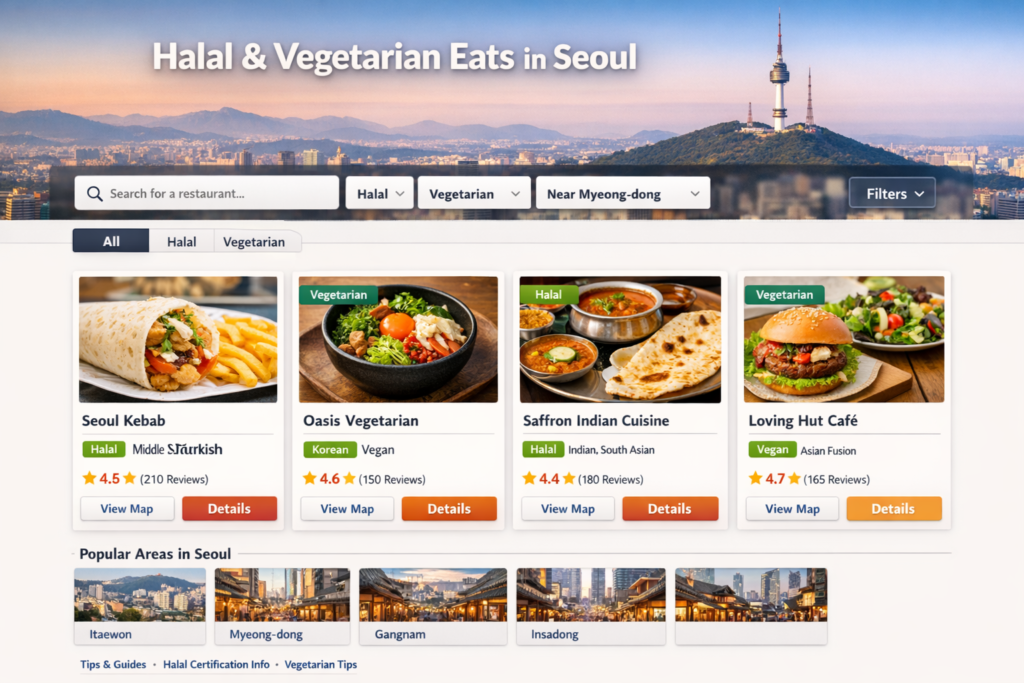
The client is an early-stage food tech startup in South Korea building a halal and vegetarian food discovery app. The product helps locals and international residents find trusted places to eat by combining map-based search with clear dietary labels, reviews, and location details. Designed for fast decisions and clean conversions, the app focuses on reducing uncertainty through structured information, smooth UX, and reliable data integration.
Services Provided:
-
Food app consulting and product strategy
-
Business plan structuring and market direction
-
MVP scope definition and feature prioritization
-
UX flow planning and information architecture
-
UI direction, color logic, and design rules
-
Functionality planning (what to include vs delay)
-
Budget-friendly vendor sourcing and build setup
-
Launch readiness planning (onboarding + support basics)
Top Challenges:
-
Too Many Features, Not Enough Product Boundaries
-
Trust Signals Were Mandatory, Not Optional
-
UX Needed to Work for Locals and International Users
-
Limited Budget Required Smart Build Decisions

Solutions Implemented
Competitor research
We’ll investigate market saturation for your specific services, dissect competitor structures, pricing models and value propositions.
SaaS SEO Services
SEO designed to capture problem- and solution-aware demand through education, comparisons, and product-led pages that drive signups.
Performance Tracking
We track advanced metrics to deliver insights on user interactions and site performance, helping to optimize strategies for better results and growth
Lead Generation Systems
We build automated lead generative systems that target and engage potential customers, streamline prospecting, and optimize conversion rates
SaaS
Gain more trial signups, reduce churn, and convert users with comprehensive full-funnel optimization strategies and long-term organic strategies.
From Idea to MVP: Product Consulting for a Halal and Vegetarian Food App in Korea
- Last time updated: 31th of January, 2026
In this case study, you will see how aboveA helped two founders turn a strong idea into a launch-ready product. We shaped the business plan, narrowed the positioning, and designed a practical MVP that could be built on a tight budget. The outcome was a clear app concept, a clean user experience, and a build plan with real execution partners. So the founders could move from “big vision” to “shipping version one.”
The Challenge: Defining an MVP for a Halal and Vegetarian Food App in Korea
The founders came with a strong vision for a food discovery app in South Korea focused on halal-friendly and vegetarian options. The problem was not ideas. It was turning those ideas into a launch-ready MVP that could be built with a limited budget and still feel trustworthy.
Key blockers were clear:
-
MVP scope was too wide. Too many features were “nice to have,” which risked delays and cost overruns.
-
UX needed to reduce doubt. For halal and vegetarian users, small uncertainty kills retention. The app needed clear filters, labels, and information hierarchy from the first screen.
-
Brand direction wasn’t locked. Colors, tone, and UI style rules were still open, which slowed decisions and made design inconsistent.
-
The value proposition needed sharpening. It had to be explainable in one sentence so users, restaurants, and partners instantly understood what made the product different.
-
Execution partners had to match reality. The build plan needed developers and contributors who could ship fast without inflating scope.
The real challenge was building a system that balanced trust + simplicity + speed. So the product could launch in Korea without turning into an endless rebuild.
Solutions Implemented for MVP Build-up
Food app consulting in South Korea helped two founders turn a niche idea into a launch-ready product. They wanted a vegetarian and halal-friendly food app, but the scope was wide, and the budget was tight. To keep everything in order and make the product ready for clean UX and conversions, we implemented the following.
1. Product Strategy and MVP Planning
We started by turning a big vision into a product plan that could actually ship. First, we clarified who the app serves in Korea and what problem it solves in one sentence.
When we defined the MVP boundaries, the first release stayed focused and affordable. We mapped the core journeys a user must complete without friction, and we made sure every planned feature supported that journey.
We also removed “nice ideas” that created extra complexity without improving trust or decision speed. This gave the founders a clear build sequence, fewer debates, and a product scope that could be delivered without constant changes.
2. UX/UI Direction for Food Discovery Apps
This product needed clarity more than cleverness. Users with dietary restrictions do not browse for fun; they browse to confirm. We structured the experience so filtering happens early, listings answer key questions fast, and the interface stays calm under real-world usage.
We defined how labels, notes, and food attributes should appear so the information feels reliable without overwhelming the screen. We also guided the visual direction to keep the app consistent across pages, which supports both usability and conversion. The result was a simple, predictable journey: discover, validate, decide, and return, without friction or doubt.
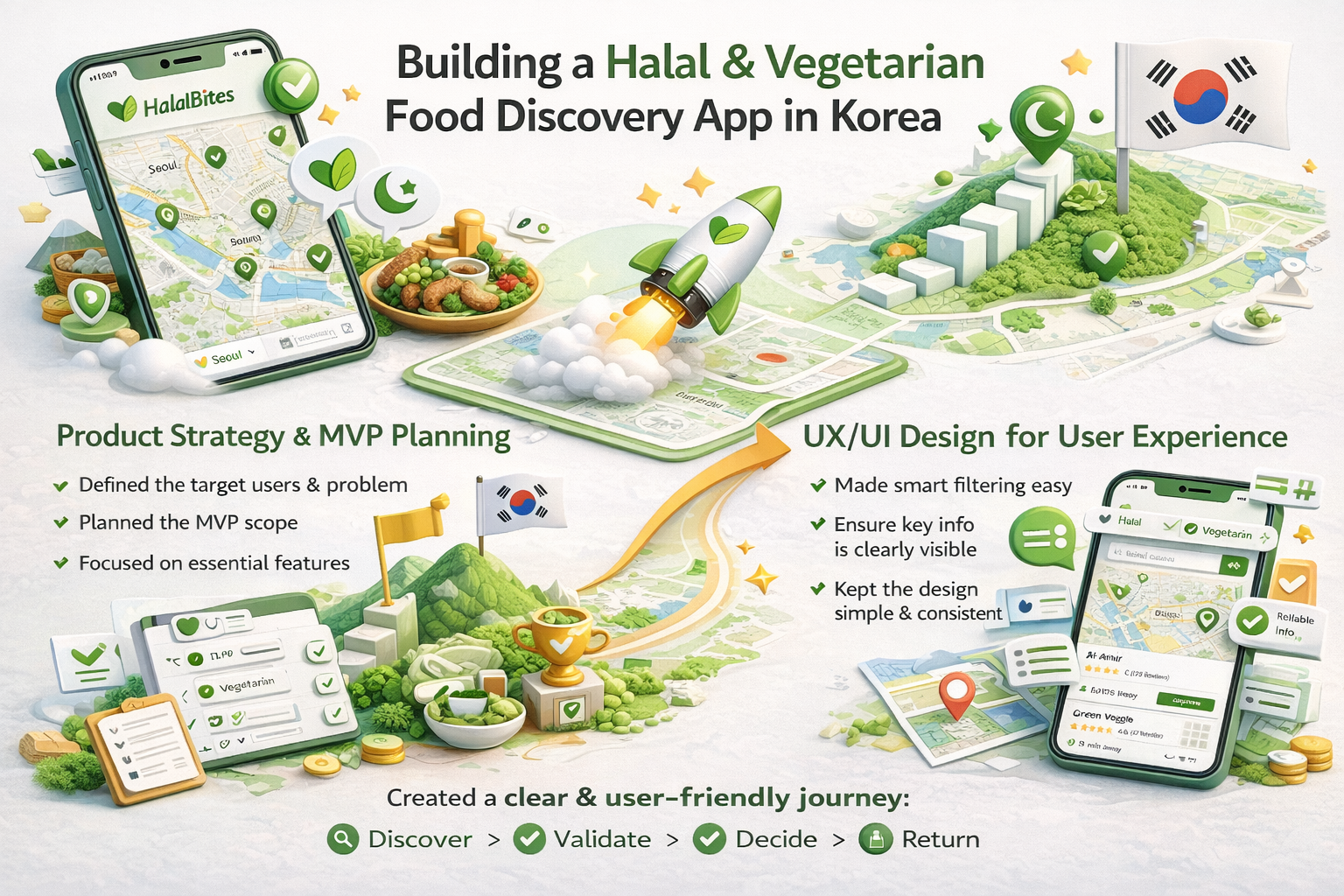
3. Business Plan Structuring for a Food Tech Startup
A niche food app in Korea needs more than a nice interface. It needs a business plan that matches how supply, trust, and growth actually work. We structured the plan around a realistic rollout logic, starting narrow enough to build quality and expanding only once repeat usage is proven.
We clarified the target user segments, the early adoption story, and the value exchange for partners so the platform can grow without losing focus. We also aligned monetization thinking with trust, because in dietary-sensitive use cases, aggressive monetization too early can damage retention. This planning made the product easier to explain, sell, and execute.
4. integration and Cloud Data Infrastructure.
Instead of vendor sourcing, the critical work was building the right integration and infrastructure. The app relied on Korean-native platform data tied to maps, places, reviews, addresses, and discovery signals.
We helped define the integration approach so this data could be accessed, structured, and served reliably inside the product experience. We aligned the setup with a Google Cloud-based architecture, focusing on clean data flows that support speed, stability, and scalability.
The goal was to make search and discovery feel instant, keep location information accurate, and ensure the app could grow its dataset without breaking performance. This is what made the product feel real, not fragile.
Results After 7 Months: Food App Launch Progress in South Korea
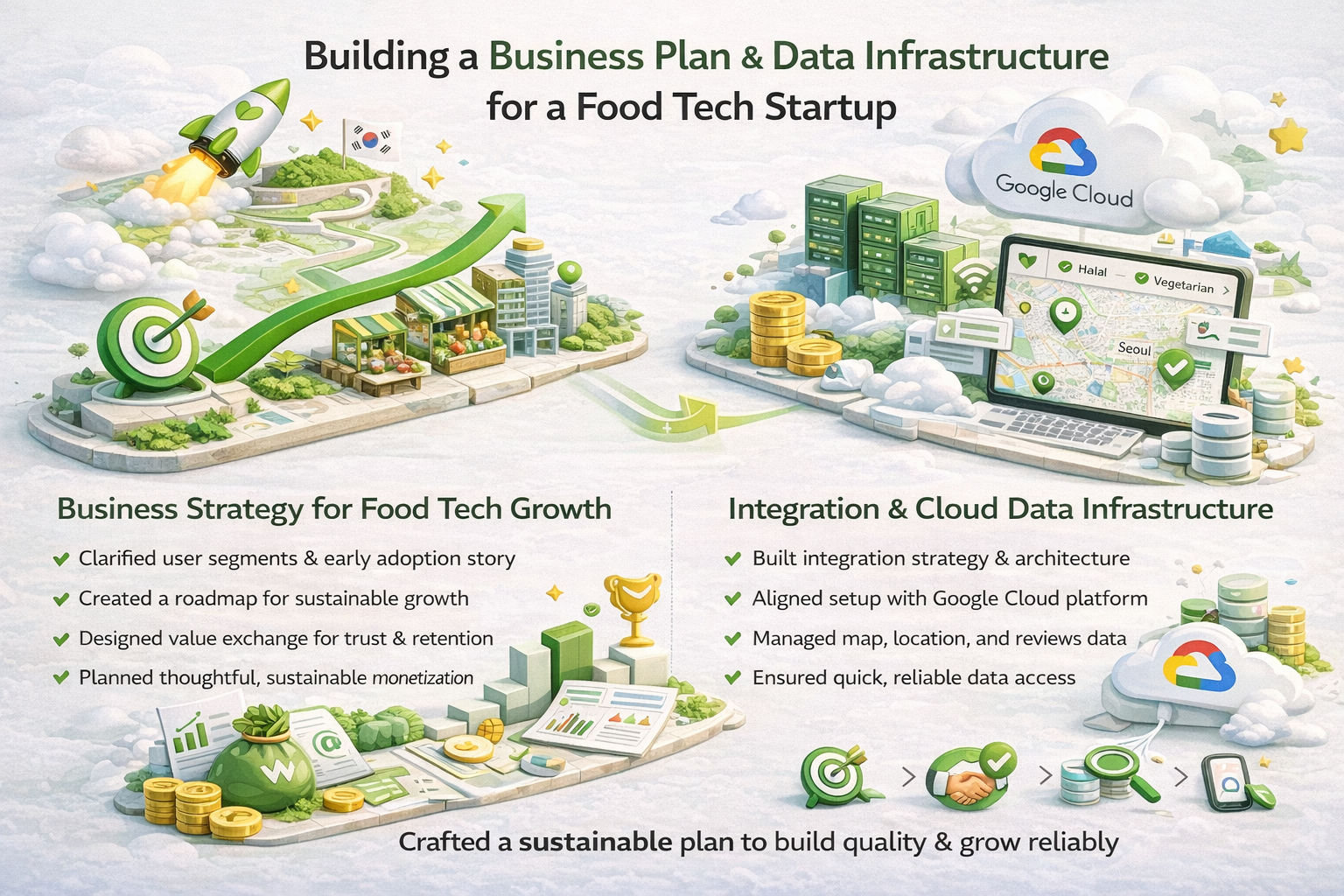
After seven months, the app moved from a validated MVP into a stable, scalable product. Instead of patching basics, the team focused on improving discovery, trust, and conversion paths. We reviewed usage signals, UX performance, and data reliability, then iterated with clear priorities and measurable checkpoints that supported steady growth.
Pre-launch acquisition and early registrations
Before launch, we ran targeted pre-launch advertising to build a high-intent waitlist instead of chasing broad reach. The core mechanic was a simple landing flow with one promise, early-access positioning, and a referral loop that rewarded sharing – an approach commonly used in modern waitlist campaigns.
We paired that with Korea-native distribution touchpoints (including Kakao ecosystem placements) to reduce friction and keep signups “local.” Result: the wishlist grew to 5,823, and ~3,510 of those users converted within the first month after launch, giving the app immediate traction and reviews to compound growth.
Measurement stack and conversion tracking for food tech startup
Right after the waitlist phase, we set up a measurement foundation so every growth decision could be tied to real user behavior. We connected Google Search Console and GA4, then implemented Google Tag Manager with an event schema built for a marketplace-style food app.
That included advanced tagging rules to prevent duplicate events, separate real intent from casual browsing, and keep attribution clean across ads, referrals, and organic discovery. We also built Looker Studio dashboards so the founders could see performance daily without digging through raw reports, which helped speed up product and marketing iteration.
Key tracking work included:
-
Defining conversion events such as filter use, saves, navigation clicks, and order-intent actions
-
Building funnel and cohort views to see activation, retention, and drop-off points over time
-
Standardizing UTM naming so every channel stayed readable and comparable in reporting
This setup made growth predictable because improvements could be validated quickly and repeated with confidence.
Marketing infrastructure synergy and trust signals for local + international users
Once tracking and tagging were stable, we aligned the marketing stack so ads, onboarding, and in-app discovery all reinforced the same trust story. We didn’t run “random campaigns.” We built a system where every message matched what users saw after they clicked, which reduced drop-off and improved conversion quality.
On the trust side, we applied Google-style E-E-A-T thinking by making expertise and credibility visible inside the product and around it. That meant clear sourcing logic for place data, consistent category rules, and transparent labeling that helps dietary-restricted users feel safe.
We also localized trust signals for Korean users while keeping the language and UI cues understandable for international residents and tourists. In practice, the app felt reliable before it felt “marketed,” and that reliability compounded growth.
Market Momentum and proof of demand
By month seven, the story stopped being “a niche idea” and became a scalable wedge into a large market. From the pre-launch wishlist of 5,823, about 3,510 users converted in the first month, proving the positioning can pull demand fast when distribution is focused.
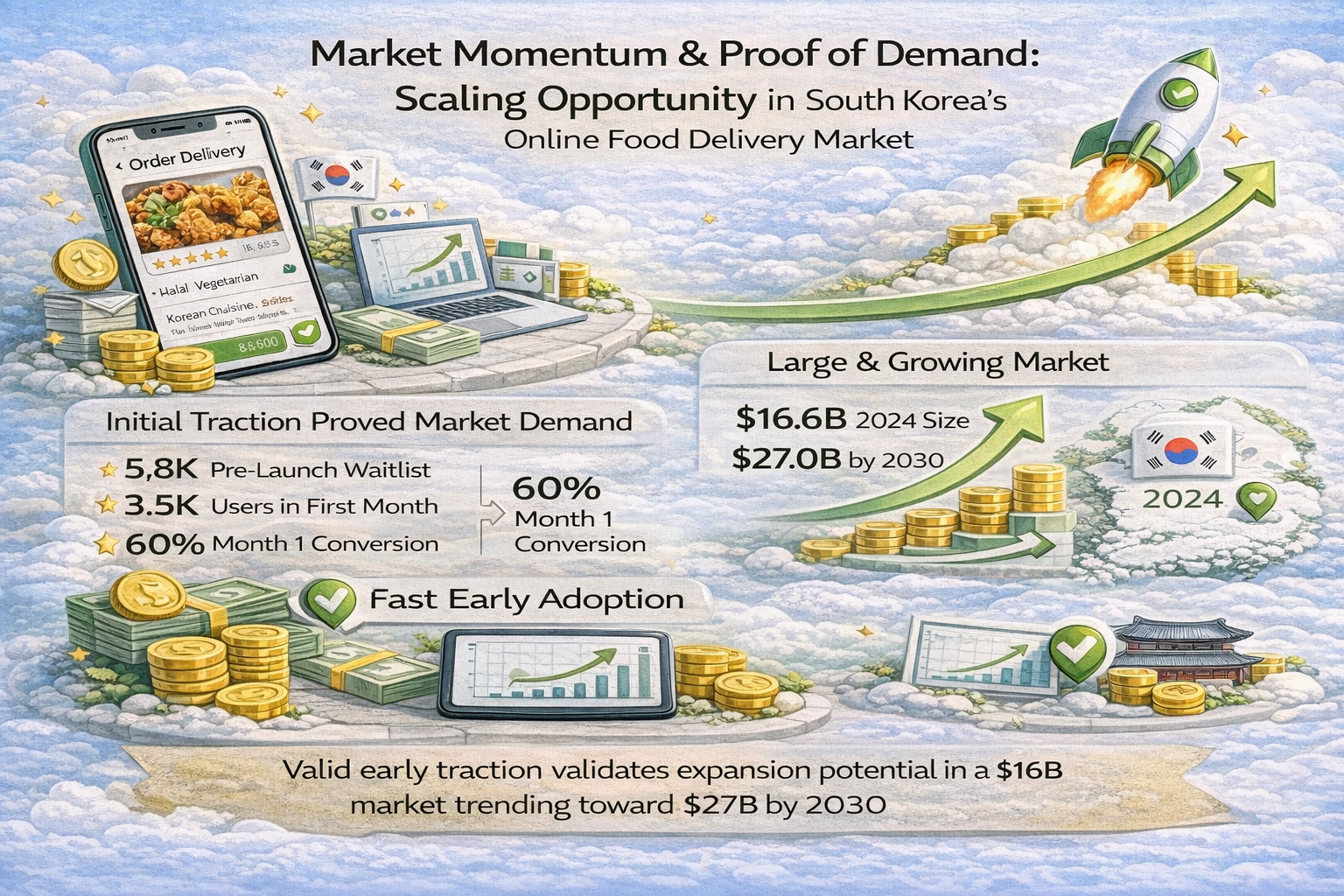
On the market side, South Korea’s online food delivery services were estimated at ~$16.6B in 2024 and projected to reach ~$27.0B by 2030 (about a 9% CAGR), which gives the app a clear expansion runway once retention loops stabilize. With credible infrastructure, clean tracking, and a trust-first niche, this is the kind of early traction that becomes “fundable” when paired with predictable unit economics and repeat usage signals.
Why it Worked? Food App in South Korea
Food app consulting in South Korea worked because we treated growth like a system, not a set of campaigns. We combined pre-launch user acquisition, conversion-ready UX, and reliable map data integration to help users find trusted halal and vegetarian options quickly.
That reduced doubt, which is the biggest conversion killer in dietary-restricted food discovery. We also built measurable funnels with GA4, Tag Manager, and dashboards, making optimization straightforward and repeatable.
On top of that, we added trust signals aligned with Google E-E-A-T principles, supporting credibility for both local Korean users and international audiences. The result was traction that looks commercial, not accidental.
Launch your product with a clear MVP, clean UX, and a growth system that converts
Project Heroes:

Vita Klimaite
head of Growth

Amber Maritz
SEO Specialist

Nusta Berdzenishvili
Market Development Specialist

Faustas Norvaisa
CEO
Frequently Asked Questions for Food App Consulting in South Korea
What is food app consulting in South Korea?
Food app consulting helps founders validate positioning, define an MVP, and design a launch-ready user journey for Korean market behavior. It connects product strategy, UX decisions, and growth planning into one execution path.
How do you define an MVP for a halal and vegetarian food app?
You lock the core promise, set strict feature boundaries, and focus on the “discover → confirm → decide” flow. Filters, labels, and place details must work instantly, while everything else is staged for later releases.
What features matter most for food discovery apps with dietary restrictions?
Clear filters, consistent labeling, reliable place data, review context, and a calm information hierarchy. Users need certainty fast, so the product must reduce doubt more than it adds options.
How do you integrate Korean map and place data into a mobile app?
You choose a reliable Korean-native data source, define clean data structures, and build an integration layer that keeps addresses, reviews, and discovery signals accurate. A Google Cloud setup supports performance, stability, and scaling.
What makes a niche food app “fundable” after launch?
Proof of demand, clean retention signals, reliable data infrastructure, and scalable unit economics. A focused niche with strong trust signals becomes investable when usage patterns look repeatable, not viral luck.
How do you grow a waitlist before launching an app in Korea?
Use pre-launch ads with one clear promise, early-access positioning, and a referral loop. Pair it with Korea-native distribution touchpoints so signups feel local and convert faster after launch.
