
Project details
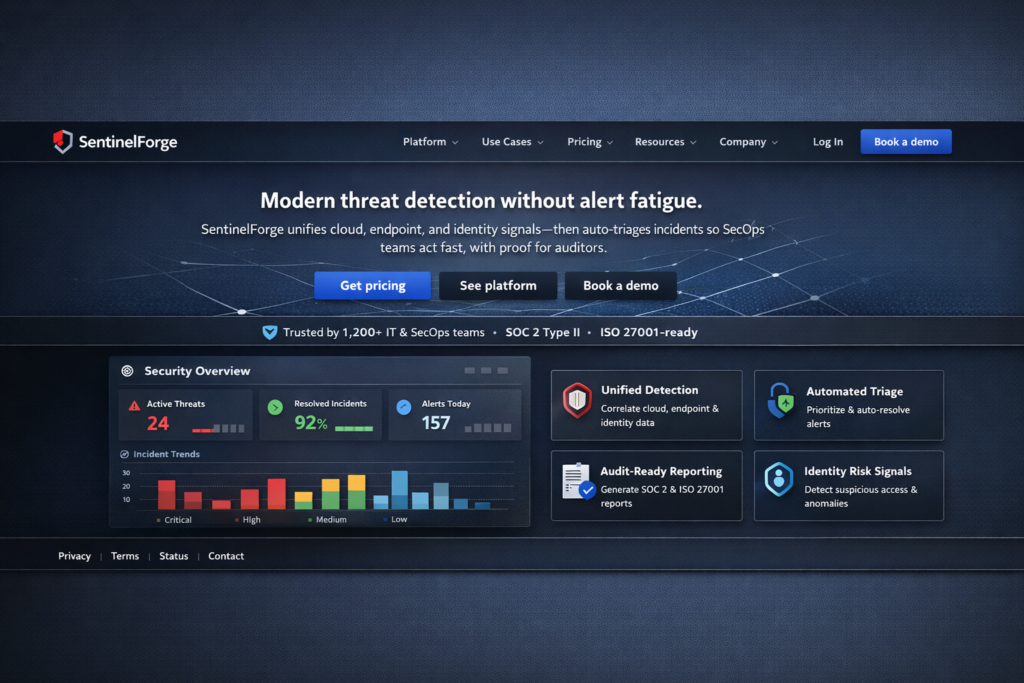
Client: B2B cybersecurity SaaS company (mid-market + enterprise)
Location: US + EU
Industry: Cybersecurity SaaS / cloud security / SecOps tooling
Goal: Build a predictable inbound engine from SEO + AI search visibility, with trusted reporting and measurable pipeline impact.
The client had strong product-market fit and an experienced sales team, but inbound demand was inconsistent, and internal performance data wasn’t trusted. Their search footprint was fragmented, competitors were noisy, and security buyers were skeptical. aboveA rebuilt the growth system end-to-end, fixing tracking integrity, aligning page architecture to commercial security intent, reducing demo and security-review friction, and connecting reporting to CRM outcomes so lead quality and pipeline influence were clear.
Services Provided:
Cybersecurity SaaS demand generation strategy and ICP refinement
Measurement cleanup (GA4 + Google Tag Manager) and attribution governance
Commercial SEO architecture (SOC 2 readiness, CSPM, fraud prevention, SIEM/SOAR alternatives)
Integration pages and competitor/alternative pages for evaluation-stage intent
Conversion rate optimization (CRO) for demo and security-review paths
Lead qualification rules and routing aligned to enterprise buying signals
CRM visibility and reporting dashboards for pipeline tracking and governance
Top Challenges:
Inconsistent inbound pipeline and rising paid search costs
Tracking integrity issues and unreliable attribution across tools
Intent mismatch: high-intent searches landing on generic pages
Weak differentiation vs competitors during evaluation
Friction in demo booking and security review readiness paths
Lead qualification gaps that diluted sales focus and pipeline quality

Services Employed
SaaS SEO Services
SEO designed to capture problem- and solution-aware demand through education, comparisons, and product-led pages that drive signups.
B2B Software
Get more qualified leads with SEO, funnels, and paid ads for B2B software. Increase demo bookings and reduce cost per lead.
Lead Generation Systems
We build automated lead generative systems that target and engage potential customers, streamline prospecting, and optimize conversion rates
Performance Tracking
We track advanced metrics to deliver insights on user interactions and site performance, helping to optimize strategies for better results and growth
Cybersecurity SaaS Demand System Rebuild for Predictable Pipeline
- Last time updated: 31th of January, 2026
This case study is about a B2B cybersecurity SaaS selling to IT and SecOps leaders in mid-market and enterprise accounts. The company had strong product-market fit and a working sales motion, but inbound demand was inconsistent and performance data wasn’t trusted, so growth felt random. They weren’t looking for more campaigns. They wanted a SaaS growth strategy that turns high-intent security search demand into qualified demos and stays credible in AI-driven evaluation paths.
B2B cybersecurity SaaS growth challenges
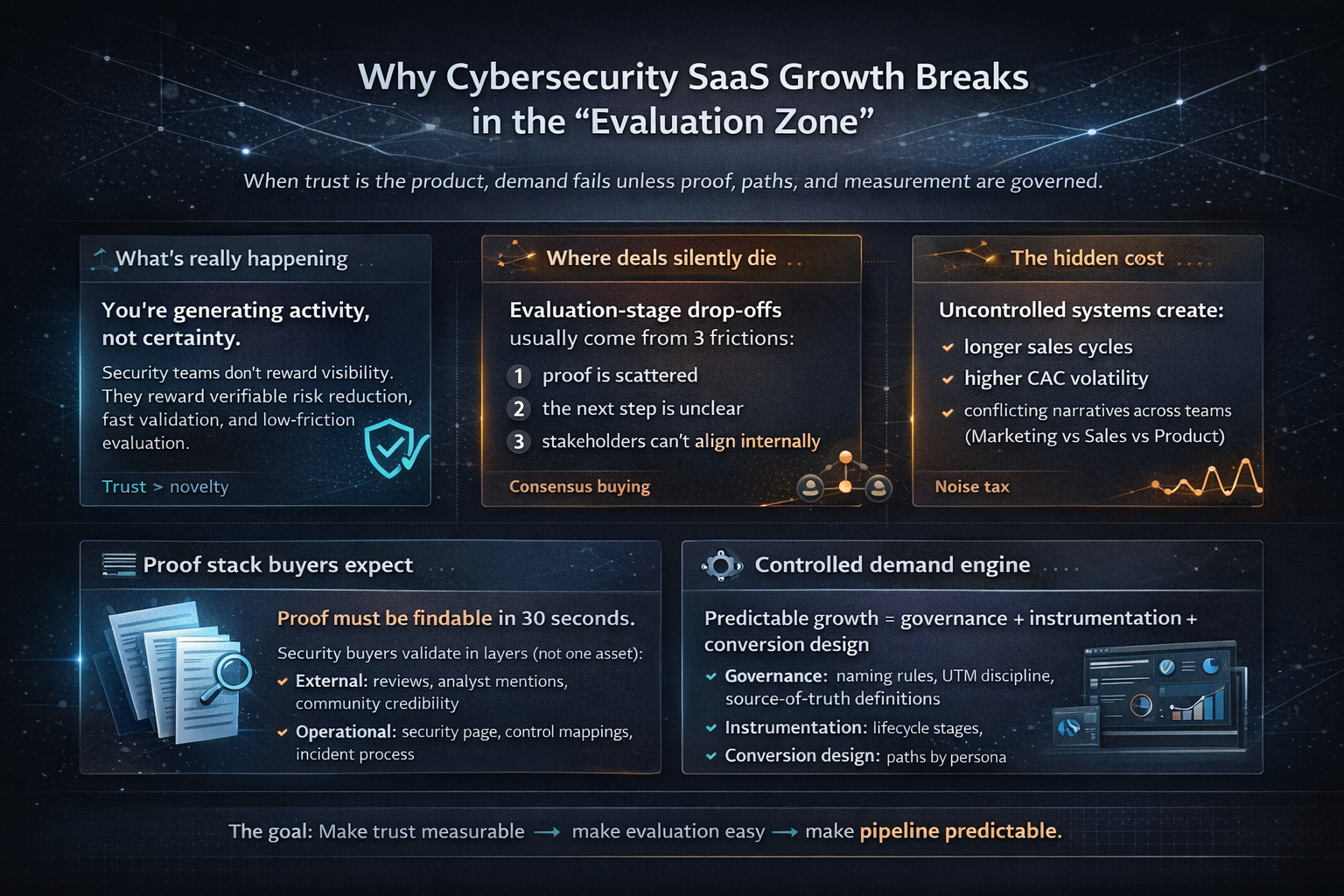
The cybersecurity SaaS client’s growth system looked active, but wasn’t controlled. Paid search costs kept rising, organic traffic didn’t translate into pipeline, and internal dashboards disagreed across tools.
Security buyers were also unusually skeptical, so weak proof and unclear paths created a drop-off at the exact moment evaluation should have accelerated. Competitors were loud in search, and leadership pushed for quick wins, but the company needed something stronger than tactics: a predictable demand engine with clean reporting and governance.
Cybersecurity SaaS Growth Solutions Implemented
To turn random inbound into a repeatable pipeline, we rebuilt the growth system in the right order: measurement first, then intent-led architecture, then conversion paths, and only then scaling what worked.
The goal was not more activity. It was control. Every change had a measurable purpose, tied to lead quality and CRM outcomes, so the team could defend decisions under pressure and keep improving without chaos.
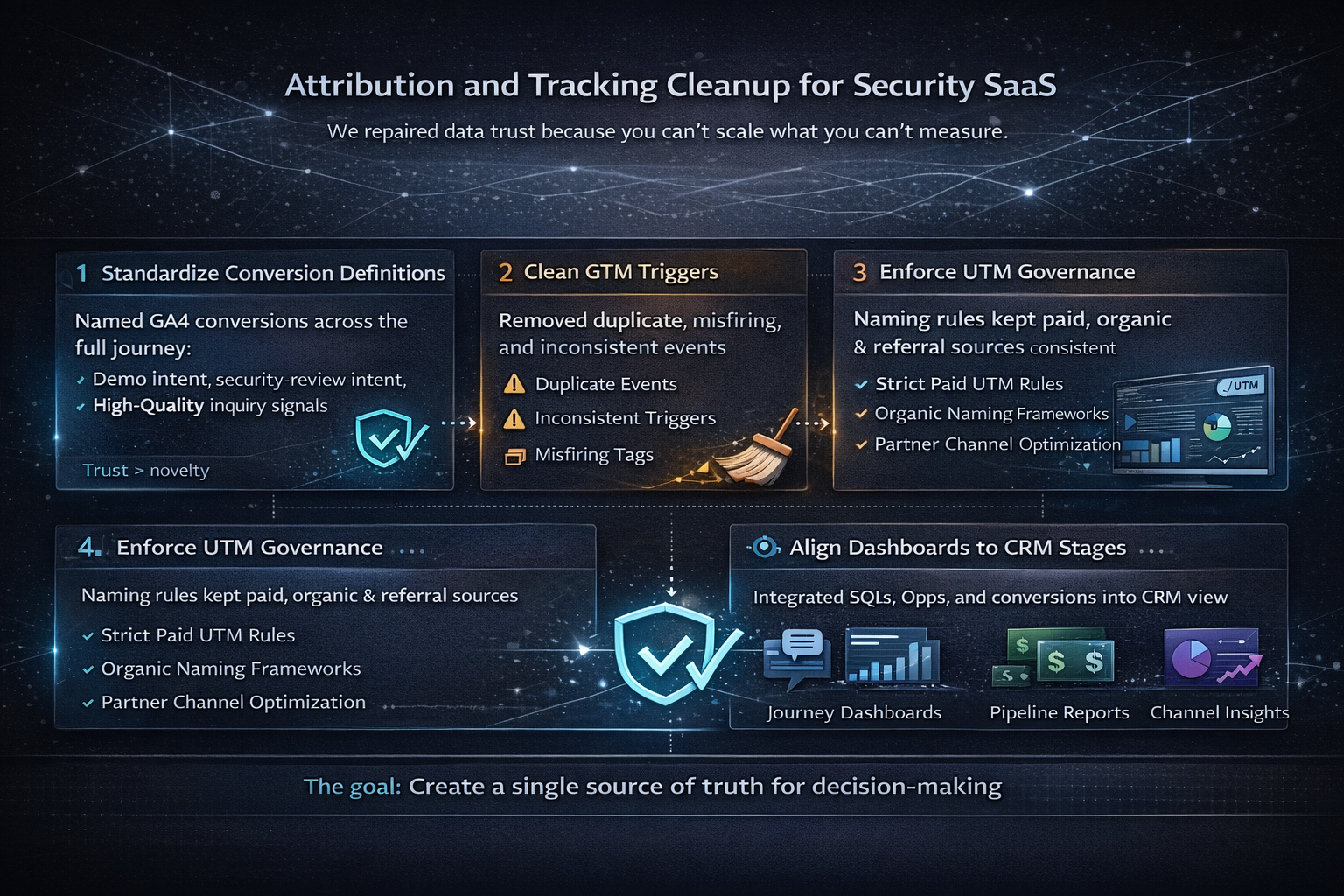
1. Attribution and Tracking Cleanup for Security SaaS
First of all, we started by repairing data trust, because you can’t scale what you can’t measure. We standardized GA4 conversion definitions across the full journey demo intent, security-review intent, and high-quality inquiry signals, then cleaned Google Tag Manager rules to remove duplicate events and inconsistent triggers.
Next, we enforced strict UTM governance so paid, organic, partner, and referral traffic stayed readable over time instead of collapsing into “direct” or mixed sources. Finally, we aligned dashboards to CRM stages, so the company could see not just leads, but which channels and pages influenced SQLs and opportunities. This created a single source of truth that stakeholders could trust, which reduced internal debate and made optimization decisions faster, calmer, and far more defensible.
2. Commercial-Intent Page Architecture for SecOps Searches
Once tracking was reliable, we rebuilt the site around security intent so Google and AI surfaces could match buyers to the right page without confusion. Instead of overlapping feature pages fighting each other, we created a clean architecture aligned to evaluation searches IT and SecOps leaders actually use. As a result, each page had one job: answer the query, prove credibility, and move the next step toward a demo or security review.
Key page clusters targeted terms like:
SOC 2 readiness and security compliance software
cloud security posture management (CSPM) platform
fraud prevention for SaaS and risk monitoring
SIEM alternative / SOAR alternative comparisons
security tool integrations (Splunk, Okta, AWS, etc.)
Next, we consolidated thin pages, reduced documentation index bloat, and improved internal linking so authority flowed to “money pages,” not duplicates. Finally, we added clear entity wording, scannable sections, and structured data, which increased clarity, the 2026 best practice for ranking stability, and AI citation.
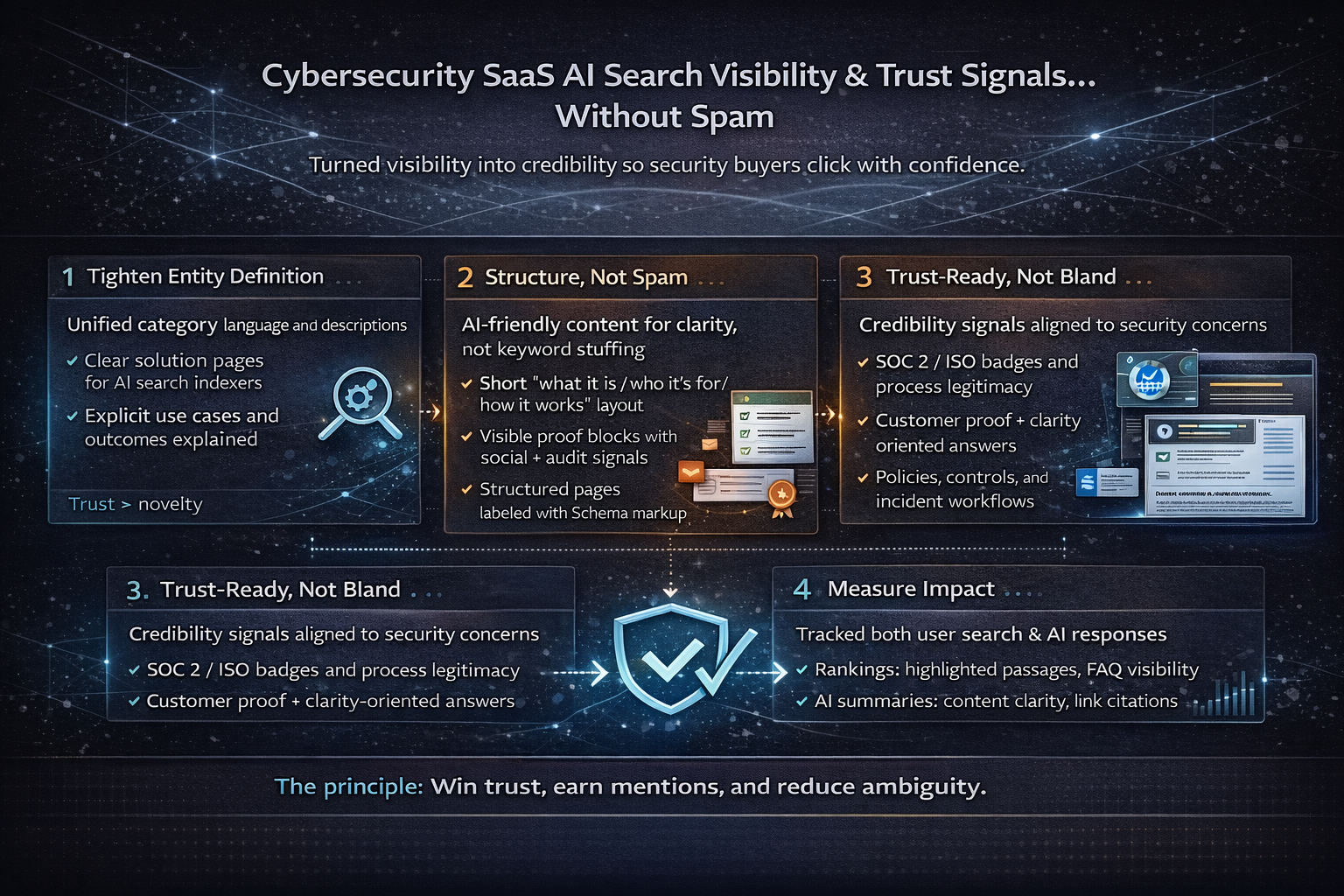
3. Cybersecurity SaaS AI Search Visibility and Trust Signals Without Spam
Moreover, security buyers increasingly start research inside AI surfaces, so we made the site easier to understand, cite, and trust without resorting to keyword stuffing. We tightened entity language and definitions across solution pages so the product category, use cases, and outcomes were consistent everywhere.
Additionally, we added scannable structures, proof blocks, and structured data, which improved clarity, then introduced AI-friendly content patterns, such as short “what it is / who it’s for / how it works” sections that reduce ambiguity.
We also supported credibility with security-ready trust signals, clear process explanations, customer proof positioning, and evaluation-stage answers so the site didn’t just attract clicks, it reduced doubt. This approach improved visibility across both traditional search results. It also had an impact on AI-driven summaries while staying aligned with policy-safe, people-first content practices.
4. Demo and Security Review Funnel Optimization for Cybersecurity SaaS
Finally, we rebuilt the demo and security-review journey for enterprise cybersecurity buyers. Instead of a single “book a demo” form, we offered two paths: demo-first for evaluation-ready leads and docs-first for security review. This reduced uncertainty, improved lead quality, and made pipeline attribution clean.
| Commercial search query | Best-fit destination page | Conversion upgrade |
|---|---|---|
| SOC 2 readiness platform | Trust + compliance page | Proof blocks + shorter form |
| SIEM alternative / SOAR alternative | Competitor and alternatives page | Objection-led CTA + smarter routing |
| cloud security posture management integration | Integration page | Security review start + checklist |
Next, we added expectation setting (who joins, what’s shown, and response times) to cut drop-offs. Then we tightened qualification using firmographics and intent signals such as integration clicks, pricing views, and security-review starts. Finally, we mapped these events into the CRM, so marketing and sales could see demo-to-SQL, review-to-opportunity, and cost per qualified lead by channel. As a result, growth stopped feeling random and became scalable with reliable reporting.
Cybersecurity SaaS Results After 6 Months
After six months, growth stopped behaving like a slot machine. The team could finally trust the numbers. Clean measurement, commercial-intent pages, and a rebuilt demo + security-review path made pipeline movement visible. We stopped optimizing for “more traffic.” We optimized for qualified demos and sales-ready conversations.
SEO and paid search attribution became consistent across tools. SecOps buyers moved faster because the site reduced doubt early. Reporting became simple, decisions became calmer, and demand became repeatable.
Predictable Pipeline From Cybersecurity SaaS SEO and AI Search Visibility
Organic performance became steady because evaluation searches landed on the correct page. Queries like SOC 2 readiness platform, SIEM alternative, SOAR alternative, cloud security posture management platform, and fraud prevention for SaaS stopped leaking into generic pages. Intent matched content.
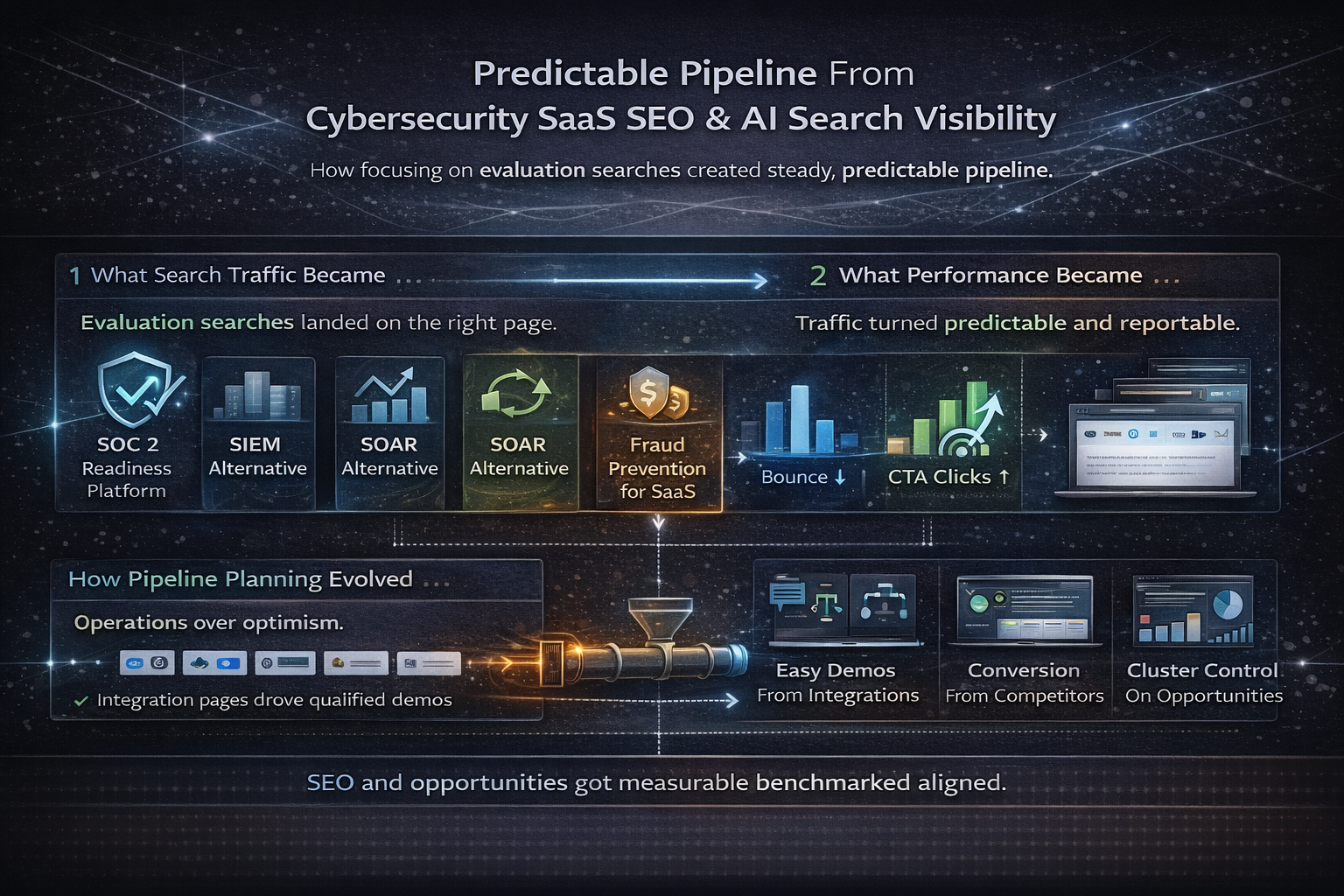
Bounce dropped. CTA clicks rose. AI search surfaces also performed better because pages were clearer, more structured, and less fragmented. The biggest shift was in mindset. “SEO traffic” became “pipeline traffic.”
The team could see which page clusters influenced opportunities. Integration pages pulled qualified demos. Competitor and alternatives pages shortened evaluation. Planning stopped being hopeful and became operational.
Higher Demo Quality With Security Review Ready Conversion Paths
Security-review-ready demo funnel upgrades improved demo quality more than volume. We rebuilt the “request a demo” journey for SecOps and IT leaders, then added a docs-first path for buyers searching SOC 2 readiness platform, SIEM alternative, or cloud security posture management integration. Next, we set expectations (agenda, attendees, response time) and reduced form friction while strengthening qualification.
| Commercial search query | Best-fit page | Next-step CTA |
|---|---|---|
| SOC 2 readiness platform | Trust & compliance | Start security review |
| SIEM/SOAR alternative | Competitor alternatives | Book a qualified demo |
| CSPM integration | Integrations | Share requirements |
Routing then used intent signals, pricing views, integration clicks, and security-review starts, so sales spoke to evaluators faster. As a result, conversion rate optimization became easier to validate, and CRM reporting showed demo-to-SQL lift without attribution arguments. Stakeholders got proof, not guesses.
Trusted Reporting and Growth Governance That Reduced Chaos
Control was the real win. GA4 and Google Tag Manager cleanup removed duplicate conversions and broken events. UTMs were standardized, so channels stayed readable. Dashboards were tied to CRM stages, so pipeline influence was visible.
No more arguing about “which tool is right.” Weekly governance created a repeatable rhythm: what to scale, what to fix, what to cut. Because attribution was stable, the team could invest confidently in cybersecurity SaaS SEO, SecOps lead generation pages, and paid search for high-intent queries. Results became defensible. Growth became scalable.
Why It Worked?
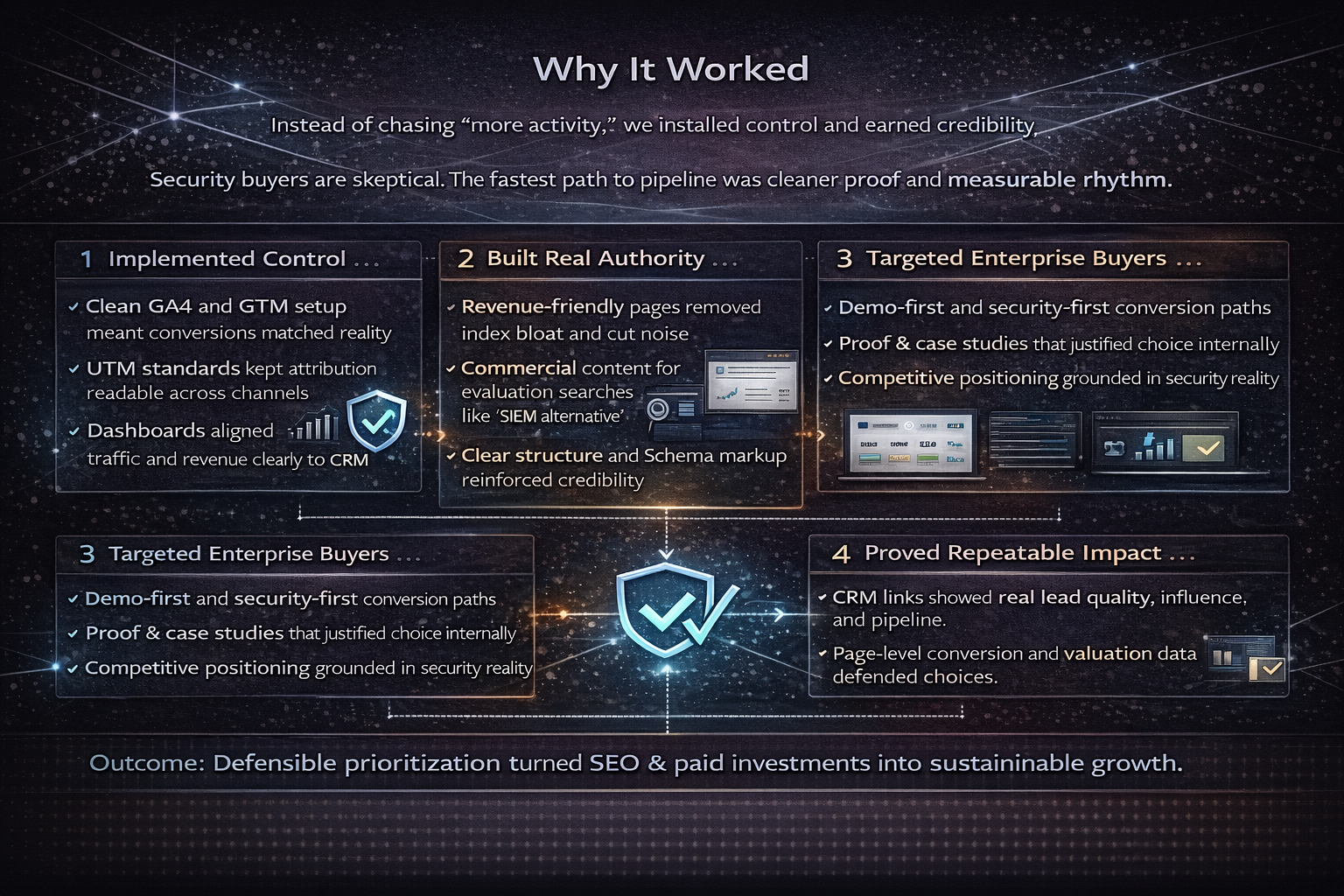
This cybersecurity SaaS growth system worked because we didn’t chase “more activity.” We installed control, then earned credibility with security buyers. In a category where IT and SecOps leaders default to skepticism, the fastest path to pipeline is not louder messaging. It is cleaner proof, clearer intent mapping, and reporting that the whole team can trust. Once tracking integrity was fixed, every decision became measurable.
Then, once commercial intent pages were aligned to real evaluation searches like SOC 2 readiness platform, SIEM alternative, SOAR alternative, cloud security posture management platform, and fraud prevention for SaaS, inbound stopped being random and started behaving like a repeatable demand engine.
What made the difference was the operating rhythm. We treated growth like infrastructure, with governance and accountability:
Clean GA4 and Google Tag Manager implementation, so conversions matched reality
Page architecture that reduced index bloat and strengthened authority on revenue pages
Conversion paths built for enterprise evaluation, including demo-first and security-review-first routes
CRM visibility that proved lead quality, not just lead volume
Proof-led positioning versus competitors, so buyers could justify the choice internally
Under market pressure, we defended priorities with evidence: page-level conversion shifts, lead qualification signals, and pipeline influence in the CRM. The outcome was simple. The team could scale SEO and paid search without chaos. Demand became predictable. Sales trusted marketing. Leadership trusted the numbers.
Predictable Security Pipeline Without Chaos
In cybersecurity SaaS, trust drives conversion. By fixing tracking integrity, aligning commercial search intent to the right pages, and rebuilding demo plus security-review paths, we turned random inbound into a controlled growth system. The team gained clear reporting, repeatable demand generation, and stronger lead quality. Instead of chasing quick wins, they scaled with confidence and proof.
Fix the numbers. Then scale pipeline.
Project Heroes:

Vita Klimaite
head of Growth

Amber Maritz
SEO Specialist

Nusta Berdzenishvili
Market Development Specialist

Olga Zhukova
Organic Growth Manager
FAQ for Cybersecurity SaaS Demand System Rebuild
How do you make inbound demand predictable for a cybersecurity SaaS?
We start by fixing tracking integrity, then align SEO page architecture to commercial intent searches like SOC 2 readiness platform, SIEM alternative, and cloud security posture management platform, and finally optimize demo and security-review conversion paths.
What is “AI search visibility” for cybersecurity SaaS websites?
It means structuring pages so AI Overviews and other AI evaluation surfaces can understand, trust, and cite them in clear entity language, scannable sections, proof blocks, and structured data, where it improves clarity.
Which pages usually drive the most qualified demos in security SaaS?
Evaluation pages convert best: SOC 2 and compliance pages, integration pages, competitor/alternative pages, and use-case pages like fraud prevention for SaaS or cloud security posture management.
Do you focus on technical SEO or revenue pages first?
Revenue pages first. Technical SEO supports them by removing index bloat, fixing crawl waste, improving internal linking, and ensuring key pages are fast, accessible, and correctly indexed.
How do you prove SEO and AI visibility work beyond traffic metrics?
We tie reporting to pipeline: demo-to-SQL, security-review starts, opportunity influence, and cost per qualified lead. If CRM outcomes improve steadily, the system is working.
