
Project details
Client: SaaS Company
Location: Germany
Industry: HR Tech
The client is a mid-stage B2B SaaS provider operating in the HR tech space, offering workforce analytics tools to enterprise teams across North America and Europe. Despite having strong product-market fit and active outbound sales, they struggled to attract qualified inbound leads, especially those aligned with their ideal customer profile (ICP).
Services Provided:
ICP-driven content strategy
Mid-funnel content production (use cases, solution pages, decision-focused blogs)
Search intent–based keyword mapping
Lead magnet creation and integration
Blog-to-MQL funnel redesign
SEO and conversion optimization
Email nurture flows for warm leads
Performance tracking by funnel stage and content type

Solutions Implemented
SEO Strategy And Content
We conduct keyword research, create website architecture and content map with timelines as well as facilitate full production
Competitor research
We’ll investigate market saturation for your specific services, dissect competitor structures, pricing models and value propositions.
Lead Generation Systems
We build automated lead generative systems that target and engage potential customers, streamline prospecting, and optimize conversion rates
Continuous Optimization
We will keep analyzing the data from your campaigns, make changes to improve results and ensure your strategies are effective.
4X More Demo Requests: How Smart Content Boosted MQLs for a B2B SaaS
- Last time updated: 30th of January, 2026
In this case study, you’ll learn how aboveA helped a B2B SaaS company in the HR tech space dramatically increase demo requests and qualified leads by implementing a content system rooted in buyer intent. Through strategic keyword mapping, mid-funnel content creation, and conversion-focused SEO, we turned an underperforming blog into a powerful MQL engine. If your team is investing in content but not seeing pipeline results, this case will show how to align content with sales outcomes and ICP needs.
The Challenge
The company had previously invested in blog writing and gated content, but most of it was generic, keyword-stuffed, or misaligned with the buyer’s journey. Key issues included:
Low lead-to-MQL conversion rate
Content that attracted researchers, not decision-makers
No clear handoff from top-of-funnel to middle-of-funnel
SEO traffic wasn’t translating into pipeline movement
Our Approach: MQL-Focused Content Marketing
We didn’t just “write blogs.” We built a revenue-aligned content system designed to attract high-intent readers and guide them toward sales readiness. Here’s how:
1. ICP & Funnel Alignment
We redefined their content roadmap based on actual sales calls, CRM insights, and interviews with past closed-won deals. This gave us clear insights into their best-fit buyer questions, blockers, and decision timelines.
2. Mid-Funnel Content Production
Instead of prioritizing traffic-only topics, we built:
Solution-aware articles (e.g., “How Enterprises Cut Onboarding Time with Workforce Analytics”)
Use case breakdowns, linking to demo pages
Problem-led narratives with CTAs to case studies, benchmarks, or consultation offers
3. SEO & Lead Capture Upgrades
We built a strategy around search queries with clear MQL intent, such as:
- “Workforce analytics tools for HR teams”
“HR dashboards with predictive insights”
“How to reduce employee churn with data”
4. We also created content clusters that included:
Lead magnets (ROI calculators, checklists)
Embedded conversion forms
Email flows to nurture warm leads post-download
5. The Content System in Action
To measure effectiveness, we tracked:
MQLs generated per content type
Time-to-conversion from first visit to sales form
Organic lead quality by funnel stage
Each piece of content was scored not only for SEO success, but also for its downstream pipeline impact, including demo requests, booked meetings, and qualified opportunities.
Results After 4 Months
Over just four months, this B2B SaaS company saw a clear transformation in lead quality and marketing contribution to pipeline. Our content system wasn’t just about publishing more; it was about driving MQLs through strategic, intent-led content.
MQL Conversion Performance
Before our involvement, the company’s content attracted top-of-funnel traffic with minimal sales impact. Conversion rates were stagnant, under 1% from blog to lead.
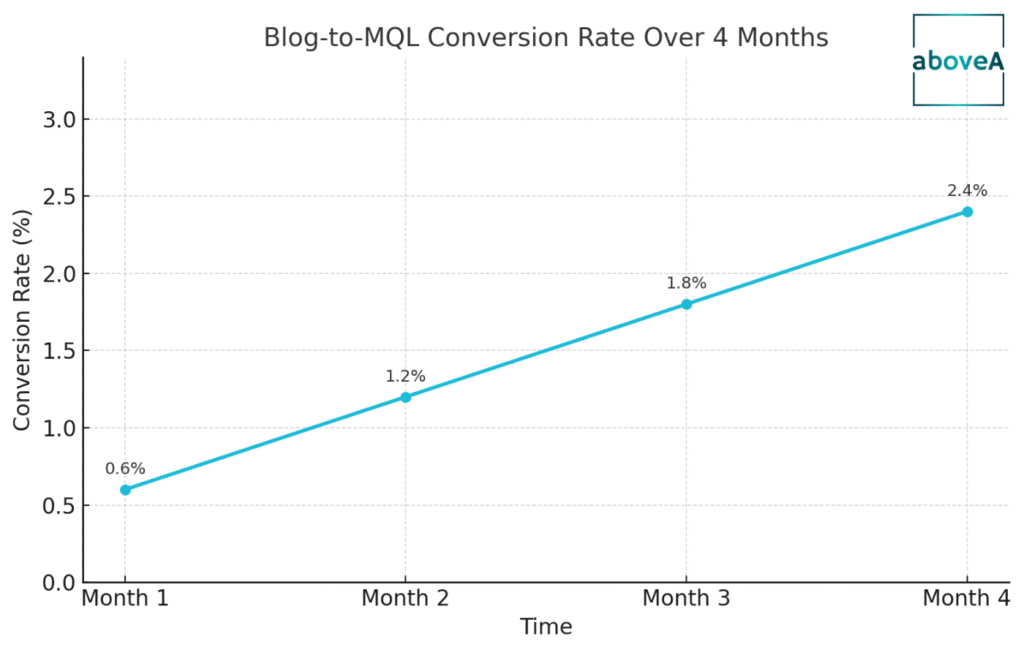
Once we introduced ICP-aligned content, lead magnets, and problem-aware articles tied to actual sales conversations, conversion rates began rising steadily across key entry points.
By month four, the blog-to-MQL conversion rate had increased to 2.4%, up from 0.6% previously. This shift proves the impact of writing for sales enablement, not just for search engines.
Growth Metrics After Content Optimization
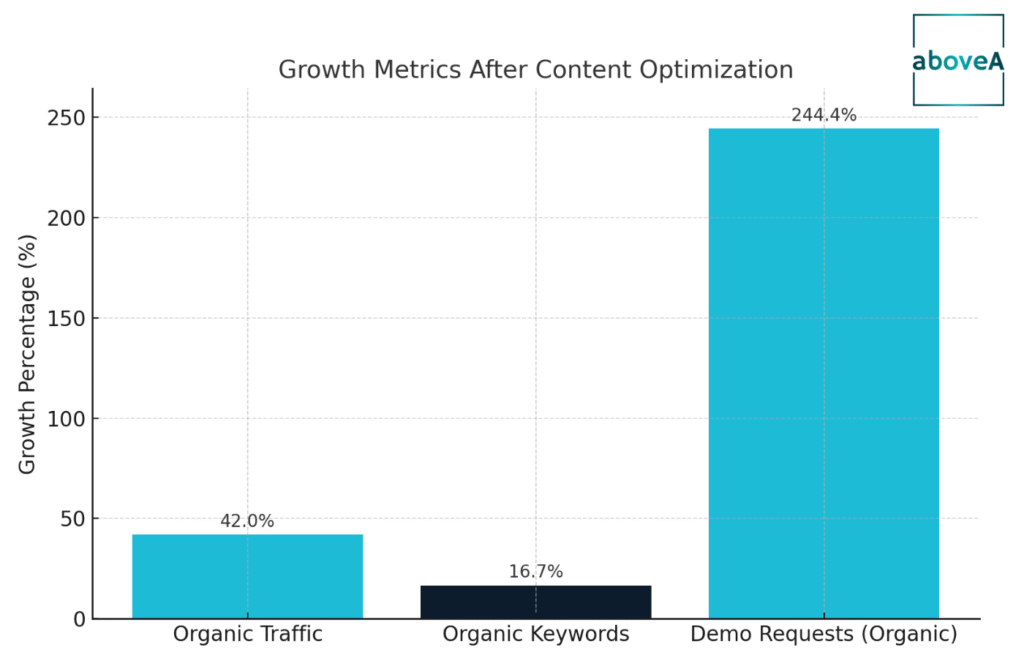
These improvements in MQL generation were only part of the bigger picture. Our content marketing system helped boost full-funnel metrics:
Organic Traffic increased by 42% in total, driven by search-intent queries like “best HR analytics platform” and “reduce onboarding time enterprise.”
Organic Keywords rose by 16.7%, with a visible increase in decision-stage and use-case-specific terms.
Demo Requests from Organic nearly tripled, going from 9/month to 31/month, proving that we were attracting real buyers, not just readers.
Why It Worked?
By building content with marketing-qualified lead generation in mind, we shifted the company’s blog from a passive asset into an active sales tool.
Our content strategy blended:
Buyer-led keyword targeting
Mid-funnel content with conversion flows
Lead magnets tied to product use cases
Email nurturing for warm traffic
This created clear pathways from education → evaluation → conversion.
The result?
A predictable stream of sales-ready MQLs, more efficient pipeline generation, and greater sales and marketing alignment.
Ready to turn your blog into a qualified lead machine?
Project Heroes:

Amber Maritz
SEO Manager

Teerisra Donlunwad
Marketing Specialist

Erika Hornmark
Researcher & Writer

Audrey Lau
Researcher & Writer
Frequently Asked Questions for MQL-Focused Content Marketing
What is MQL-focused content marketing for B2B SaaS?
It’s a content system built to generate marketing-qualified leads, not just traffic. It targets buyer-intent keywords, answers evaluation questions, and routes readers into demo pages, lead magnets, and nurture flows.
How do you increase demo requests from organic traffic?
You build mid-funnel pages that match decision-stage searches, then connect them to clear CTAs and conversion paths. When content aligns with ICP needs, organic visitors behave like buyers, not readers.
Which SEO keywords drive qualified leads in HR tech?
High-intent queries usually include workforce analytics tools for HR teams, employee churn analytics software, predictive HR dashboards, and enterprise onboarding analytics. These searches signal evaluation, not curiosity.
What content formats convert best into MQLs?
Use-case articles, solution-aware pages, comparison-style posts, ROI tools, and checklists tend to convert best. They help buyers justify decisions and move from evaluation to action faster.
How long does it take to see results from a content system like this?
Most SaaS teams see early movement in 6–10 weeks, with clearer MQL and demo lift by months 3–4. Results accelerate when internal linking, CTAs, and nurture flows are implemented together.
