
Chaophya Nillawan
A content writer at aboveA focused on go-to-market strategy, international expansion, and startup growth across Europe and Southeast Asia. With a psychology background, he helps businesses build trust, enter new markets, and become more fundable.
Startup funding sources in Japan in 2026: Grants, VC, loans, accelerators, and public support
- Last time updated: 20th of May, 2026
Startup funding sources in Japan in 2026 are made up of public grants, JFC loans, NEDO and JST programmes, VC funds, corporate investors, accelerators, startup hubs, and support for foreign founders.
However, the ambudance should not be confused with easy access! In 2026, the startup funding environment is very competitive for Japanese natives. Now, founders are asked to provide reasons why they think a fund matches their stage, sector, and deliver enough credibility, as well as a market plan. No logic, data, or backing means no money…
To help you avoid situations like this, our guide aims to provide a comprehensive overview of the main sources, what each one supports, and how founders should prepare before applying, pitching, or entering Japan with a serious funding plan in place.
Make your startup easier to fund
Table of Contents
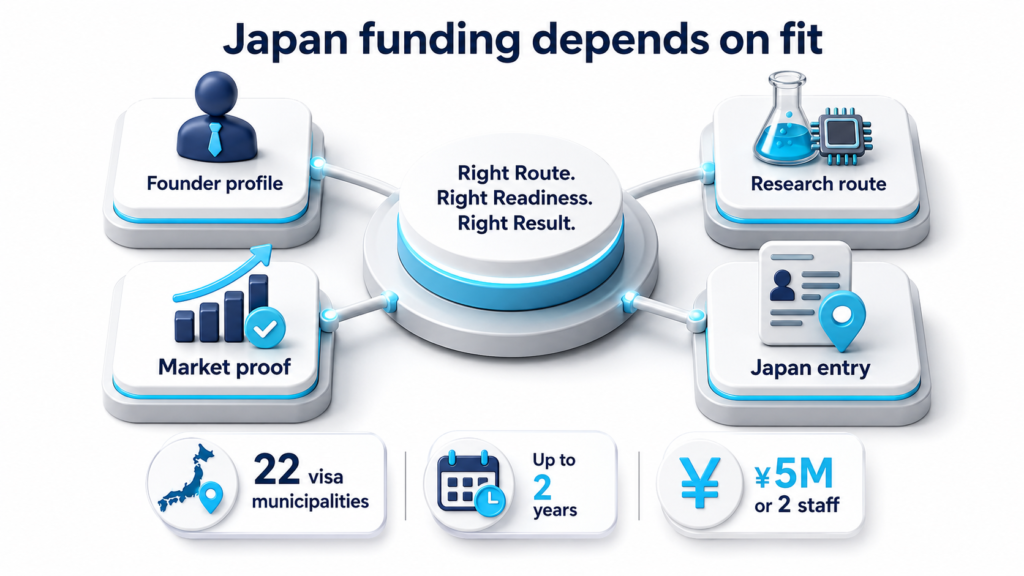
Which Japan startup funding source fits your stage?
Why does Japan’s 2026 startup funding market matter?
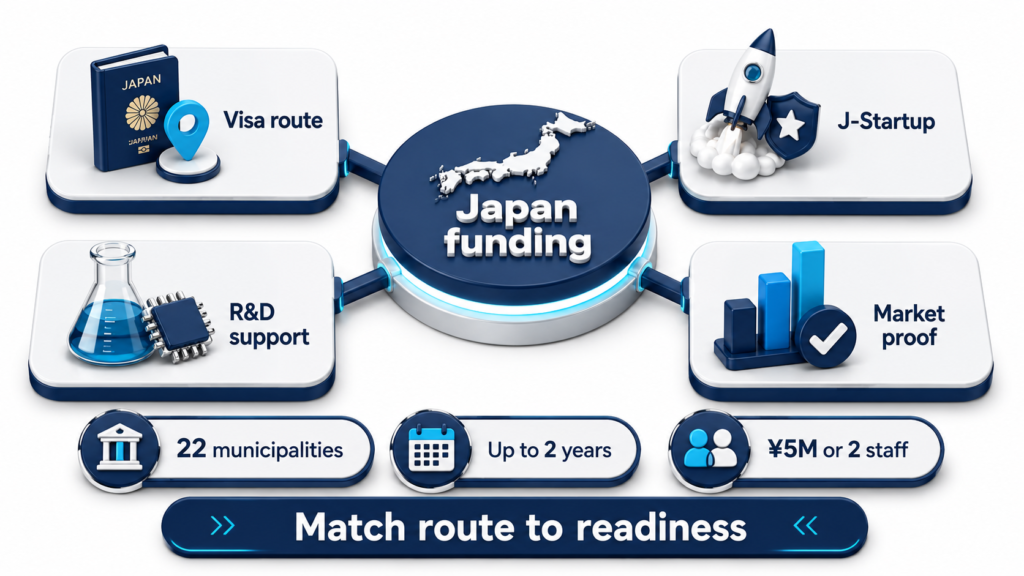
Which public programmes support startups in Japan?
How does J-Startup create visibility and access?
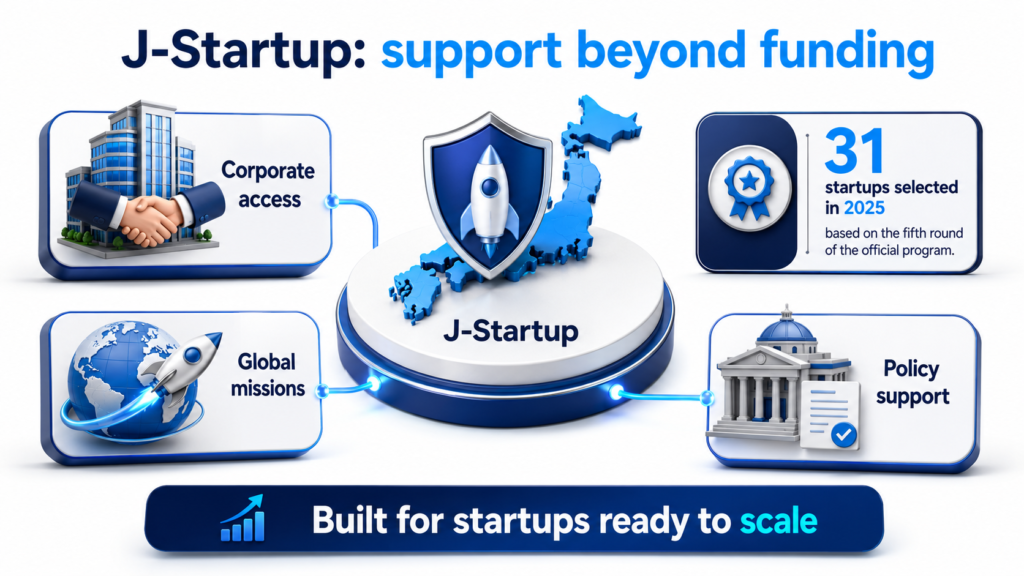
J-Startup is built for selected companies that already show stronger potential. Its model is not only financial. The programme selects startups recommended by private supporters, then connects them with a public-private support community that includes venture capitalists, accelerators, large companies, and government organisations. Support can include overseas missions, event participation, business matching, subsidy-related advantages, regulatory sandbox access, and help with regulatory requests.
That makes J-Startup useful when the founder’s main barrier is not only money. A company might need credibility, corporate access, government visibility, or a stronger global expansion path. For that reason, it fits startups that can already explain their mission, originality, growth potential, and wider market relevance.
How does NEDO support deep tech risk?
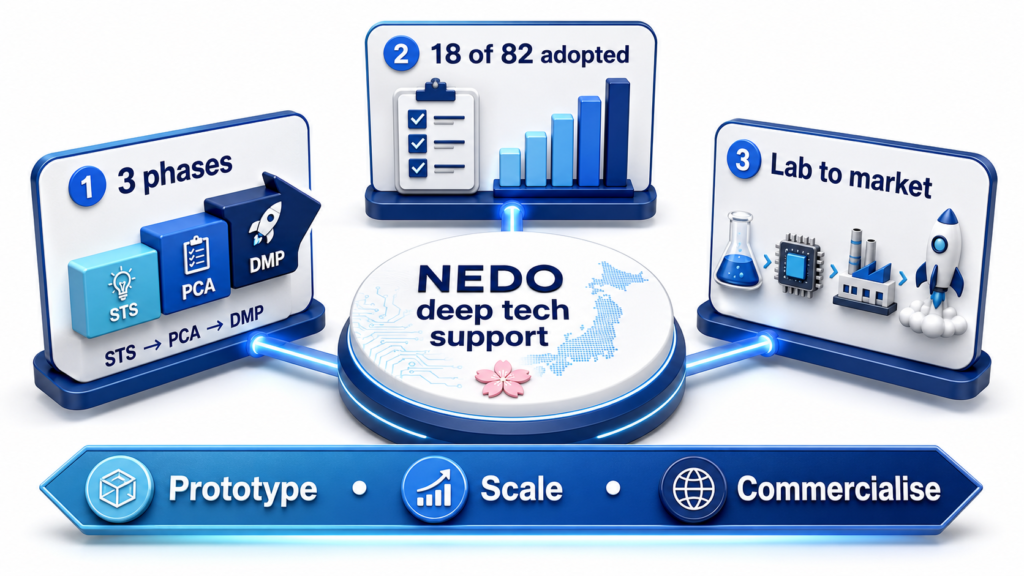
NEDO startup funding is more relevant when the company is building technology that normal investors struggle to evaluate early. Its DTSU programme runs from FY2023 to FY2032 with a total budget of JPY 87.7 billion, while the GX programme has about JPY 38 billion as of April 2026. NEDO also states that these programmes support R&D and commercialisation for deep tech startups working on high-risk technologies that need long-term development, large-scale funding, and social implementation.
Deep tech startups often need more than a pitch deck. They need prototype progress, technical milestones, partner interest, production logic, and proof that the technology can move from research into practical use. NEDO can assist in reducing the technical and capital risk before the company becomes easier for private investors to judge.
How does JST help research become a company?
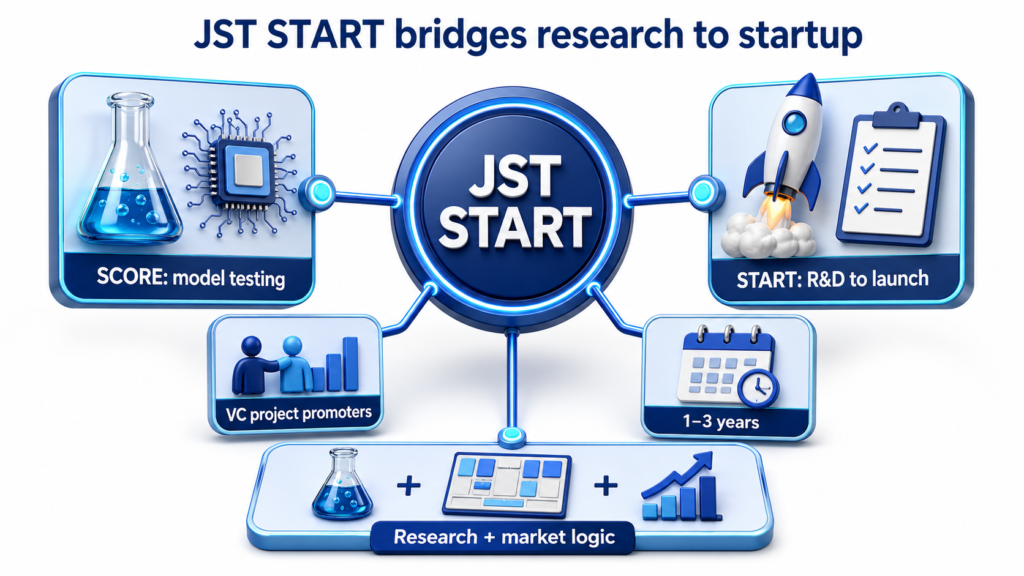
JST START is useful when the business starts inside research, not inside a normal commercial team. JST describes START as support for R&D toward commercialisation, while SCORE helps refine the business model before startup creation. Its materials also show project promoters from venture capital firms supporting R&D and business development, with START providing R&D funds for business startup and commercialisation.
This is a different kind of funding logic. The main problem is not only capital. The research team also needs customer understanding, business planning, commercial direction, and a realistic company-building path.
How does the Startup Visa support foreign founders?
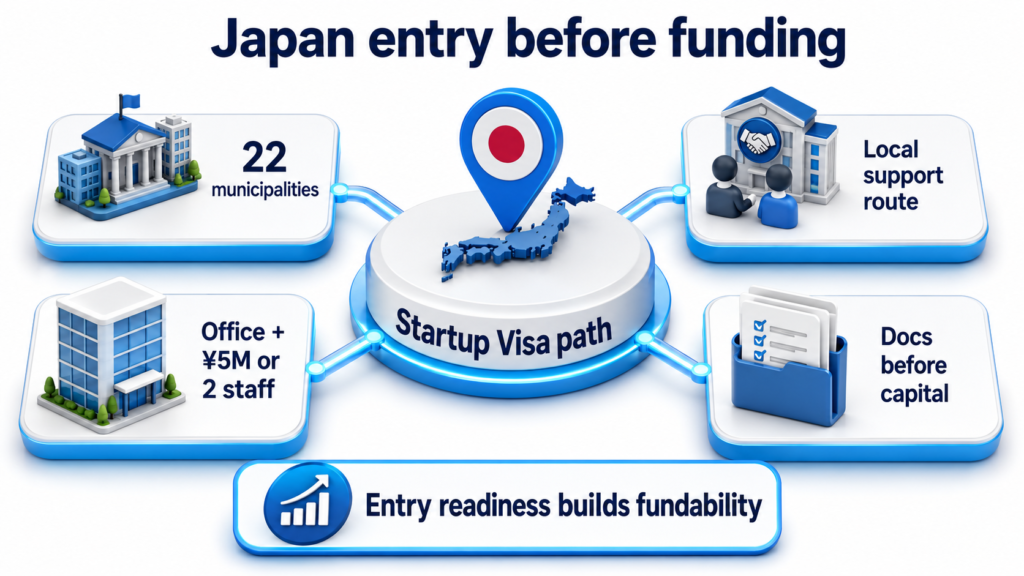
Japan Startup Visa support matters when the founder first needs legal and operational time in Japan. METI states that eligible foreign entrepreneurs can stay in Japan for up to two years while preparing to start a business before meeting the full Business Manager status requirements. Applicants must work through an approved Foreign Entrepreneurship Promotion Organization, and requirements differ by municipality or organisation.
For foreign founders, this changes the funding question. The first need might be a credible Japan entry plan, local support route, business documents, and municipality fit before grants, loans, or investors become realistic. Public support, therefore, becomes part of the fundability path, not only a separate funding source.
Which loan and debt routes can Japanese startups use?
Japan startup loans can help founders who need working capital, equipment funding, or early operating support before equity investment makes sense. This route is different from grants because the money must be repaid. It is also different from VC because the founder does not give away ownership. For that reason, loans fit startups that can explain how the money will be used, how the business will earn, and when repayment will become realistic.
When does JFC financing make sense?
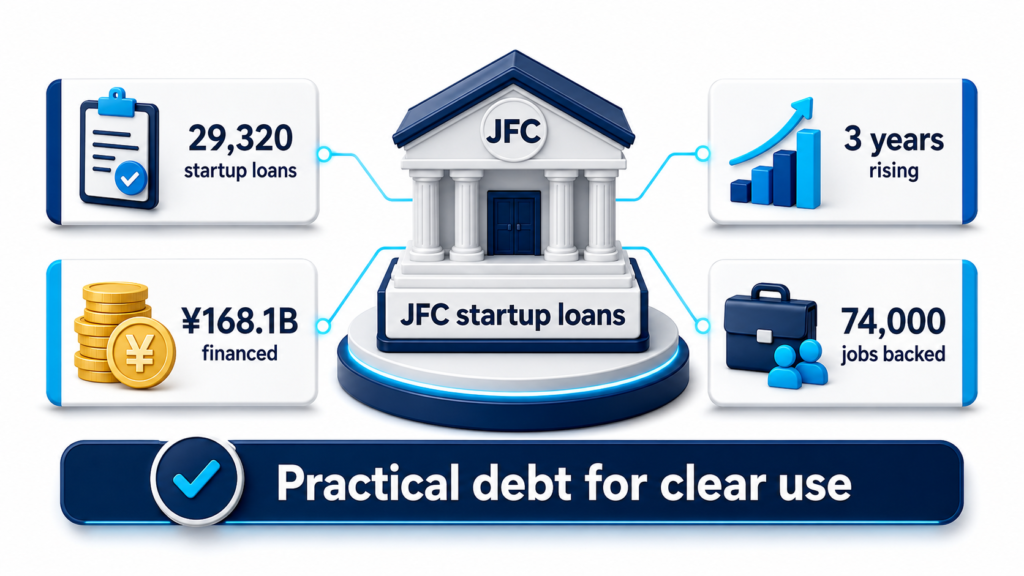
Japan Finance Corporation loans are one of the first debt routes founders often check. JFC says business startups are eligible for its Micro Business and Individual Unit loans, with options that do not require collateral or guarantors. It also lists long repayment periods and fixed interest rates as key loan features. First-time applicants should prepare a business startup plan sheet, while corporations should also prepare registry documents and financial information where available. The interview process can also cover fund use, business status, and plans, so weak planning can become visible quickly.
This route can work when the founder has a practical cost to fund, such as equipment, store setup, product preparation, hiring, or early operations. It is less suitable when the business has no clear repayment logic.
What should foreign founders know about debt support?
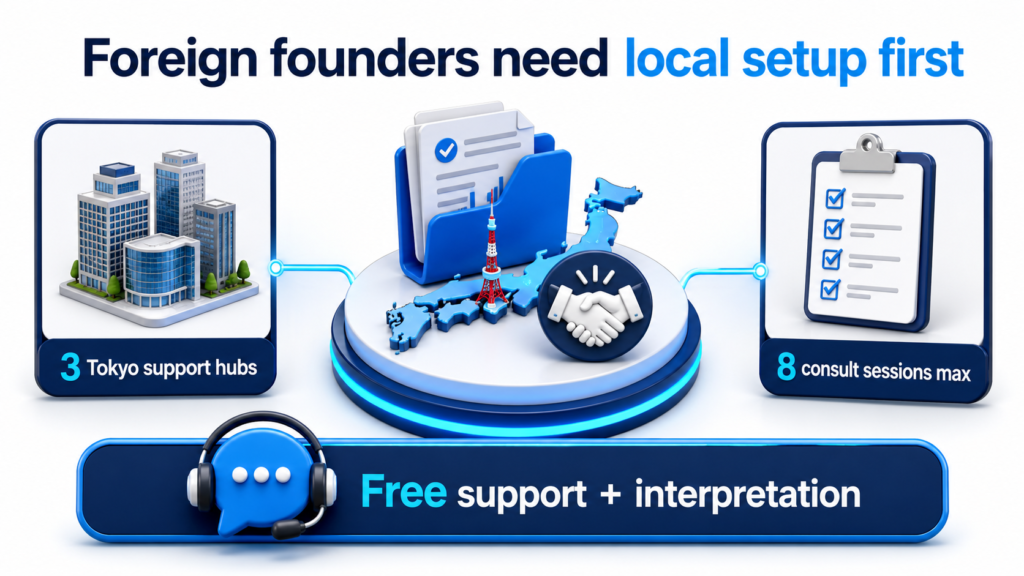
Foreign founder funding in Japan often needs extra preparation because language, documents, residence status, and local business proof can affect access. Tokyo’s Business Development Center provides fundraising support for foreign entrepreneurs, including information on government-directed credit and subsidies, advice by startup phase, communication support when visiting financial institutions, and help preparing a business plan for fundraising support. Its project requirements also show that foreign entrepreneurs usually need a Japan-based corporation, a Tokyo head office or main office, and a status of residence that does not restrict business activity.
That means foreign founders should prepare more than a pitch. They need a Japan-ready business plan, local setup logic, and documents that lenders can review.
Where does later-stage debt or growth capital fit?
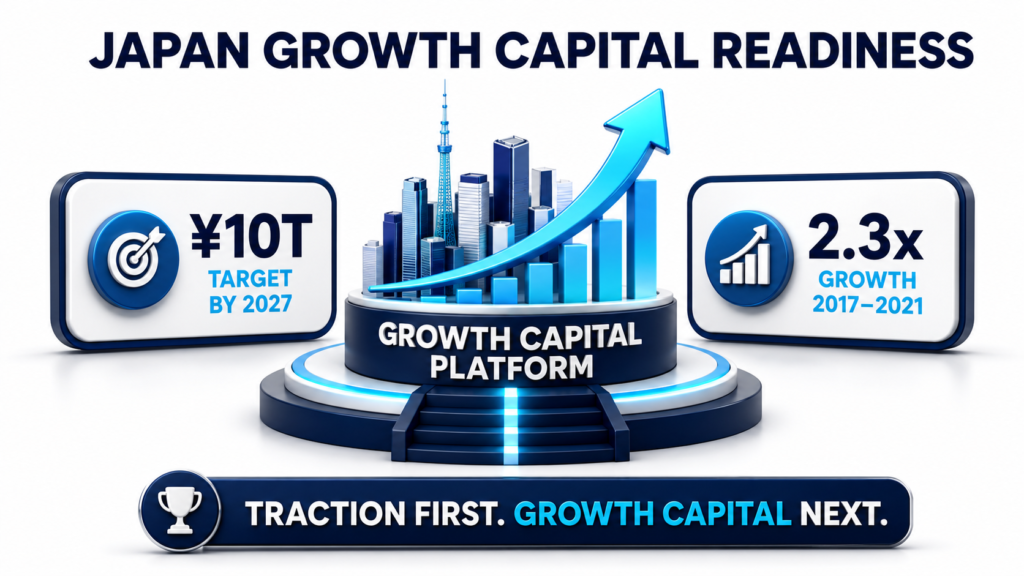
Japanese growth capital becomes more relevant when the startup has already passed basic proof. Reuters reported in January 2026 that Minerva Growth Partners secured about ¥7 billion at the first close of its second late-stage startup fund, aiming for around ¥20 billion in total. The report also noted that Japan’s shortage of late-stage capital has often pushed companies to go public while still small.
For founders, the message is practical. Loans can support early operating needs, but larger debt or growth capital needs stronger proof, cleaner numbers, and a business that can defend its next expansion step.
Where does SGInnovate fit?
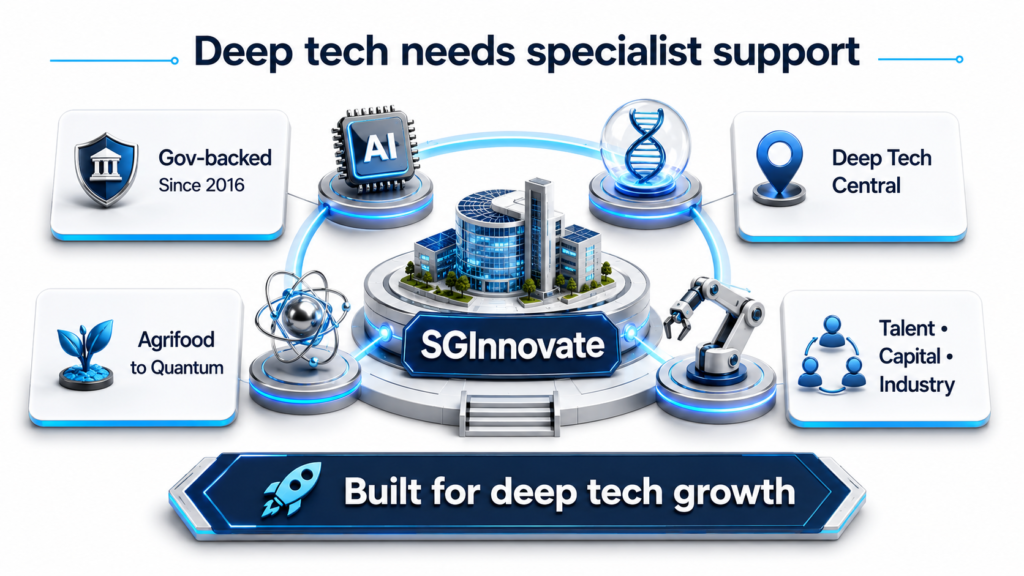
SGInnovate fits deep tech founders who need more than general startup mentoring. Its platform highlights deep tech startup growth and funding, investments, talent development, industry partners, and a deep tech community of 190,000+. That makes it more relevant for startups in areas such as AI, biotech, quantum, robotics, and research-heavy technology.
For founders, the message is practical. JFC loans and local debt routes can support early operating needs, while later-stage capital requires stronger traction, cleaner financials, and a clear expansion case. Once a startup can show that kind of proof, the funding conversation often moves beyond public support and debt into Japan’s VC, corporate venture, and strategic investor ecosystem.
Which VC and corporate investors fund startups in Japan?
Japan VC funding in 2026 is becoming more selective, but it still gives serious startups several routes into private capital. Speeda’s 2025 startup finance data, reported in May 2026, showed total startup fundraising excluding debt at ¥761.3 billion, close to the previous year’s ¥779.3 billion. The stronger signal sits under the headline. The number of companies raising capital fell 6% to 2,700, while the median funding amount dropped from ¥77.6 million to ¥62.4 million. Corporate investment also rose by ¥32 billion to ¥148 billion, while VC investment declined 8% to ¥297.3 billion. That tells founders something useful: investors are still active, but capital is becoming more concentrated and strategic.
How do independent VC funds judge startups?
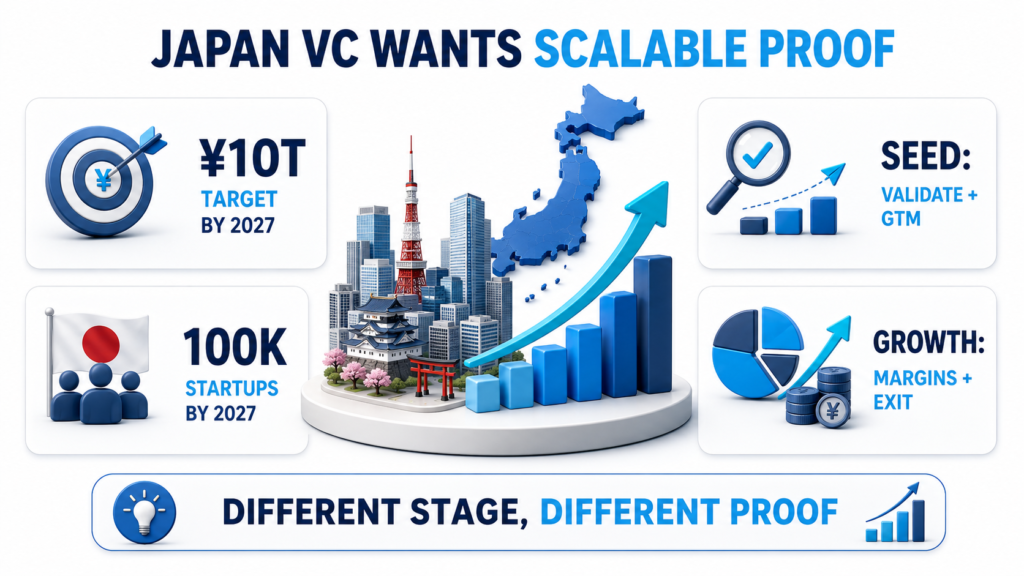
Japan venture capital firms usually look for startups that can grow beyond a small domestic niche. A founder should prepare a clear market size argument, early customer evidence, pricing logic, product roadmap, and use-of-funds plan. For SaaS, AI, fintech, robotics, healthcare, or climate technology, the pitch also needs sector proof. Investors will ask why the company can win in Japan, whether the product can scale abroad, and how the next round becomes realistic.
This means a startup should avoid pitching every VC the same way. An early-stage investor might care more about founder insight and first traction. A later-stage investor will ask harder questions about revenue quality, margins, hiring, governance, and exit paths.
Why does corporate investment matter in Japan?
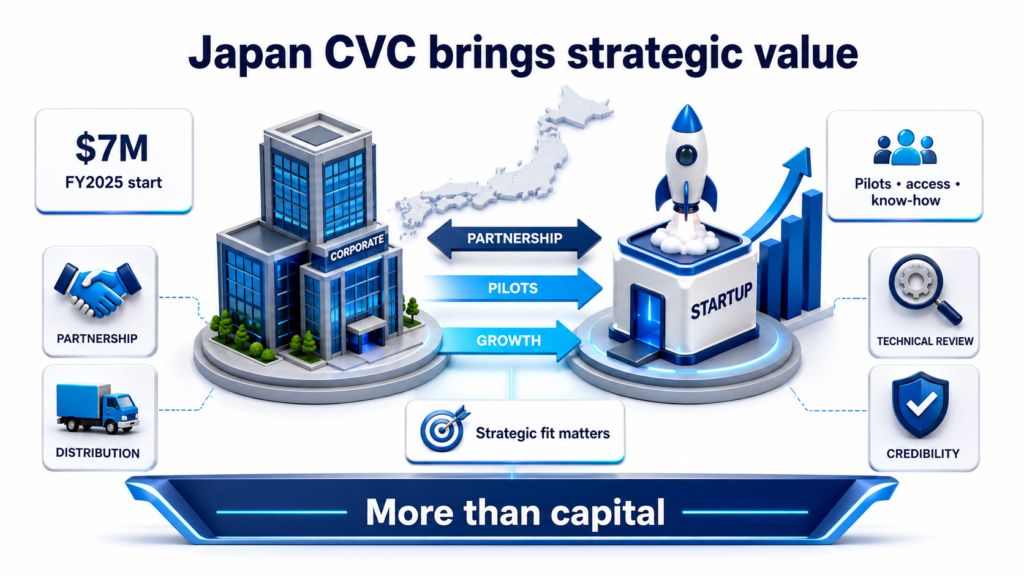
Corporate venture capital in Japan is especially important because many large companies use startup investment to find new business lines, technology, partnerships, and future acquisition targets. Shionogi’s CVC group, established in April 2025, shows this logic clearly. It focuses on seed, early, and mid-stage startups, plans an annual investment budget of about $14 million, and targets Japan, the U.S., Europe, and Asia.
For founders, corporate capital can bring more than money. It can support pilot projects, distribution access, technical review, clinical or industrial knowledge, and credibility with larger buyers. The trade-off is that corporate investors often care about strategic fit, not just financial return. A startup should know what the corporate partner wants before accepting the cheque.
Where does JIC fit in the funding system?
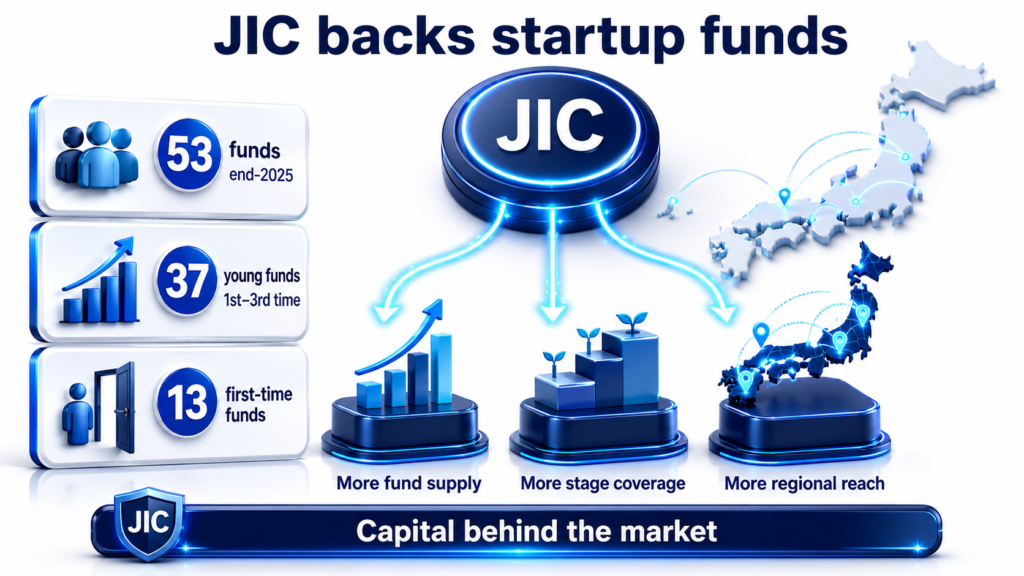
JIC startup investment supports Japan’s wider risk capital market. METI says JIC provides risk capital through its own funds and LP investments in private funds, with focus areas that include startup creation, open innovation, regional management resources, and business restructuring. METI also notes that JIC started investing as an LP in overseas VC funds in 2023 to support Japan’s startup ecosystem and help Japanese startups expand overseas.
This route matters because it strengthens the funds behind the startup market. Founders might not always apply directly to JIC, but JIC-backed funds can shape where capital becomes available.
Which startups fit growth-stage capital?
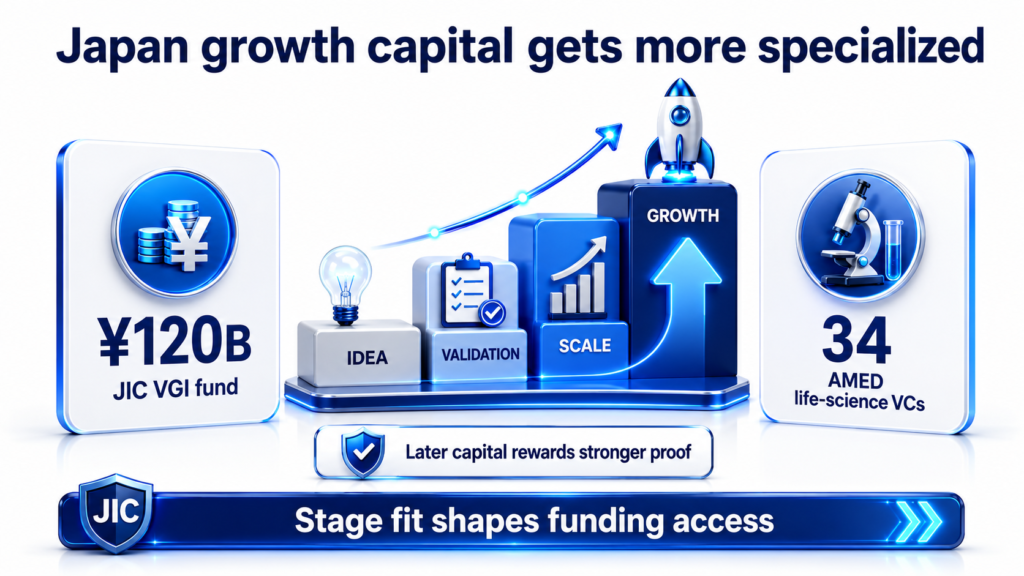
Japan’s growth-stage funding fits companies that have already passed early validation. JIC Venture Growth Investments says its growth fund supports expansion, growth, and later-stage startups before IPO, while its deep tech fund supports fields such as AI, IoT, robotics, mobility, space, materials, and electronic devices.
For life science founders, AMED’s 2026 registered VC list also shows specialist capital routes, including firms focused on biotech, therapeutics, healthcare, and university research commercialisation.
Taken together, Japan’s private funding market rewards clearer proof, stronger sector fit, and better partner logic. Startups that still need structure before these conversations often get more value from accelerators, hubs, and ecosystem programmes.
Which accelerators and incubators can help Japan-focused startups?
Japan startup accelerators can help founders who need structure before serious funding conversations. Some teams have technology, but weak customer proof. Others understand the product, but still need market entry guidance, mentor feedback, pitch practice, or partner access. Programmes such as J-Startup, Tokyo startup hubs, university incubators, corporate accelerators, and sector-focused communities can help founders test whether the business is ready for grants, VC, or corporate partnerships.
| Route | Best fit | What it should improve |
|---|---|---|
| Public hubs | Japan entry and ecosystem access | Local network and visibility |
| University incubators | Research-based founders | Commercial model and team formation |
| Corporate accelerators | B2B and deep tech startups | Pilots, industry feedback, buyer access |
| aboveA Incubator | Early and expansion-stage founders | Fundability, GTM, credibility, funding route fit |
aboveA Incubator can be especially useful for founders who need to connect funding plans with go-to-market logic. A Japan-focused startup should not only ask where money is available. It should show why Japan, why this buyer group, why this capital route, and why the company is ready to move. This preparation makes later funding conversations more serious.
Which funding support helps foreign founders enter Japan?
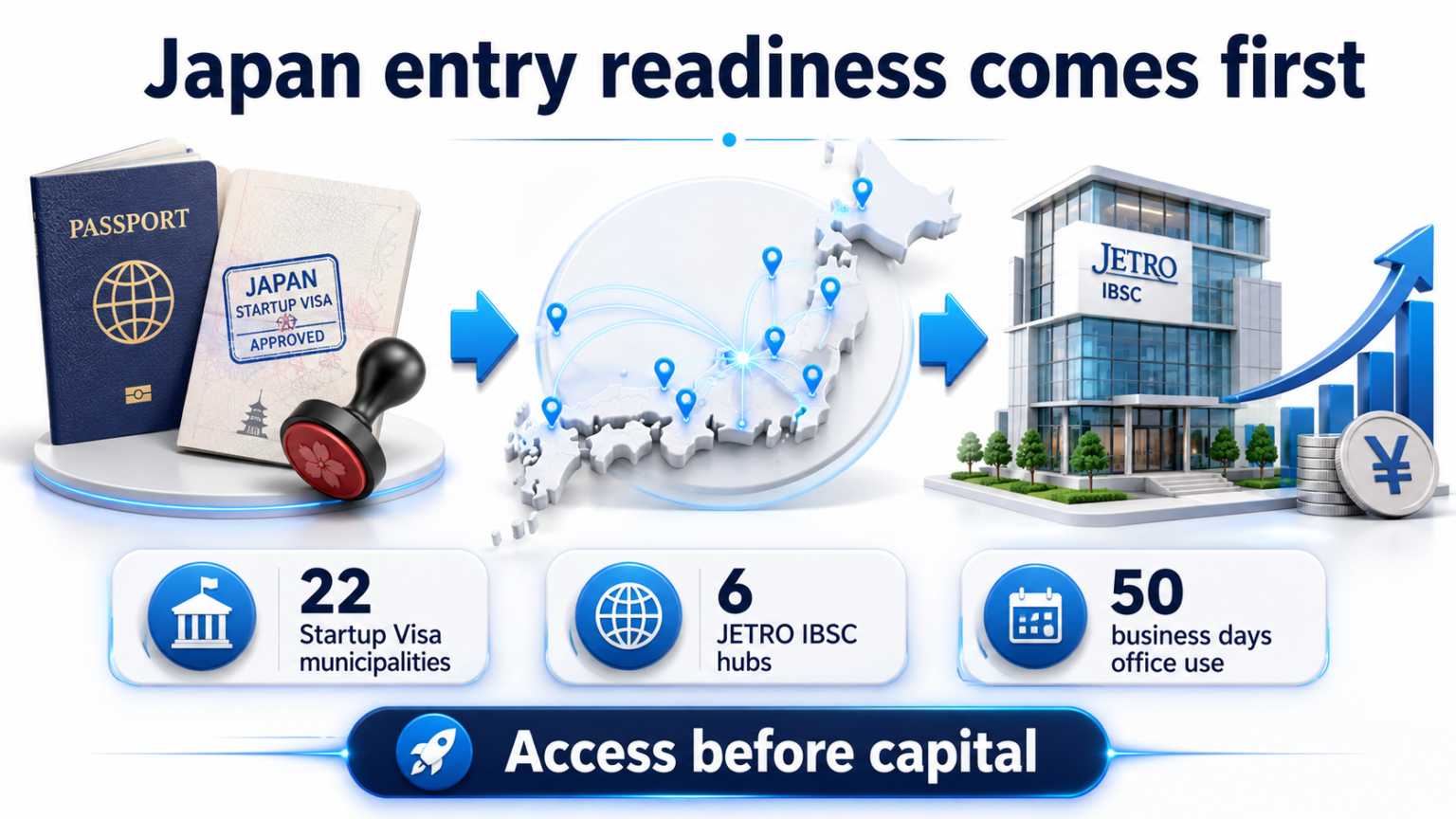
Japan startup funding for foreign founders often starts with access, not capital. A founder entering Japan needs time to set up the business, understand local requirements, prepare documents, and build partner trust. METI says the Startup Visa allows eligible foreign entrepreneurs to stay in Japan for up to two years while preparing to start a business before meeting full Business Manager status requirements.
Foreign founders should prepare:
- a Japan-ready business plan
- local market and customer proof
- funding or repayment logic
- municipality or support organisation fit
- Japanese-language documents were needed
- partner, pilot, or advisor evidence
JETRO also supports foreign and foreign-affiliated companies with online consultations, business setup guidance, and IBSC support in major cities such as Tokyo, Yokohama, Nagoya, Osaka, Kobe, and Fukuoka.
For foreign founders, early funding readiness is tied to entry readiness. Investors and lenders will take the business more seriously when the founder can show a real path into Japan, not only an interest in the market.
Which startup industries are attracting more investment in Japan?
Japan startup investment in 2026 is moving strongly toward AI, deep tech, healthcare, climate, defence, robotics, and enterprise software. Tracxn reports that Japanese startups raised $2.93 billion across 308 equity rounds in 2026 up to May, which shows active deal flow even in a selective market.
Deep tech is one of the clearest areas to watch. Tracxn’s Tokyo deep tech data lists 284 deep tech companies, including 129 funded companies that have raised $2.5 billion in total. AI is also pulling larger cheques. Blackbox’s 2026 funding coverage highlighted Japan’s concentration around physical AI and foundation models, including Turing at ¥24 billion and Sakana AI at ¥20 billion in major funding.
Healthcare is also gaining attention. Sound Wave Innovation raised about $17 million for an ultrasound-based Alzheimer’s therapy trial, backed by medical and international investors. Defence and dual-use technology are becoming more relevant, too, as Japan is urging banks to fund defence companies and support startups working on AI, drones, satellites, and related technologies. These patterns show which sectors need stronger funding preparation, not only stronger products.
What should founders prepare before applying or pitching?
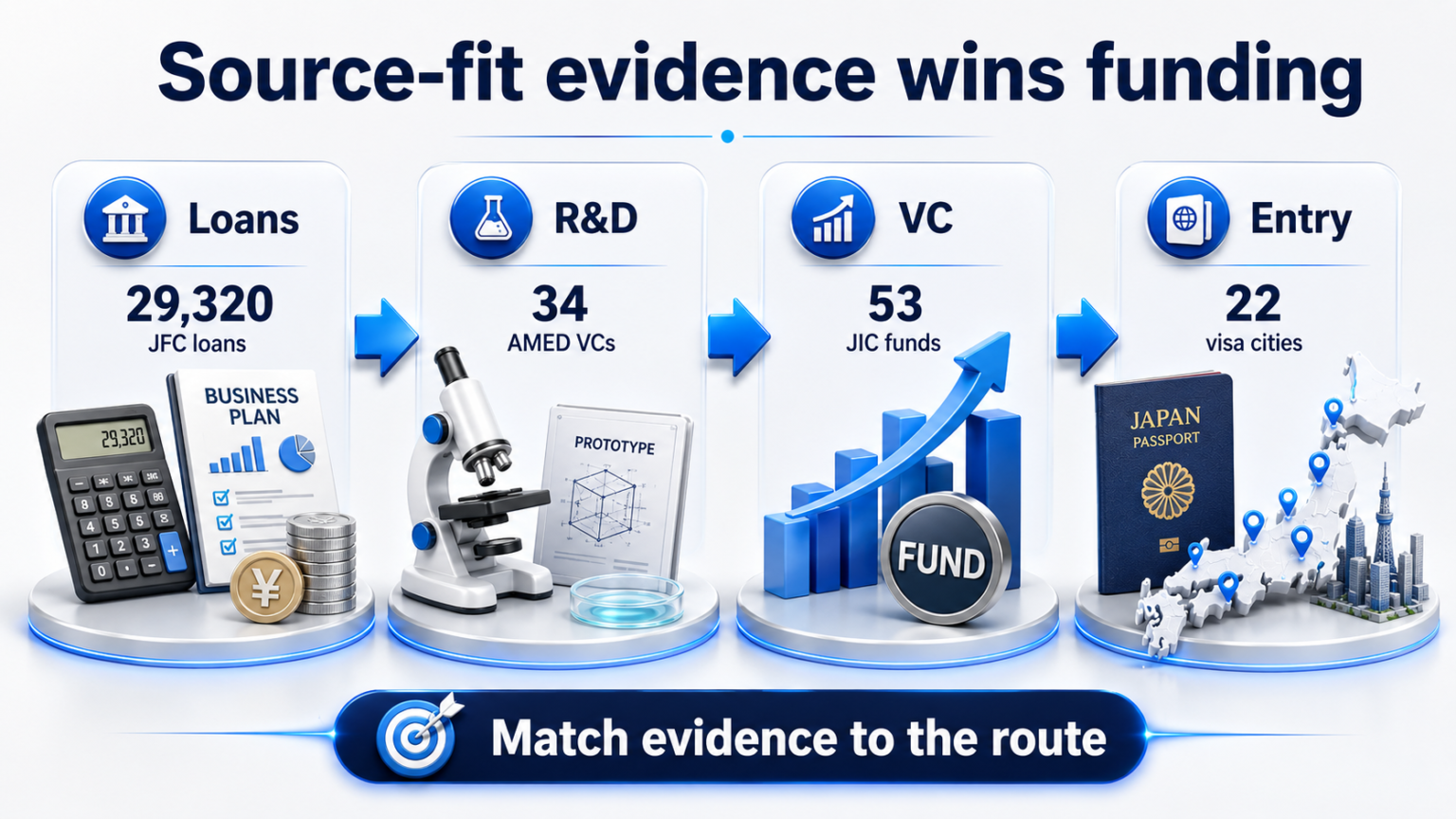
Japan startup funding preparation should begin with evidence that matches the source. Loan applications need repayment logic, financial forecasts, and a clear use of funds. R&D programmes need technical milestones, prototype plans, partner logic, and commercialisation routes. VC and corporate investors need traction, market size, sales evidence, team strength, and expansion potential. Foreign founders should also prepare Japan entry documents, local market research, and proof that the business can operate in Japanese conditions. When these materials are ready before outreach, the funding conversation becomes less about promises and more about whether the source fits the company’s next move.
Conclusion: Startup funding sources Japan 2026
Startup funding sources Japan 2026 give founders several routes, from public R&D support and JFC loans to VC, corporate investors, accelerators, and Startup Visa pathways. The right source depends on the stage, proof, sector, and Japan market readiness. Founders should avoid treating every programme as the same opportunity. A better approach is to match capital to one clear business need, then prepare documents that prove why the startup is ready for that route.
Grow Your Startup with Us!
aboveA Startup Incubator for Japansese Startups
Turn ideas into real businesses. aboveA Startup Incubator equips Japansese founders with practical tools, mentorship, and structured guidance to develop, validate, and launch their startups with confidence. Learn to scale, avoid common mistakes, and access resources designed for real-world success.
Startup Fundraising Readiness Services
Our startup fundraising readiness services can turn scattered traction, unclear positioning, weak credibility, and early market signals into a clearer investment case. We help Japanese startups prepare the proof, story, visibility, and go-to-market logic needed before serious investor conversations begin.
aboveA Product Launch / Market Entry Program
Launch with impact. Let us guide your Japanese startups through every step of introducing a product to new markets. From market research and validation to marketing strategies and operational readiness, founders gain the knowledge and support needed for a successful international market entry.
FAQ: Startup funding sources Japan 2026
Startup funding sources Japan 2026 create practical questions about loans, public programmes, foreign founders, deep tech, and investor readiness.
Can a founder in Japan use loans before raising VC?
Yes, but the loan should fund a clear business need. Public founder discussions often mention self-funding, JFC loans, bank loans, and external investment as separate options, which shows why founders need to compare repayment pressure with equity dilution before choosing.
Is Japan’s Startup Visa enough to make a foreign founder fundable?
No. The Startup Visa gives eligible foreign entrepreneurs up to two years to prepare a business in Japan, but fundability still depends on local proof, documents, market logic, and a route into operations.
Why do deep tech startups in Japan need public funding first?
Deep tech often needs longer R&D, technical validation, and commercial proof before private investors can judge the risk. That is why NEDO-style support matters for founders building high-risk technology with longer development paths.
Why is late-stage funding still a concern in Japan?
Japan still has a late-stage capital gap. Reuters reported that limited late-stage capital can push startups to list while still small, which explains why stronger growth funds matter for scaling companies.
What should foreign founders prove before asking for Japan funding?
Foreign founders should prove more than product potential. They need a Japan-ready business plan, local setup route, customer logic, documents, and a realistic funding path because eligibility and operational requirements can be stricter.
