
Chaophya Nillawan
A content writer at aboveA focused on go-to-market strategy, international expansion, and startup growth across Europe and Southeast Asia. With a psychology background, he helps businesses build trust, enter new markets, and become more fundable.
UK Startup funding in 2026: How to make your business fundable before raising capital
- Last time updated:19th of May, 2026
Startup funding in the UK in 2026 requires proving that a business is clear, trusted, and ready to grow. Many founders who are looking for capital fail because they can’t explain and support their market, customer demand, use of funds, or go-to-market plans. That creates risk for investors and can seriously impact their willingness to back startup ventures.
In this article, we will discuss how UK startups can become more fundable this year and avoid fundability issues by showing stronger proof, better strategy, SEIS and EIS readiness, also tapping into what grants owners can look for, and how to do clearer capital planning.
Develop a fundable startup with aboveA
Table of Contents
Why UK startups need stronger proof before raising capital
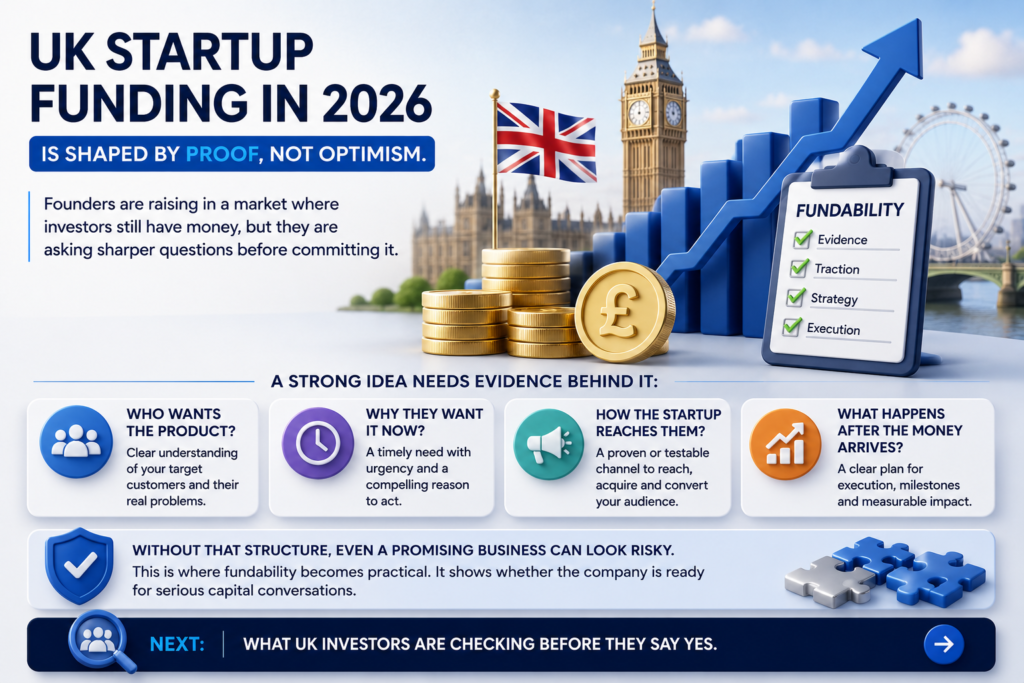
UK startup funding in 2026 is shaped by proof, not optimism. Founders are raising in a market where investors still have money, but they are asking sharper questions before committing it. A strong idea needs evidence behind it: who wants the product, why they want it now, how the startup reaches them, and what happens after the money arrives. Without that structure, even a promising business can look risky. This is where fundability becomes practical. It shows whether the company is ready for serious capital conversations. Next, the article should look at what UK investors are checking before they say yes.
What UK investors check before funding a startup
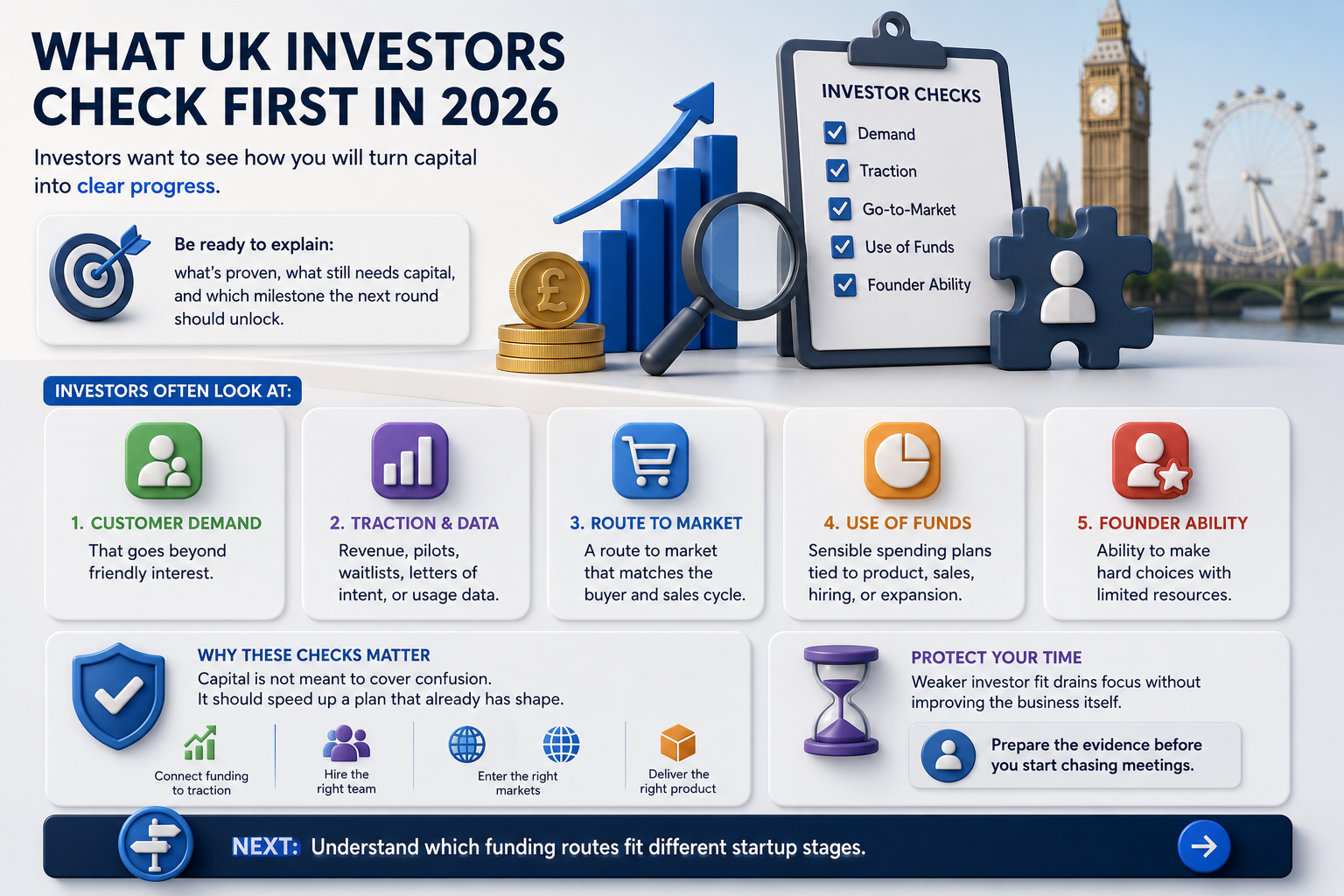
UK startup investors in 2026 usually check whether the business can turn capital into clear progress. They are not only reviewing the pitch deck. They are testing the logic behind the raise. A founder should be ready to explain what has already been proven, what still needs capital, and which milestone the next round should unlock.
Investors often look at:
- customer demand that goes beyond friendly interest
- revenue, pilots, waitlists, letters of intent, or usage data
- a route to market that matches the buyer and sales cycle
- sensible spending plans tied to product, sales, hiring, or expansion
- founder ability to make hard choices with limited resources
These checks matter because capital is not meant to cover confusion. It should speed up a plan that already has shape. If the startup cannot connect funding to traction, hiring, market entry, or product delivery, the raise becomes harder to defend. This preparation also protects time, because weaker investor fit drains focus without improving the business itself. That is why founders should prepare the evidence before they start chasing meetings. Next, it helps to understand which funding routes fit different startup stages.
Which UK startup funding route fits your stage
UK startup funding routes in 2026 should match the company’s stage, risk level, and proof. A founder raising too early from the wrong source can lose time, weaken confidence, and accept terms that do not fit the business. The better move is to connect each capital route with a clear use case.
| Funding route | Best fit | What founders should prove |
|---|---|---|
| SEIS | Very early startups | Clear idea, eligible structure, early market proof |
| EIS | Growing startups | Stronger traction, growth plan, investor-ready numbers |
| Grants | Innovation-led companies | Technical value, public benefit, delivery ability |
| Angels | Early commercial progress | Founder quality, market logic, clear next milestone |
| VC | High-growth companies | Scalable market, fast growth path, strong team |
This matters because each route asks a different question. A grant body will care about innovation, fit, and delivery. An angel might focus on founder judgment and early signs of demand. A VC will look for scale, speed, and return potential. Founders should choose the route that matches their real position, not the route that sounds most impressive. After that, SEIS and EIS deserve closer attention because they can directly affect investor interest.
SEIS and EIS readiness can strengthen investor confidence
SEIS and EIS readiness in 2026 can make a UK startup more attractive because investors are not only judging the business idea. They are also judging the risk of putting money into it. Tax relief does not make a weak startup strong, but it can make a serious opportunity easier to support. For angels, family offices, and early-stage investors, SEIS or EIS eligibility can reduce part of the downside and make the funding conversation more practical.
Founders should check eligibility before investor outreach
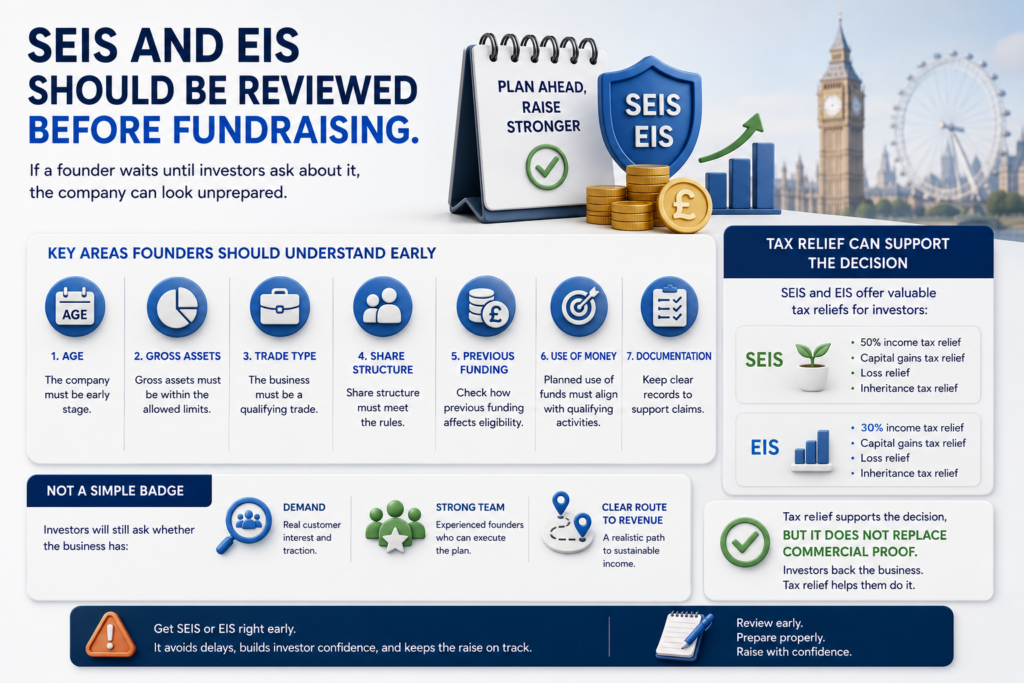
SEIS and EIS should be reviewed before the startup begins serious fundraising. If a founder waits until investors ask about it, the company can look unprepared. The business should understand its age, gross assets, trade type, share structure, previous funding, and planned use of money. These details matter because a small structural issue can slow the raise or weaken investor confidence.
Founders should also avoid treating SEIS or EIS as a simple badge. Investors will still ask whether the business has demand, a strong team, and a clear route to revenue. Tax relief supports the decision, but it does not replace commercial proof.
Advance assurance can reduce friction
SEIS or EIS advance assurance can help founders show investors that the company has already taken the tax-relief question seriously. It gives investors more comfort before they commit, especially when the startup is early and still building traction. This does not guarantee investment, but it can remove one avoidable blocker from the conversation.
That matters because early-stage fundraising often fails through small doubts. If investors like the idea but see unclear structure, weak documents, or uncertain eligibility, they can delay the decision. A prepared founder gives them fewer reasons to pause.
Use SEIS and EIS as part of the full capital story
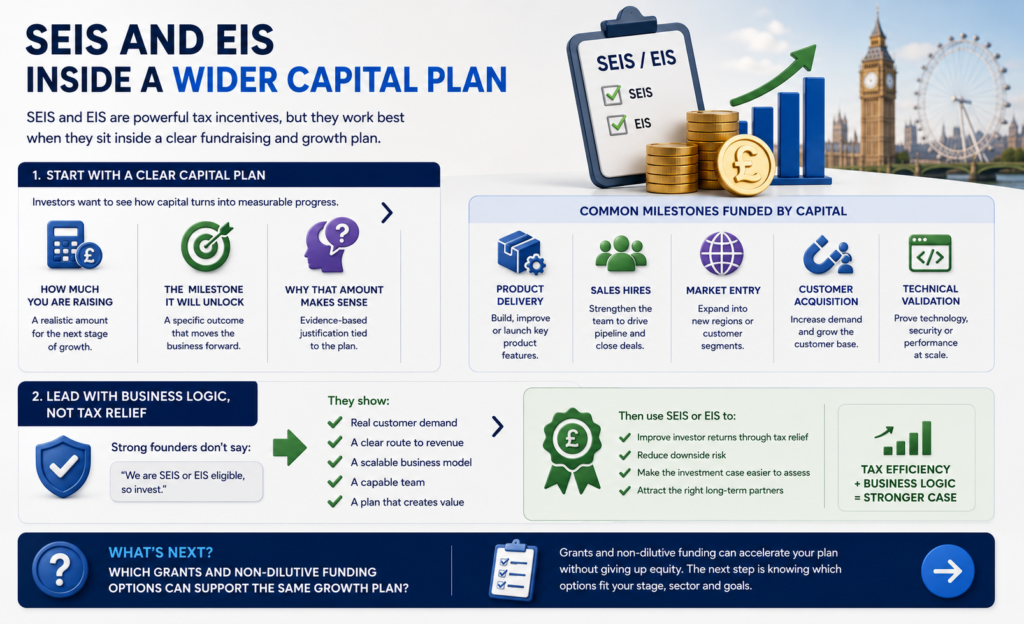
SEIS and EIS should sit inside a wider capital plan. Founders still need to explain how much money they are raising, what milestone the money will unlock, and why that amount makes sense. A clear plan might connect funding to product delivery, sales hires, market entry, customer acquisition, or technical validation.
The strongest founders do not say, “We are SEIS or EIS eligible, so invest.” They show why the company can grow, then use SEIS or EIS to make the investment case easier to assess. That is a stronger position because it combines tax efficiency with business logic. From there, the next question is which grants and non-dilutive funding options can support the same growth plan.
UK startup grants should support a clear funding plan
UK startup grants in 2026 should be treated as strategic capital, not a shortcut around investor pressure. A grant can help a founder fund research, testing, product development, or technical validation without giving away equity. However, it also brings rules, deadlines, reporting, and delivery expectations. That means founders should apply only when the grant fits the project, the timeline, and the evidence they can provide.
Match the grant to the work being funded
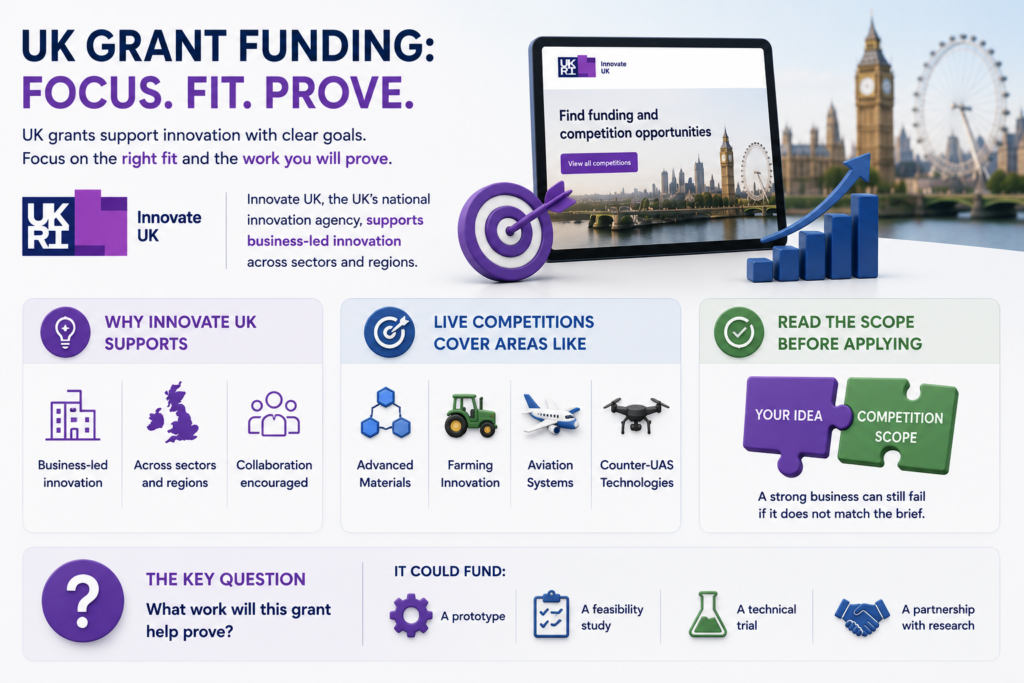
UK grant funding is often built around specific innovation aims. Innovate UK, the UK’s national innovation agency, supports business-led innovation across sectors and regions, while its live competition portal lists open funding calls for areas such as advanced materials, farming innovation, aviation systems, and counter-UAS technologies. Founders should read the scope before writing the application, because a strong business can still fail if the project does not match the competition brief.
The key question is simple: what work will this grant help prove? It could fund a prototype, a feasibility study, a technical trial, or a partnership with a research body. If the answer is vague, the application will probably be weak.
Use loans when repayment makes sense
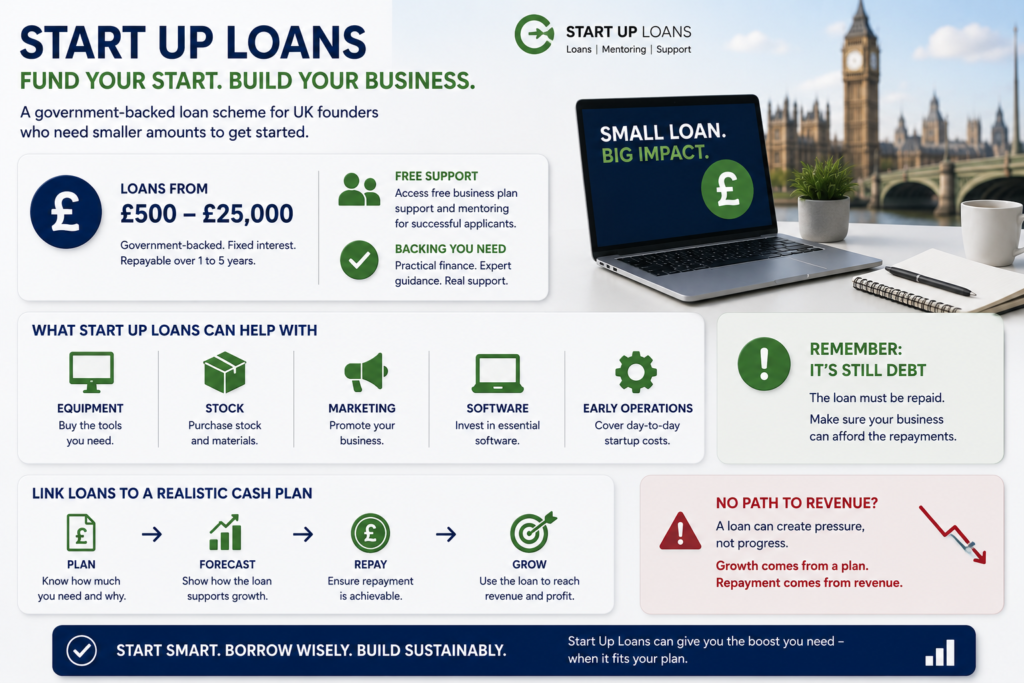
Start Up Loans can support founders who need smaller amounts for practical business costs. The UK government-backed scheme offers £500 to £25,000, with free business plan support and mentoring for successful applicants. This can fit founders who need money for equipment, stock, marketing, software, or early operations, but it is still debt. The founder must be able to repay it.
That is why loans should be linked to a realistic cash plan. If the business has no path toward revenue, a loan can create pressure rather than progress.
Show delivery ability, not only ambition
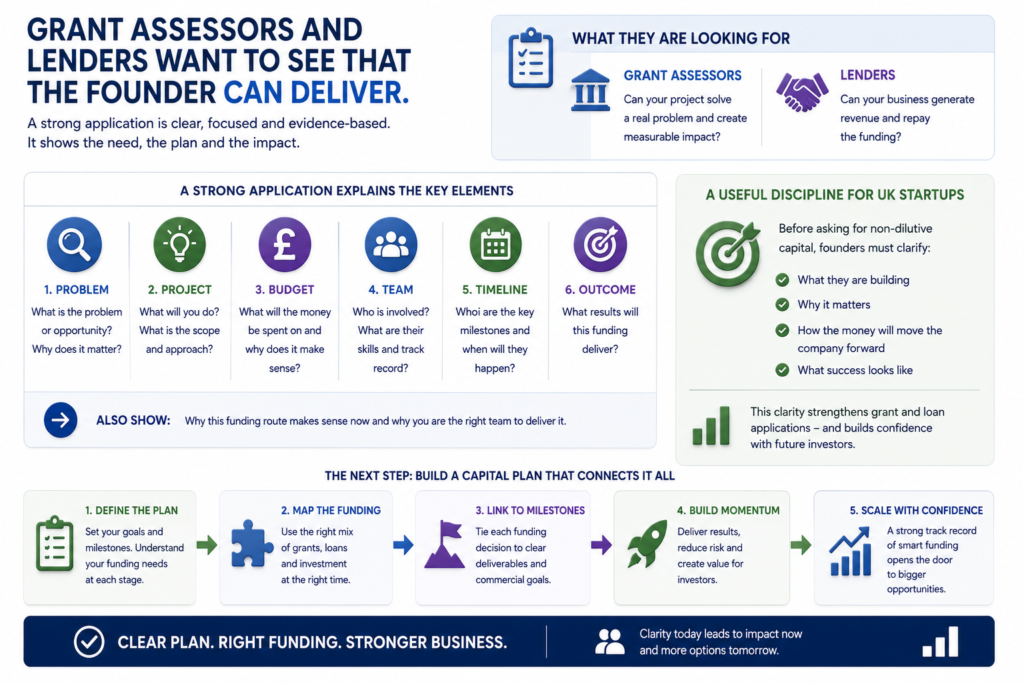
Grant assessors and lenders both want to see that the founder can deliver. A strong application will explain the problem, the project, the budget, the team, the timeline, and the expected outcome. It should also show why this funding route makes sense now.
For UK startups, this creates a useful discipline. Before asking for non-dilutive capital, founders must clarify what they are building and how the money will move the company forward. That clarity also helps when future investors review earlier funding decisions. Once that is clear, the next step is building a capital plan that connects grants, investors, and commercial milestones.
What 2026 funding data says about investor pressure
UK startup funding data in 2026 shows that capital is available, but it is moving toward companies with stronger proof. HSBC Innovation Banking and Dealroom reported that UK innovation businesses raised $7.8 billion in venture capital in Q1 2026, up 60% year over year. AI startups took $5.8 billion of that amount, while the UK raised 41% of all European venture capital in the same period.
For founders, these numbers should change the fundraising plan. A startup cannot rely on the idea alone when investors are comparing it with companies that already show technical strength, market demand, and faster growth signals. The same pressure sits behind tax-relief changes. From April 2026, EIS and VCT company limits increase, including a lifetime investment limit of £24 million and annual company limit of £10 million. That gives stronger companies more room to raise, but it also raises the standard for weaker ones. Next, founders should connect those facts with practical fundraising readiness.
UK funding signals show where founders should prepare harder
UK startup funding support in 2026 is not only coming from classic VC rounds. Founders also need to understand grants, government-backed loans, and innovation programmes because these routes can support readiness before a larger raise. That matters for startups that still need to prove technical value, customer demand, or delivery ability before speaking to bigger investors.
Grant funding is becoming more targeted
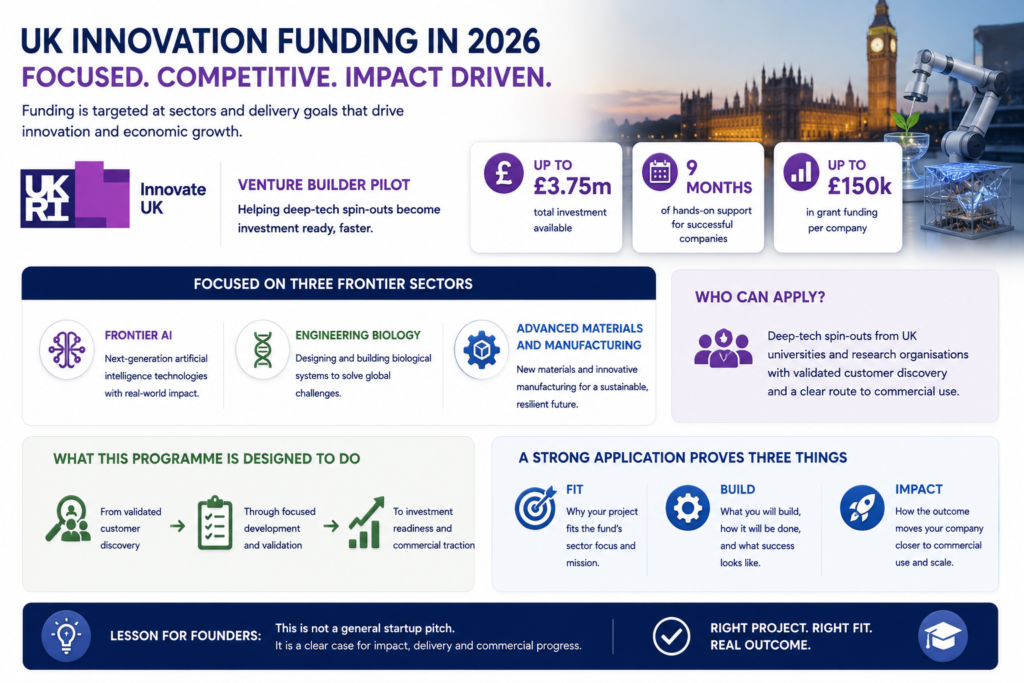
UK innovation funding in 2026 is focused on specific sectors and delivery goals. Innovate UK’s Venture Builder pilot will invest up to £3.75 million, with successful companies receiving nine months of support and up to £150,000 in grant funding. The programme focuses on Frontier AI, Engineering Biology, and Advanced Materials and Manufacturing, and is designed to move deep-tech spin-outs from validated customer discovery toward investment readiness.
This gives founders a useful lesson. A grant application should not sound like a general startup pitch. It should prove why the project fits the fund, what will be built, and how the outcome brings the company closer to commercial use.
Sector funds reward clear project fit
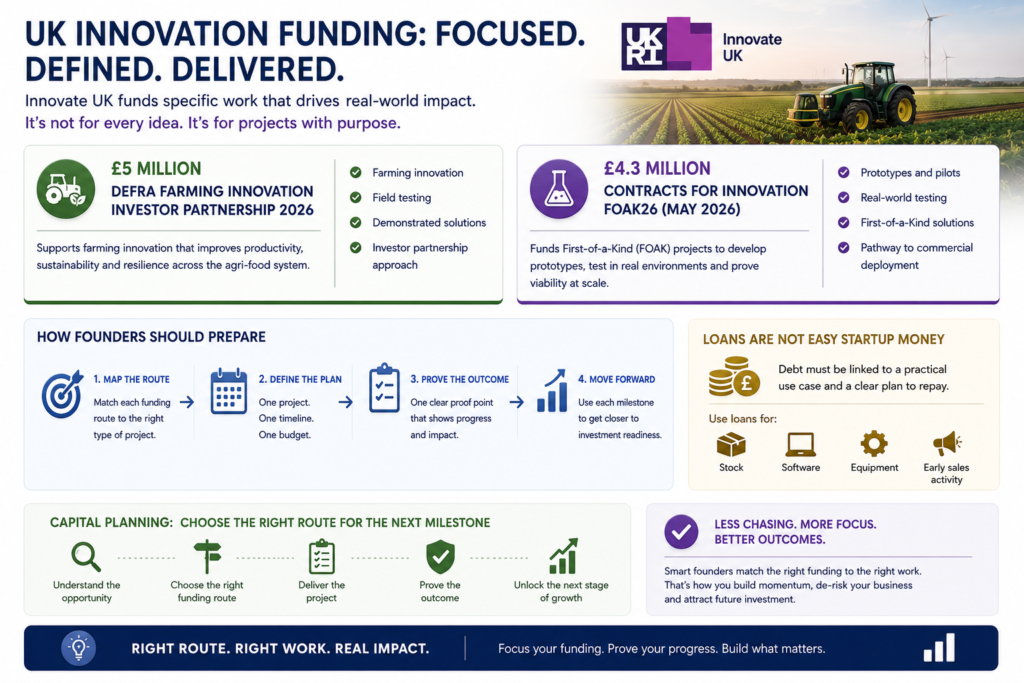
Innovate UK also listed a £5 million Defra Farming Innovation Investor Partnership 2026 fund and a £4.3 million Contracts for Innovation FOAK26 competition in May 2026. These are not broad funding pots for any founder with ambition. They support defined work, such as farming innovation, prototypes, field testing, and demonstrated solutions.
For founders, this changes the preparation process. They should map each funding route to one project, one timeline, one budget, and one expected proof point.
That means founders should not treat loans as easy startup money. They should connect debt to a practical use case, such as stock, software, equipment, or early sales activity. From there, capital planning becomes less about chasing money and more about choosing the right funding route for the next business milestone.
Loans require repayment discipline
UK Start Up Loans can also support early founders, but they should be treated carefully. British Business Bank says founders can borrow £500 to £25,000, with up to £100,000 available for one business when several partners apply. The application also requires business documents such as a business plan and cash flow forecast.
Build a capital plan around real milestones
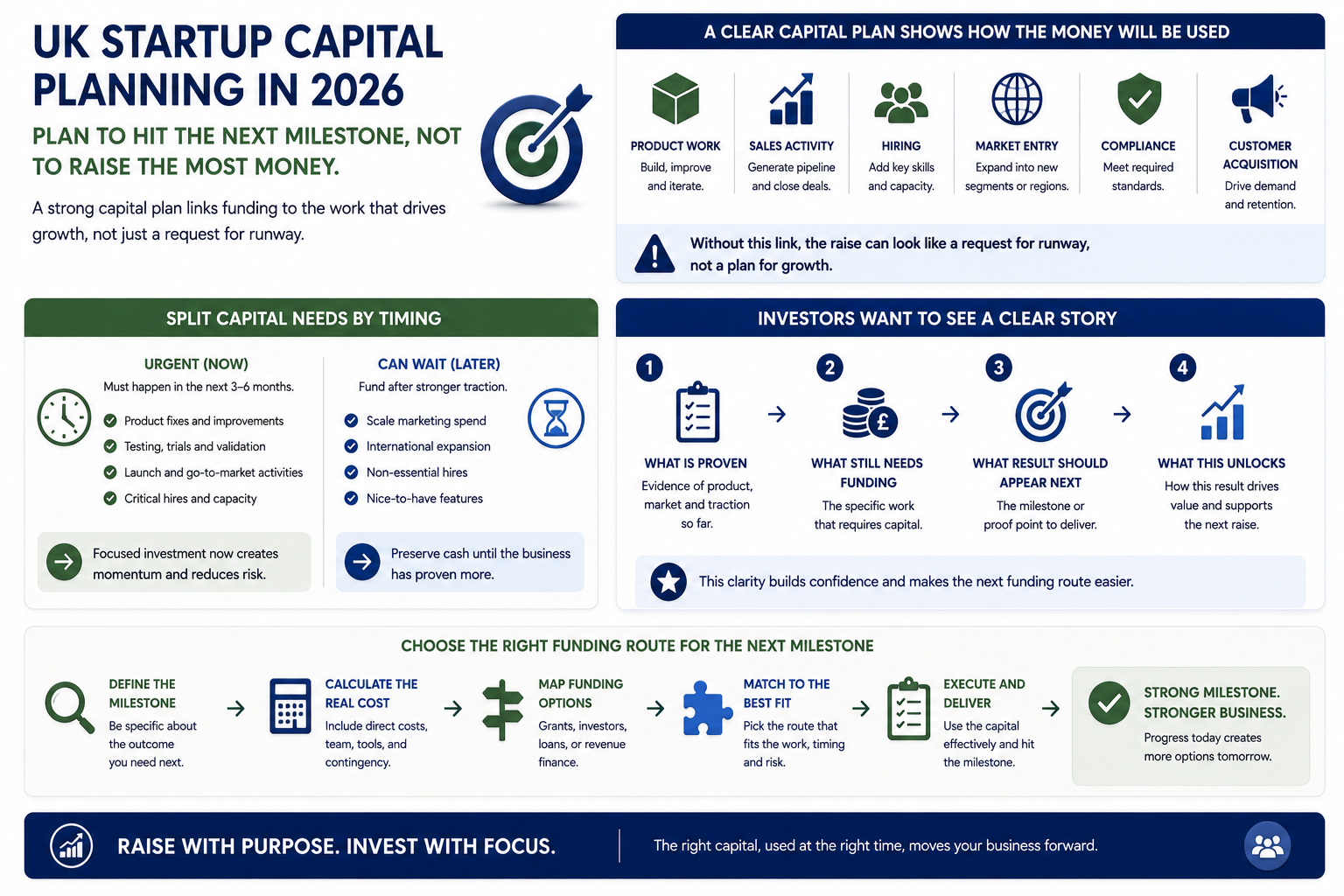
UK startup capital planning in 2026 should start with the next business milestone, not the largest amount a founder hopes to raise. A clear capital plan shows how the money will be used within the company. It should connect funding to product work, sales activity, hiring, market entry, compliance, or customer acquisition. Without that link, the raise can look like a request for runway rather than a growth plan.
Founders should also split capital needs by timing. Some costs are urgent, such as product fixes, testing, or launch work. Others can wait until stronger traction appears. This helps founders avoid asking for too much too early, which can weaken trust and create valuation pressure. A stronger plan tells investors what has been proven, what still needs funding, and what result should appear before the next raise. This clarity makes the funding route easier overall.
Investor readiness documents should support every funding claim
Investor readiness documents in 2026 should make the funding case easier to check, not harder to understand. A pitch deck alone will not carry the full story if the numbers, market notes, traction evidence, and use-of-funds plan sit in separate places or do not match. Founders should prepare a clean data room with key documents that explain the business clearly and support every major claim.
This can include financial forecasts, customer proof, product roadmap, company registration details, cap table, contracts, grant records, SEIS or EIS notes, and market research. Each document should answer a real investor concern. Can the business sell? Is the team serious? Are the assumptions realistic? Is the next milestone possible?
When documents are weak, investors spend more time finding risk than seeing opportunity. Stronger preparation makes the next step easier: shaping the story around traction and customer demand.
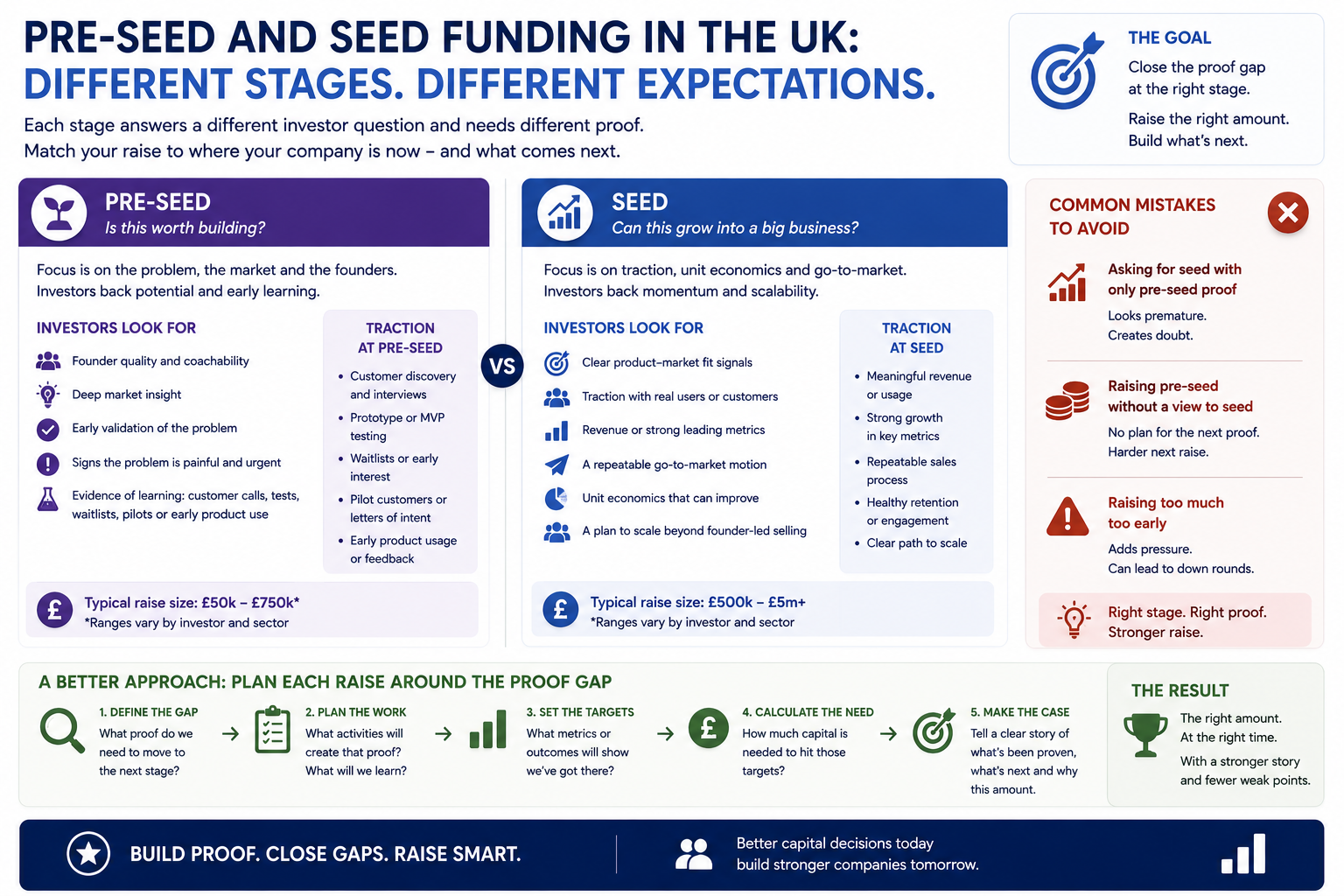
Pre-seed and seed funding should match the proof level
Pre-seed and seed funding in the UK should not be treated as the same raise with different names. At pre-seed, investors often look at founder quality, market insight, early validation, and whether the problem is painful enough to build around. The company might not have strong revenue yet, but it should still show serious learning from customer calls, tests, waitlists, pilots, or early product use.
Seed funding usually needs a stronger case. Investors will expect clearer traction, better numbers, a sharper go-to-market plan, and a reason to believe the business can grow beyond founder-led selling. A seed-stage startup should show what has already worked and what extra capital will help scale.
Founders weaken their raise when they ask for seed money with only pre-seed proof. They also create risk when they raise pre-seed without knowing what evidence they need for the next round. A better approach is to plan each raise around the proof gap. This helps founders ask for the right amount, at the right stage, with fewer weak points in the story.
Conclusion
UK startup funding in 2026 rewards founders who can show proof before they ask for capital. Investors, grant bodies, and lenders want to see more than ambition. They want a clear market, real demand, sensible numbers, and a funding plan that explains what happens after the money arrives. SEIS, EIS, grants, loans, pre-seed, and seed funding can all support growth, but only when the route matches the startup’s stage and evidence. Founders who prepare early will have stronger conversations, fewer weak points, and a clearer path toward capital. The real goal is not only to raise money, but to build a startup that deserves it.
Grow Your Startup with Us!
aboveA Startup Incubator
Turn ideas into real businesses. aboveA Startup Incubator equips founders with practical tools, mentorship, and structured guidance to develop, validate, and launch their startups with confidence. Learn to scale, avoid common mistakes, and access resources designed for real-world success.
Startup Fundraising Readiness Services
Our startup fundraising readiness services can turn scattered traction, unclear positioning, weak credibility, and early market signals into a clearer investment case. We help startups prepare the proof, story, visibility, and go-to-market logic needed before serious investor conversations begin.
aboveA Product Launch / Market Entry Program
Launch with impact. Let us guide your startups through every step of introducing a product to new markets. From market research and validation to marketing strategies and operational readiness, founders gain the knowledge and support needed for a successful international market entry.
FAQ: Startup funding UK 2026
Startup funding UK 2026 raises practical questions about investor proof, grant fit, tax relief, and capital planning before fundraising.
What makes a UK startup more fundable in 2026?
A UK startup becomes more fundable when it can show real demand, clear numbers, strong founder judgment, a practical route to market, and specific funding use.
Should UK founders raise pre-seed or seed funding first?
Founders should raise pre-seed when they need capital to prove demand. Seed funding fits better when traction, revenue signals, and repeatable sales logic already exist.
How do SEIS and EIS help UK startup fundraising?
SEIS and EIS can reduce investor risk through tax relief, but founders still need eligibility checks, clean documents, commercial proof, and a strong funding story.
Are grants a good option for UK startups?
Grants can work well when the project fits a specific funding call, has clear innovation value, and shows that the team can deliver the proposed work.
What documents should founders prepare before raising capital?
Founders should prepare a pitch deck, financial forecast, customer proof, use-of-funds plan, cap table, product roadmap, company documents, and key market research.
