
Faustas Norvaisa
A Growth & Product Expert with 10 years of experience in revenue diversification, international expansion, SEO, and digital marketing. Passionate about scaling businesses and building global brands, he empowers companies to thrive with his motto, "sharing is caring.
Japan AI search statistics 2026: SEO and AI visibility
Japan AI search statistics 2026 are key in finding a business path to success. To know the dynamic and current developments can help you learn how visibility is changing for companies that want to win attention in Japan. Nowadays, users still use Google and Yahoo every day, yet people are also checking ChatGPT, Gemini, and AI answers before they click, especially at the discoverability stage of the search.
This shift matters because search traffic is no longer only about rankings alone. It also has to do with being clear, trusted, and easy to compare. This expert guide aims to explain how AI search is affecting startups, foreign brands, B2B companies, and market-entry teams. It also intends to show where commercial clicks still happen, why proof matters, and what businesses should fix next.
Win more visibility - turn searches into leads
Table of Contents
Why AI search is becoming part of Japan’s visibility problem
According to Japan AI search statistics, in 2026, it shows a market where old and new habits now overlap. People still search through Google and Yahoo, yet many are also using AI tools to compare answers faster. Research cited by The Egg discovered that 91% of users use traditional search engines, but 31% use generative AI for daily search. Because of this, visibility is becoming harder to protect. Startups and companies are in crucial need of pages that rank, explain value clearly, and give AI systems enough proof to understand what the business does. To which not all Japanese businesses, both within and overseas, and foreign ones seem to have adapted well.
Why traditional SEO still matters in Japan
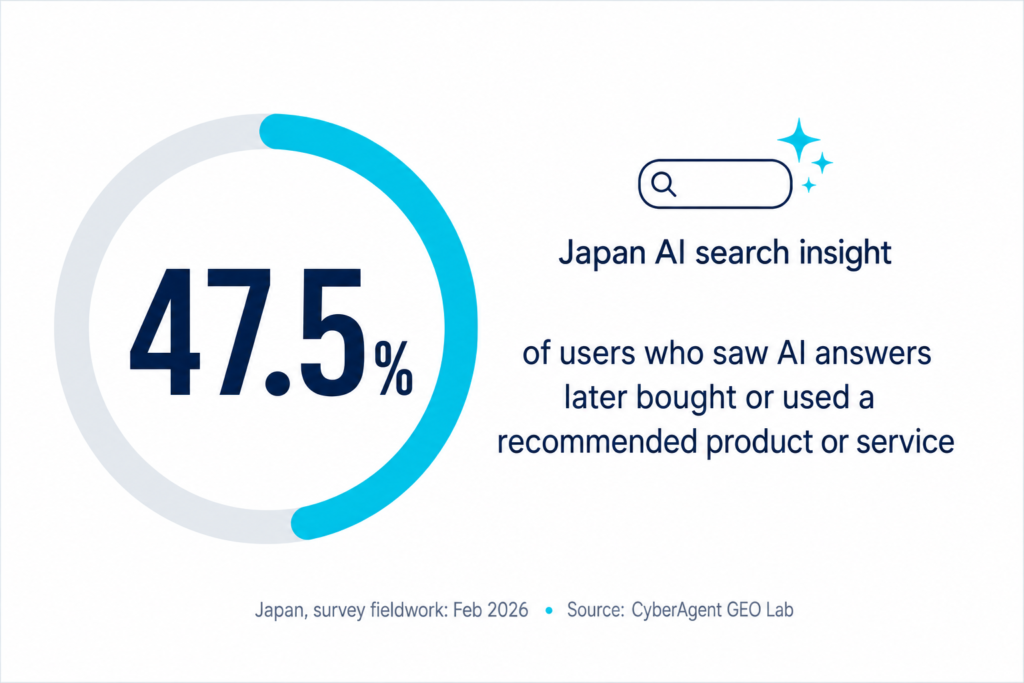
Of course, Japanese traditional SEO underpinnings still matter because search is split across several routes. Not only AI answers. In April 2026, StatCounter showed Google holding 55.39% of Japan’s search engine share, while Bing reached 36.41% and Yahoo held 6.38%. Hence, this mix means companies need pages that work across different search habits, devices, and result formats.
Secondly, a buyer checking software, agencies, clinics, hotels, or B2B tools still reads titles, snippets, reviews, location signals, and service pages before making contact. Therefore, SEO in Japan should not stop at keywords. It should improve page structure, proof, internal links, and conversion paths. Now we will move to the next section, which looks at which clicks matter most for business growth.
Why commercial clicks matter more than broad traffic in 2026
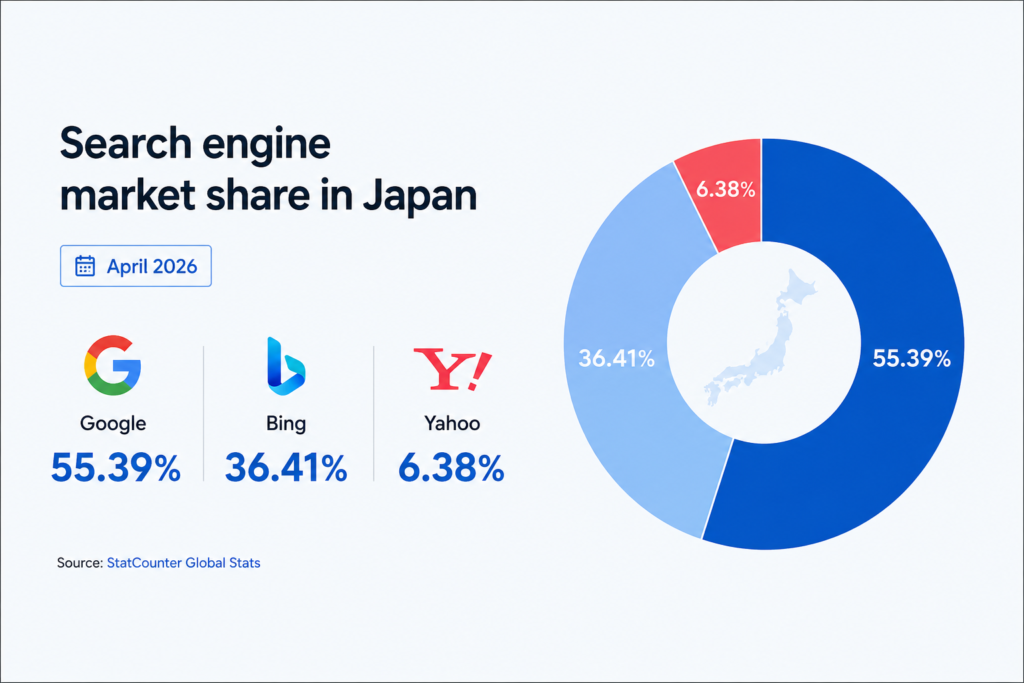
Commercial search clicks in Japan matter more than broad visits because they come from people already comparing choices. AI summaries can answer simple questions quickly, so weak informational traffic becomes less useful. However, buyer searches still carry value when users need prices, proof, contact options, case examples, or local fit. Semrush data reported by Search Engine Land showed AI Overviews moving beyond informational searches in 2025, with commercial queries rising from 8% to 18% and transactional queries from 2% to 14%. That shift makes strong service pages more important, not less important. For that purpose, the nature and use of clicks and significance may differ. To make it clear, let’s explore the table below:
| Click type | What the user is really doing | What the page must show | Business value |
|---|---|---|---|
| Informational click | Learning a topic, trend, rule, or market problem | Clear answer, recent data, simple explanation, useful next step | Builds early trust, but rarely converts fast |
| Commercial click | Comparing providers, tools, agencies, prices, reviews, or market-entry options | Service proof, pricing logic, case examples, testimonials, FAQs, and clear contact routes | Strong lead value because the user is already judging options |
| Transactional click | Ready to book, request a quote, contact sales, register, or buy | Short forms, visible CTA, fast page speed, trust badges, payment or booking details | Highest value because the user is close to action |
| Brand-check click | Searching a company name before contacting or replying | Updated website, founder profiles, third-party mentions, reviews, and consistent messaging | Protects trust when the buyer is almost ready |
| Local-intent click | Looking for a nearby service, office, hotel, clinic, store, or partner | Maps, hours, location pages, reviews, photos, and direct contact buttons | Converts well when the business removes friction quickly |
As you probably see, Japan SEO should focus on searchers who are closer to action. A startup, hotel, clinic, SaaS company, or foreign brand needs pages that answer doubts before the user leaves. Clear offers, comparison content, reviews, FAQs, and contact buttons help protect valuable clicks. Next, we shall look at where companies lose visibility before buyers even compare them.
Where companies lose visibility before buyers compare them
Japan’s online visibility gaps occur before a buyer reaches a contact form. That’s common a lot nowadays. A company can have a useful product, yet still lose attention because its public information is thin, scattered, or hard to verify. This is especially common for startups, foreign brands, B2B service firms, hotels, clinics, and local platforms entering a competitive Japanese search space. First, weak titles and unclear service pages make the offer difficult to understand. Then, missing proof creates doubt. A visitor may look for case examples, founder details, customer signals, pricing logic, reviews, or partner mentions and find very little. After that, AI tools also have less context to summarize the business accurately.
The problem grows when English pages, Japanese pages, social profiles, and directory listings say different things. Buyers might start comparing risk, not only value. Search visibility can then become a trust issue. To fix this, companies must have clearer page structure, stronger proof near decision points, and consistent signals across search, AI, and brand checks. The next section explains why this matters for foreign brands entering Japan before serious sales conversations even begin.
Why foreign brands struggle to enter Japan through search
Japan market entry search is difficult because foreign brands are not only fighting for rankings. They are fighting for trust before a buyer speaks to them. A company can have strong results in the US, Europe, or Southeast Asia, yet still look unclear in Japan if its pages do not match local search habits. Buyers often want proof, local context, clear service details, and a reason to believe the company understands the market. Without that layer, even good traffic can turn into weak enquiries.
Search intent changes by market
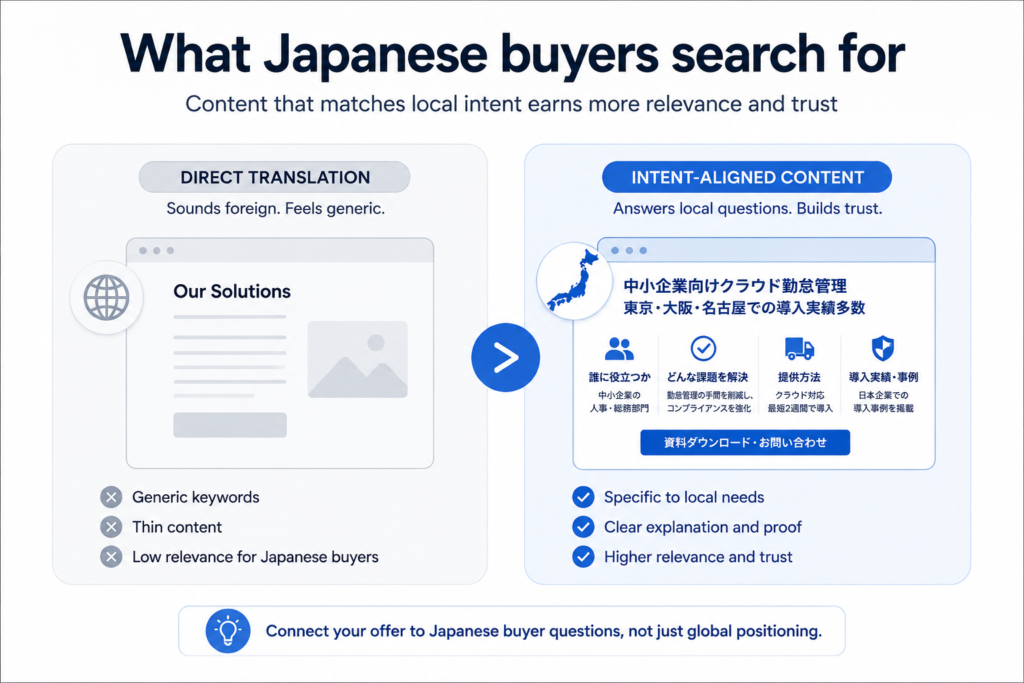
Japan’s search intent does not always follow the same pattern as English-speaking markets. A foreign brand might build pages around global keywords, but Japanese buyers often search with more specific needs. They compare local use cases, service areas, language support, industry fit, and risk. For example, a B2B company entering Japan needs more than one translated homepage. It needs pages that explain who the service helps, what problem it solves, how delivery works, and what proof supports the offer.
Because of this, direct translation often creates thin content. The words are local, but the message still sounds foreign. Stronger search pages should connect the offer with Japanese buyer questions, not only repeat global positioning.
Proof matters before contact
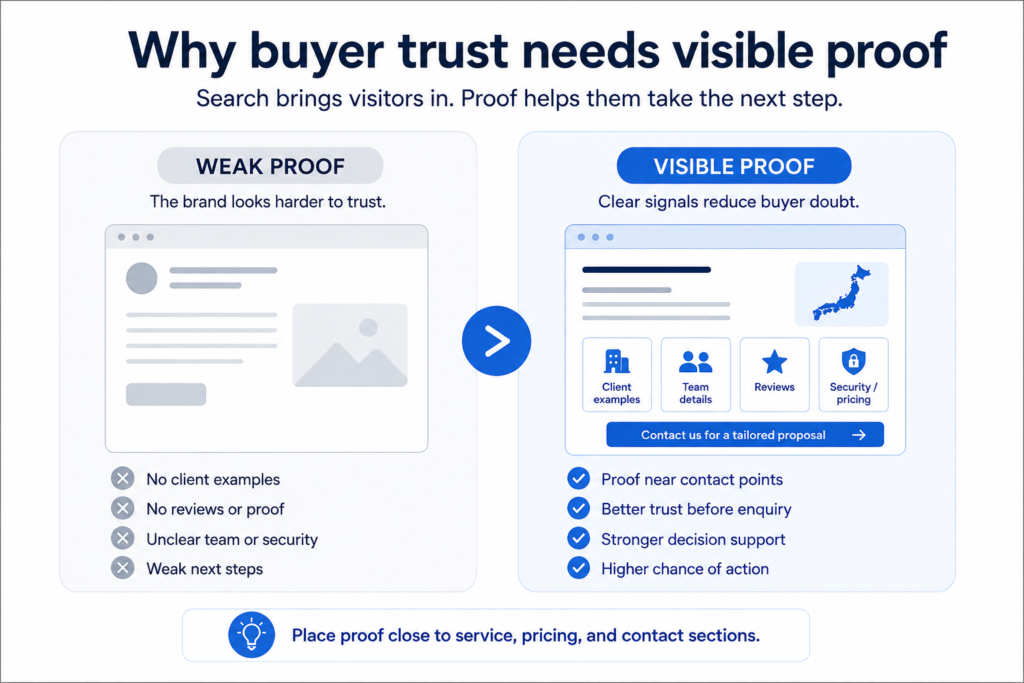
Japanese buyer trust also depends on visible proof. A user checking a foreign software company, agency, manufacturer, clinic, hotel group, or consulting partner will often look for signals before sending a message. They want to see client examples, market knowledge, reviews, team details, security notes, pricing logic, partner mentions, or clear next steps.
If those signals are missing, the brand can look risky. This happens even when the company is real and capable. Search brings the visitor in, but weak proof sends the visitor back out. For this reason, credible content should sit close to contact buttons, service pages, pricing pages, and comparison sections.
AI search adds another pressure
AI search visibility makes the problem more serious. AI tools need clear, structured, and consistent information to explain what a company does. If a brand has scattered pages, unclear descriptions, weak third-party mentions, or mixed messages across platforms, AI systems can skip it or summarize it poorly.
That affects startups and foreign brands that depend on first impressions. A buyer might ask an AI tool for software options, Japan market-entry partners, agencies, tourism platforms, or B2B suppliers. The companies with clearer public signals have a better chance of being understood.
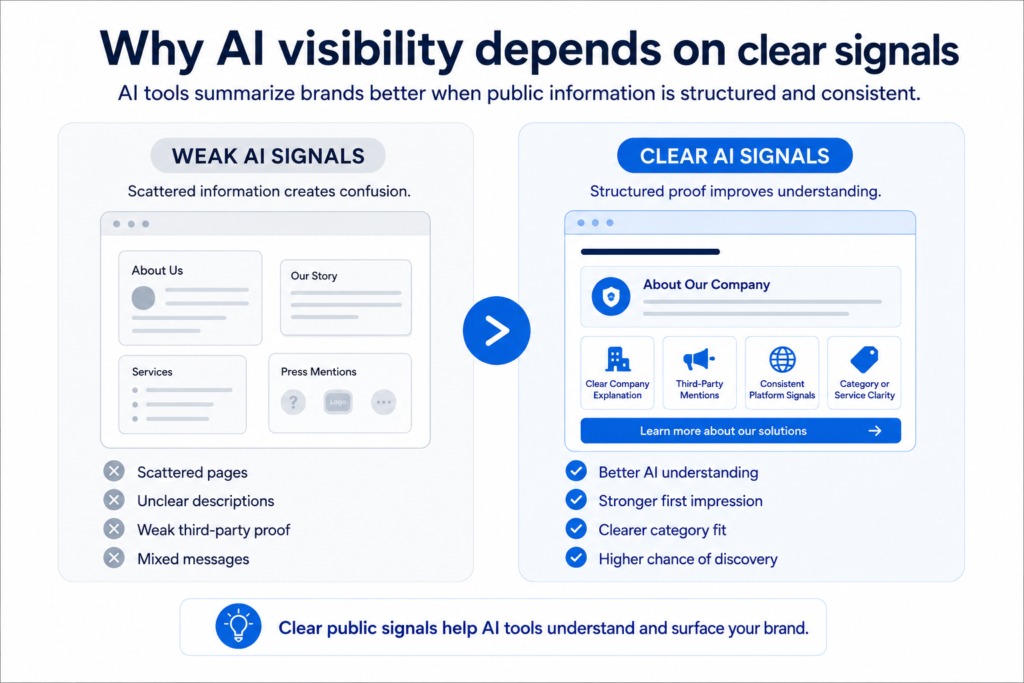
Therefore, Japan market entry now needs more than translation. It needs a search strategy, localized proof, a strong page structure, and content that helps buyers compare the business with less doubt.
Why Japanese startups struggle to become visible outside Japan in 2026
Japanese startup visibility often breaks when strong technology leaves its local context. Japan has serious global ambition, but international buyers, investors, and partners still need a simple way to understand the company. JETRO says it supports 700+ Japanese startups each year through 15 acceleration programs, plus 3,000+ through mentoring, which shows that overseas growth is already a practical need.
Strong technology still needs market language
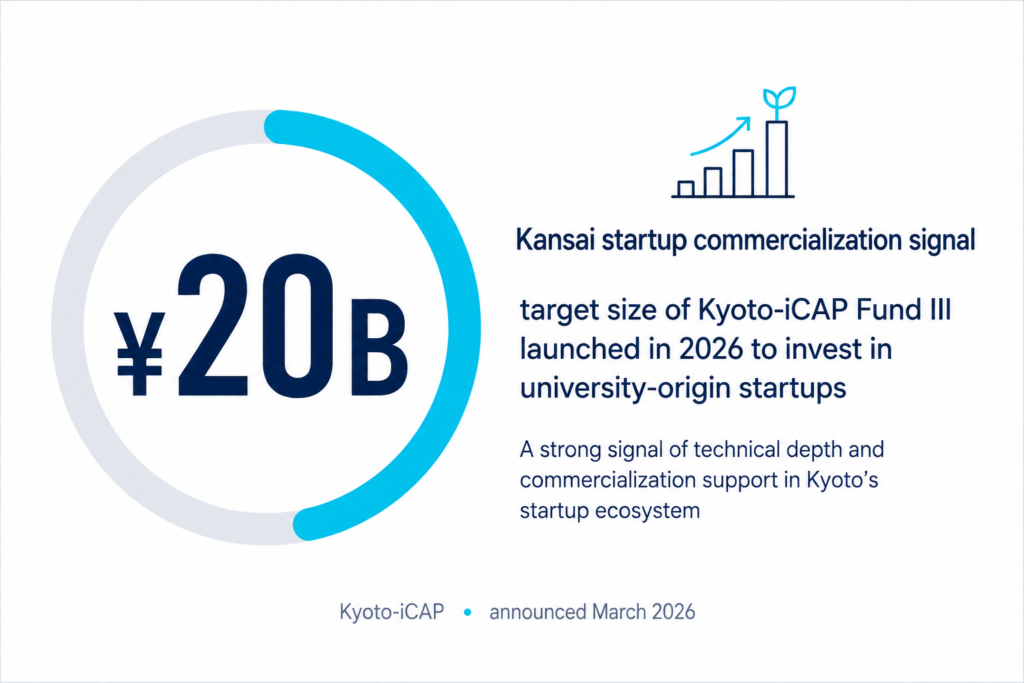
Japanese startup positioning can weaken when the message stays too close to the lab, product, patent, or platform. In January 2026, JETRO reinvited five overseas VC firms to Kansai and said the program gave startups practical advice on pitching to overseas investors and international expansion. The same report noted that overseas VCs evaluated Kansai’s patents, deep tech base, Kyoto University, and Kobe Biomedical Innovation Cluster. That is a useful signal: Japan has technical depth, while global capital still needs a clearer commercial story.
English signals affect global discovery
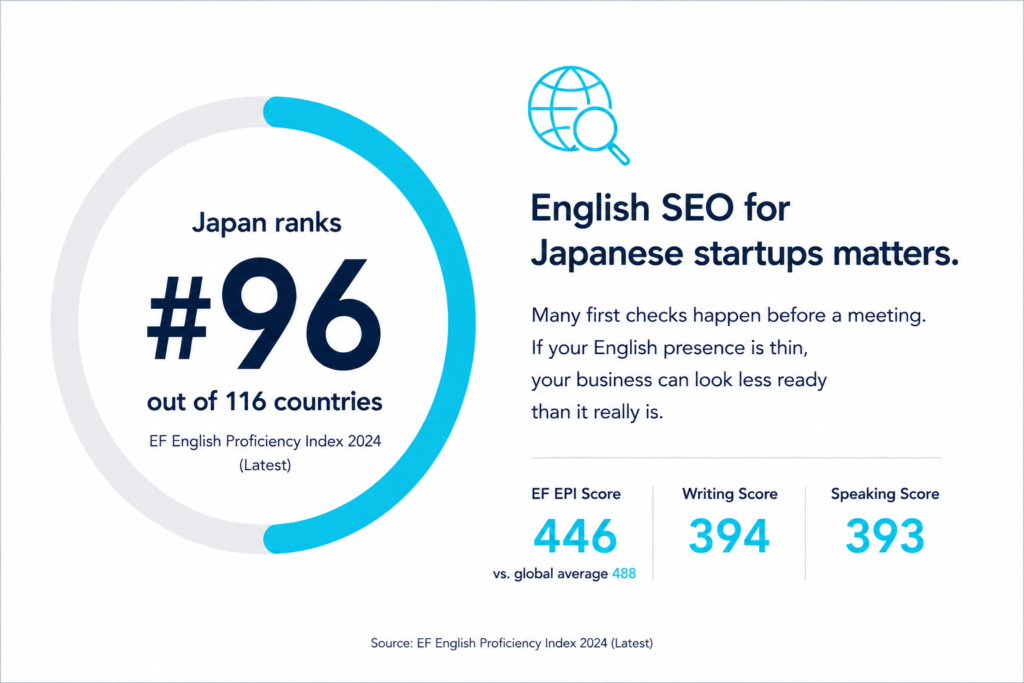
English SEO for Japanese startups matters because many first checks happen before a meeting. A foreign buyer can search the company name, founder, product category, security details, customer proof, or partner mentions. If the English layer is thin, the business can look less ready than it is. EF’s latest English Proficiency Index ranks Japan #96, with a score of 446 against a global average of 488. Japan’s writing score is 394, and its speaking score is 393, which helps explain why English pages, pitch text, and founder visibility often need more care.
Proof must travel across markets
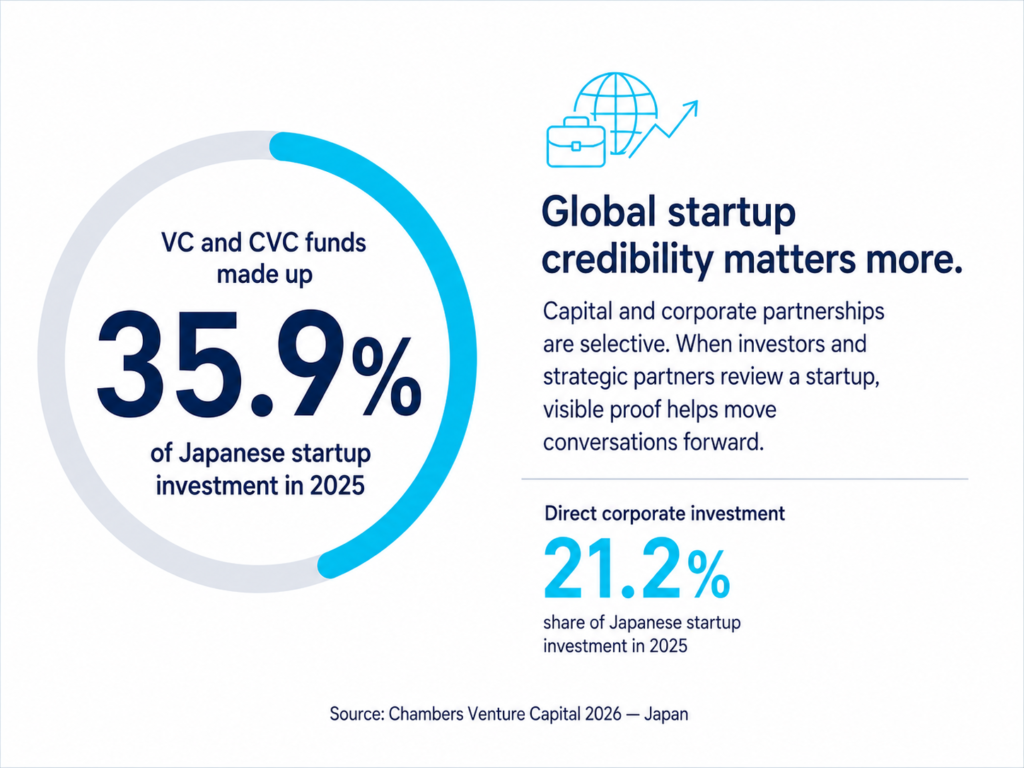
Global startup credibility becomes more important when capital and corporate partnerships are selective. Chambers’ 2026 Japan venture capital guide says VC and CVC funds made up 35.9% of Japanese startup investment amounts in 2025, while direct corporate investment reached 21.2%. That means many growth conversations involve investors, corporates, or strategic partners that need proof before they move forward.
Therefore, Japanese startups need translated pages plus clear English positioning, useful sector pages, founder proof, customer evidence, partner signals, and content that explains business value without hiding the technical strength. The next section should show what companies need to fix before spending more on Japan SEO, AI visibility, or global growth campaigns.
What companies should fix before investing more in Japan SEO
Japan SEO strategy should start with the public layer that buyers, search engines, and AI tools already read. More content can help, but only when the foundation is clear. If the website has weak service pages, missing proof, poor internal links, or unclear contact paths, extra traffic will not solve the problem. It will only expose the same gaps to more people. Before spending more on campaigns, companies need to fix the signals that shape trust.
Make the offer easy to understand
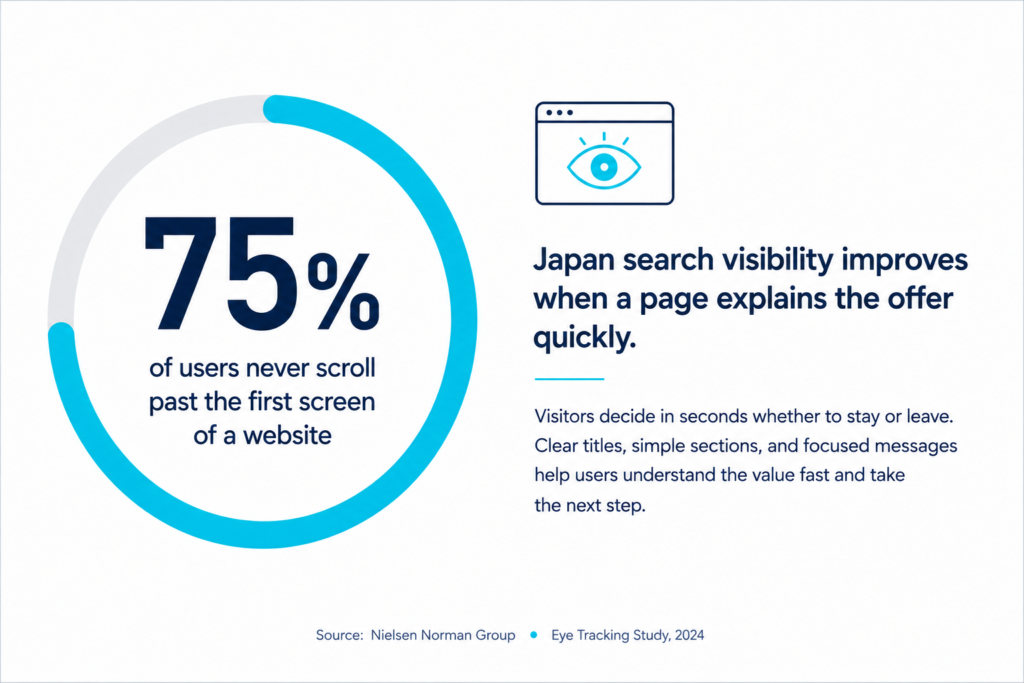
Japan search visibility improves when a page explains the offer quickly. A visitor should understand who the company helps, what problem it solves, where it operates, and what action comes next. This is especially important for startups, SaaS companies, agencies, clinics, hotels, and foreign brands entering Japan. If the first screen is vague, users leave before reading the proof. Clear titles, simple page sections, and focused service descriptions reduce that risk.
Place proof near decisions
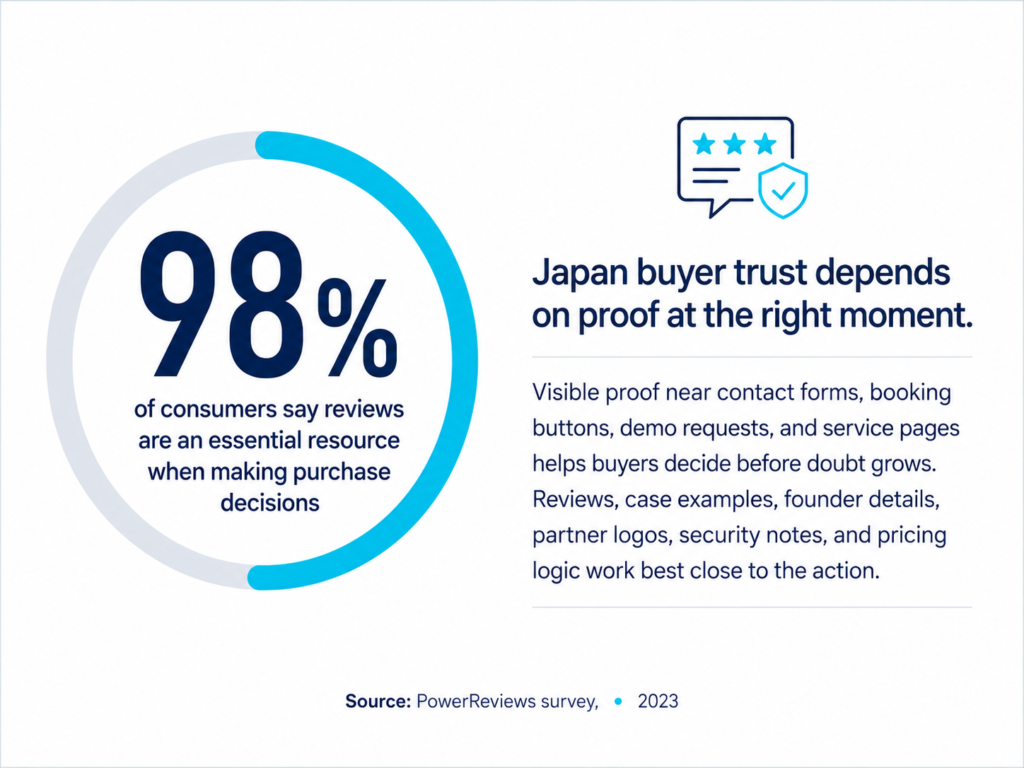
Japan buyer trust depends on proof that appears at the right moment. Reviews, customer types, case examples, founder details, partner logos, security notes, pricing logic, and process explanations should sit near contact forms, booking buttons, demo requests, and service pages. Proof hidden in a separate page works less effectively. Buyers need reassurance while they are deciding, not after doubt has already grown.
Connect pages into a stronger journey
Japan’s content strategy also needs better movement between pages. A user might start with a blog post, then check a service page, then search the brand name, then compare reviews. Each step should guide the next one. Internal links, FAQs, comparison pages, location pages, and clear CTAs help keep that journey alive. At the same time, consistent wording across English and Japanese pages helps search engines and AI systems understand the company better.
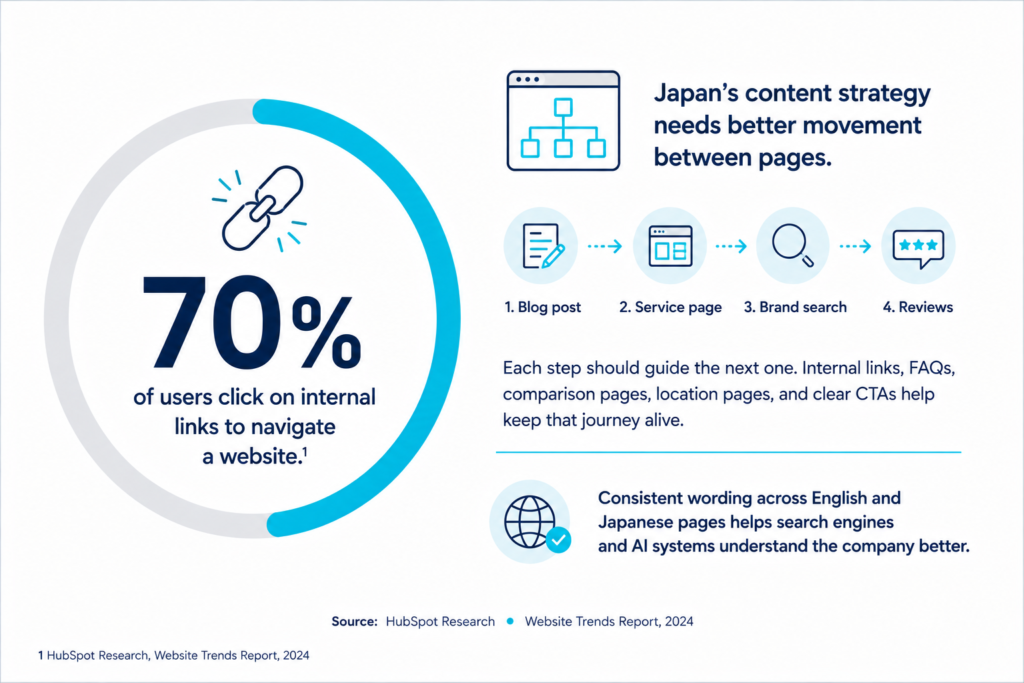
Fixing these basics makes later SEO work stronger. It also helps businesses turn visibility into leads, not only visits. It supports stronger sales conversations from day one. The next section can explain how AI visibility changes the way companies should structure content for Japan.
How AI visibility changes content structure for Japan
Japan AI visibility now depends on clearer content because AI use is moving into real business work. Teikoku Databank’s 2026 survey found that 34.5% of Japanese companies already use generative AI, while 86.7% of users say it has helped their work. Yet 50.4% still worry about information accuracy, which means vague content becomes a bigger risk.
A stronger page should show:
- Who the company helps, by industry or buyer type
- What problem does the offer solve in Japan
- Which proof supports the claim
- How the service, product, or process works
- What the user should do next
Japan’s AI content structure also matters because investment is rising fast. IDC expects Japan’s AI infrastructure spending to pass $5.5 billion in 2026, up at least 18% year over year. Fortune Business Insights also projects Japan’s generative AI market to be $9.43 billion in 2026. Because of this, companies need pages that are easy to read, verify, and summarize. The next section should explain which content types support search and AI-led discovery best.
Which content types support search and AI-led discovery best
Japan search content works best when it helps users compare, verify, and act. DataReportal’s 2026 Japan report says the country had 107 million internet users at the end of 2025, with online penetration at 87%. It also counted 99 million social media user identities, equal to 80.5% of the population. That means company proof is checked across websites, social platforms, search results, and AI tools before contact happens.
Research pages and statistics pages
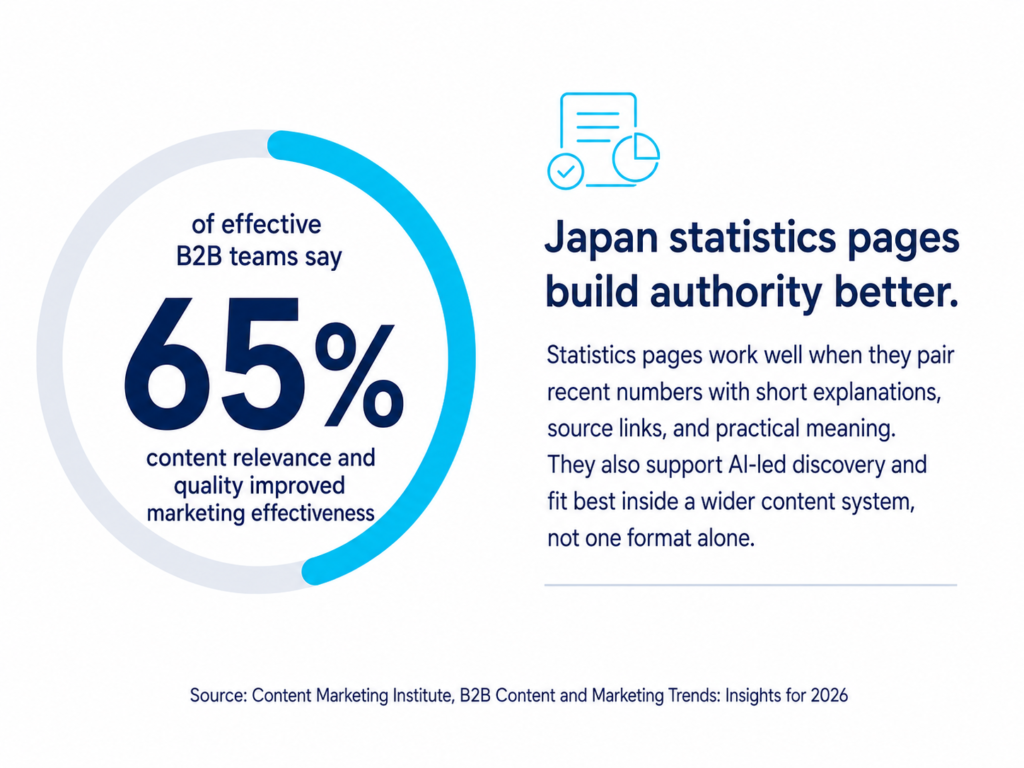
Japan’s statistics pages are useful because they answer broad searches while building authority. A strong statistics page should include recent numbers, short explanations, source links, and practical meaning for startups, foreign brands, or B2B teams. These pages work well for AI-led discovery because structured data, clear headings, and direct answers are easier to summarize.
Case studies and proof pages
Japan buyer proof matters when users move from learning to comparing. Content Marketing Institute’s 2026 B2B research found that marketers planned to invest most in content marketing formats such as blogs, white papers, and similar assets at 28%, followed by experiential or event marketing at 23%, webinars at 22%, and video at 15%. This supports a mixed content system, not one format alone.
Comparison and service pages
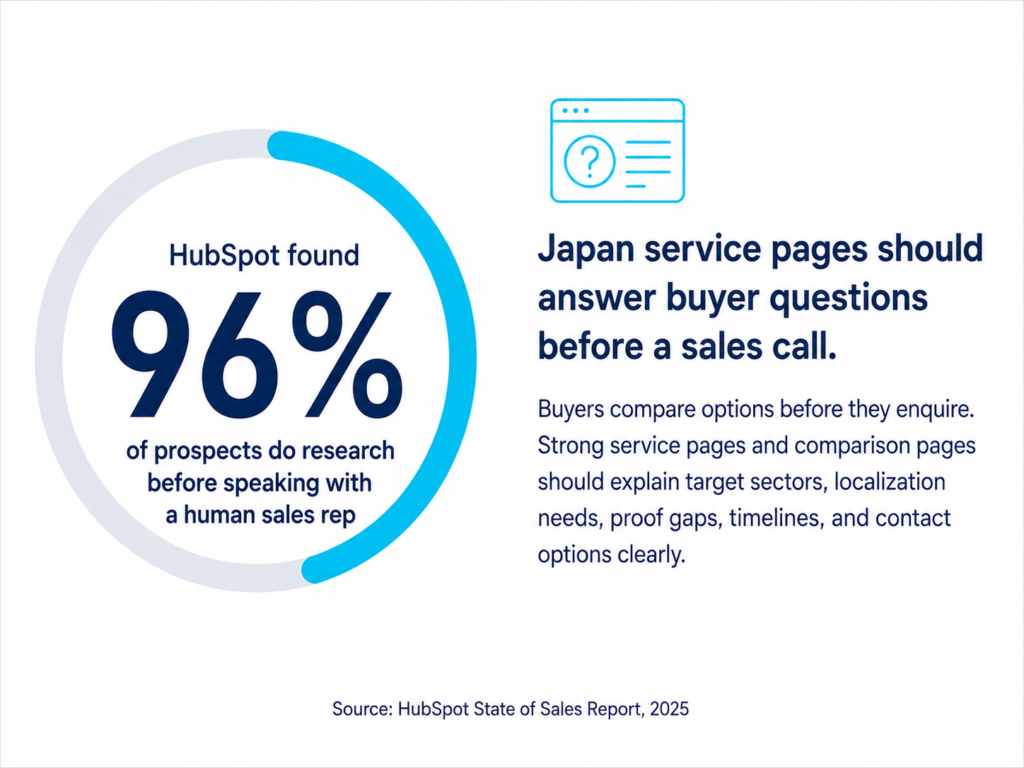
Japan service pages should answer buyer questions before a sales call. For example, a Japan market-entry page can explain target sectors, local search behavior, localization needs, proof gaps, timelines, and contact options. A comparison page can show why one solution, market, or growth path fits better than another.
These content types work together. Statistics attract early research. Case studies reduce doubt. Service pages convert intent into enquiries. Comparison pages help buyers make sense of options. Next, we will explain how companies can measure whether Japan SEO and AI visibility are creating business value, not only traffic.
How to measure SEO and AI visibility Today
In fact, SEO measurement should focus on business value, not traffic alone. A page can attract visitors and still fail if people do not contact, book, request a quote, or remember the brand. This matters because Japan’s digital competition is growing. Dentsu reported that total ad spend in Japan reached ¥8.0623 trillion in 2025, while internet advertising made up 50.2% of all ad spending for the first time. It also expects internet advertising media spending to reach ¥3.584 trillion in 2026.
Useful metrics include organic enquiries, assisted conversions, branded searches, demo requests, booking clicks, form starts, email clicks, and pages that appear in AI-led searches. These signals show whether content is helping buyers move forward. Rankings still matter, but they should support revenue paths. In the following chapter, we will see how to turn these insights into a practical Japan growth plan.
How to turn Japan visibility into a growth plan
Japan growth plan should connect search visibility with real buyer movement. After measuring rankings, branded searches, enquiries, and AI-led mentions, companies need to decide what to fix first. Some businesses need stronger service pages. Others need proof, localization, founder visibility, or clearer contact routes. The goal is not to publish more content without direction. The goal is to remove the gaps that stop users from trusting the company.
| Growth area | What to check | What to improve |
|---|---|---|
| Search visibility | Which pages bring qualified users | Titles, headings, internal links, keyword focus |
| Trust signals | What buyers see before contact | Reviews, case studies, partner proof, team details |
| AI visibility | How clearly tools understand the brand | Structured pages, consistent descriptions, source-backed content |
| Conversion path | Where users stop before action | CTAs, forms, booking buttons, contact options |
| Market fit | Whether content matches Japan demand | Local examples, buyer questions, industry pages |
This gives teams a clearer order of action. First, fix confusing pages. Then, strengthen the proof near decision points. After that, build content around commercial intent, not broad topics alone. That turns Japan SEO from a traffic project into a growth system.
Common mistakes companies make with Japan SEO and AI visibility
Also, Japan SEO mistakes often start with direct translation. A page can look local, yet still miss the questions Japanese buyers ask before they trust a company. Some teams also chase broad traffic without building service pages, proof blocks, or clear contact paths. That creates visits, not leads. Another mistake is treating AI visibility as a separate project. AI tools read the same weak public signals that search users see, so unclear descriptions, thin profiles, and mixed messages reduce trust twice.
Companies also hide proof too far from action points. Reviews, case examples, partner mentions, pricing logic, and founder details should support the moment before contact. Finally, many brands ignore branded searches. When users search the company name, they should find consistent pages, updated profiles, and clear proof. The next section can explain where support fits into this work during market entry planning.
Where aboveA Can Help With Japan growth
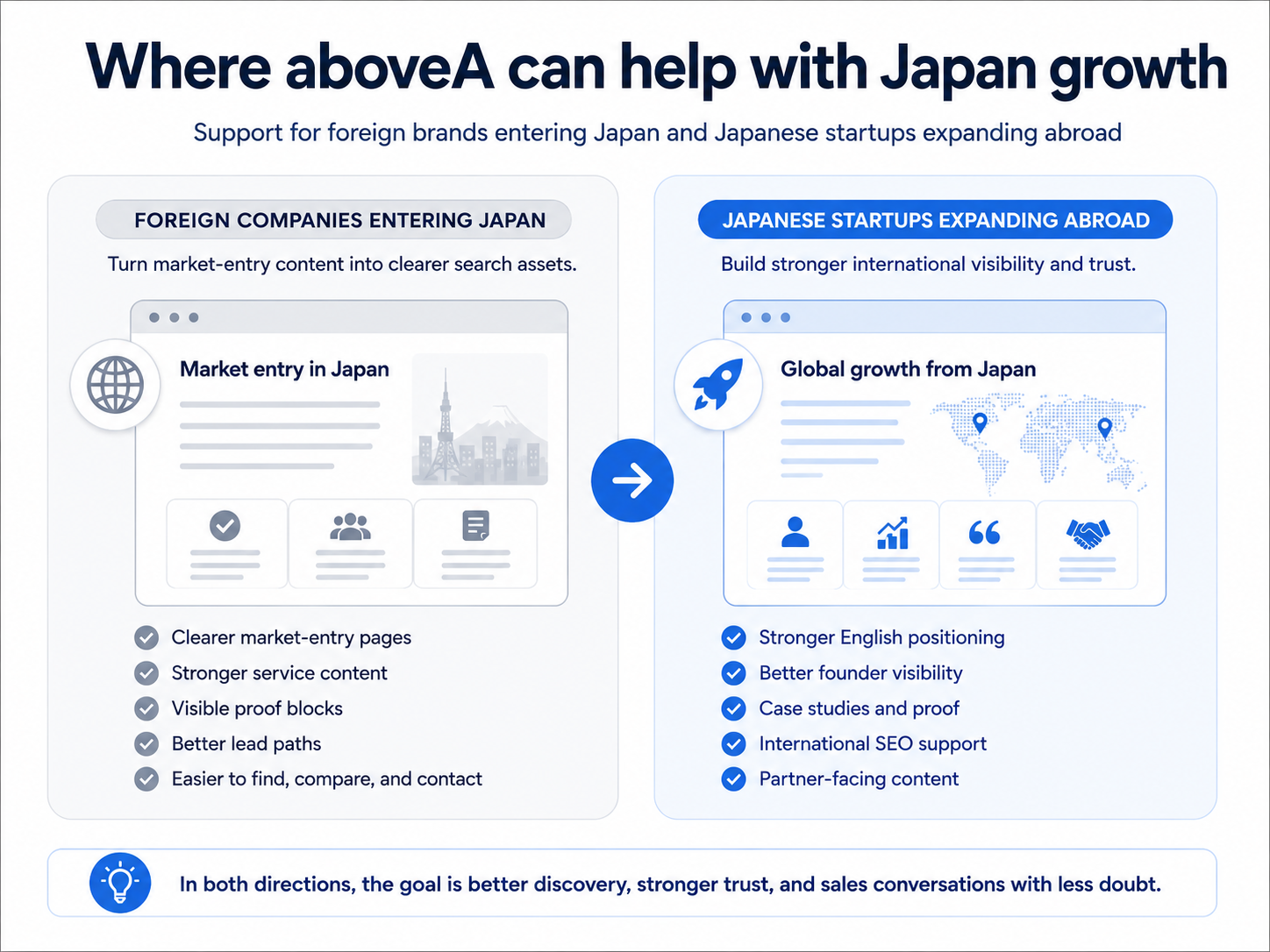
Moreover, Japan’s growth support from aboveA works for both directions: foreign companies entering Japan and Japanese startups expanding abroad. For foreign brands, we help turn market-entry pages, service content, proof blocks, and lead paths into clearer search assets. That makes the company easier to find, compare, and contact in Japan. For Japanese startups, we support stronger English positioning, founder visibility, case studies, international SEO, and partner-facing content. In both cases, the goal is not traffic alone. It is better discovery, stronger trust, and sales conversations that start with less doubt. This helps visibility become business growth.
Takeaway
As seen from our Japan AI search statistics 2026 overview, visibility now depends on search rankings, AI clarity, and trust proof working together. Foreign companies entering Japan need localized pages that answer buyer questions, not simple translations. Japanese startups expanding abroad need stronger English positioning, founder proof, and international discovery paths. The clear takeaway is that traffic only matters when it supports contact, comparison, and confidence. Companies that fix content structure, proof, and conversion paths will turn visibility into better market growth outcomes.
Japan AI search statistics 2026 FAQ
Japan AI search statistics 2026 help explain how search, AI answers, and proof now shape visibility across Japan growth plans.
What do Japan AI search statistics 2026 show for companies?
They show that companies need visibility across search engines, AI answers, and brand checks, because buyers now compare proof before contacting a provider in Japan.
Is SEO still important in Japan?
Yes. SEO still matters because buyers use search to compare services, reviews, locations, pricing, and company proof before making contact or booking a sales call.
Why do foreign brands struggle with Japan visibility?
Foreign brands often struggle because translated pages miss local search intent, buyer doubts, service details, and proof signals needed to build trust in Japan faster.
How can Japanese startups improve global visibility?
Japanese startups can improve global visibility with clearer English pages, founder profiles, case studies, sector content, partner proof, and stronger international SEO structure.
What should companies fix before investing more in Japan SEO?
Companies should fix unclear service pages, weak proof, poor internal links, slow contact paths, mixed messaging, and content that attracts traffic without leads.
