
Faustas Norvaisa
A Growth & Product Expert with 9 years of experience in revenue diversification, international expansion, SEO, and digital marketing. Passionate about scaling businesses and building global brands, he empowers companies to thrive with his motto, "sharing is caring.
Startup funding in Thailand: Become investor-ready in 2026
Startup funding in Thailand is growing, but investors are still careful. This guide aims to show Thai startups and foreign founders what to prepare before asking for capital. Also, it will tap into what investors check, why local proof matters, and how pre-seed, seed, or Series A companies can build trust.
We also cover here common weak spots: unclear traction, thin market research, weak pitch materials, and messy growth plans. By the end, you will know how to make your company easier to understand, believe, and fund in Thailand, without sounding bigger than it is.
Build a robust startup - expert guide available one click away!
Table of Contents
Startup funding in Thailand is active, but selective
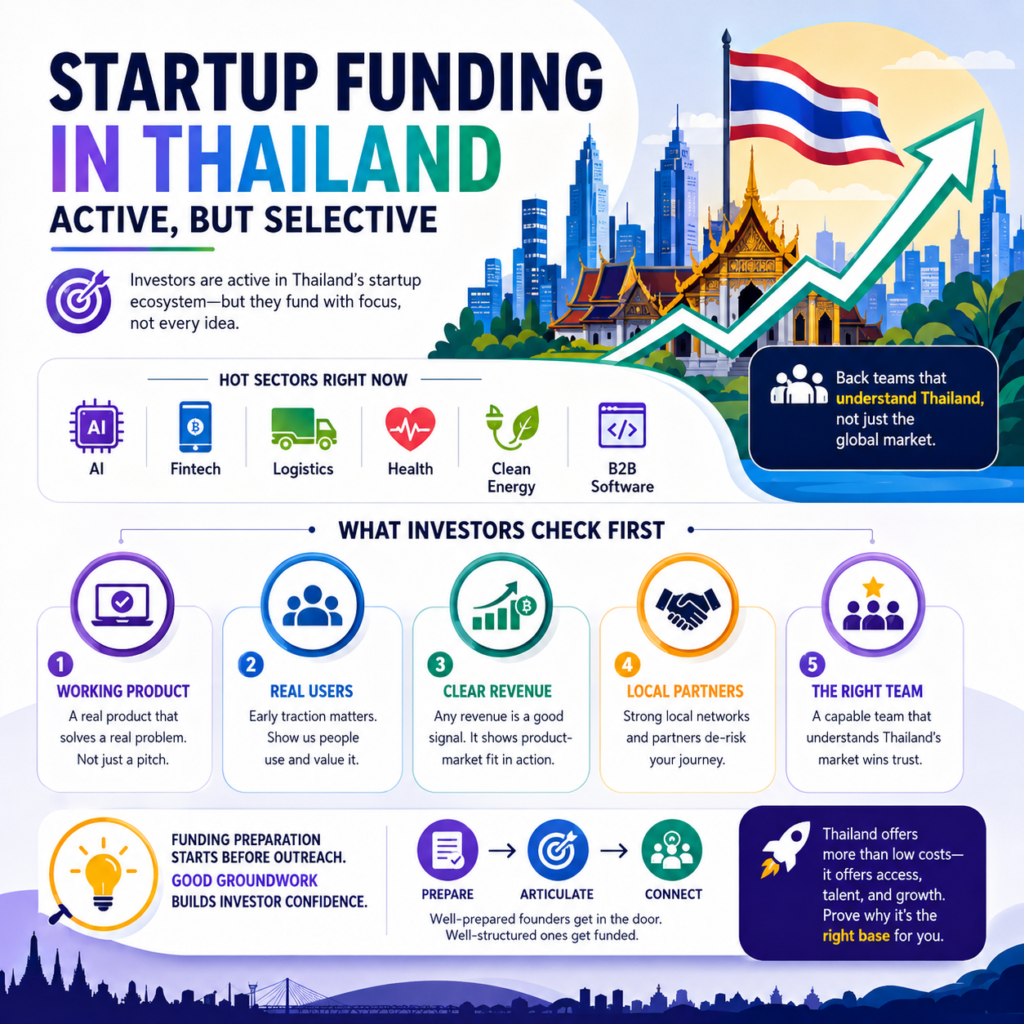
Startup funding in Thailand is active, but selective. Lately, this year, a lot of founders are building in AI, fintech, logistics, health, clean energy, and B2B software businesses. Despite growing innovation and interest in offering new solutions, investors are not rushing into every strong idea as many might come to think. Mostly because what they need is well-structured and documented proof.
That proof can look simple: a working product, real users, clear revenue, and local partners. Especially, a team that understands Thailand, not only the global market. For foreign startups, this also means showing why Thailand is the right base, not just a cheap location. Because of this, funding preparation starts before outreach, and demands a more thorough preparation and good groundwork to be done. Next, we will look at what investors usually check first.
What investors look for before funding Thai startups
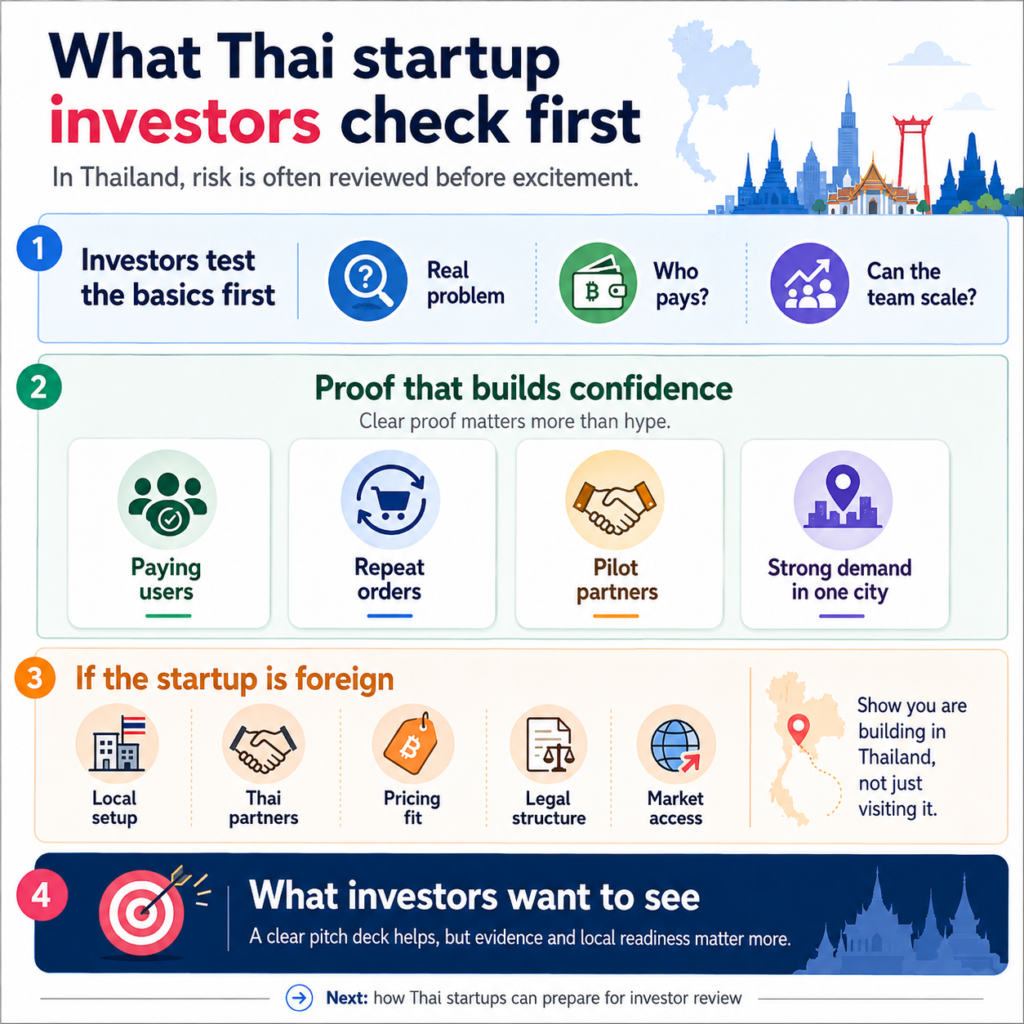
Commonly, Thai startup investors usually check risk before they check excitement. These investors want to know if the company solves a real problem, who pays for it, and if the core team can keep growing after the first small wins. Of course, a clear pitch deck can always help. Although providing well-grounded and articulated proof matters more.
For Thai startups, this proof can come in various ways. For instance, from paying users, repeat orders, pilot partners, or strong demand in one city before wider growth. For foreign businessmen and companies in Thailand, investors and funds may also ask about local setup, Thai partners, pricing, legal structure, and market access. In other words, they need to see that the company is not only visiting the market, but building inside it, and most importantly, know what they do and have proof to back their claims. Up next, in the following section, we will break down how Thai startups can prepare for that review.
How Thai startups can become investor-ready
Thai startups can become investor-ready by turning early activity into proof that investors can check. A good idea is not enough. Founders need to show who the product serves, why buyers care now, and how the company will grow after funding.
Start with the basics. Build a clean pitch deck, a simple financial plan, and a clear use-of-funds table. Then add market proof. This can include paid users, signed pilots, repeat customers, waitlist demand, partner talks, or strong sales data from one focused segment. If the startup is still pre-seed, small proof still matters. Investors know early companies are not perfect, but they need signs that the team is learning fast and making smart choices.
Local context also matters. A Thai startup should explain how it fits Thailand’s market, customer habits, regulations, and sector trends. Strong founders do not hide weak points. They show what has been tested, what failed, what changed, and what comes next. Next, we will look at foreign startups in Thailand and how they can reduce investor doubt before a serious investor call or funding round starts properly.
How foreign startups in Thailand can reduce investor risk
Foreign startups in Thailand need to reduce investor risk before they ask for funding. A Korean, Japanese, Singaporean, or European company may have a strong product, but investors will still ask one question first, especially when the team has limited local history, few Thai references, or no regional investor network: does this business truly fit Thailand?
That fit must be easy to prove.
| Investor concern | What foreign founders should show |
|---|---|
| Local demand | Thai users, pilots, sales calls, or signed interest |
| Market access | Local partners, channels, advisors, or distribution plans |
| Legal clarity | Company setup, ownership structure, contracts, and compliance notes |
| Growth logic | Why Thailand can lead to wider ASEAN expansion |
This is why foreign startup funding in Thailand often depends on more than traction from another country. A product that worked in Seoul, Berlin, or Singapore may need new pricing, new language, and new buyer proof in Bangkok. Investors want to see that the team has already been adapting, not only planning.
A foreign company should also explain why Thailand is not just a test market. It should show why the timing, sector, and local problem make sense. Next, we will compare pre-seed, seed, and Series A readiness in Thailand.
Pre-seed, seed, and Series A readiness in Thailand
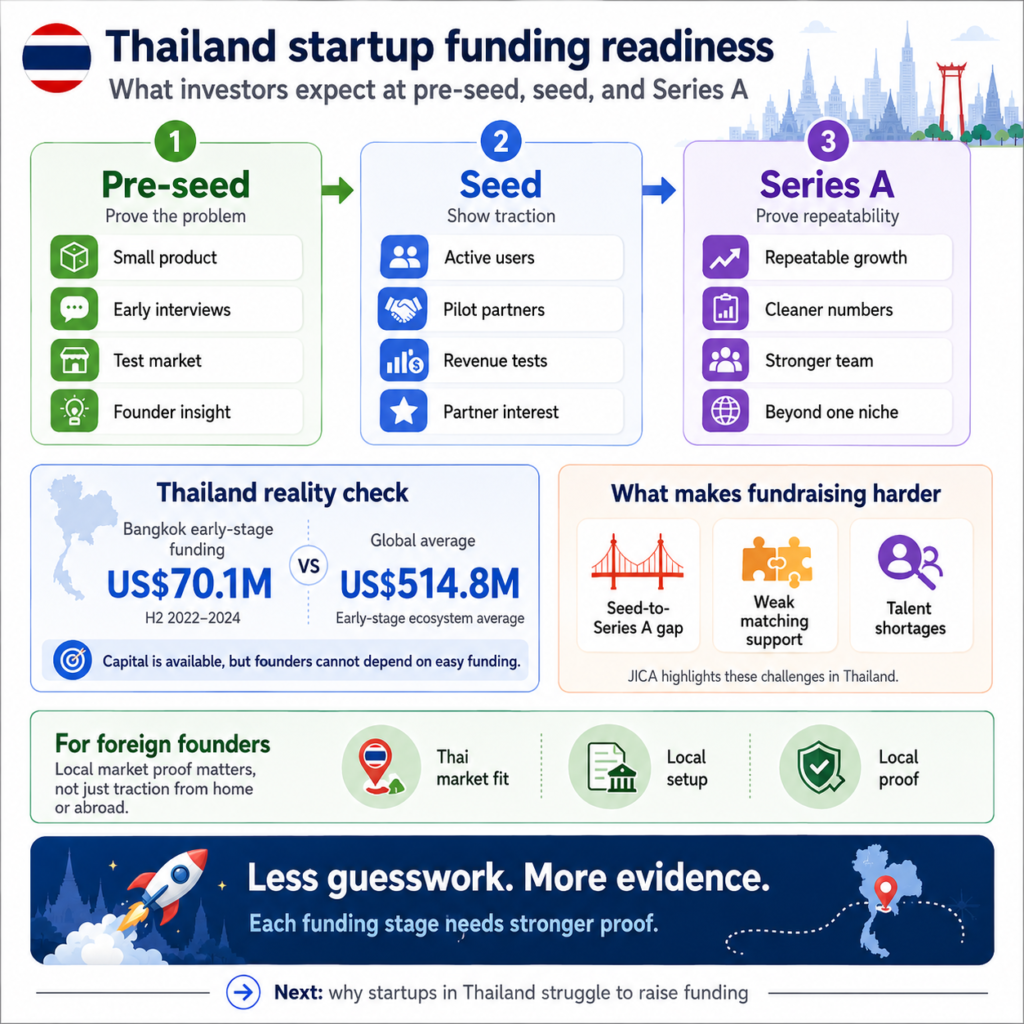
Pre-seed, seed, and Series A funding in Thailand each require different proof. At pre-seed, investors may accept a small product, early interviews, a test market, and a founder who clearly understands the problem. At seed, they expect stronger signs: users, pilots, revenue tests, or partner interest.
By Series A, the question changes. Investors want repeatable growth, cleaner numbers, a stronger team, and a clear path beyond one local niche. This matters because Bangkok recorded US$70.1 million in total early-stage funding from H2 2022 to 2024, while the global average was US$514.8 million. That gap means founders cannot depend on easy capital. JICA also points to a major Seed-to-Series A funding gap in Thailand, along with weak matching support and talent shortages. Foreign founders also need local market proof, not only traction from home or abroad. So, each stage should show less guesswork and more evidence. Next, we will cover the common reasons startups in Thailand struggle to raise funding.
Founders who are still comparing funding paths can also review our guide to startup funding sources in Thailand, which explains how VCs, angel investors, grants, CVCs, and accelerators fit different stages.
Common reasons startups in Thailand struggle to raise funding
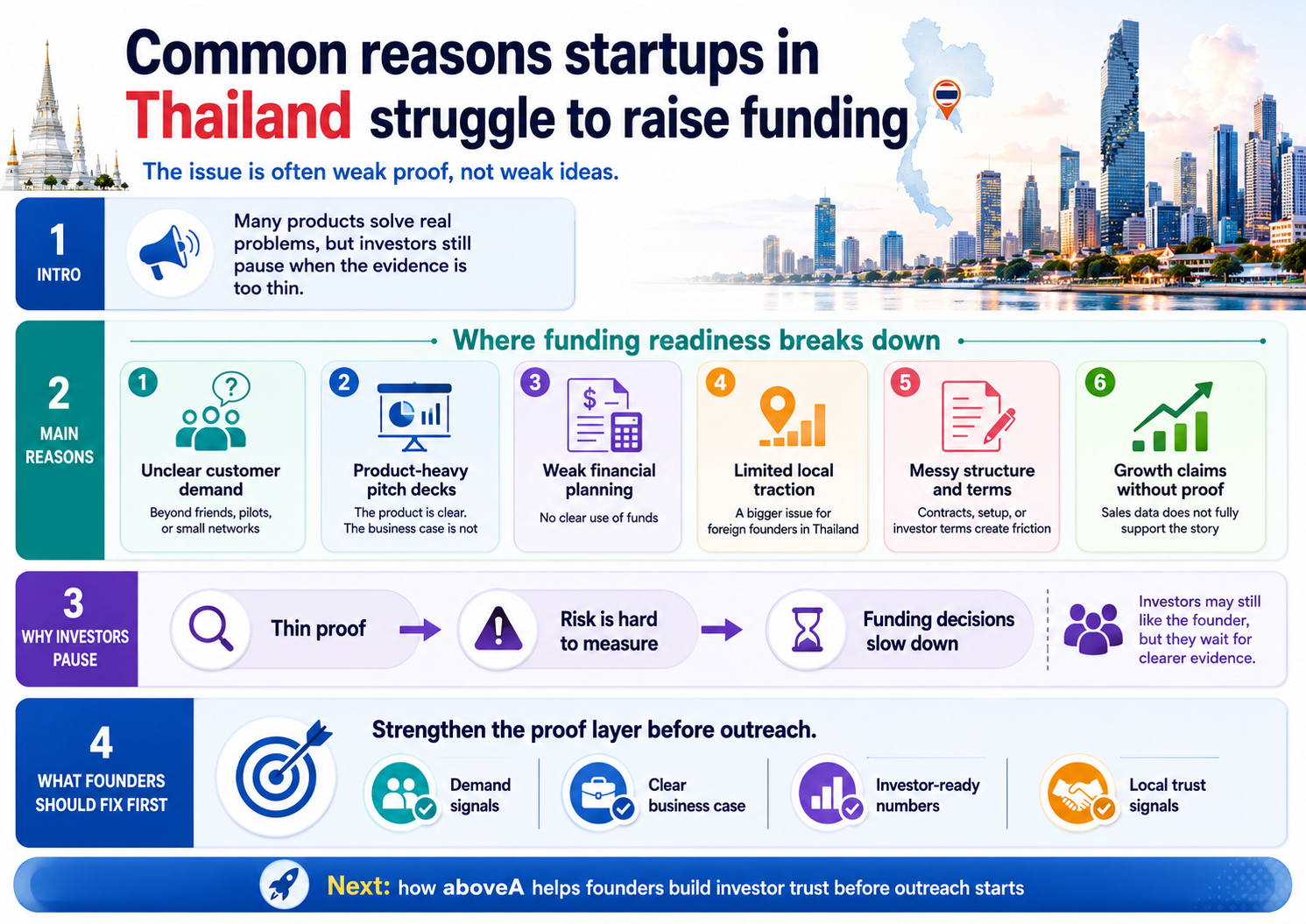
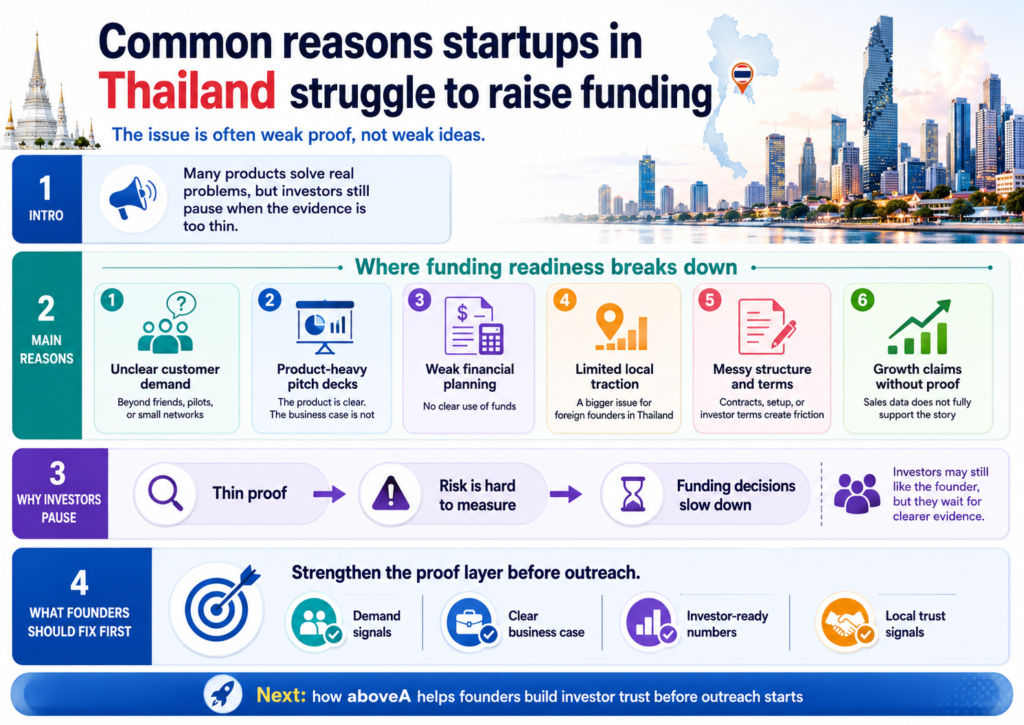
Common reasons startups in Thailand struggle to raise funding start with weak proof, not weak ideas. Many founders are building useful products, but investors cannot see enough evidence yet. The story may sound promising, while the numbers, market logic, and local trust signals remain too thin.
The biggest issues often include:
- unclear customer demand outside friends, pilots, or small networks
- pitch decks that explain the product but not the business case
- weak financial plans, with no clear use of funds
- limited local traction for foreign founders entering Thailand
- messy company structure, contracts, or investor terms
- growth claims that are not backed by real sales data
These gaps create a delay. Investors may still like the founder, but they pause because the risk is hard to measure. For early companies, this can happen even when the product is real, useful, and solves a serious market need. That is why funding preparation should fix the proof layer first. Next, we will look at how aboveA helps founders build stronger investor trust before outreach starts.
Investor-readiness checklist for startups in Thailand
Proof building in Thailand should start before a founder sends the first investor message. This is where many startups lose time. They prepare a pitch deck, but they do not prepare enough evidence around market need, local access, legal readiness, and commercial testing. Investors may like the idea, yet still ask for more signals. This section shows how Thai startups and foreign founders can build proof in a cleaner way. It focuses on practical steps that make the company easier to review, compare, and trust before a pre-seed, seed, or Series A conversation begins.
Show real local validation
Local validation in Thailand should prove that the market has been tested, not only researched. Founders can start with buyer interviews, signed letters of interest, product demos, trial users, partner discussions, or a small paid test. The point is simple: investors need to see that someone in Thailand understands the offer and may use it.
For foreign founders, this step is even more important. A Korean or European company may have strong traction at home, but that does not always transfer to Thailand. Local proof can show that pricing, language, timing, and buyer habits have been tested. It also helps founders avoid sounding like they are using Thailand only as a regional label.
Use PoC and partner activity as proof
Proof of Concept activity can make startup funding in Thailand easier to discuss because it shows real-world testing. NIA’s Global Startup Hub 2026 includes business matching, investor access, legal and regulatory understanding, and PoC opportunities with larger companies. That is useful because it shows what the ecosystem itself treats as valuable proof: not only ideas, but tested solutions, partners, and business readiness.
A founder does not need to wait for a large programme to begin. They can build the same logic on a smaller scale. One corporate test, one distribution partner, or one structured pilot can make the investor story stronger. Add clear notes: what was tested, who joined, what changed, and what result came out.
Make legal and company structure easy to review
Foreign startup funding in Thailand often gets harder when the company structure is unclear. Investors may ask who owns the company, where IP sits, which entity signs contracts, and whether the business can legally operate in the sector. These questions are not small details. They affect risk.
Thailand’s draft Startup Promotion Act has also raised attention because it points toward more flexible startup fundraising tools, including legally recognized instruments such as convertible debentures and preferred shares for certified startups. Founders should not treat this as legal advice, but it shows why legal structure matters. Before outreach, prepare a simple structure note, a cap table summary, contract status, and any regulatory questions that still need legal review.
Build investor-facing visibility
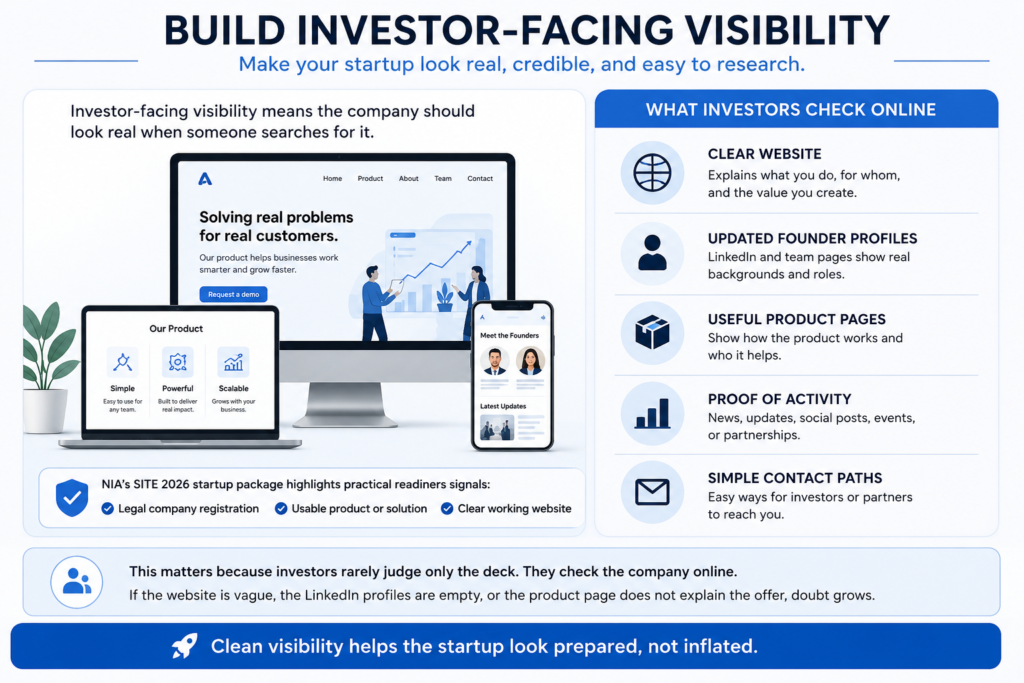
Investor-facing visibility means the company should look real when someone searches for it. This does not require a huge brand. It requires a clear website, updated founder profiles, useful product pages, proof of activity, and simple contact paths. NIA’s SITE 2026 startup package also lists practical readiness signals such as legal company registration, a usable product or solution, and a clear working company website.
This matters because investors rarely judge only the deck. They check the company online. If the website is vague, the LinkedIn profiles are empty, or the product page does not explain the offer, doubt grows. Clean visibility helps the startup look prepared, not inflated.
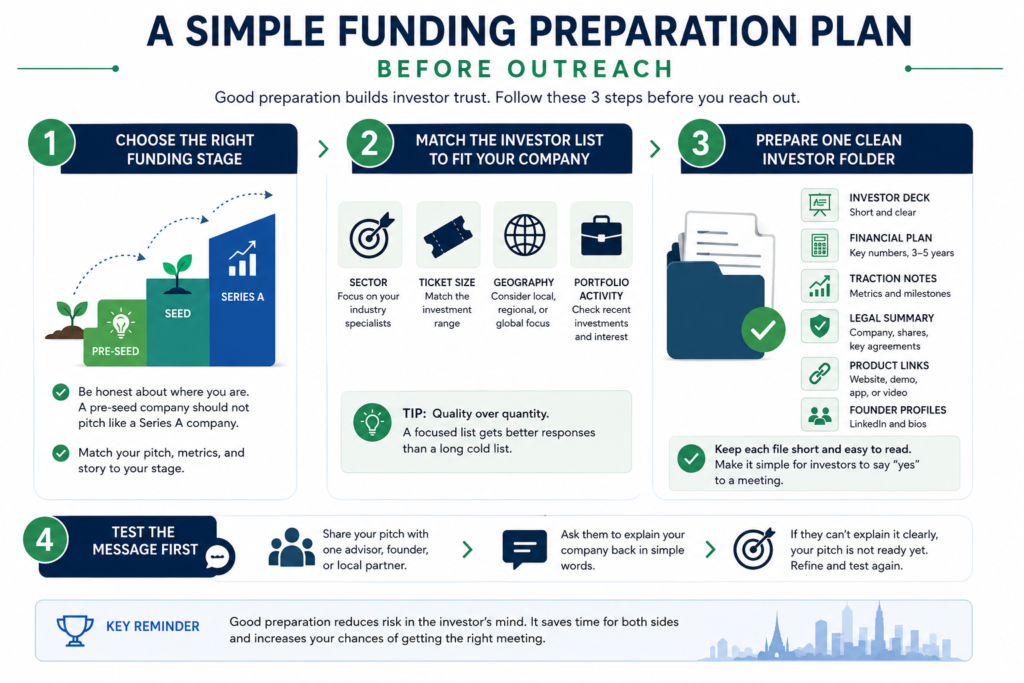
A simple funding preparation plan before outreach
Startup funding outreach in Thailand should not begin with a cold list of investors. It should begin with a short preparation plan. First, choose the right funding stage. A pre-seed company should not pitch like a Series A company. Then, match the investor list to sector, ticket size, geography, and past portfolio activity.
Next, prepare one clean investor folder. It can include the deck, financial plan, traction notes, legal summary, product links, and founder profiles. Keep each file short. Investors should not search through messy documents to understand the company.
Finally, test the message before sending it widely. Share it with one advisor, founder, or local partner. If they cannot explain the company back in simple words, the pitch is not ready yet. This step also helps founders avoid weak outreach and rushed follow-ups before investor contact. The next section can show what founders should include in their investor-readiness checklist.
Investor-readiness checklist for Thailand funding
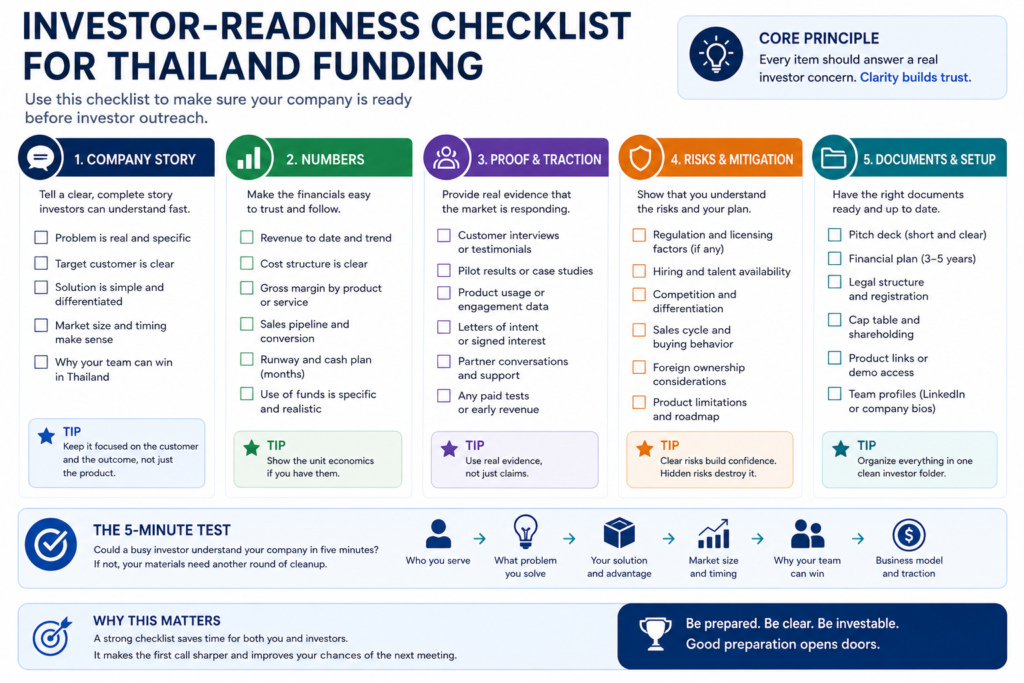
An investor-readiness checklist for Thailand funding should help founders see what is missing before investor outreach becomes public. The checklist is not only about documents. It is about whether each document answers a real investor concern.
Start with the company story. It should explain the problem, customer, solution, market timing, and why the team can win. Then check the numbers. Revenue, costs, margins, sales pipeline, and runway should be easy to follow. After that, review the proof. Add customer notes, pilot outcomes, product usage, signed interest, or partner conversations where possible.
Founders should also prepare a short risk section. This can cover regulation, hiring, competition, sales cycles, foreign ownership questions, or product limits. Clear risks do not scare serious investors. Hidden risks do.
Before sending anything, ask one simple question: could a busy investor understand the company in five minutes? If not, the materials need one more round of cleanup. This makes the first call sharper and saves time for both sides early. Next, we will cover how to avoid weak investor outreach.
How to avoid weak investor outreach in Thailand
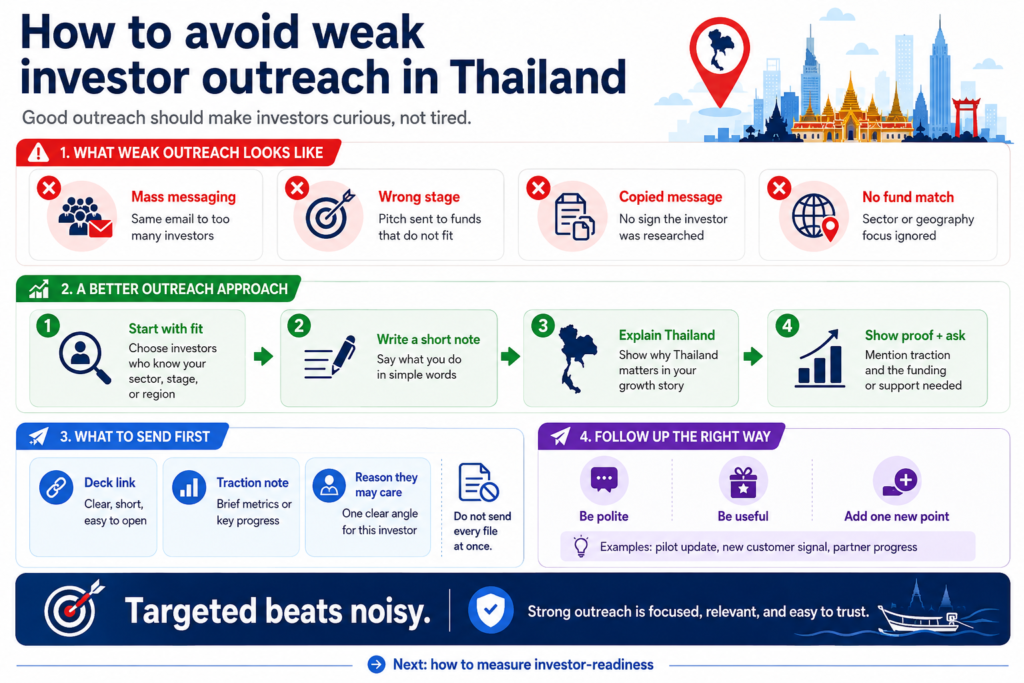
Weak investor outreach in Thailand usually starts when founders contact too many people with the same message. It looks active, but it often wastes good leads. Investors can tell when the email was copied, the stage is wrong, or the founder has not checked the fund’s focus.
A better approach is slower and more targeted. Start with investors who already understand your sector, stage, or region. Then write a short message that explains what the company does, why Thailand matters, what proof already exists, and what kind of funding or support is needed.
Do not attach every file at once. Share a clear deck link, a short traction note, and one reason the investor may care. Keep follow-ups polite and useful. Add one new point each time, such as a pilot update, new customer signal, or partner progress.
Good outreach should make the investor curious, not tired. Next, we will look at how founders can measure whether they are becoming more investor-ready.
How to measure investor readiness over time in Thailand
Investor readiness in Thailand should be measured before outreach and during the funding process. Founders often wait for investor feedback, but they can track signs earlier. The goal is to see whether the company is becoming clearer, safer, and easier to believe.
| Readiness signal | What to check |
|---|---|
| Message clarity | Can others explain the company back? |
| Proof quality | Are traction claims backed by real data? |
| Investor fit | Are target investors relevant to the stage? |
| Trust level | Do website, deck, and profiles match? |
These checks help founders see weak spots before they become investor objections. A company may not be fully ready yet, but progress should be visible. The pitch should get shorter. The proof should get stronger. The investor list should become more focused. Next, we will look at how aboveA can support this preparation without replacing the founder’s own work.
Where outside support can help without taking over the raise
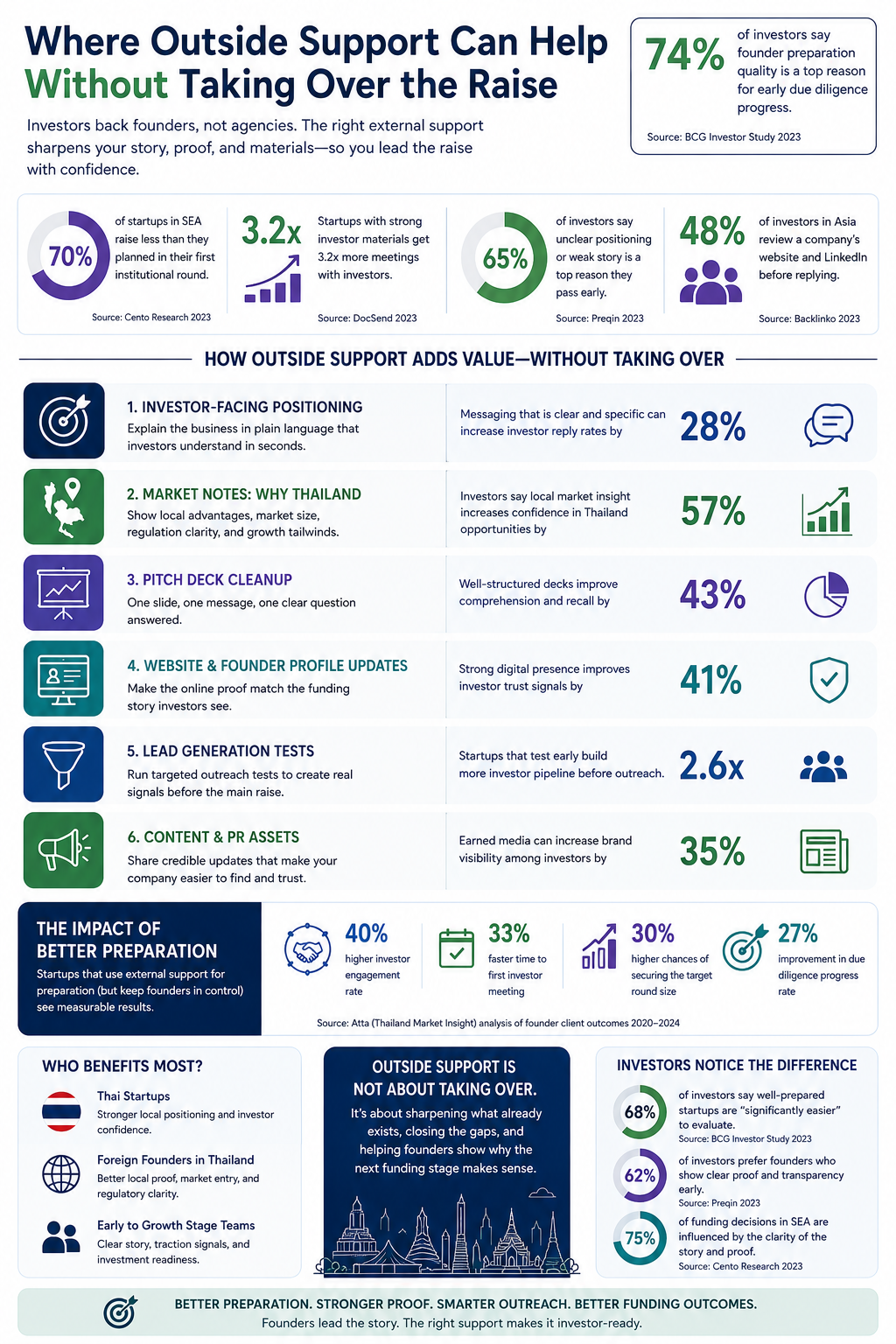
External support for Thailand funding preparation should not replace the founder’s voice. Investors still want to hear the real team, the real story, and the real plan. What outside help can do is make the proof sharper before those conversations begin.
A support partner can help with:
- investor-facing positioning that explains the business in plain language
- market notes that show why Thailand is the right place to build or expand
- pitch deck cleanup, so each slide answers one clear question
- website and founder profile updates that match the funding story
- lead generation tests that create stronger proof before outreach
- content and PR assets that make the company easier to find and trust
For aboveA, this role is practical. The work is not about making a startup look bigger. It is about helping founders show what already exists, what still needs testing, and why the next funding stage makes sense. This is useful for Thai startups and foreign founders who need stronger local proof. Next, we will close the article with a clear summary of what founders should do before raising funds in Thailand.
Prepare Your Thailand Funding Story With aboveA
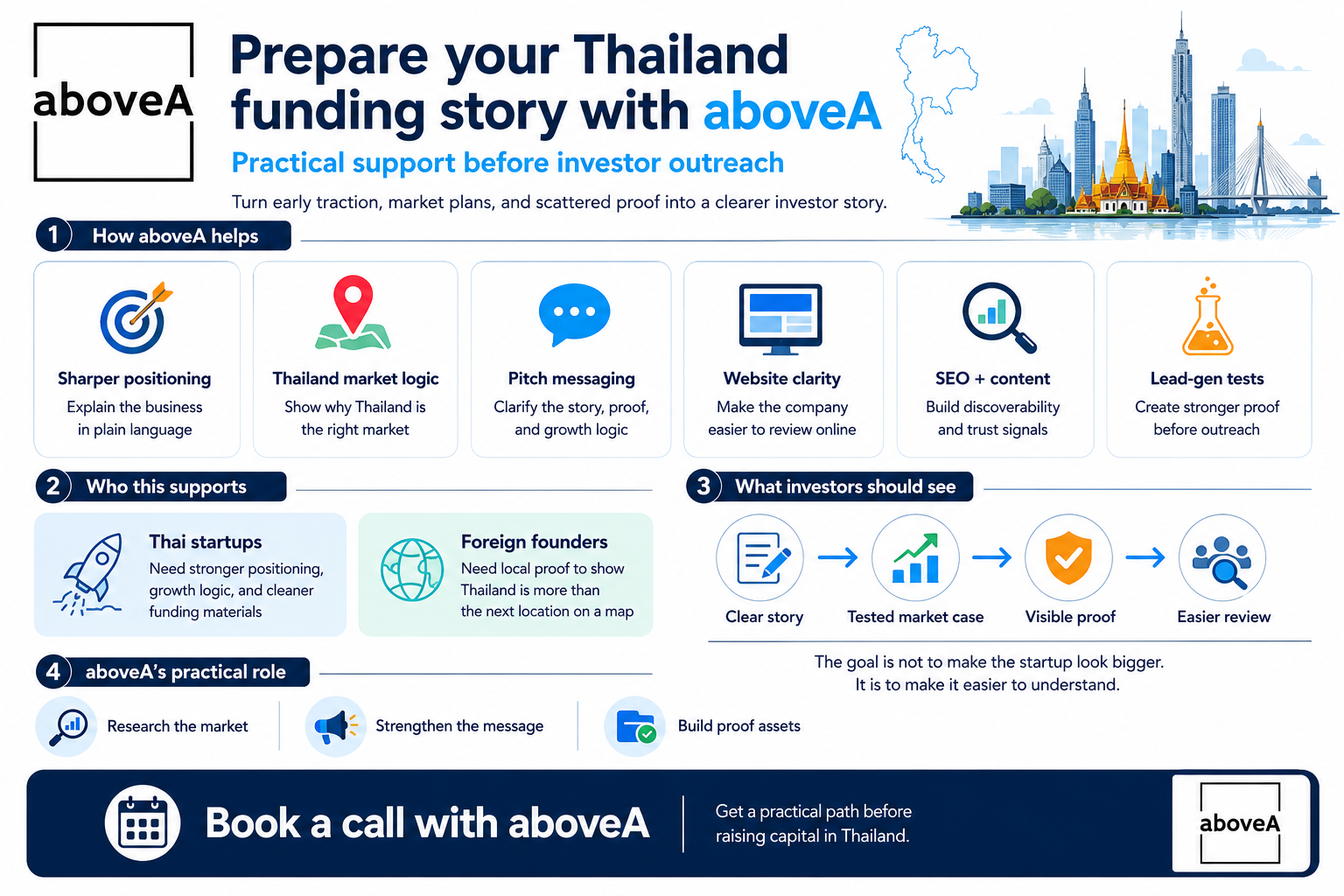
If your company is planning to raise funding in Thailand, preparation should start before investor outreach. aboveA helps founders turn early traction, market plans, and scattered proof into a clearer investor story. We can support Thai startups that need sharper positioning, stronger growth logic, and cleaner funding materials. We can also help foreign founders explain why Thailand is the right market, not just the next location on a map. The work can include market research, pitch messaging, website clarity, SEO content, lead generation tests, and proof-building assets. That way, investors see a company that is easier to understand and review. Book a call with aboveA if you want a practical path before raising capital.
Final thoughts on startup funding in Thailand
Startup funding in Thailand rewards founders who prepare before they pitch. A strong idea can open a door, but proof keeps the conversation moving. Thai startups need clear demand, clean numbers, and a growth story investors can follow. Foreign founders need one more layer: local fit. They must show why Thailand matters, who will buy there, and how the company is building trust inside the market.
The best next step is simple. Review the company through an investor’s eyes. Fix weak documents. Test the message. Organize proof. Then approach fewer investors with a sharper reason to care. Funding is never guaranteed, but better preparation makes every investor conversation more useful, more focused, and easier to move forward.
Frequently asked questions about startup funding in Thailand
Startup funding in Thailand raises questions for Thai founders and foreign teams preparing investor outreach, proof, structure, and growth plans.
What is the first step before raising startup funding in Thailand?
The first step is checking whether your company has proof that investors can review. This includes customer demand, market fit, financial logic, and clean founder materials.
Can foreign startups raise funding in Thailand?
Yes, foreign startups can raise in Thailand, but local proof matters. Investors usually want Thai buyer signals, legal clarity, partner activity, and market commitment.
What do Thailand startup investors usually check first?
Thailand startup investors usually check the problem, customer demand, founder quality, traction, financial plan, legal setup, and whether the funding request fits the company’s stage.
Is pre-seed funding available for startups in Thailand?
Pre-seed funding exists, but it is selective. Founders need early proof, such as interviews, pilot users, product tests, partner talks, or clear market research.
Why do some startups in Thailand struggle to raise funding?
Many startups struggle because their pitch is clearer than their proof. Investors may see weak traction, unclear numbers, messy structure, or poor local validation.
How can foreign founders show Thailand market fit?
Foreign founders can show Thailand market fit through local users, Thai partners, adapted pricing, translated materials, sector research, pilot results, and clear expansion logic.
How can aboveA help with investor readiness in Thailand?
aboveA helps founders shape their funding story, improve market proof, clean up investor materials, strengthen digital credibility, and prepare clearer outreach before serious investor talks.
