
Austeja Norvaisaite
Growth hacker and strategic partnership coordinator. Passionate about blending creativity with data-driven insights to craft accessible, resonant content for diverse audiences.
Redesign vs Website Optimization: Which Do You Need?
- Last time updated: 1/11/2026
Website redesign vs website optimization is a common question many business owners face. Should you rebuild your entire site or improve the one you already have? Both paths can enhance performance, rankings, and conversions, but they operate in distinctly different ways. A website redesign typically involves rebuilding layouts, changing the design, and sometimes migrating to a new platform. Website optimization, on the other hand, focuses on speed, SEO, and user experience without requiring a complete overhaul. In this guide, we’ll compare both, explain costs and benefits, and help you decide which option fits your business best.
Boost Your Website Performance and Conversions with aboveA
Table of Contents
What Is Website Redesign?
A website redesign means rebuilding a site’s structure, layout, and design. It goes beyond small fixes and often creates an entirely new look and feel. Businesses usually choose a redesign when their site feels outdated, fails to reflect their brand, or struggles with technical limits. For example, an old site built on outdated code might not support mobile devices or modern security features. In that case, optimization alone would not be enough. A full redesign can also involve migrating to a new content management system (CMS), such as WordPress or Shopify, to make management easier.
What Is Website Optimization?
Website optimization is the process of improving an existing site without rebuilding it from scratch. Instead of replacing everything, optimization focuses on making small but powerful changes. The goal is to improve speed, SEO performance, user experience, and conversions. Unlike a redesign, optimization is an ongoing process; it adapts to new search engine updates, user behavior, and evolving performance standards.
Examples include compressing images to reduce load times, updating meta tags to match target keywords, or improving navigation so visitors can find content quickly. Optimization also includes mobile improvements, fixes to Core Web Vitals, and enhanced calls to action. Many businesses opt for optimization when their site design is still modern, but traffic or conversions are declining. By making steady updates, they can achieve long-term growth without the cost and risk of a complete rebuild.
Key Differences Between Redesign and Optimization
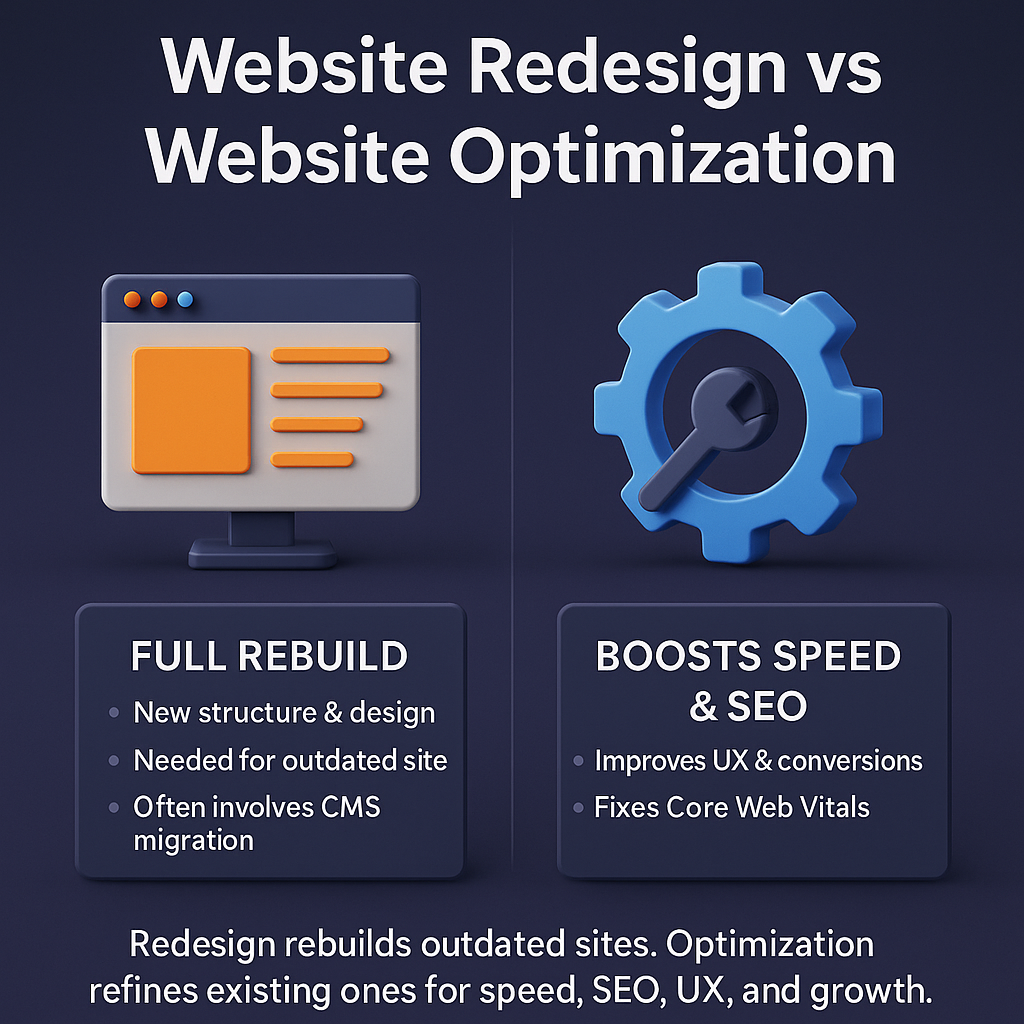
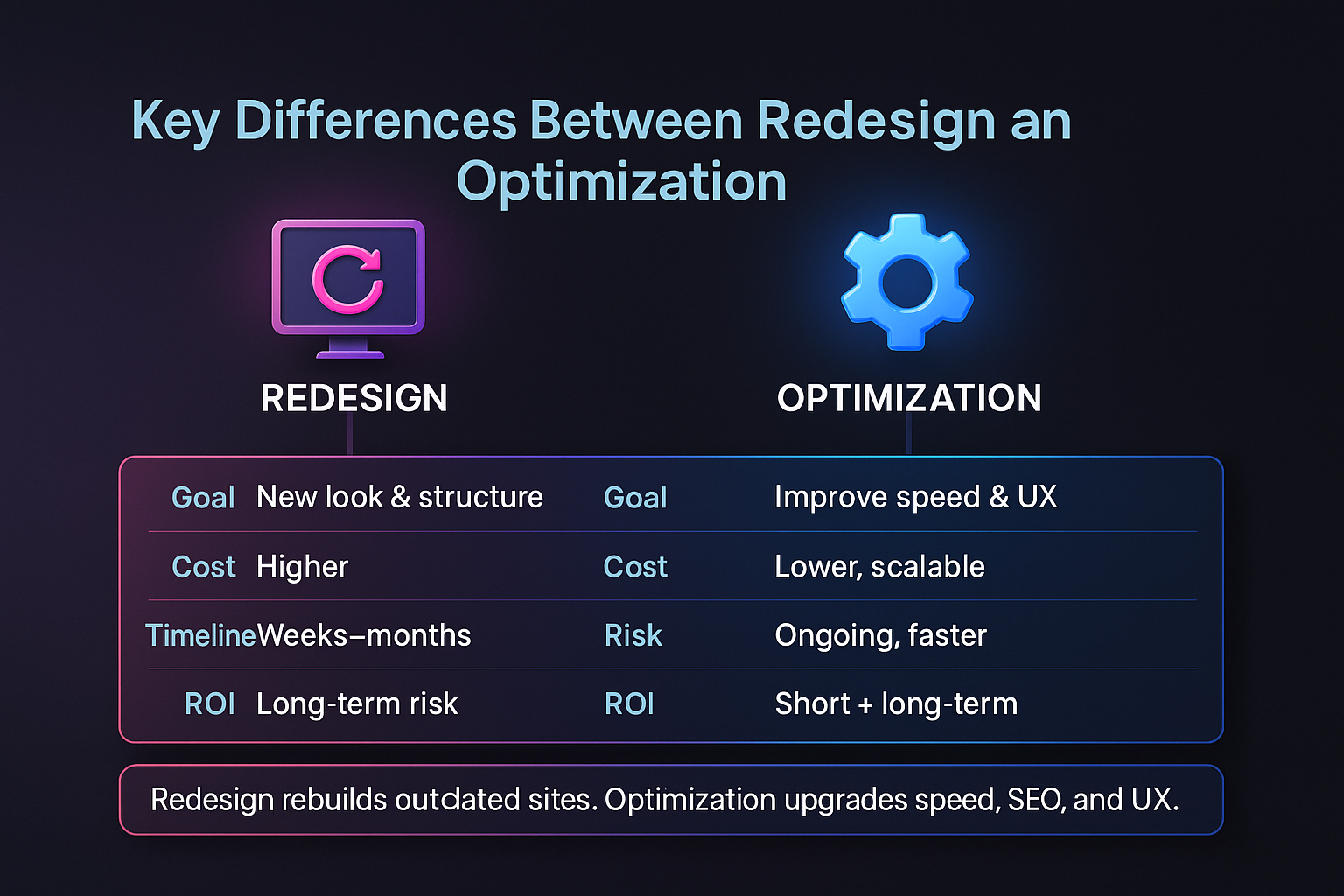
At first, website redesign and website optimization may sound similar, but they solve different problems. A redesign is like building a new house, while optimization is more like upgrading the one you already live in. Both approaches improve performance, but they vary in cost, timeline, and risk.
Here’s a breakdown of the main differences:
| Aspect | Website Redesign | Website Optimization |
|---|---|---|
| Goal | Create a new look, structure, or platform | Improve speed, SEO, and user experience |
| Cost | Higher, often thousands of dollars | Lower, can be scaled by budget |
| Timeline | Weeks to months | Ongoing, with faster results possible |
| Risk | May lose SEO rankings during migration | Lower risk, small changes over time |
| ROI | Long-term if brand and structure improve | Short-term and long-term through growth |
In short, redesign works best for outdated or broken websites. Optimization is ideal when design is fine but performance and visibility need improvement.
When You Should Choose Website Redesign?
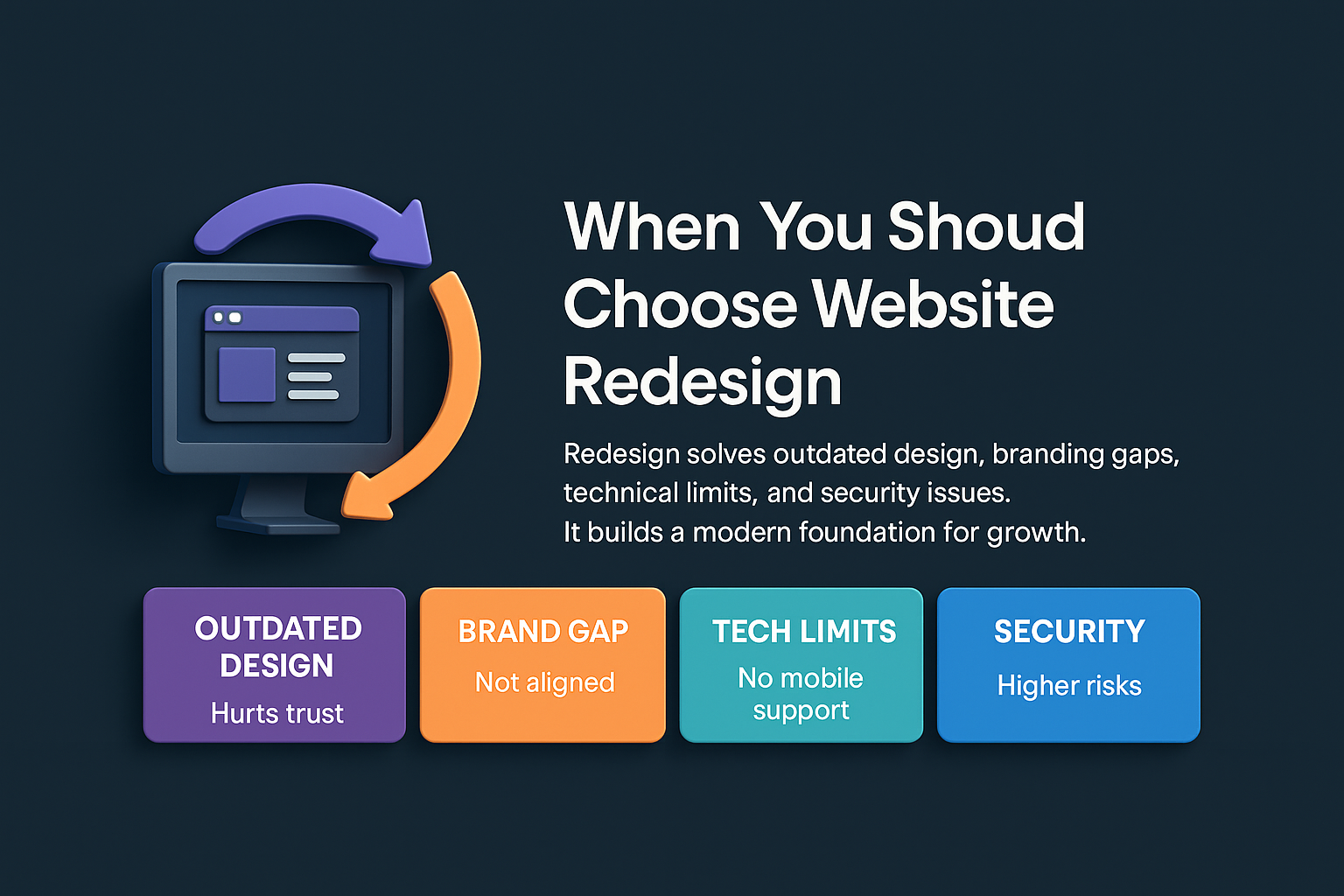
Website redesign is the right choice when optimization alone cannot solve deeper issues. If your site appears outdated, feels misaligned with your brand, or relies on obsolete technology, rebuilding becomes necessary. Redesign also helps when navigation is confusing, mobile responsiveness is missing, or security is at risk. In these cases, starting fresh provides a stronger foundation for performance, SEO, and long-term business growth.
Outdated Design and Brand Alignment
The most common reason to choose a redesign is when your website appears outdated or fails to reflect your brand accurately. A visitor can usually tell within seconds whether a site feels modern, trustworthy, or obsolete. If your site design hasn’t changed in five or more years, chances are it doesn’t meet today’s design standards. This can damage credibility and make visitors question the quality of your business.
A redesign is also necessary when your brand identity has evolved. If your visuals, color scheme, or messaging have changed, but your website hasn’t kept up, customers may feel disconnected. Aligning your website design with your brand builds consistency and trust. It also helps you stand out from competitors who may already be investing in fresh designs.
Technical Limits, Security, and Usability Issues
Another strong reason to choose a redesign is when your site has technical barriers that optimization cannot fix. For example, older websites often fail to meet mobile requirements. Since Google uses mobile-first indexing, an unresponsive site can harm SEO rankings. If your current platform doesn’t allow responsive layouts, only a redesign can solve the issue.
Security is another factor. Websites built on outdated code or unsupported systems are more vulnerable to hacks. Fixing security flaws with patches only works for so long; sometimes, starting fresh is the safest option.
Usability issues also play a role. If your navigation is confusing, pages are poorly structured, or the content management system makes updates nearly impossible, optimization may not be enough. A redesign enables you to restructure the site, enhance user flow, and migrate to a more robust CMS, such as WordPress, Shopify, or Webflow.
In short, a website redesign is the best path when design, branding, technology, or security problems limit growth. It’s a larger investment, but it creates a foundation that supports modern SEO, mobile performance, and user trust for years to come.
When You Should Choose Website Optimization?
Website optimization becomes your best choice when the design of your site is still solid, but performance, traffic, or conversions are underperforming. In 2026, many businesses face a similar scenario: they don’t need a complete rebuild, but their site needs fine-tuning to keep up with rising user expectations.
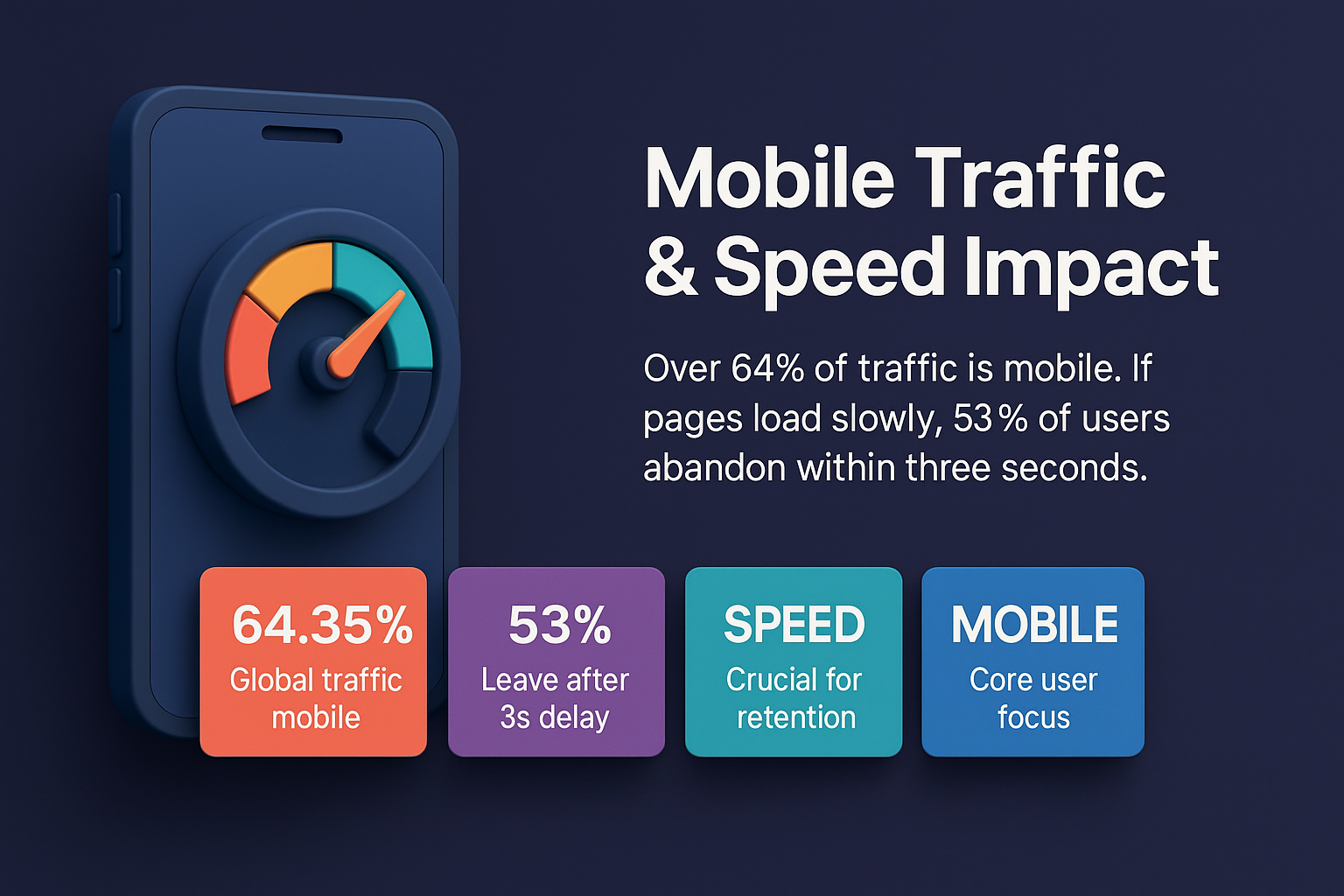
On mobile, for example, 64.35 % of global web traffic comes from mobile devices. Because of that, even small speed issues can drive visitors away. Studies show that 53 % of users abandon a site if it takes more than three seconds to load. If your site design looks fresh and your branding is fine, but load times are slow, speed optimization is often wiser than rebuilding.
Search trends in 2026 also favor optimization. AI overviews, answer engines, and user behavior signals are changing how search results are delivered. In many cases, improving SEO signals, schema markup, and content structure can yield better gains than a complete redesign.
You should choose optimization when:
-
Your design is modern, but site speed, Core Web Vitals, or responsiveness are weak.
-
Traffic is fine, but conversion rates or engagement levels are low.
-
You want to adapt to new SEO trends without incurring huge costs or risks.
-
Your content is strong and well-branded, but internal linking, meta tags, and mobile usability need improvement.
By optimizing instead of redesigning, you reduce risk to SEO rankings, avoid massive costs, and can see results faster. In situations where your site still looks good but performance lags, optimization is often the more brilliant move.
Hybrid Approach: Redesign + Optimization
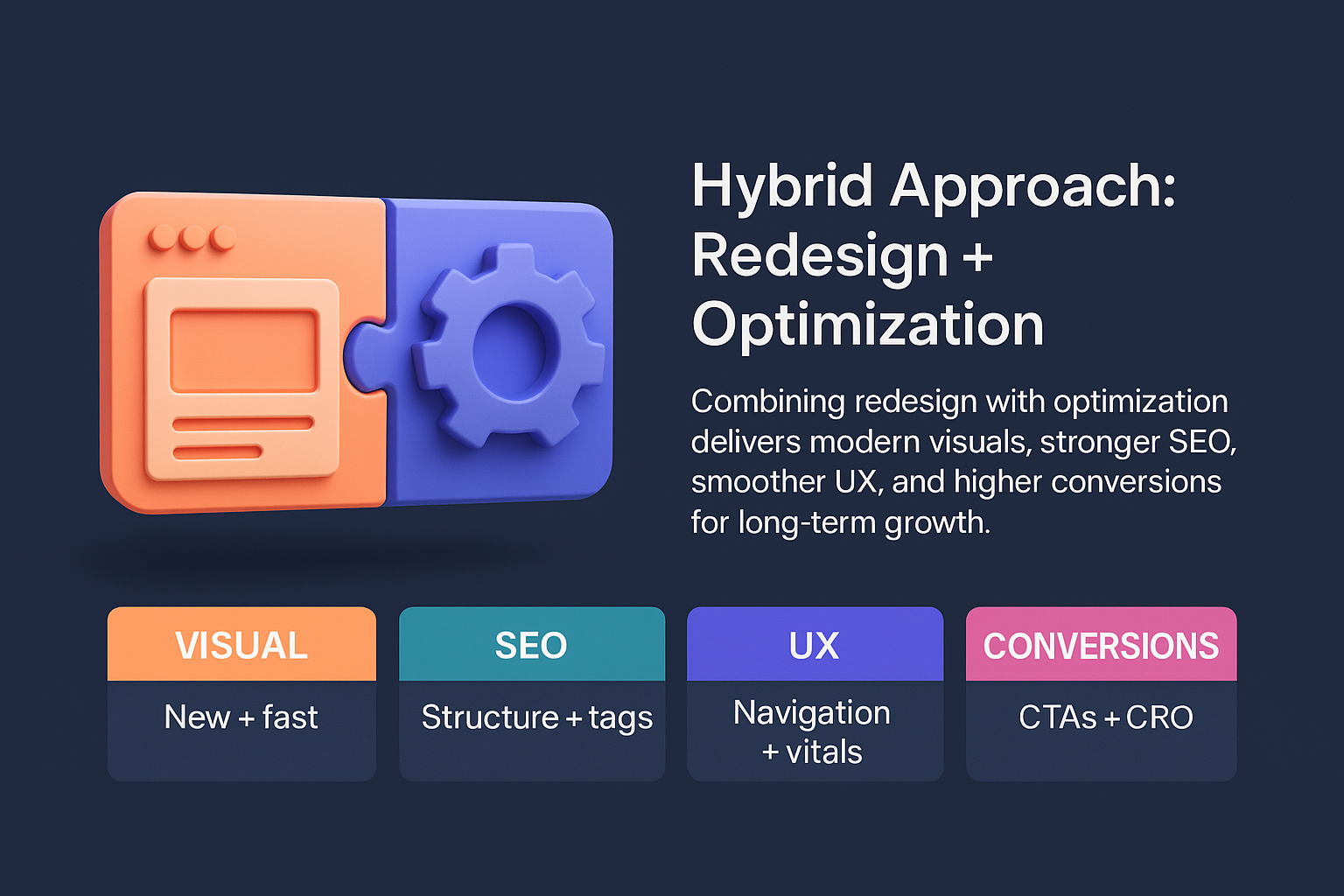
In many cases, the best strategy is not choosing between website redesign and website optimization, but combining both. A hybrid approach enables businesses to refresh their design while also improving speed, SEO, and usability. This way, you can enjoy the benefits of a modern look and stronger performance simultaneously.
Imagine a company rebranding its visuals and messaging. A redesign updates layouts, color schemes, and overall structure. But if you stop there, the new site might look good yet load slowly or rank poorly. By adding optimization, such as compressing images, improving Core Web Vitals, and updating meta tags, the redesign becomes a growth engine instead of just a facelift.
Here’s a breakdown of what a hybrid approach might look like:
| Area of Focus | Redesign Contribution | Optimization Contribution | Combined Impact |
|---|---|---|---|
| Visual Appeal | New layouts, branding, modern look | Fast-loading images, responsive adjustments | Stronger first impressions and retention |
| SEO Performance | Updated site structure, new content flow | Meta tags, schema markup, link optimization | Higher rankings and more organic traffic |
| User Experience (UX) | Simplified navigation, mobile-friendly UI | Core Web Vitals fixes, faster interactions | Smooth, engaging journeys for visitors |
| Conversions | Clear CTAs in design | A/B testing, CRO adjustments | Better signups, sales, or inquiries |
This approach works exceptionally well for e-commerce and SaaS companies, where design influences trust and optimization ensures conversions. While the cost may be higher, the ROI is often more substantial because every part of the website works toward growth.
Cost and ROI Breakdown
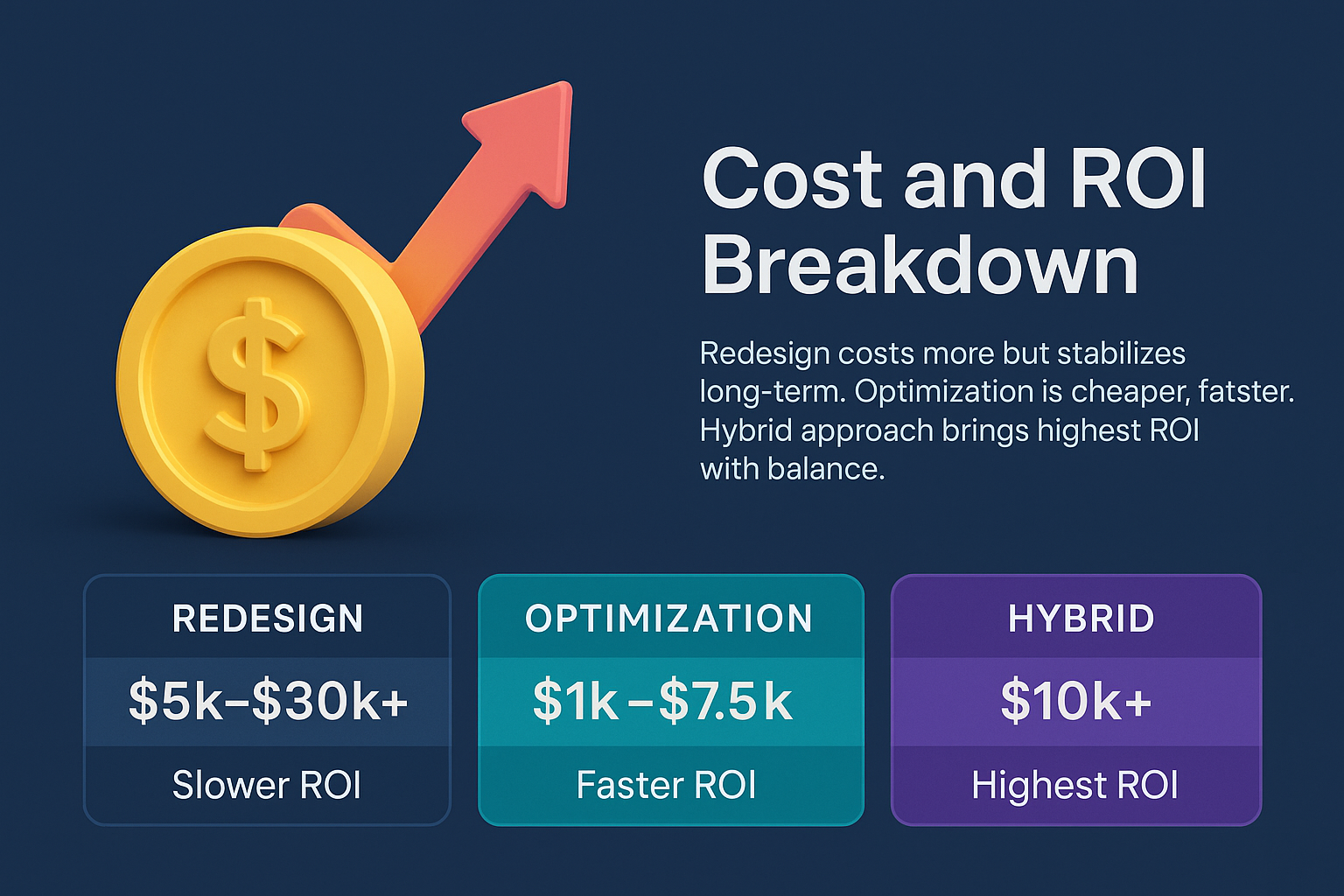
When choosing between website redesign and website optimization, cost and return on investment (ROI) are two of the biggest factors. Each option requires different levels of time, budget, and risk. Businesses need to weigh what they spend against the potential growth in traffic, leads, or sales.
Typical Costs:
Website Redesign: Can range from $5,000 to $30,000+ depending on size, complexity, and platform migration.
Website Optimization: Often starts from $1,000 to $7,500, depending on whether you’re fixing speed, Core Web Vitals, SEO, or conversions.
Hybrid Approach: A blend of redesign and optimization usually costs more upfront, but it reduces long-term fixes and creates higher ROI.
ROI Considerations:
Redesign ROI comes from refreshed branding, better usability, and long-term stability. It may take months before results show.
Optimization ROI is usually quicker. Speed fixes, SEO updates, and UX changes can deliver traffic and conversion gains within weeks.
Hybrid ROI is highest if done well. New design attracts attention, while optimization ensures visitors stay, engage, and convert.
| Factor | Website Redesign | Website Optimization | Hybrid Approach |
|---|---|---|---|
| Initial Cost | High ($5k–$30k+) | Moderate ($1k–$7.5k) | Higher ($10k+) but flexible |
| Timeline | Months | Weeks to ongoing | Months + continuous improvement |
| SEO Impact | Risk of drops during migration | Stable or improves gradually | Balanced with structured planning |
| ROI Speed | Slower but longer-term | Faster, short-term and ongoing | Strongest—new look + better performance |
The smartest choice depends on your goals. If your design is outdated, redesign is worth the investment. If your design is solid but performance is weak, optimization gives faster ROI.
Which One Is Right for You? (Decision Guide)
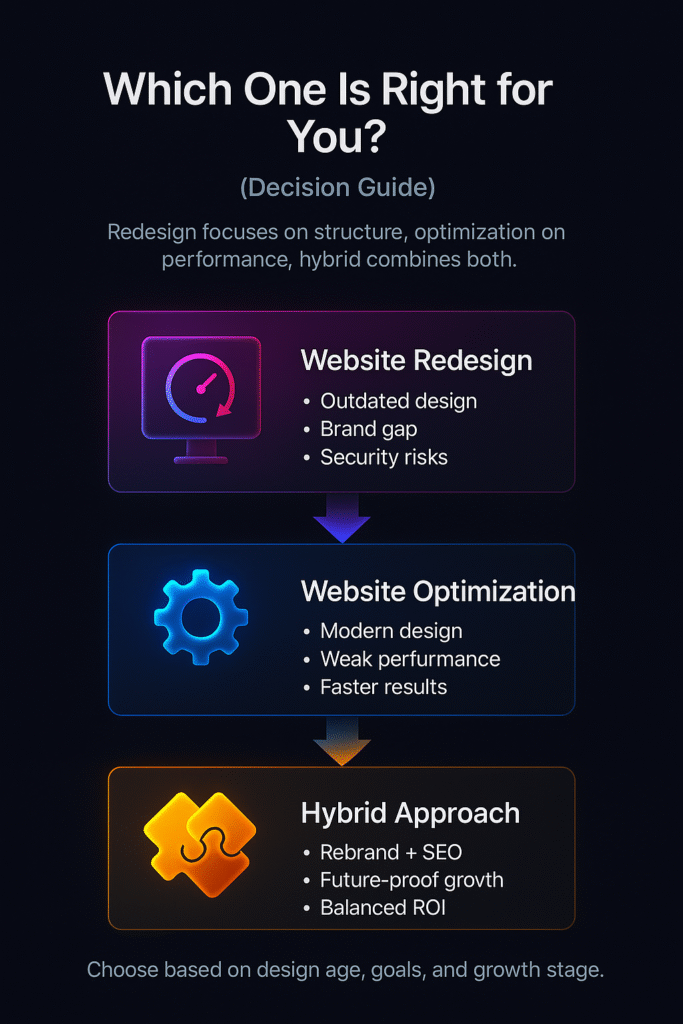
Deciding between website redesign and website optimization depends on your current challenges, goals, and budget. If you’re unsure, use this decision guide to help you make the right choice.
Choose Website Redesign if:
Your site looks outdated and doesn’t reflect your brand.
The platform or CMS is old, hard to update, or lacks mobile responsiveness.
Navigation is confusing and restructuring is needed.
Security risks from outdated code are a concern.
You’re planning a major rebrand or want a fresh identity.
Choose Website Optimization if:
The design is modern but performance is weak.
Your site loads slowly and fails Core Web Vitals.
Traffic is strong, but conversions or engagement are low.
You want faster results without the cost of a rebuild.
You’re adapting to new SEO and AI-driven search trends.
Choose a Hybrid Approach if:
You need a new design but also want strong SEO and speed.
Your business is growing quickly and requires a future-proof site.
You’re rebranding and want performance improvements at the same time.
In short, redesign is about appearance and structure, optimization is about performance and growth, and a hybrid approach combines the best of both. Your decision should match where your business is now—and where you want it to go next.
Website Redesign vs Optimization: Decision Matrix
Sometimes it’s not obvious whether to choose website redesign, website optimization, or a hybrid of both. To help, here’s a simple decision matrix. Score your site in each area, then total your points. The higher your score, the more likely a redesign is the right choice. Lower scores usually mean optimization will deliver better results.
How to Use the Matrix?
Rate your site on each factor from 1 (strong) to 5 (poor).
Add up your total score.
Use the decision guide below the table.
| Factor | 1 (Strong) | 3 (Average) | 5 (Poor) |
|---|---|---|---|
| Design & Branding | Fresh, modern, aligned with brand | Neutral, slightly outdated | Old, inconsistent, hurts credibility |
| Mobile Responsiveness | Fully responsive, touch-friendly | Some issues on smaller devices | Not responsive, difficult to use |
| Site Speed & Performance | Loads in under 2 seconds | Loads in 3–4 seconds | Takes 5+ seconds, high bounce rate |
| SEO & Visibility | Strong rankings and organic traffic | Mixed performance, declining SEO | Weak rankings, poor visibility |
| Usability & Navigation | Clear menus, smooth journey | Some confusion for users | Very confusing, frustrating |
| Security & Technology | Up-to-date CMS, secure plugins | Some outdated features | Outdated CMS, security risks |
Scoring Guide
6–12 points → Your site is solid. Focus on website optimization to improve speed, SEO, and conversions.
13–20 points → Mixed results. A hybrid approach with partial redesign plus optimization will give the best ROI.
21–30 points → Your site is outdated. A complete website redesign is the more intelligent choice for long-term success.
Why This Works?
This scoring system removes guesswork. It examines both design and performance factors, which is where most businesses struggle to make a decision. By reviewing your site honestly, you’ll see whether a redesign or optimization is the clear winner or if a hybrid approach makes more sense.
DIY vs Agency: Who Should Handle Website Changes?
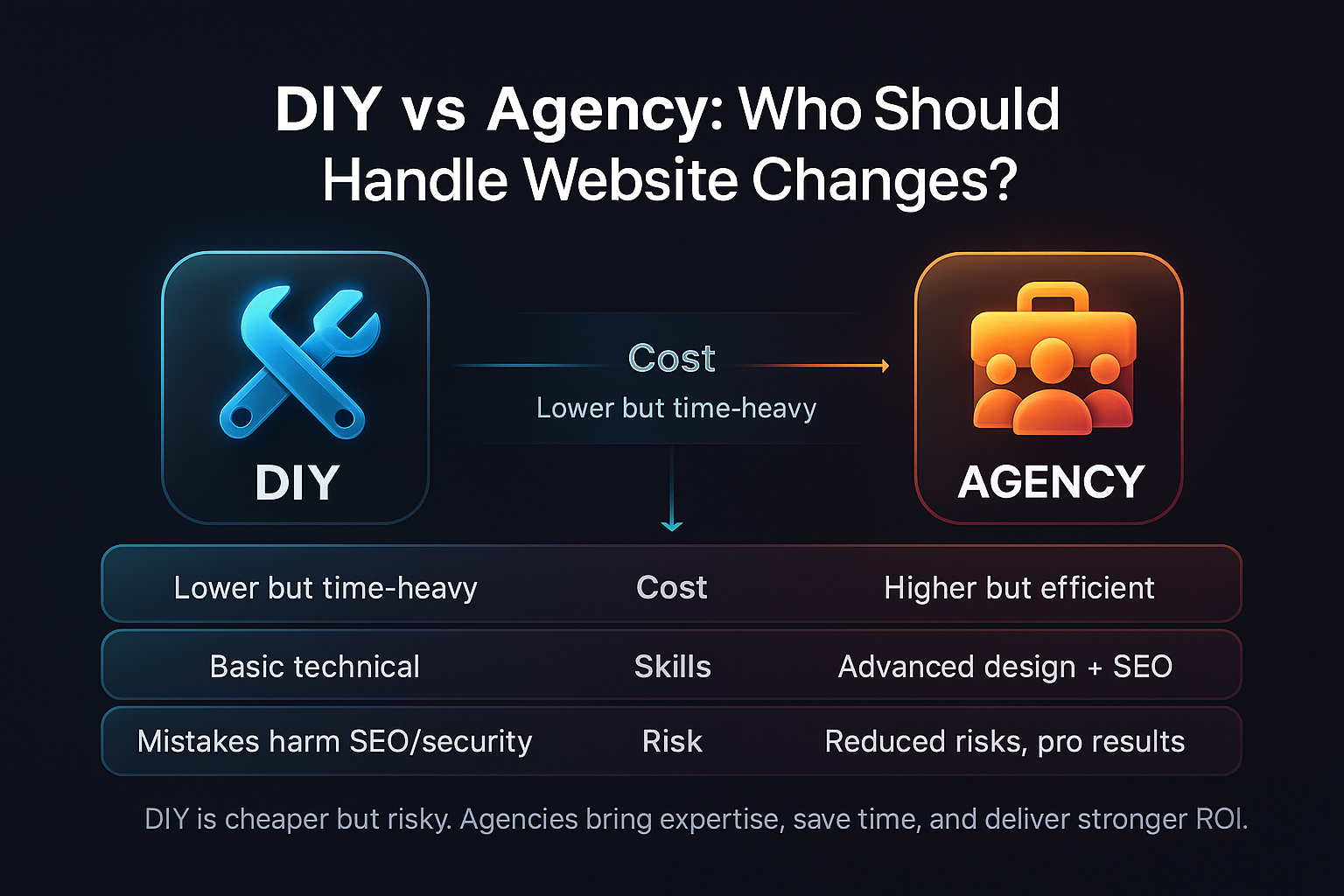
Once you’ve decided between a website redesign and website optimization, the next question is: should you do it yourself or hire an agency? Both options can be effective, but the right choice ultimately depends on your budget, skills, and long-term goals.
Doing optimization yourself is possible if you have some technical knowledge. For example, compressing images, tweaking meta tags, or running Google PageSpeed Insights reports are tasks many business owners can handle. DIY is cheaper, but it takes time and may not deliver professional-level results. Redesigning a website, on the other hand, often requires advanced coding, UX design, and SEO knowledge. Without experience, mistakes can lead to broken pages, SEO losses, or security risks.
Agencies bring expertise, strategy, and resources. A professional team can handle both redesign and optimization, ensuring that design, SEO, and performance improvements work together effectively. Hiring an agency costs more, but it reduces risk and saves time. For businesses that rely on their website for leads or sales, investing in expert help often produces a more substantial ROI.
DIY vs Agency Comparison
Here’s a closer look at how DIY and agency approaches stack up:
| Factor | DIY Approach | Agency Approach |
|---|---|---|
| Cost | Lower upfront cost, but may require tools | Higher upfront cost, scalable with project size |
| Time Investment | High—owners handle tasks themselves | Low—agency manages everything for you |
| Expertise Needed | Moderate to high (technical knowledge) | Provided by specialists in SEO, UX, and design |
| Risk Level | Higher—mistakes can harm SEO or security | Lower—agencies follow proven processes |
| Control | Full control over every decision | Less direct control, more guided by strategy |
| Best For | Small sites with limited budgets | Growth-focused businesses needing ROI |
Final Thoughts
DIY can work when budgets are small and changes are simple. But for businesses where websites drive sales, hiring an agency ensures professional execution and long-term success. In most cases, the cost of errors in DIY is greater than the investment in expert help.
Conclusion
Choosing between website redesign and website optimization depends on your current needs and long-term goals. A redesign provides a fresh structure and brand presence, while optimization enhances speed, SEO, and user experience without requiring a complete overhaul. Some businesses even benefit most from a hybrid approach, combining new design with ongoing improvements. Whatever path you choose, the goal is the same: building a website that attracts visitors, ranks well in Google, and converts consistently. By aligning your choice with your business objectives, you create a digital foundation for growth, trust, and lasting success.
Frequently Asked Questions
Is it better to redesign or optimize a website?
It depends on your needs. Redesign is best for outdated sites, while optimization works if your design is solid but performance and SEO are weak.
How often should you redesign a website?
Most experts recommend a redesign every 3–5 years. This ensures your site matches brand updates, new technologies, mobile expectations, and evolving user behaviors.
How long does website optimization take?
A strong brand consists of a clear message, a consistent visual identity (such as a logo, colors, and fonts), and a distinct brand voice. It also involves connecting with your target audience on an emotional level and building trust through authenticity and value.
Can you redesign and optimize at the same time?
Yes. Many businesses use a hybrid approach, redesigning layout and branding while optimizing speed, SEO, and conversions. This combines fresh design with strong performance improvements.
